You’re out of charge on I-680, on the Sunol Grade. That’s the named climb between Fremont and Pleasanton. Stay with the car if that’s where you stopped. Get the hazards on. Then get a mobile charge so you can roll into town.
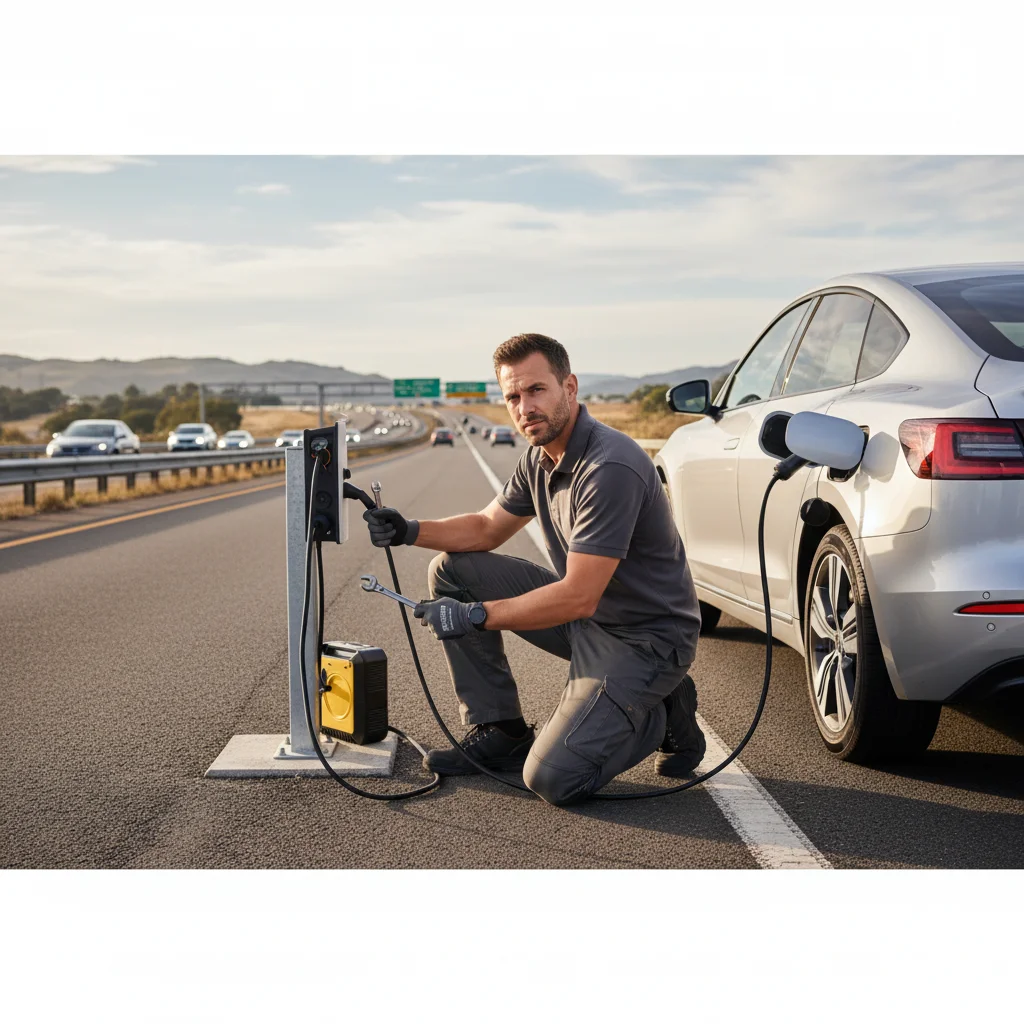
The Sunol Grade sits between two different cities
I-680 is the East Bay’s north-south spine. South of the hill it runs through San Jose, Milpitas, and Fremont. North of the hill it hits Pleasanton, then the Tri-Valley ridge. After that it continues through San Ramon, Danville, Walnut Creek, Concord, and Martinez.
Alameda CTC runs the I-680 Sunol express lanes on this stretch. MTC runs the Contra Costa express lanes farther north. FasTrak is required in those lanes. Hours are generally 5 AM to 8 PM on weekdays.
We couldn’t confirm a published elevation or percent grade for the Sunol Grade. Caltrans District 4 and Census sources didn’t list one. We also couldn’t confirm a published exit inventory for that climb. Don’t treat the next ramp as a sure roll-off. If the pack is already dying, stay on the shoulder and summon help.
Fremont sits at the south end of that named stretch. Pleasanton sits at the north end, at the I-580 split. Those aren’t the same stop. Tell the operator which city you last passed.
Fremont is the south end of the climb
Fremont had about 228,518 residents in the ACS 2019-2023 count. The separate 2024 Census estimate was 228,192. ZIP areas that overlap the place include 94536, 94538, 94539, 94552, 94555, and 94560. A ZIP on that list can run past the city limits. Treat it as a caller clue, not a hard boundary.
PG&E delivers the wires in Fremont. Ava Community Energy supplies the generation, as it does in Pleasanton, Dublin, and Livermore. That pairing doesn’t put energy into a car on the shoulder.
One charging site we can name in Fremont is the BART lot at Warm Springs / South Fremont. bart.gov lists 42 Level 2 plugs there. Level 2 is a parked-car charge, not a freeway bailout. It only helps if you can already drive into that lot. Confirm it’s open in your charging app before you leave a shoulder for it.
Milpitas sits just south of Fremont on the same freeway. It had about 78,216 residents in the ACS count. The 2024 estimate was 79,746. PG&E still delivers the wires there. Silicon Valley Clean Energy supplies the generation. San Jose Clean Energy is the pairing in San Jose, not in Milpitas. Say the city, not just “South Bay.”
EV roadside help in Fremont covers the in-town version south of the grade.
Pleasanton is the north landing, then I-580
Pleasanton had about 77,500 residents in the ACS count. The 2024 estimate was 75,664. About 40.9% of housing is pre-1980.
The I-580 / I-680 junction is the local tangle. Dublin sits on the 580 side of that split. Dublin had about 70,542 residents in the ACS count. The 2024 estimate was 70,544. PG&E and Ava cover both cities. If you stall in that interchange, say which freeway and which direction.
EV roadside help in Pleasanton covers the junction version of this problem.
Livermore is east on I-580, not on I-680. Don’t mix those corridors on the call. They’re adjacent. They’re not the same shoulder.
The ridge through San Ramon and Danville
Once you’re off the Sunol Grade, I-680 rides the Tri-Valley ridge. Fremont, Pleasanton, and Dublin are in Alameda County. San Ramon is in Contra Costa County. That county line doesn’t change the shoulder protocol.
San Ramon had about 85,734 residents in the ACS count. The 2024 estimate was 85,924. Only about 23.8% of housing is pre-1980.
PG&E still delivers the wires. MCE supplies generation in San Ramon and Danville. Ava doesn’t.
Danville had about 43,426 residents in the ACS count. The 2024 estimate was 43,410. If you last passed Danville, say so. Ridge cities blur together on a dark shoulder.
EV roadside help in San Ramon is the ridge-city version of this call.
Walnut Creek, Concord, and the north end at Martinez
Walnut Creek had about 69,790 residents in the ACS count. The 2024 estimate was 70,817. About 67.4% of housing is pre-1980. The SR-24 split is where this freeway meets the Caldecott run. Lafayette sits on SR-24, not on I-680. Don’t leave a 680 shoulder to hunt SR-24 on foot.
Concord had about 124,260 residents in the ACS count. The 2024 estimate was 124,016. About 32.3% of residents were Hispanic or Latino.
Martinez had about 36,926 residents in the ACS count. The 2024 estimate was 37,006. It’s the last in-scope city on northbound I-680 in this network. Past Martinez you’re looking at the Benicia-Martinez Bridge. That span is Caltrans-owned. Tolls are eastbound only. Cash ended in March 2020. All-electronic Open Road Tolling uses FasTrak, a license-plate account, or an invoice.
We found no published disabled-vehicle-on-a-bridge policy. If you stall on the approach, name Martinez and your direction. Don’t assume you can sit on the span.
MCE is the generation provider in Walnut Creek, Concord, and Martinez. PG&E still runs the wires.
Inland heat on this freeway is not a coastal commute
San Francisco’s July average high is 71.5F on the 1961-1990 normals. Oakland Airport sits at 70.4F on that same vintage. Livermore’s July average high is 89.7F. The inland gap over the coast is real, and it’s large.
The Sunol Grade and the Tri-Valley sit on the hot side of that split. Your pack works harder in that heat. Highway speed on I-680 does the rest. A leftover range number from a cooler Peninsula drive won’t hold up here.
Check 511 SF Bay for live conditions before a long push. Caltrans District 4 QuickMap is the other public feed.
If the car dies in an I-680 express lane
Alameda CTC runs the Sunol lanes. MTC runs the Contra Costa express lanes on the same freeway. FasTrak is required.
A primary page didn’t confirm whether those lanes sit in the median or on the left. Don’t assume a left-shoulder pull is the safe move. We couldn’t verify that geometry.
If the car dies in a restricted lane, stay in it if you can. Keep the hazards on. Summon help. California Vehicle Code 21718 bars stopping on a freeway except in limited cases. One case is a vehicle so disabled that stopping is unavoidable. You also need to have summoned another vehicle to assist.
If you’re in a travel lane or a dangerous spot, call 911. CHP says that outright. For other roadside help in this metro, dial 511 and say “Roadside Assistance.”
Four hours, Freeway Assist, and a tow you don’t pick
A second clock starts once you’re stopped on a full-access-control freeway. CVC 22651(f) covers a car left in that situation. The vehicle may be removed after more than four hours. That applies when you can’t move it under its own power. That’s a removal rule. It isn’t a reason to sit and hope.
The Freeway Service Patrol is a partnership of MTC, CHP, and Caltrans. Private tow companies run the beats during posted hours. Those hours are Monday to Friday, 6 to 10 AM and 3 to 7 PM, per 511.org. Reach them by dialing 511 and saying “Freeway Assist,” or by using a call box.
FSP clears crashes and debris. The published list also includes a free gallon of gas, jump-starts, and radiator refills. The MTC FSP page, read 2026-09-18, doesn’t mention electric vehicles or out-of-charge help. A jump-start can wake a 12V. It doesn’t refill an empty traction pack. Treat that patrol as a safety and clearance crew. Don’t treat it as an EV charge truck.
Outside those hours, calls go to the CHP Rotation Tow Program. Approved vendors rotate, so you don’t pick the company.
A rotation tow and a mobile charge are different jobs. A tow doesn’t put miles back in the pack. California doesn’t cap ordinary private or consensual tow rates statewide. Confirm the quote before a hook goes on. See when you need a mobile charge, not a tow.
Stay off the travel side of the car if you have to step out. Don’t walk the shoulder looking for a call box you already reached by phone.
Empty pack, or a 12V that took the car with it
An EV can look dead in two different ways. The traction pack is at zero, and the car won’t roll. Or the small 12V battery has dropped, and the computers won’t wake. Teslas have a 12V. So does every other major EV. A 12V failure can leave you locked out, dark, and stuck on the same shoulder.
Tell the operator which one you’re looking at. “I’m at 4 percent on the Sunol Grade” is one job. “Nothing on the screen, and the doors won’t release” is another. The independent pros we connect you with can jump or replace a dead 12V on site. They can also bring a 240V Level 2 source to the charge port. The pros we connect you with are licensed and insured.
Native NACS for Teslas. CCS or J1772 adapters for non-Tesla EVs. Typical roadside charging adds 10 to 20 miles of range in 15 to 30 minutes of charging. That’s charging time. It isn’t an arrival time. We don’t promise when someone gets there.
Tesla still wants owners to request roadside help in the Tesla app. Tesla says out-of-range help may be available. It also says that help isn’t financially covered. That’s Tesla’s published policy, not a local promise.
What a shoulder charge is for on I-680
The point of a mobile EV charge here isn’t a full pack. It’s enough range to get off I-680 and into Fremont or Pleasanton under the car’s own power. From there you can pick a public post with your own eyes. Those 10 to 20 miles are a recovery buffer. They’re not a reason to keep climbing.
Out-of-charge recovery is the service that matches this call. The operator quotes you before starting and bills you directly. Charge Pro SF holds no license, owns no trucks, and doesn’t set the price. The brand matches stranded drivers with independent local mobile rescue operators. It doesn’t perform the work.
It’s the same pattern for a Tesla or a Rivian. Ford, Hyundai, and every other plug-in follow it too. The hardware on the rig has to match the port.
There’s a wider freeway playbook if you want it. Read what to do when your EV dies on a Bay Area freeway.
What to say so the operator can find you
Give a location a stranger can drive to. “Northbound I-680, Sunol Grade, last passed Fremont, right shoulder” is usable. “I’m somewhere on 680” isn’t enough to dispatch on. Name the last city you last passed and your direction of travel. Say whether you’re on the shoulder or in an express lane. A nav pin helps if you have one.
Then give the car: year, make, model, and color. Then the failure: percent remaining, or a car that won’t wake. Say if FSP or CHP is already with you. Say if you’re blocking a lane.
If you still have a few miles, say that too. Getting off at a Fremont or Pleasanton ramp is safer than dying mid-grade. Don’t spend those last miles hunting a pin you haven’t confirmed. Confirm the post in your app. If you can’t confirm it, stay put and wait for the charge.
Calls on this line play a recording notice. That’s because California Penal Code 632 requires all-party consent before a confidential call is recorded.
When this is the right call
If the pack is empty on I-680 and the car can’t make Fremont or Pleasanton, that’s an out-of-charge call. If the 12V died and the car is dark, that’s too. Maybe you limped onto a Fremont or San Ramon surface street. If you still can’t reach a post, it’s the same call.
Frequently asked questions
What should I do first if my EV dies on I-680?
If you’re in a travel lane or a dangerous spot, call 911. Get the hazards on. Stay with the car if that’s where you stopped. Report the stop on 511. Ask for Freeway Assist during posted FSP hours. Then call for a mobile charge so you can leave under your own power.
Will Freeway Assist charge an empty EV on I-680?
No published FSP page we read lists EV charging or out-of-charge help. The MTC FSP page, read 2026-09-18, lists gas, jump-starts, and radiator refills. A 12V jump can wake a dark car. It won’t refill a traction pack. Plan on a mobile Level 2 charge for an empty pack.
Empty pack or dead 12V: who helps on I-680?
Tell the operator what the car is doing. A percent remaining with Drive still available is a charge job. A dark screen and locked doors is often the 12V. The independent operators we connect you with handle Tesla and every major EV brand. They quote before they start. They bill you directly.
Call (415) 630-6268. We’ll connect you with an independent local operator. They quote before they start. They bill you. We don’t.