The I-580 and I-680 split in Pleasanton is where a thin pack often dies. Southbound I-680 from that interchange starts the Sunol Grade toward Sunol and Fremont. Eastbound I-580 from the same knot is the Altamont approach toward Livermore. Leave Hacienda or Stoneridge with a small buffer and those grades take it. Charge Pro SF is a referral line for EV roadside assistance in Pleasanton. We connect you with independent local operators who can charge the car in place.
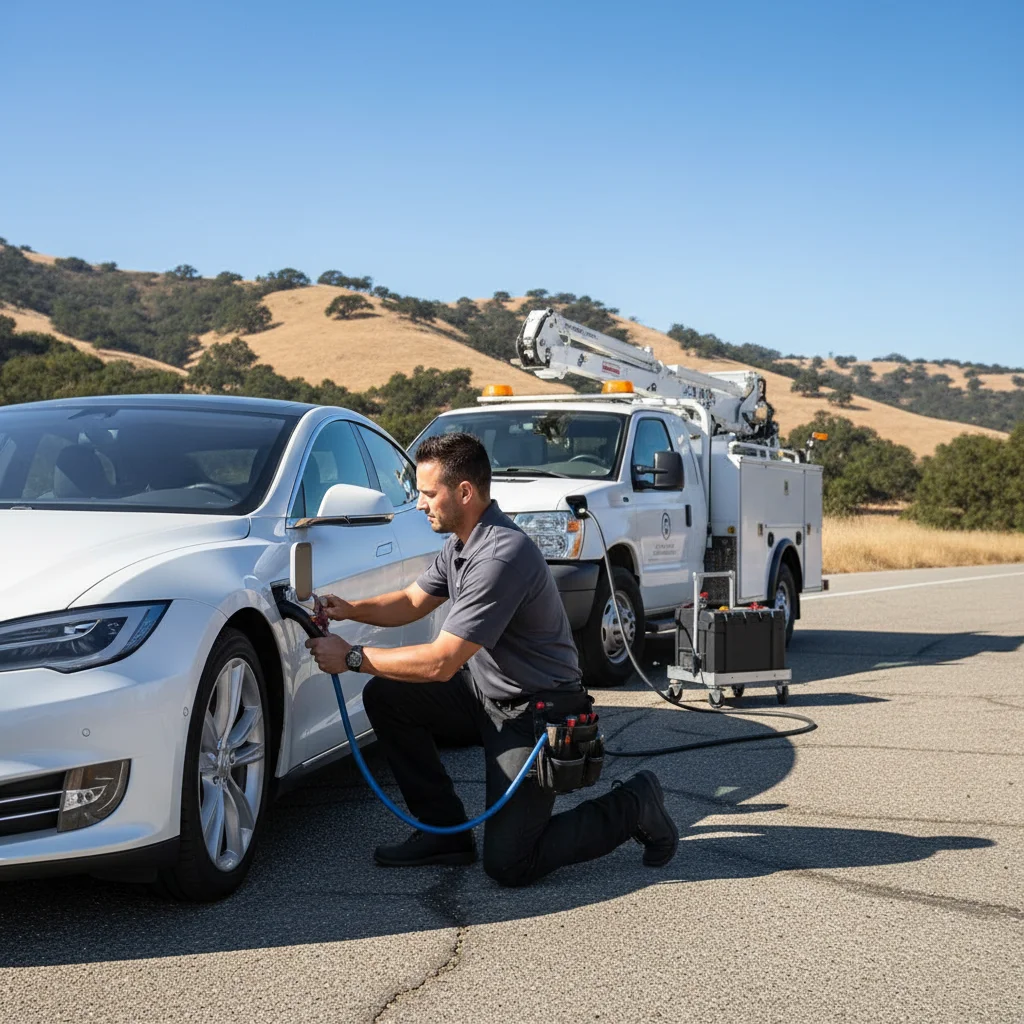
Why the 580 and 680 junction dumps range
Pleasanton is an incorporated Alameda County city on the Tri-Valley floor. Census Gazetteer land area is 24.141 square miles. The ACS 2019-2023 population is 77,500, and the 2024 Census estimate is 75,664. It’s inland, with summer heat and AC load a coastal commute never sees.
The I-680 Sunol Grade and the I-580 Altamont approach both start in this city. That’s the local stranding pattern, and it shows up after work. A car can look fine in a lot at 5 PM. Then the grade eats the estimate you trusted at the light. On that southbound climb, start with out of charge on I-680. If you’re eastbound toward the pass, use out of charge on I-580 over the Altamont.
Dublin, Livermore, and San Ramon share these freeways. Fremont is over the Sunol Grade from here. A Pleasanton start doesn’t guarantee a Pleasanton finish. Don’t keep driving at 1% because the next city isn’t far. Mileage left is a guess on a climb.
Shoulder rules on 580 and 680
California Vehicle Code 21718 bans freeway stops except in limited cases. A disabled vehicle may stop if it’s unavoidable and you’ve summoned help. Get to the right shoulder if the car can still creep. Put the hazards on and stay out of live lanes.
Dial 511 and say “Freeway Assist” for the Freeway Service Patrol. FSP is an MTC, CHP, and Caltrans partnership. Published hours are weekdays, 6 to 10 AM and 3 to 7 PM, per 511.org. You can also use a roadside call box. MTC’s FSP page lists gas, jump-starts, and radiator refills. It doesn’t mention electric vehicles or an out-of-charge fill.
Outside those windows, CHP’s Rotation Tow Program assigns the truck. You don’t choose the vendor on that rotation. Caltrans District 4 covers Bay Area highway conditions on QuickMap. 511 SF Bay is the regional traveler line.
California Vehicle Code 22651(f) allows a freeway removal after four hours. That applies on a full-access-control freeway if the car can’t move. Treat that four-hour clock as a deadline you don’t want.
Express lanes run on I-580 and on the I-680 Sunol corridor. Alameda CTC runs those lanes, and FasTrak is required. Hours are generally 5 AM to 8 PM weekdays. No published disabled-vehicle policy for those lanes turned up. Don’t sit in a toll lane hoping it counts as a shoulder. If the car can still move, get to a real shoulder.
Where the car actually sits in Pleasanton
Not every stall is on the freeway in Pleasanton. Downtown Main Street and the Hacienda Business Park hold cars all day. The Alameda County Fairgrounds and Stoneridge Shopping Center do the same on weekends and errands. Wineries on the south edge add a long park after a tasting. Neighborhoods include Downtown, Val Vista, Vintage Hills, Ruby Hill, Mohr, and Birdland. Surface corridors include Sunol Boulevard and Stanley Boulevard. SR-84 on Isabel Avenue is the Dumbarton path.
For the city page that sits under this geography, see EV charging in Pleasanton. We serve Pleasanton and every other city in the Bay Area service area. The brand owns no trucks, no yard, and no chargers. Independent operators do the work and bill you.
If GPS shows 94566, 94588, 94551, 94586, or 94568, still give a lot. Census ZIP overlays spill past city limits, so dispatch needs a pin.
Hacienda, fairgrounds, and Stoneridge
Hacienda is the weekday hold for parked EVs. Cars sit through a full inland workday at Hacienda. Then they merge onto 580 or 680 on a pack that never topped off. The fairgrounds is the event version of the same story. You park for hours, then exit into stacked freeway traffic. Stoneridge is the errand version of the same squeeze. You arrived with enough and leave after stops you didn’t count.
Public posts may still be in town. The car may not reach the one you’d pick. Check the AFDC station map yourself for current plugs. Don’t guess a distance from the shoulder.
South hills, Stanley, and Isabel
Vintage Hills and Ruby Hill sit against the south side of town. Those streets aren’t the Sunol Grade, but the return onto I-680 still is. Stanley Boulevard is the east run toward Livermore. Sunol Boulevard feeds the south edge and those wineries. Westbound Dumbarton Bridge tolls are all-electronic, FasTrak, plate, or invoice. No published disabled-vehicle policy for that bridge turned up. Don’t roll onto a bridge crossing on a prayer and a percent.
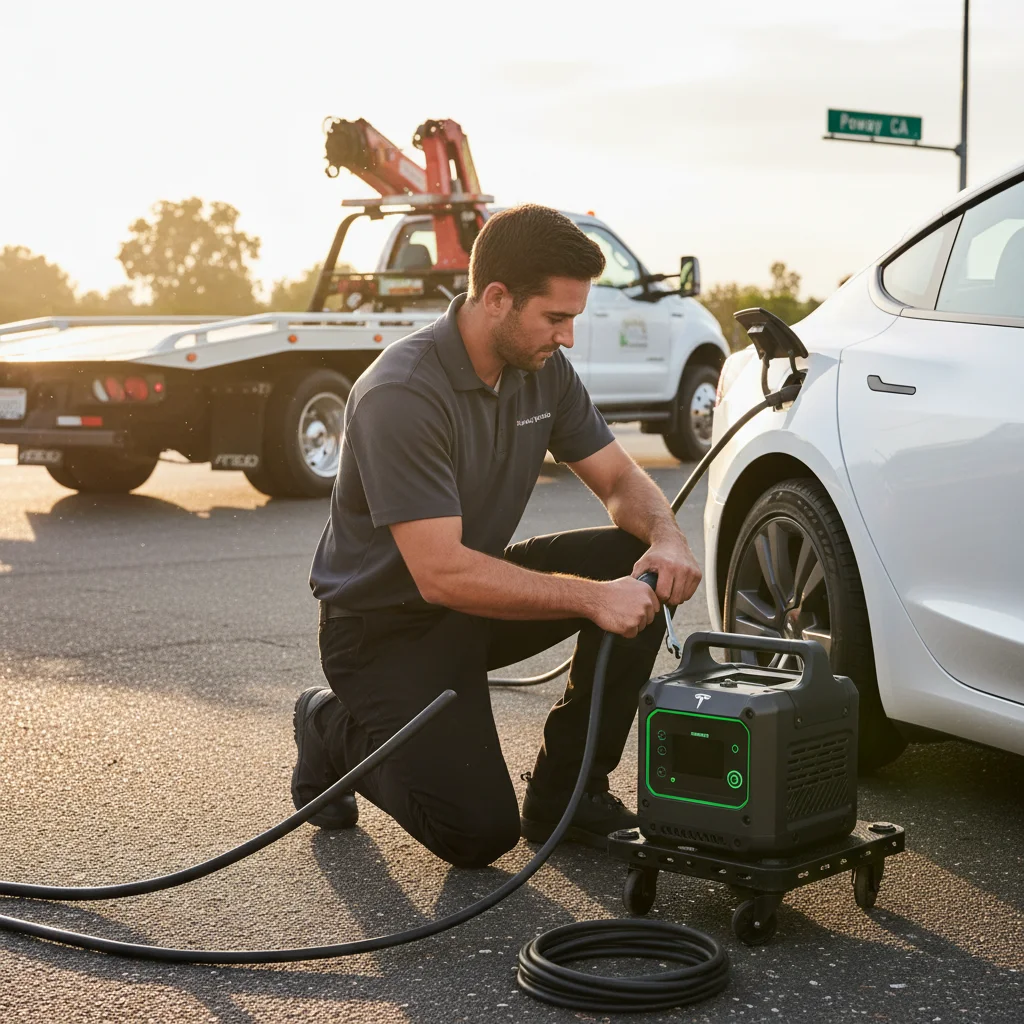
Empty pack, or a 12V that won’t wake the car
Two failures look identical from the curb in Pleasanton. One is a traction pack that’s actually empty. The other is a dead 12-volt auxiliary battery. Teslas and most other EVs still need that small 12V to wake. If the screens are dark and the handles are dead, think 12V. A full main pack won’t help until that 12V is jumped or replaced.
Operators in this network can jump a Tesla 12V at the car. They also handle other major EV brands on the 12V. Say whether the car will power on. That one sentence changes the kit they bring.
A car that still wakes and shows a low percentage is the empty-pack case. That’s a charge at the inlet, not a jump at the 12V posts.
What a mobile charge actually is
Charge Pro SF matches stranded drivers with independent local mobile rescue operators. We don’t perform the work, set prices, or promise an arrival window. The operator quotes you before starting and bills you directly.
What they typically bring is a 240-volt Level 2 source. Teslas take a native NACS plug on that lead. Non-Tesla EVs use a CCS or J1772 adapter. In 15 to 30 minutes of charging, you typically gain 10 to 20 miles. That’s charging time only, not a clock on arrival. It’s meant to reach a public post you choose. It isn’t a fill for the rest of the week.
Tesla and every major EV brand are in scope for these operators. If a connector isn’t on the truck, the operator should say so. Details on the kit sit on the mobile EV charging page.
When a charge is enough, and when you still need a tow
Most empty-pack stops don’t need a flatbed at all. If the car is healthy and just empty, add range where it sits. Walk through that choice in mobile EV charging or a tow.
A tow is the right call for a bent wheel. It’s also right for a tire you can’t drive on. Same if a fault won’t clear after a charge. The operator should say so if that’s what they find. Tesla’s in-app roadside path often defaults to a tow on a dead pack. That’s one option, not the only one. A local operator quote is a separate decision.
California doesn’t cap ordinary consensual tow rates statewide. Ask the towing company what they’ll charge before the hook goes on. On a freeway, CHP rotation may already be rolling if you called 511. Tell each party who’s already assigned so you don’t stack two responses. If a lot at Stoneridge or Hacienda is threatening a hook, read the posted sign. Private-property tows follow CVC 22658, so read that sign.
Heat, AC, and a pack that looked fine at noon
Pleasanton’s climate is warm inland valley, not fog. Livermore’s July average maximum in the 1961-1990 NWS normals, via WRCC, is 89.7°F. San Francisco’s July figure at SFO is 71.5°F. That gap is AC on 580 and 680. A buffer that worked in a cool month can fail on a Tri-Valley afternoon.
PG&E delivers the wires here, and Ava Community Energy is the CCA. That split doesn’t change what you do on the shoulder.
What to say when you call
Give a location a stranger can plot on a map. On the freeway, give direction, route, and a mile marker or last exit. “Southbound 680 after the 580 split” is usable, and “Pleasanton” is not. In town, use the lot name or a Main Street cross.
Then the car: make, model, and year. Add the connector if you know it. Then the state of charge, even a rough one. Then say whether it wakes, and lead with that if it doesn’t.
Don’t bump the car along at zero. Park safe and put the hazards on. Once you call, you’ve summoned help under that disabled-vehicle exception. For the rescue line itself, use EV roadside assistance. Nearby Livermore, Dublin, San Ramon, and Fremont sit on the same climbs.
If the pack is dead at the 580 and 680 junction, that’s the call. Same on the Sunol Grade or in a Hacienda stall. The operator quotes before they start. Call (415) 630-6268 and we’ll connect you with a local pro.