EV roadside assistance in Fremont is the backup when charging won’t get you home. The Tesla Factory sits in Warm Springs. That landmark doesn’t wake a car that’s already dead. When the pack is empty, you need energy at the car. When the 12V won’t boot, you need that 12V addressed on site. Either way, a mobile 240V source at the bumper is the backup.
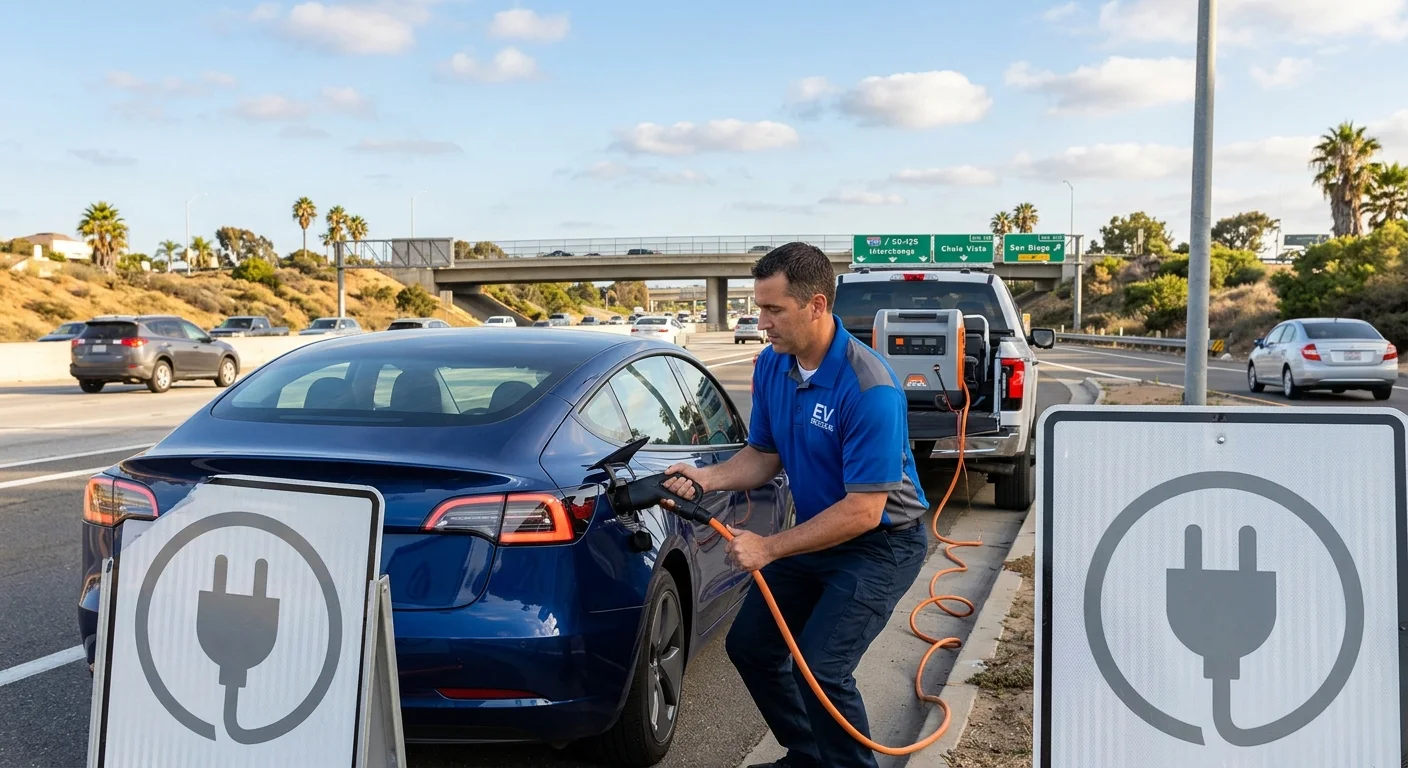
Fremont is factory parking, two freeways, and a long grade
Fremont is an incorporated city in Alameda County. The land area is 78.103 square miles. ACS 2019-2023 population is 228,518. The 2024 Census estimate is 228,192.
Those people aren’t in one neighborhood. Mission San Jose meets the hills. Niles meets the canyon. Centerville and Irvington hold much of the older core. Warm Springs holds the Tesla factory and a BART station. Ardenwood sits toward the Dumbarton.
I-880 runs the west side toward Union City and Newark. I-680 climbs the Sunol Grade toward Pleasanton. SR-84 is the Dumbarton west and Niles Canyon inland. SR-238 is Mission Boulevard.
Summer here is inland-influenced and hotter than the bayfront. Cabin cooling is a real load on a thin pack.
Fremont is the Tesla factory city. Cars still die on I-880 and the Sunol Grade.
A dark screen and a zero pack aren’t the same job
They look identical from the curb. They aren’t.
Teslas still have a 12-volt battery. It wakes the computers, the contactors, and the charge port. The traction pack can hold energy while that 12V is dead. The car just sits.
If the display works and range is the problem, the pack needs a charge. If the car is dark or won’t shift, start with the 12V. Do the same if the port won’t open.
Copy the warning text. Don’t rewrite it into a theory.
Independent operators in this network jump or replace a 12V on site. They also bring a 240V Level 2 source to the car. The plug is native NACS. CCS and J1772 adapters cover non-Tesla EVs. They handle Tesla and every major EV brand.
Charging time typically adds about 10 to 20 miles of range in 15 to 30 minutes. That’s session time on the cable. It isn’t when a truck shows up.
Charge Pro SF is a referral line. We match stranded EV drivers with independent local mobile rescue operators. We perform no work. The operator quotes you before starting. The operator bills you directly.
If the car is reachable and needs energy, start with mobile EV charging. For the wider help path, see EV roadside assistance.
Confirm the stop in Tesla’s tools before you spend miles
Supercharger names, access notes, and status change. Open Tesla’s current official tools for the site you’re considering. A saved pin isn’t a live check.
Read the listing Tesla shows for this trip. Confirm it matches your car. Read access notes. Check status. Then compare the full driving route with the energy on your display.
Background reading is fine. Live station status isn’t the same thing. The U.S. Department of Energy’s EV resources explain how EVs work. Tesla’s own tools are what you use for a Tesla site.
One public charging location we can name from a primary source is BART Warm Springs / South Fremont. BART lists Level 2 charging there, with 42 plugs. Confirm those stalls before you aim the last miles at the lot. Level 2 is slower than a Supercharger. Plan with that in mind.
If Tesla’s tool shows a site down or full, don’t keep driving on a guess. Supercharger down or full: what to do before you stall covers that fork.
Match the property in front of you to the listing. A connector in the next aisle isn’t automatically your stall.
If you can’t confirm a reachable, usable stop, park legally. Stay with the car.
Warm Springs still needs a 240-volt visit for a dead car
The factory lot is a long sit. So is the BART park-and-ride next to it. Cars sit through a shift or a commute. Some wake with a dead 12V. Some leave with too little pack for the grade home.
A wall box at a house in Centerville doesn’t reach a car in Warm Springs. ACS figures show 55.2 percent of Fremont housing was built before 1980. A lot of that older stock never received a dedicated EV circuit. Drivers still charge at work, at BART, or on a public session. When that session fails, the car needs energy brought to it.
What’s an EV charging truck, and who actually bills you walks through the rig and the invoice. Charge Pro SF doesn’t perform that licensed work. We connect you with an operator who does.
Don’t guess the miles you’ll add. The operator sees the car, the state of charge, and the access. Confirm the proposed service and the price with that operator before work starts.
Tell them the corridor, the exit, and the pin
“Fremont” is too large for a dispatch. Drop a pin. A ZIP can run past the city line.
On I-880, say northbound or southbound and the nearest exit. On I-680, say whether you’re on the Sunol Grade. That climb toward Pleasanton spends range fast. If you’re already stopped there, read out of charge on I-680.
On SR-84, say Dumbarton or Niles Canyon. The Dumbarton Bridge is Caltrans-owned, with all-electronic tolling. The tolled direction is westbound only, toward Menlo Park. No published disabled-vehicle-on-a-bridge policy turned up in the sources checked on 2026-09-18. If you’re on the span, contact CHP or use Caltrans District 4 traveler info. Don’t invent a refuge that isn’t marked.
On Mission Boulevard, name the cross street. Central Park and Lake Elizabeth, Mission San Jose, and Niles are different access problems.
California Vehicle Code 21718 generally bans stopping on a freeway. A disabled vehicle that can’t keep moving is an exception, once you’ve summoned help. CVC 22651(f) allows removal after more than four hours. That applies on a full-access-control freeway when the car can’t move under its own power.
Freeway Service Patrol is a partnership of MTC, CHP, and Caltrans. Private tow companies run weekday beats from 6 to 10 a.m. and 3 to 7 p.m. Dial 511 and say “Freeway Assist.” MTC describes gas, jump-starts, and radiator refills. The FSP page, read 2026-09-18, doesn’t mention out-of-charge EV help. Outside those hours, CHP Rotation Tow assigns a vendor. You don’t choose the truck. That path is a tow, not a charge.
If traffic is an immediate danger, call emergency services first.
Stop driving when the next listing is only a maybe
A second charger is a backup only if the car can finish every turn. Count the property entrance. Count a wrong driveway. Count a detour.
The Sunol Grade and Niles Canyon punish a close margin. Fremont’s inland heat does too, once the AC is on.
If the displayed range can’t absorb a mistake, stay put. A Level 2 rescue at the car can add 10 to 20 miles. Use that to reach a stop you’ve actually confirmed.
Work these four points before you roll:
- Tesla’s current tool still lists that exact site.
- You can name the entrance you’ll use.
- The car shows enough energy for the whole route.
- You know what you’ll do if that site fails.
If any point is fuzzy, request help while the car is still accessible.
Some scenes need out-of-charge recovery instead of a charge in place. A blocked stall is one case. So is a car that won’t accept a plug. A lot you can’t enter is another. The operator decides after seeing the vehicle and the access. Charge Pro SF doesn’t make that call.
PG&E delivers electricity in Fremont. Ava Community Energy is the community choice aggregator. Those names describe how power is organized. They don’t refill a stranded pack. Leave the bill for later.
Union City and Newark share the I-880 side. Milpitas sits on the south curve. Pleasanton is over the grade. Menlo Park is across the Dumbarton. For the local charging picture, use EV charging in Fremont.
Describe the car, not a diagnosis
Lead with the pin and a landmark you can see. Tesla factory, Warm Springs BART, Lake Elizabeth, Niles, Ardenwood, or the freeway exit.
Then give the operator this picture. Brand and model, if you know them. The percent on the screen, or that the screen is dark. The warning text as written. Whether the car powers on and shifts. Whether the charge port opens. Whether a cable is still latched. What the last charging attempt did. Where you meant to charge next. Whether everyone is in a safe spot.
If they ask for a photo, include the full warning. Don’t handle damaged equipment to improve the shot.
Say you want enough energy to reach a verified charger, or you need another recovery path. Don’t promise the next station is working.
The pros we connect you with are licensed and insured. They’re independent. You contract with them. Confirm the quote, the access plan, and the destination before you authorize work.
Call (415) 630-6268 when the Fremont stop you checked isn’t usable, and more driving isn’t sound. We’ll connect you with a local EV rescue operator.