The Hyundai Ioniq 5 battery comes in two sizes: a 58.0 kWh Standard Range pack and a 77.4 kWh Long Range pack. The usable figure is closer to 54.0 kWh and 74.0 kWh, because Hyundai holds back a buffer at each end of the pack to protect cell life. EPA range lands around 220 miles on the Standard, 303 on the Long Range RWD, and 260 on the Long Range AWD.
The number on the spec sheet does not decide whether you reach a charger today. A full pack does not help on a hill that ate 20 percent climbing up. A full pack does not help when a cold coastal sit drained the 12V and the contactors will not close. A full pack does not help when the post you drove to is offline and the next one is 30 miles away on US-101. This post walks through what each Ioniq 5 pack can do, where the Bay Area eats range, and what to do when neither pack gets you home.
What 54 and 74 usable kWh actually mean
Usable capacity is the figure that runs the motor. Gross capacity is what the cells physically hold. Manufacturers set usable below gross on purpose, because a deep cycle wears lithium cells faster than a shallow one. Hyundai’s buffer is around 5 to 7 percent on each end. That is normal across the industry.
The Standard Range Ioniq 5 pairs with a single rear motor and lands around 220 miles on the EPA cycle. Real Bay Area driving on 101 and 280 with normal climate use tends to land a bit lower. The Long Range RWD is the version most Ioniq 5 owners around Mountain View, Cupertino, and Sunnyvale see. It pairs a bigger pack with the same single motor and lands near 303 miles on the cycle. Long Range AWD adds a front motor for traction and drops EPA range to about 260. The AWD is the common choice in the Santa Cruz Mountains and around Tahoe-bound weekend trips.
Both packs charge at the same peak rate on a DC fast charger. The 800-volt architecture lets the Ioniq 5 take up to about 239 kW at a capable post. That is a fast charge, not a slow one. The downside shows up when you only need a few miles to reach a working post. A DC fast handshake takes a couple of minutes before electrons start flowing. If you are already at zero percent on a shoulder, those two minutes are not what you have.
Where Bay Area driving eats range
The Bay Area does not have the same climate penalty as the Central Valley. Most days stay mild. That keeps AC load light. The real range cost here is geography and dwell.
The Santa Cruz Mountains climb out of Los Gatos on SR-17 is a real range cost. A driver heading to Santa Cruz from the South Bay on a thin percent will watch the pack drop through the curves. The summit sits high enough that you will not make it back down with much to spare. Plan a top-off before the climb, not at the bottom of the hill.
The Caldecott Tunnel on SR-24 spends range on the west climb from Oakland into Lafayette. A driver who started with 30 miles showing and a full HVAC load sometimes arrives at the Orinda side of the bore with a number that surprises them. The return trip regenerates some of it back, but only if you let the car coast in low regen or hold a steady pace.
The Sunol Grade on I-680 between Fremont and Pleasanton is the same lesson. It is a sustained climb out of the South Bay toward the Tri-Valley, and a driver who arrived at the bottom on 25 miles often arrives at the top on 10. SR-92 over the coastal hills toward Half Moon Bay eats range too, and there is no charging near the summit.
The Coastside itself is a long-haul region. Fog, two-lane roads, and long stretches between towns. A low pack at Pillar Point Harbor with the next charger still miles down SR-1 is the situation that strands people.
When a full pack is still not enough
A spec sheet does not help in three situations that Bay Area drivers actually run into.
A cold damp coastal sit drains the 12V long before it touches the traction pack. The Ioniq 5, like every modern EV, runs screens, locks, and contactor logic off the 12V. A car left on a San Francisco curb through a foggy week, or parked in Pacifica for a long weekend, often returns with a dead 12V and a traction pack still showing real range. Pressing the door handle does nothing. The pack is fine. The car cannot wake to use it.
A failed public post leaves you parked at a charger that does not charge. Handshake failures are real, and they spike after atmospheric-river rain. The car sits at the post for ten minutes, throws an error, and now you have spent time and a few percent of battery heat for nothing.
A climb at low state of charge forces a decision. The Ioniq 5 does not leave you stranded mid-grade just because you have 10 percent. But it may ask you to pull over on the next safe spot if the pack runs hot. That pull-over is not an arrival time. It is a warning.
What mobile charging looks like in the Bay Area
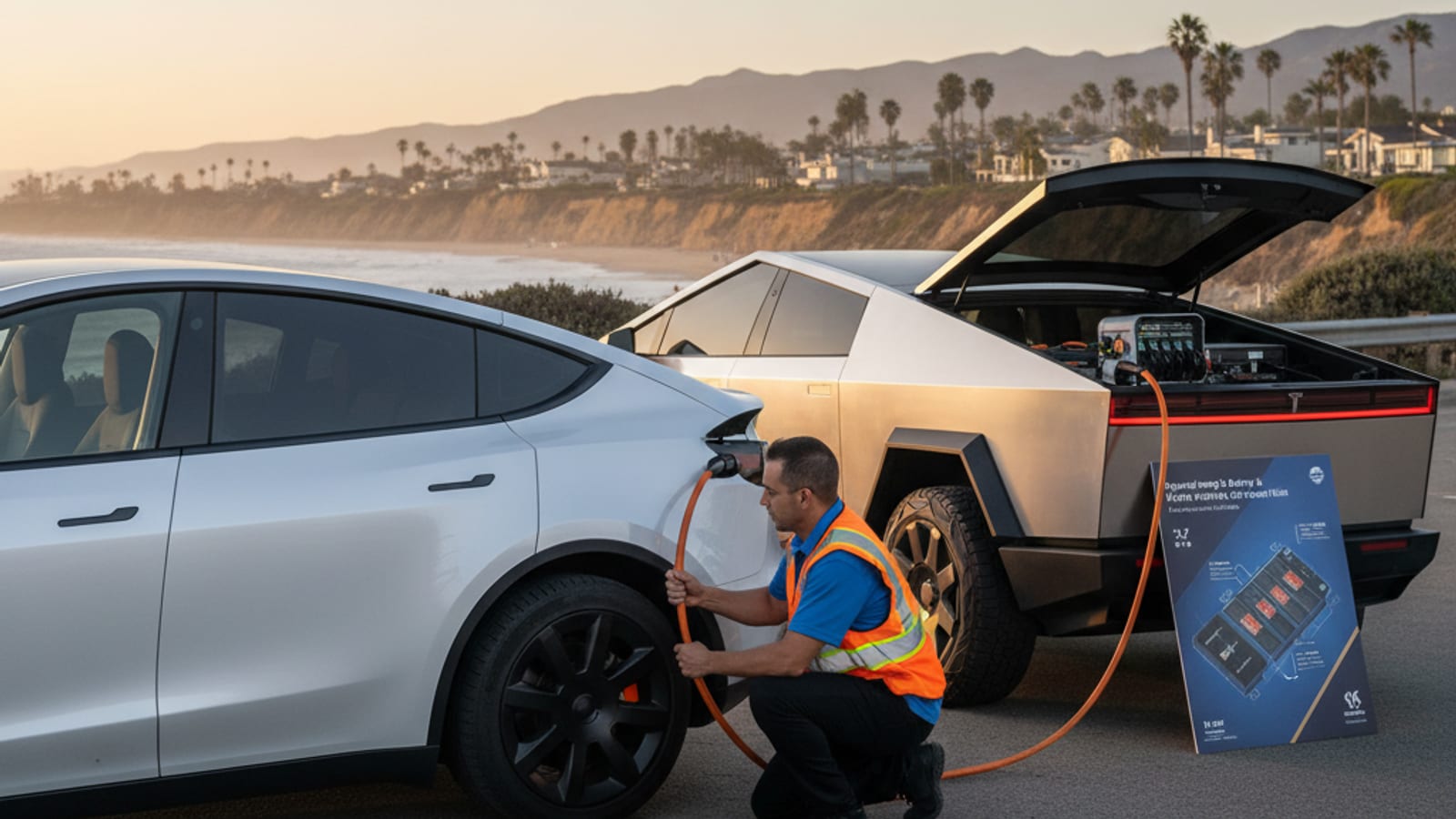
Charge Pro SF is a referral line. It matches stranded drivers with independent local operators. The operators we connect you with are licensed and insured. They bring a 240V Level 2 source, a CCS adapter for Ioniq 5, and a NACS adapter for newer model years. They quote you before they start. They bill you directly.
A typical session adds about 10 to 20 miles of range. That is enough driving room to reach a working DC fast charger, a home charger, or a garage outlet. The 15 to 30 minutes of charging time is charging time, not an arrival window. Operators serve all 50 cities and communities in the Bay Area, from Pacifica to Brentwood and from San Jose to Vallejo-adjacent corridors.
Two reasons to know your pack size before you call
The first reason is so the operator shows up with the right cable. An Ioniq 5 with a healthy 12V takes a CCS plug. An Ioniq 5 with a dead 12V needs the 12V jumped before any CCS handshake will work. Knowing which one you are looking at saves a return trip.
The second reason is so you know whether you need a mobile charge at all. If the 12V is dead and the traction pack shows real range on the app, you do not need range. You need a 12V jump. If the pack is genuinely low and the 12V is fine, you need a Level 2 session. Mixing the two is how people request a tow that did not need to happen.
FAQ
How many kWh is the Ioniq 5 battery?
The Standard Range Ioniq 5 carries about 58.0 kWh gross, or 54.0 kWh usable. The Long Range carries 77.4 kWh gross, or 74.0 kWh usable. The usable figure is what shows up as range.
Does cold weather reduce Ioniq 5 range?
The Bay Area stays mild year-round. Cold is rarely the cause here. A long damp sit kills the 12V, which keeps the car from waking. That looks like a range problem but is a 12V problem.
Can a Level 1 outlet fully charge an Ioniq 5 overnight?
A standard 120V outlet adds only a few miles of range per hour. It is fine as a maintenance top-up. It does not refill a Long Range pack overnight.
What is the Ioniq 5 DC fast charging peak?
On a compatible DC fast charger the Ioniq 5 can take up to about 239 kW. Under that peak, a 10 to 80 percent session can land in roughly 18 minutes when conditions cooperate.
What plug does the Ioniq 5 use?
The Ioniq 5 uses CCS. With an adapter, newer model years can use NACS hardware including many Tesla Superchargers.
Call (415) 630-6268 when a full pack is not enough to get you home. The operator quotes before any cable goes on. Nobody on this line promises an arrival clock.