Friday on the Bishop Ranch campus, the car won’t wake. Screens stay dark after a long work week in the lot. That’s the usual EV roadside assistance in San Ramon pattern. The 12V quit while you sat through meetings on campus. The traction pack often still has range left. Operators on the I-680 ridge see this on Crow Canyon Road. They see the same stall on Bollinger Canyon Road. Planned streets east of the freeway get that Friday failure too.
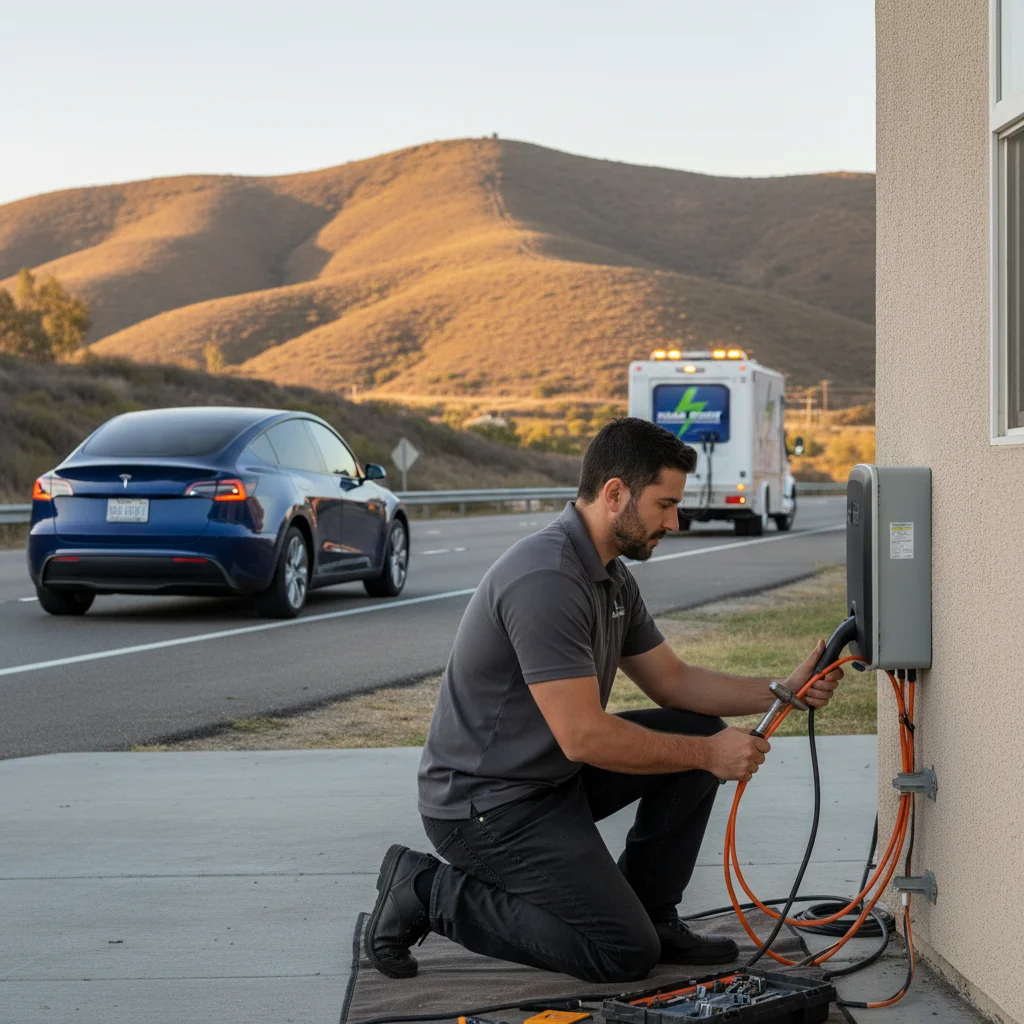
A work week at Bishop Ranch hides the 12V
Bishop Ranch is the corporate core of this Contra Costa city. Chevron and GE sit in that campus mix with other offices. City Center Bishop Ranch keeps lots full from morning onward. A large corporate EV fleet sits there through the workday. Cabin overheat protection sips from the small 12V battery. Those loads don’t come from the traction pack on the app.
San Ramon is an incorporated city in Contra Costa County. Land area is 20.059 square miles in the 2023 Gazetteer. Census ACS 2019-2023 counted 85,734 people in the city. The separate 2024 Census estimate is 85,924 residents. Only 23.8% of housing went up before 1980. Home charging is common on those post-1980 lots. Drivers often leave the driveway with a healthy pack. The failure that strands them is still the little 12V. It runs computers, latches, and the contactor that wakes the pack.
You walk out after a late meeting and the app won’t connect. The door handle won’t present, and the screens stay black. That’s a 12V pattern after a long sit, not an empty pack. It’s why Tesla 12V failure after a long park matches a Bishop Ranch Friday. Teslas still use a 12V to boot computers and contactors. Kill it, and a full pack sits useless behind a dark screen.
Wires in San Ramon belong to PG&E for distribution. Generation for many accounts is MCE, Marin Clean Energy. MCE publishes Charge Up Contra Costa for workplace and multifamily Level 2 rebates. That program doesn’t jump a dead 12V in a campus stall.
The I-680 ridge, heat, and a car that won’t roll
I-680 is the spine through San Ramon and the Tri-Valley. It runs along the Mount Diablo foothills on the inland side. San Ramon sits in a warm inland valley, not on the coast. Summer heat is real here, and AC load is part of the stall. Livermore’s 1961-1990 NWS normals show a July average max of 89.7F.
Express lanes run on I-680 in Contra Costa County, and FasTrak is required. Hours are generally 5 AM to 8 PM on weekdays. If the car dies in a lane, don’t invent a pull-left rule. No primary page confirmed where a disabled EV should sit. Get right if you can, and stay in the vehicle if that’s safer.
California Vehicle Code 21718 bars stopping on a freeway except in limited cases. One case is a vehicle so disabled that stopping is unavoidable. Another vehicle must already be summoned to assist. CVC 22651(f) lets officers remove a vehicle left more than four hours. That applies on a full-access-control freeway when you can’t move. That clock is why you shouldn’t wait on the shoulder for a reboot.
The Bay Area Freeway Service Patrol is a partnership of MTC, CHP, and Caltrans. Weekday hours are 6 to 10 AM and 3 to 7 PM. Dial 511 and say Freeway Assist, or use a call box. FSP lists a free gallon of gas, jump-starts, and radiator refills. MTC’s page, read 2026-09-18, doesn’t mention electric vehicles or out-of-charge help. A patrol jump may wake a 12V on the shoulder. It won’t add traction miles if the pack is empty. Outside those hours, CHP’s Rotation Tow Program assigns the next approved truck. You don’t pick the company on that rotation.
If the pack itself is empty on the 680 grade, that’s a different job. Read out of charge on I-680 for the shoulder steps. Confirm the next DC post in the car’s map before you idle down.
Planned streets from Dougherty Valley to Canyon Lakes
East of the freeway the map turns into named tracts. Dougherty Valley, Windemere, and Gale Ranch sit toward the Danville border. Twin Creeks and Canyon Lakes follow the same planned-street pattern. Crow Canyon Road and Bollinger Canyon Road feed those tracts. San Ramon Valley Boulevard is the old north-south spine. Norris Canyon Road climbs toward the hills from the valley floor. Callers often give ZIP 94582 or 94583. 94506 and 94526 overlap the Danville side of the line.
These streets hide a 12V in a quieter way than the ridge. You charge at home because the house is newer stock. Sentry mode and a hot cabin overnight can flatten the 12V by Monday. The pack still showed a healthy percentage in the last screenshot. The car won’t boot to use that pack until the 12V comes back.
Gale Ranch school runs and Canyon Lakes errands make short trips. Short trips never exercise the 12V the way a long I-680 commute does. Then you sit at Bishop Ranch all week in a hot lot. Friday evening is when the latch fails and the screens stay dark.
Danville is the next ridge town north of that border. If you stall there, EV roadside assistance in Danville covers the same 680 pattern. Dublin and Pleasanton sit south at the 580 junction. Castro Valley is over the hills on Crow Canyon Road.
A home backup battery won’t solve a dark EV either. It can keep lights on during a PG&E outage. It can’t reach a car that won’t close the contactor. That split is the point of San Ramon home backup versus a dead EV.
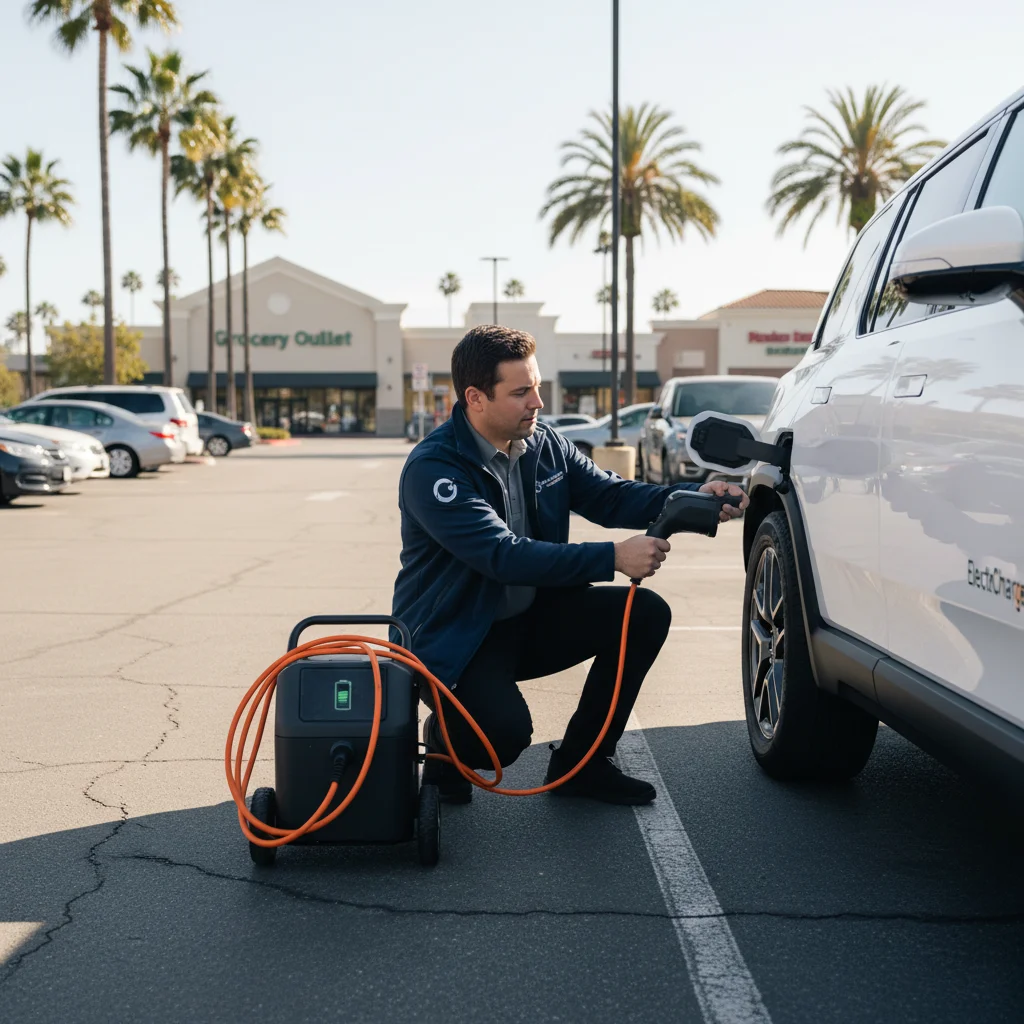
What the operator brings, and who bills you
Charge Pro SF is a referral line for this kind of stall. It matches you with an independent local operator. It owns no trucks and it employs no technicians. It doesn’t set the price and it doesn’t promise an arrival. The operator quotes you before any cable goes on, then bills you directly.
What those pros carry is a 240V Level 2 source. Tesla cars take a native NACS plug on that cable. Other EVs use a CCS or J1772 adapter. Typical charging time adds 10 to 20 miles in 15 to 30 minutes. That’s time on the cable, never a promise of when someone arrives. If the 12V is the failure, they jump it on site. They replace it when that’s the safe fix. They handle Tesla and every major EV brand.
Call for EV roadside assistance when the car is dark. Use it on I-680 or in a Bishop Ranch stall. If you already know it’s the 12V, ask for a Tesla 12V jump. A mobile charge is the other path when the pack is empty. The person who shows up is a licensed, insured operator in the network. Charge Pro SF doesn’t do that work itself.
A patrol jump, a tow, or a mobile charge
A freeway patrol jump can restore 12V power during FSP hours. It doesn’t charge the traction pack, so a zero pack still needs miles. California doesn’t cap ordinary private tow rates statewide. The statutory ceiling in CVC 22658 is the private-property context. It’s tied to a CHP-approved or law-enforcement rate. On I-680 after hours you’re usually in the CHP rotation world.
Towing a dead EV usually means a flatbed. Loading a silent car takes time you don’t have on a live shoulder. Then you still need a charger at the far end. A mobile Level 2 session on the shoulder skips that chain. CVC 22658 requires a posted 17 by 22 inch sign for a lot tow. The operator must notify law enforcement within one hour. Penal Code 632 bars recording a confidential call without every party’s consent. Caltrans District 4 covers the nine Bay Area counties. Check QuickMap before you walk away from the shoulder.
When the screens stay dark
Stay with the car if the shoulder is narrow. Then decide: 12V jump, a Level 2 top-off, or a tow. Charge Pro SF serves San Ramon and the rest of the Bay Area. For a dark car on I-680 or at Bishop Ranch, call (415) 630-6268. The operator quotes before work starts, and you pay that operator.