A Mach-E charge port stuck after fog or rain is usually a seized latch. Coastside air can hold the CCS cable in overnight. A weak 12-volt battery can do the same thing. So can a public charger that never closed the session. Don’t yank the handle. End the charge in FordPass first. Then use the mechanical release in the frunk.
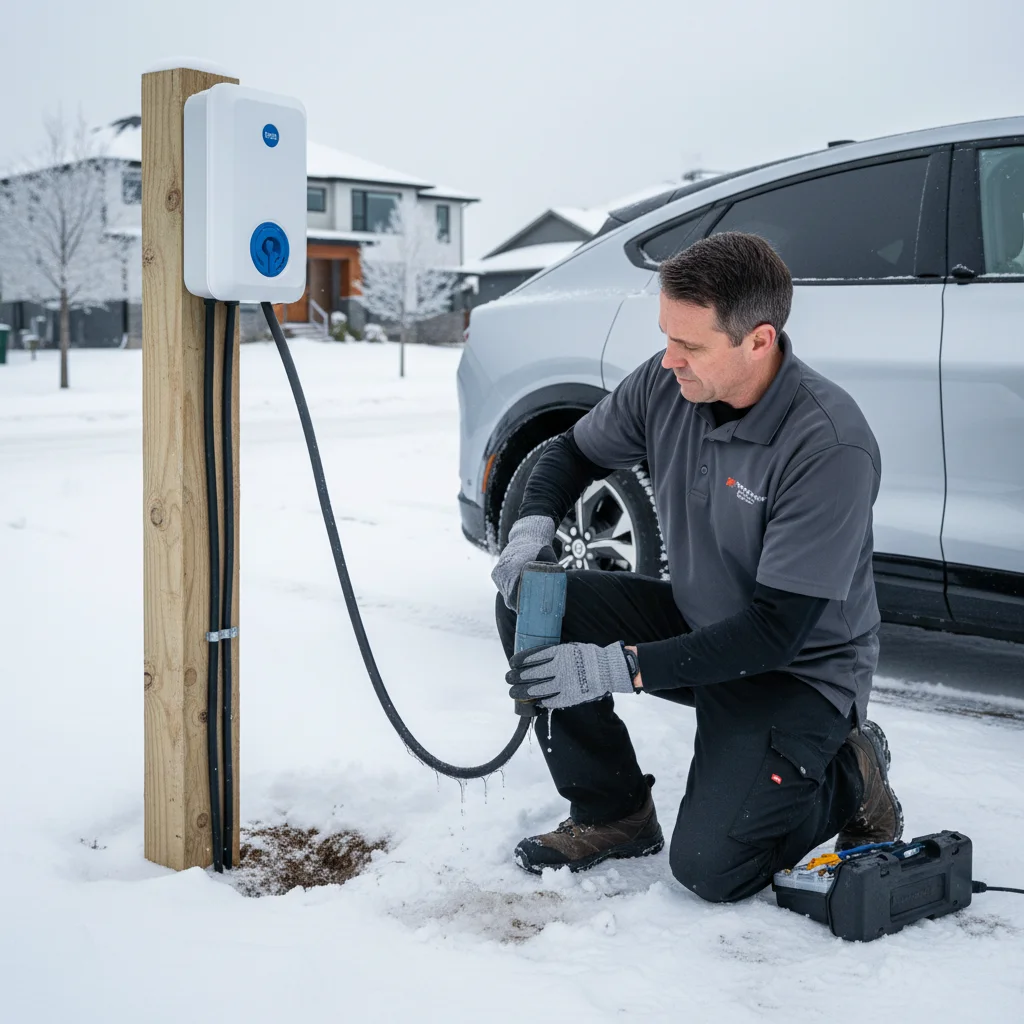
Wet air on the Coastside binds a latch inland heat never sees
Pacifica and Half Moon Bay sit in marine air most wet-season mornings. El Granada does too. Daly City’s ridges catch the same layer. The charge door faces that moisture all night if the car sits outside.
Census ACS 2019-2023 housing age is the local pattern. Pacifica’s stock is 81.1 percent pre-1980. Daly City is 78.7 percent. San Bruno is 81.9 percent. San Francisco is 77.2 percent. Those older blocks mean more curb parking and open carports. The Mach-E isn’t drying in a closed garage.
EV roadside help in Pacifica is the Coastside version of that stall.
Dublin’s pre-1980 share is 21.0 percent. San Ramon is 23.8 percent. Brentwood is 10.9 percent. More of those cars wake up indoors. They still bind after a public DC fast charge. A Sunnyvale campus lot can leave the same locked handle. So can a San Jose work stall after a shift.
Oakland is 77.9 percent pre-1980, and Berkeley is 80.8 percent. East Bay core streets follow that same outdoor pattern.
Summer heat is a separate inland problem. San Francisco’s July average max is 71.5F on the 1961-1990 normals. Livermore’s is 89.7F. Antioch’s is 90.4F. That gap is real. This page is about wet air, not that heat.
PG&E delivers the wires in Pacifica, Daly City, and Half Moon Bay. Peninsula Clean Energy supplies generation across San Mateo County. San Francisco runs CleanPowerSF on the same PG&E wires. Those pages don’t tell you how to free a stuck CCS handle.
Rain, a weak 12-volt, or a station that never let go
Owners treat every seized port as one fault. The cause isn’t always rain.
A wet motorized charge door may refuse to swing. FordPass can still show it closed. You never even see the CCS inlet. Don’t pry the door with a key. Don’t rinse the electronics with more water. Dry what you can see. Then try the door command again.
Water left in the inlet is its own hazard. Water in the EV charge port explains why you shouldn’t plug into a wet inlet.
A locked CCS connector is different. The door is already open. The handle won’t come out. The car thinks it’s still charging. Or the latch solenoid never got enough 12-volt power to let go.
The last case sits on the station. The Mach-E has ended the session. The public unit hasn’t. The handle stays clamped until that network releases it.
For shared steps across brands, start with what to try when your EV charging cable won’t come out. The Mach-E frunk strap is the Ford-specific piece.
End the charge in software before you touch the handle
Open FordPass and confirm the charge has actually stopped. On a public unit, end the session in that network’s app or on the screen. Walking away at a full pack doesn’t always close the station’s lock.
Press the release on the CCS handle once. Pull straight back with steady pressure. If it doesn’t move, stop. Forcing a locked connector can bend pins or crack the housing. That turns a morning delay into a dealer visit. A parts price for a Mach-E port assembly couldn’t be confirmed for this page. Ask a Ford dealer for a current quote if the inlet’s already damaged.
If the door itself is soaked and stuck shut, wait. Let the cabin run and try the door command again. If the car’s dark or the door motor never tries, treat it as a 12-volt problem.
A full pack still won’t fire a starved latch
The Mach-E charge door motor and the connector latch both draw from the 12-volt system. The high-voltage pack can still show a healthy charge. The small battery can still be too weak to fire the solenoid.
A Mach-E that sat near SFO for days can wake that way. San Bruno and Millbrae see that after a long trip. flysfo.com publishes an EV-charging page. It couldn’t be read for this article. Confirm any stall details in a browser.
Don’t assume the pack is empty. Check the 12-volt path first. What to check when a Mustang Mach-E won’t start covers the no-start version of the same battery.
If the 12-volt is dead, the frunk may not open from the app. Ford’s Mach-E how-to covers that case. A charge may be needed to open the door and hood first. Then you attach jumper cables. Use the Owner’s Manual Crash and Breakdown Information section for your year. This page doesn’t freeze a clamp map. If you’re not comfortable with that, stop. An independent operator can jump the 12-volt on site.
Ford hid the backup release in the frunk
Ford put a mechanical release in the front trunk. It bypasses the solenoid. That’s the move when the latch has power problems.
Open the frunk from FordPass, or use the hood release in the cabin. If the 12-volt is dead, you may need that jump first.
Look toward the driver’s side of the frunk floor, near the back wall. You want a bright orange loop, yellow on some years. It looks like a heavy zip-tie handle. A cable runs from that loop to the charge port latch. Confirm the exact layout in your owner’s manual. Model years differ.
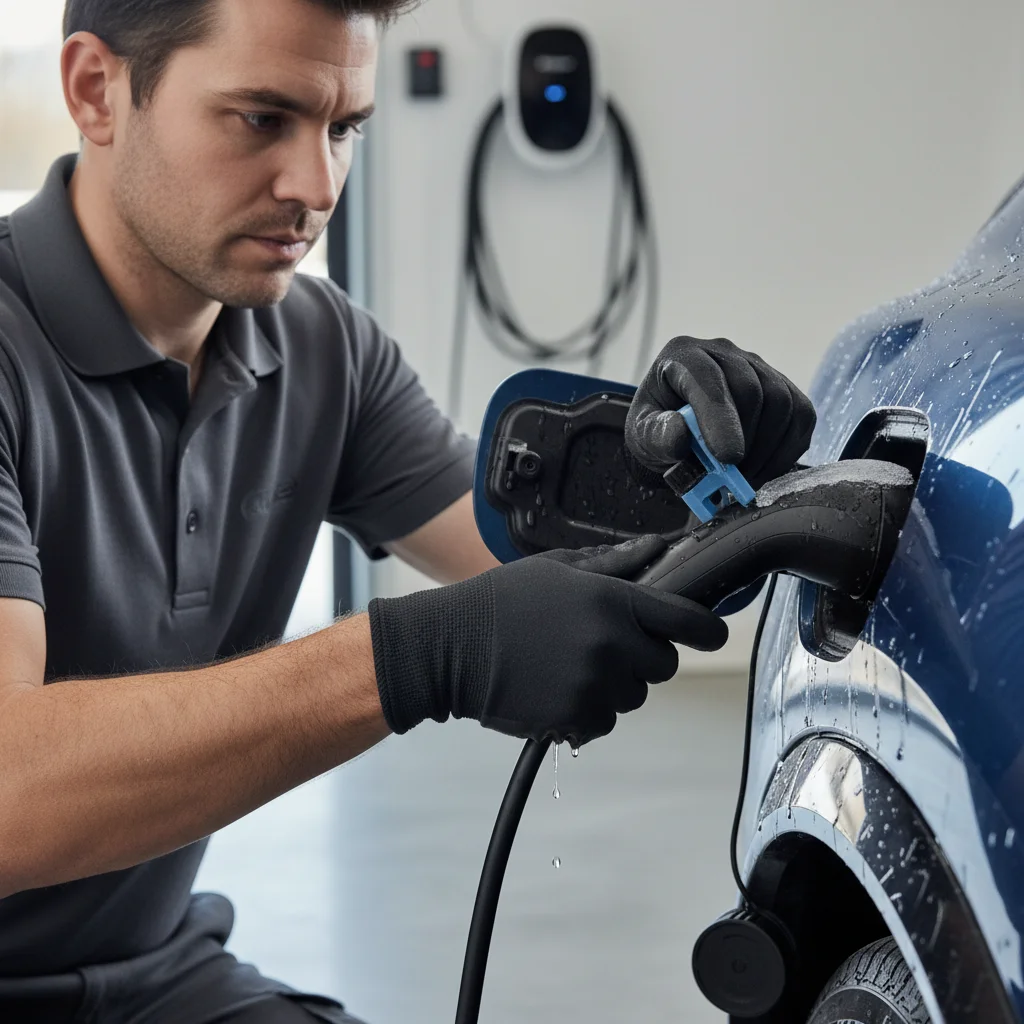
Pull once, firm and steady. Don’t yank. You should hear a soft click at the port. Go back to the handle, press the CCS release, and draw the connector out.
That strap is a workaround. It doesn’t repair a weak 12-volt. It doesn’t fix a station that’s still holding the lock.
If the strap clicked and the cable still holds
A firm tug with real resistance usually means the cable to the latch is intact. You overrode an electrical lock. If the connector still won’t move after a solid click, the station may be holding the handle. Go back to the unit’s app, screen, or the support number printed on the cabinet. Give them the station ID on the label. Ask them to release the connector remotely. How long that takes couldn’t be confirmed here. It varies by network and hour.
A limp strap is a worse sign. The cable may be slack or unhooked. The hook inside the port may be bent. You won’t fix that on the street. Don’t keep pulling until something snaps.
Don’t wait for a station to reboot as your plan. It might release, and it might not. A wet morning in a Daly City garage isn’t the time to gamble on a reboot. Neither is a public unit after dark in Oakland.
BART park-and-ride Level 2 sites use the same release steps if a handle sticks. bart.gov lists charging at Warm Springs / South Fremont with 42 plugs. Lafayette has 4 plugs. Confirm current prices on bart.gov before you pay.
If you’re already empty after the stall, freeing the port and adding range are different jobs. A mobile EV charging boost is the range call. Free the connector first, then see whether the pack actually needs energy.
Shoulder rules if the cable still has you pinned
Stopping on a freeway is limited. CVC 21718 allows it when the vehicle is so disabled that stopping is unavoidable. Another vehicle has to have been summoned to assist.
CVC 22651(f) is the clock. A car can be removed after four hours on a full-access-control freeway. That’s if you can’t move it under its own power.
Freeway Service Patrol hours are Monday to Friday, 6 to 10 AM and 3 to 7 PM. That listing is on 511.org, read 2026-09-18. Dial 511 and say “Freeway Assist,” or use a call box. MTC’s FSP page lists gas, jump-starts, and radiator refills. It doesn’t mention electric vehicles or a stuck charge cable. That page was read on mtc.ca.gov on 2026-09-18. After those hours, CHP Rotation Tow assigns the vendor. You don’t pick the company.
Call 911 if the car is in a dangerous location or a traffic lane. CHP says that on its FAQ.
When the cable still won’t come out
A closed session, a dry door, or the frunk strap can free the handle. Some stalls still don’t.
Stop if the 12-volt is dead and you can’t open the frunk. Stop if the strap is missing, broken, or limp. Stop if the CCS housing looks cracked. Stop if you’re on a public unit and the network won’t release the handle.
Charge Pro SF is a referral line. It doesn’t own trucks or employ technicians. It matches you with independent local mobile rescue operators. Those operators can jump or replace a dead 12-volt on site. They can bring a 240V Level 2 source to a Mach-E with a CCS adapter. That typically adds 10 to 20 miles of range in 15 to 30 minutes of charging. That’s charging time, not an arrival time. The operator quotes you before starting and bills you directly.
Non-Tesla EV rescue is the service path for Mach-E owners in that spot. The pros we connect you with are licensed and insured. They handle Tesla and every major EV brand.
Call (415) 630-6268 when you’ve tried the strap and the handle still won’t come out. An operator will quote the work before anything starts.