The coast run through Pacifica can flatten an EV pack before you planned. Fog stacks on SR-1, the Cabrillo Highway, and the range number starts sliding. If you need EV roadside assistance in Pacifica, you want help at the car. Charge Pro SF is a referral line. We connect you with independent local operators. They bring a 240V Level 2 source, or they jump a dead 12V. They quote you before they start, and they bill you directly.
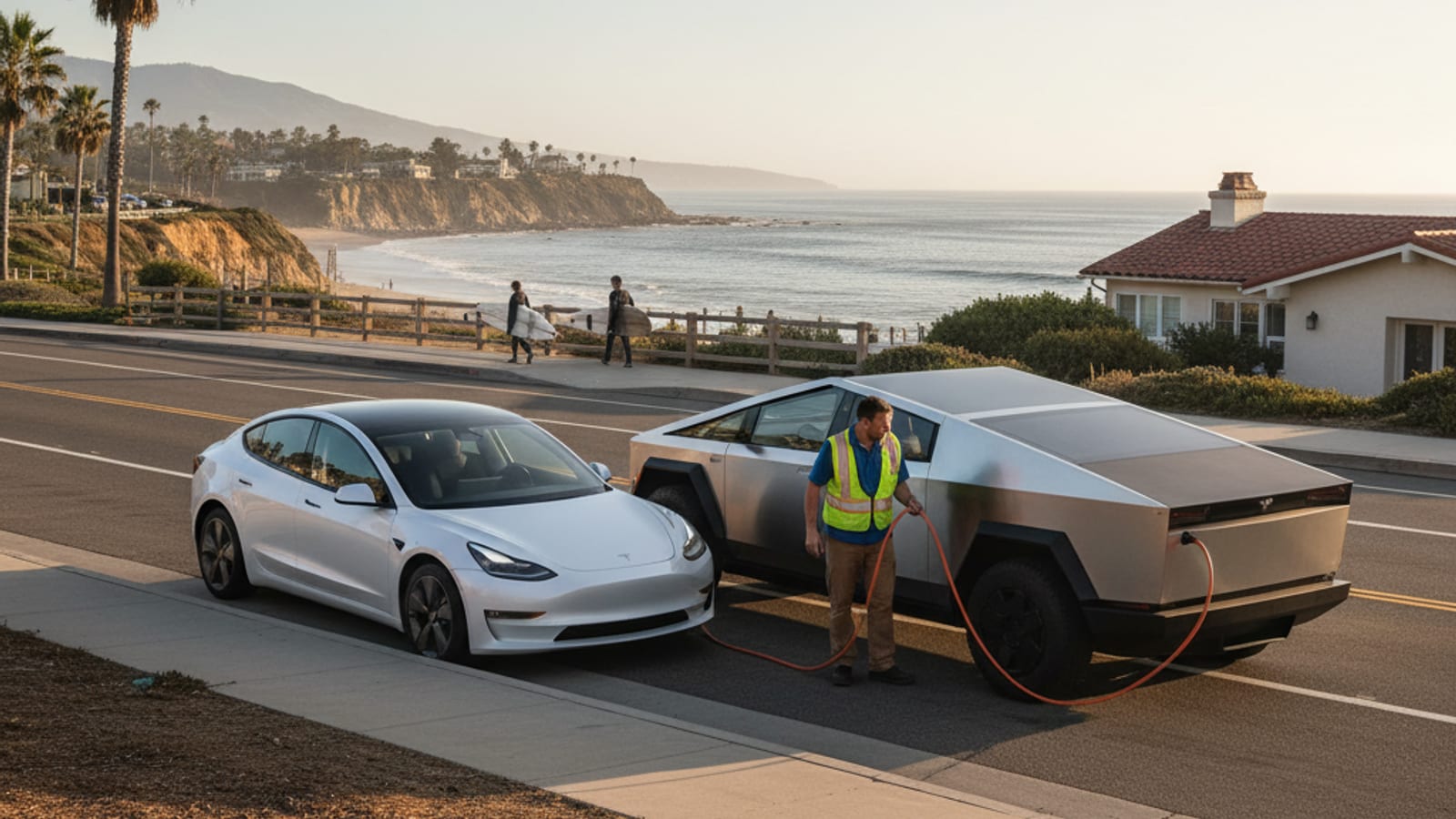
Fog on SR-1 changes how a stall feels
Pacifica sits in San Mateo County on 12.583 square miles of coast. The ACS 2019-2023 count is 37,527 people. The 2024 Census estimate is 37,056. Those two series don’t match, and that’s normal. ZIP 94044 is what most callers give. This isn’t inland Peninsula driving, and Skyline Boulevard climbs the ridge. Sharp Park Road drops you toward the water. SR-1 is the only through road.
South of town, the Devil’s Slide tunnels are the pinch point. You can’t hop a parallel arterial the way you would on the bay side. If the car quits on that stretch, you’re on whatever shoulder the highway left you. Fog is common here. Pacifica is cool, wet, and among the foggiest coast in the region. You barely run the A/C, but wind and damp still work on a 12V battery. A dark EV on SR-1 is hard to see in marine layer.
The Cabrillo Highway is the local name for this stretch of SR-1. It’s scenic, and it’s slow when the layer sits on the pavement. People come for Rockaway Beach, the Pacifica Pier, Mori Point, and Sweeney Ridge. They leave with a colder pack than the inbound estimate. Regenerative braking helps on a descent. It doesn’t refill a pack you already spent coming down Skyline. If you dropped in from the ridge, you still have to climb back out. You can also take SR-1 north or south.
Linda Mar, Sharp Park, Rockaway Beach, Pacific Manor, Vallemar, and Fairmont all sit on this same coast. A stall by the Pacifica Pier is a lot problem. A stall near Mori Point is a trailhead-lot problem. A stall at Rockaway Beach is a visitor-lot problem. A stall inside or just outside the Devil’s Slide tunnels is a highway problem. Those aren’t the same call. Sweeney Ridge adds another visitor pattern. People park, hike, and come back to a car that sat cold in the wind.
Fairmont and Pacific Manor sit higher than the beach lots. Linda Mar sits in the bowl at the south end of town. Vallemar is a small pocket along the highway. Sharp Park is the civic middle. Rockaway Beach is the visitor cluster. If you tell an operator Pacifica and nothing else, you haven’t given a pin. Give the neighborhood or a named landmark.
If you’re still rolling south toward Half Moon Bay, check remaining range before you enter the tunnels. Our notes on stalling between Pacifica and Half Moon Bay stay on that corridor.
What EV roadside assistance means on this coast
A gas-car tow script doesn’t map onto an EV. The high-voltage pack may still hold energy. The 12V may be the only thing that’s dead. Or the pack may be at zero, and a jump will do nothing. You need someone who can tell those apart at the bumper.
Roadside help here is a mobile visit. The operator comes to your pin. They don’t need you to limp to a shop bay. Charge Pro SF doesn’t own trucks, yards, or chargers. We don’t employ technicians. We match you with independent operators who already work the Coastside and the rest of the Bay Area.
The pros we connect you with are licensed and insured. That’s a claim about the network, and it’s true. The brand itself holds no contractor license, and we don’t do the work.
We serve Pacifica and every other city in the Bay Area. That’s a service-area fact. It’s not a promise that a truck is already on Sharp Park Road.
Empty pack, or a 12V that quit in the damp
Cool marine air is easy on cabin cooling. It’s rough on the small battery. Pacifica’s wind, salt air, and wet mornings sit on parked cars more than inland San Mateo. Every modern EV still has a 12V battery. It runs the computers. It wakes the high-voltage contactors. It releases the charge port. If that little battery is dead, the car can look bricked with a healthy traction pack.
Teslas do this. So do Hyundai, Kia, Ford, Chevy, VW, Rivian, and the rest. The dash goes black. The app can’t find the car. Handles don’t present. You might hear a click, then nothing.
An empty traction pack looks different. The car woke. You drove. The estimate fell through the last warning. The screens still work. The car is asking for a plug.
Don’t guess in the fog. Tell the operator both sets of symptoms. A Tesla 12V battery jump is often the whole job on a Tesla. Operators can jump or replace a dead 12V on other brands too. If the traction pack is empty, a jump won’t roll you. You need energy into the pack.
Sitting with hazards on still draws the 12V. So does a locked car that keeps trying to phone home. In damp weather that drain shows up sooner after a long park. A week at a trailhead lot is a classic 12V setup. So is a car that sat at home on a Level 1 cord that never actually made a session.
Water in the charge port is a separate snag on this coast. Fog and spray collect in the door. Don’t force a plug into a wet inlet. Open the port, let it drain, and wipe what you can see. If the car still refuses a handshake, say that on the call. The operator needs to know whether they’re charging, jumping, or looking at a port that won’t latch.
What the operator brings to the bumper
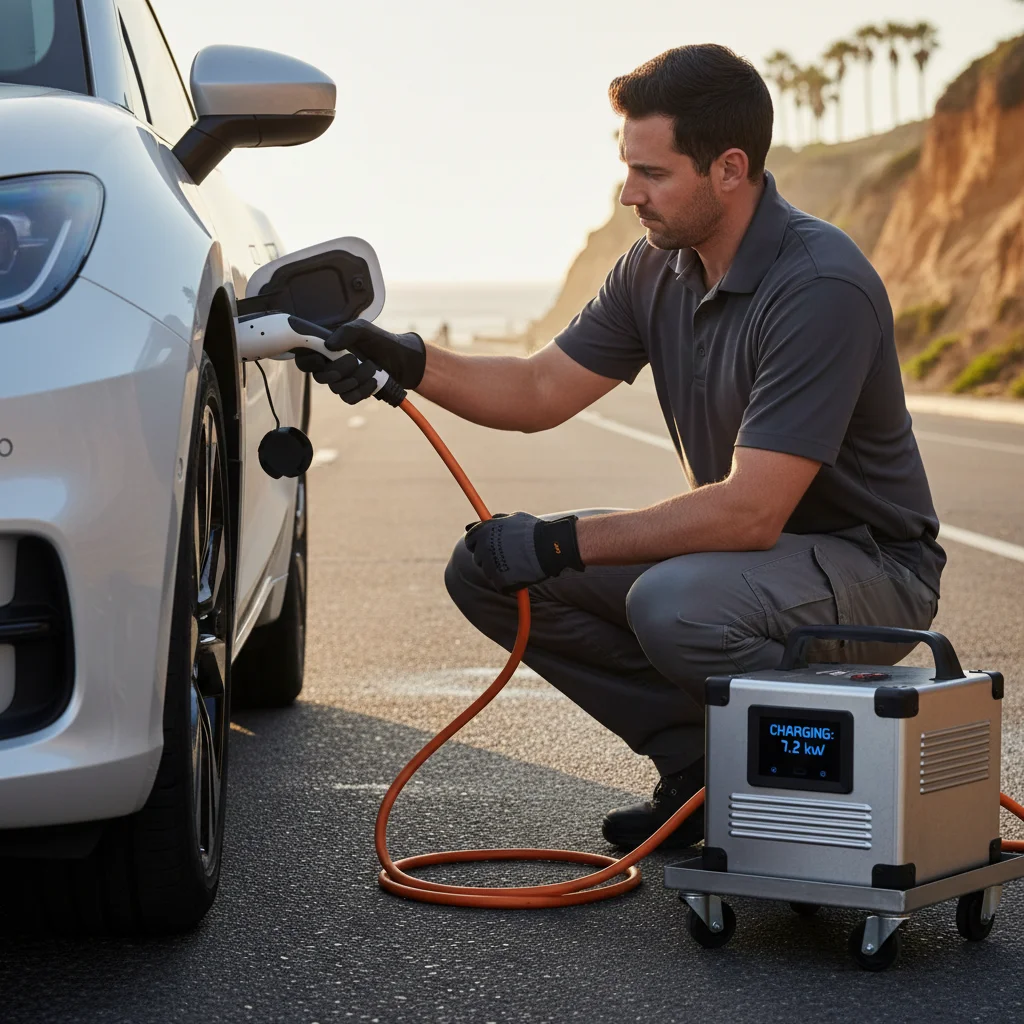
Operators bring a 240V Level 2 source to the car. Teslas take a native NACS plug. Other EVs take CCS or a J1772 adapter. That mix covers Tesla and every major EV brand the operators handle. Non-Tesla EV rescue is the same visit with a different plug.
This isn’t a Supercharger on a truck. A Supercharger is Tesla’s DC fast network, and it lives at fixed sites. Roadside rescue here is a Level 2 session at your bumper. Typical charging time is 15 to 30 minutes. That number is charging time only, not an arrival time. In that window the car often adds about 10 to 20 miles of range. Your efficiency, the cabin load, and the next grade change the result. Confirm the quote before they plug in.
That extra range is for reaching a public post you’ve already checked. It can also get you home if home is close. It’s not a full recharge. Don’t treat it like one.
Mobile EV charging is the name for that visit. If the pack is at zero, you’re in the same workflow.
A tow is a different decision
Some stalls still need a tow. A crash, a bent wheel, or a car that won’t accept charge is a tow job. Many EVs need a flatbed so all four wheels leave the pavement. A wheel-lift on a dual-motor car can stress the drive units. If charging won’t work, the operator should say so. You then choose a tow on its own quote. Charge Pro SF doesn’t set tow prices. California doesn’t cap ordinary consensual tow rates statewide. Confirm the number with the company that hooks the car.
Private-property tows follow California Vehicle Code 22658. The lot needs a posted sign of a required size, with lettering at least one inch. The sign has to name the enforcement phone and each tow company. The operator must notify law enforcement within one hour. If you’re in a Rockaway or pier lot, look for that sign before you argue on the curb.
Don’t use another EV as a charger, and don’t jump a gas car from your Tesla. Those party tricks fail, or they hurt both vehicles. Roadside help on an EV is a 12V jump, a Level 2 fill, or a flatbed. Mixing those jobs is how people wait in the fog for the wrong truck.
If you stop on the highway, the Vehicle Code already has a clock
Stopping on a freeway is generally banned under California Vehicle Code 21718. A disabled vehicle that can’t keep going, with help already summoned, is one of the listed exceptions. We checked that on leginfo on September 18, 2026.
California Vehicle Code 22651(f) allows removal after more than four hours. That applies on a full-access-control freeway when you can’t move under your own power. Four hours is the statute, not a courtesy. If you’re in the Devil’s Slide area on SR-1, treat that clock as real. Get a pin out. Get a quote. Don’t wait for the fog to lift.
The Bay Area Freeway Service Patrol is a partnership of MTC, CHP, and Caltrans. Private tow companies run the beats under bid. Published hours are Monday through Friday, 6 to 10 AM and 3 to 7 PM, from 511.org. Dial 511 and say “Freeway Assist,” or use a call box. The MTC FSP page lists a free gallon of gas, jump-starts, and radiator refills. It doesn’t mention electric vehicles or out-of-charge help. We read that page on September 18, 2026. Don’t assume FSP will put energy in an EV pack. Outside those hours, the CHP Rotation Tow Program assigns a vendor. You don’t pick the truck.
Caltrans District 4 covers the nine Bay Area counties, including San Mateo. 511 SF Bay is the traveler line. QuickMap shows highway conditions and cameras. None of those agencies published a Pacifica-specific disabled-EV playbook we could verify.
Forwarding lines play a recording notice. California Penal Code 632 requires all-party consent for confidential recordings. That’s why you hear the beep. It’s not optional color.
Coast weather is not Tri-Valley weather
Inland July heat is a real range tax. Livermore’s 1961-1990 July average max is 89.7F, from NWS cooperative-station normals via WRCC. San Francisco / SFO’s July average max is 71.5F on the same vintage. Pacifica didn’t have its own normal in the packet we used. It sits on the fog side of that gap. You don’t bake the pack the way a Dublin or Livermore commute does. You still sit in wind and wet. You lose visibility, and you drain a 12V on a cold parked car.
Don’t copy an inland charging plan onto this coast. A cabin-preheat habit from summer in Concord doesn’t apply on Sharp Park Road. A leftover-range habit from flat 101 fails here. Fog slows you, and SR-1 is the only way through.
Older streets, and why the driveway may not save tonight
About 81.1% of Pacifica housing was built before 1980, per ACS 2019-2023 table B25034. Census uses that as a count of older stock. A lot of those buildings predate a dedicated 240-volt EV circuit as a normal spec. If you live in Linda Mar or Sharp Park, you may still be on a 120-volt cord. You may share a panel that was never sized for a wall unit. That’s not a map of public chargers. It means your driveway might not be the backup you wanted after a coast run.
PG&E runs the wires. Peninsula Clean Energy is the community choice aggregator for all of San Mateo County, including Pacifica. Peninsula Clean Energy publishes an EV Incentives Program, and an EV Ready Program for business and multifamily charging. PG&E publishes residential EV rate names: Home Charging EV2-A, Electric Vehicle EV-B, and Electric Home E-ELEC. Those names come from PG&E’s EV rate-plans page as of September 18, 2026. We didn’t confirm current kilowatt-hour prices, and we won’t guess. Ask PG&E or Peninsula Clean Energy before you change a schedule. This page isn’t bill advice.
A wall unit at home doesn’t reach a car that’s already sitting empty on SR-1. Rescue and a panel conversation are different days.
What to do in the first minutes
If you’re on SR-1 in thick fog, stay in the car. Leave only if you’re in a live lane and can walk somewhere safer. Keep hazards on. Keep the cabin load down if you’re protecting the last percent. If you still have a little range, don’t spend it hunting a plug you haven’t confirmed. Use PlugShare, ChargePoint, or the car’s own nav. Confirm the stall shows in service. We’re not naming Pacifica charging sites on this page. We didn’t get a verified public inventory in this research pass, and a guessed address wouldn’t help you.
Call for help if the car won’t move. Call if the 12V looks dead, or you can’t safely reach a post you’ve confirmed. Tell the operator:
- Road, direction, and a landmark you can actually see
- Neighborhood if you know it: Linda Mar, Sharp Park, Rockaway Beach, Pacific Manor, Vallemar, or Fairmont
- Tesla or another brand, plus the plug if you know it
- Whether the car wakes
- Whether the pack reads empty, or the screens are just dark
- Whether you’re on SR-1, Skyline Boulevard, Sharp Park Road, or a side street
They quote before they start. If the quote isn’t right, you can decline. They bill you. We don’t.
If Tesla, Rivian, or your insurer has a roadside button, you can try that too. Those plans vary by contract. We don’t speak for them. A local operator is the backup when the app queue doesn’t fit a foggy shoulder.
North of town, Daly City, San Bruno, and South San Francisco give you a denser street grid. Pacifica doesn’t. El Granada continues the same SR-1 spine south of Devil’s Slide. If Half Moon Bay was the plan, be honest about range before the tunnels. We serve those cities too. The operator who takes the pin still quotes the job in front of you.
How Charge Pro SF fits, and how it doesn’t
You search for EV roadside assistance in Pacifica because you want the car to move. You don’t want a brand lecture. Here’s the split. We take the call. We match you with an independent operator. The operator inspects, quotes, and either charges, jumps, or tells you it has to be a tow. You pay that operator. We don’t hold a contractor license. We don’t stock parts. We don’t promise a clock.
When the job is a mobile charge, you’re buying 15 to 30 minutes of Level 2 energy. That’s charging time at the bumper. It typically adds about 10 to 20 miles. When the job is a 12V, you’re buying a jump or a replacement at the car. When the job is a tow, you’re buying a flatbed from whoever you accept. Keep those three tickets separate in your head.
California’s recording rule is why the line plays a notice. Stay on the line long enough to hear it.
If you’re ready to request a match, call (415) 630-6268. That’s the number for Charge Pro SF. It’s a referral line, not a dispatch clock. The operator who accepts still has to quote you on site.
Frequently asked questions
What should I check before I call from a Pacifica shoulder?
Look at whether the car wakes. If the screens are dead and the app is silent, say that. If the car is on and the pack reads empty, say that too. Note your road, direction, and a landmark. Confirm any nearby plug in an app before you spend the last bar trying to roll. Don’t stand in a foggy travel lane to read a bumper sticker.
Can an operator charge a non-Tesla on SR-1?
Yes. The operators we connect you with bring a native NACS plug for Teslas. They also carry CCS or J1772 adapters for other brands. Ford, Hyundai, Kia, Chevy, VW, Rivian, and the rest are in that set. The session is still Level 2. It’s still a short-range rescue, not a full DC fill.
Will Freeway Service Patrol put energy in my EV?
Not based on anything we can verify. FSP hours are weekday commute windows, and the published menu is gas, 12V-style jumps, and radiator refills. The MTC page we read on September 18, 2026 doesn’t mention EV charging. Treat FSP as traffic clearance, not a mobile charger. For an empty pack, you still need a Level 2 visit or a tow you accepted.