A street-parked Ford Mustang Mach-E often won’t start after a cold Bay Area night. The 12V usually failed, not the high-voltage pack. San Francisco’s older housing makes overnight curb parking the default. Census ACS 2019-2023 puts 77.2% of city homes before 1980. Daly City is 78.7%, and Oakland is 77.9%. Without a driveway plug, the small battery keeps the car’s computers alive until morning.
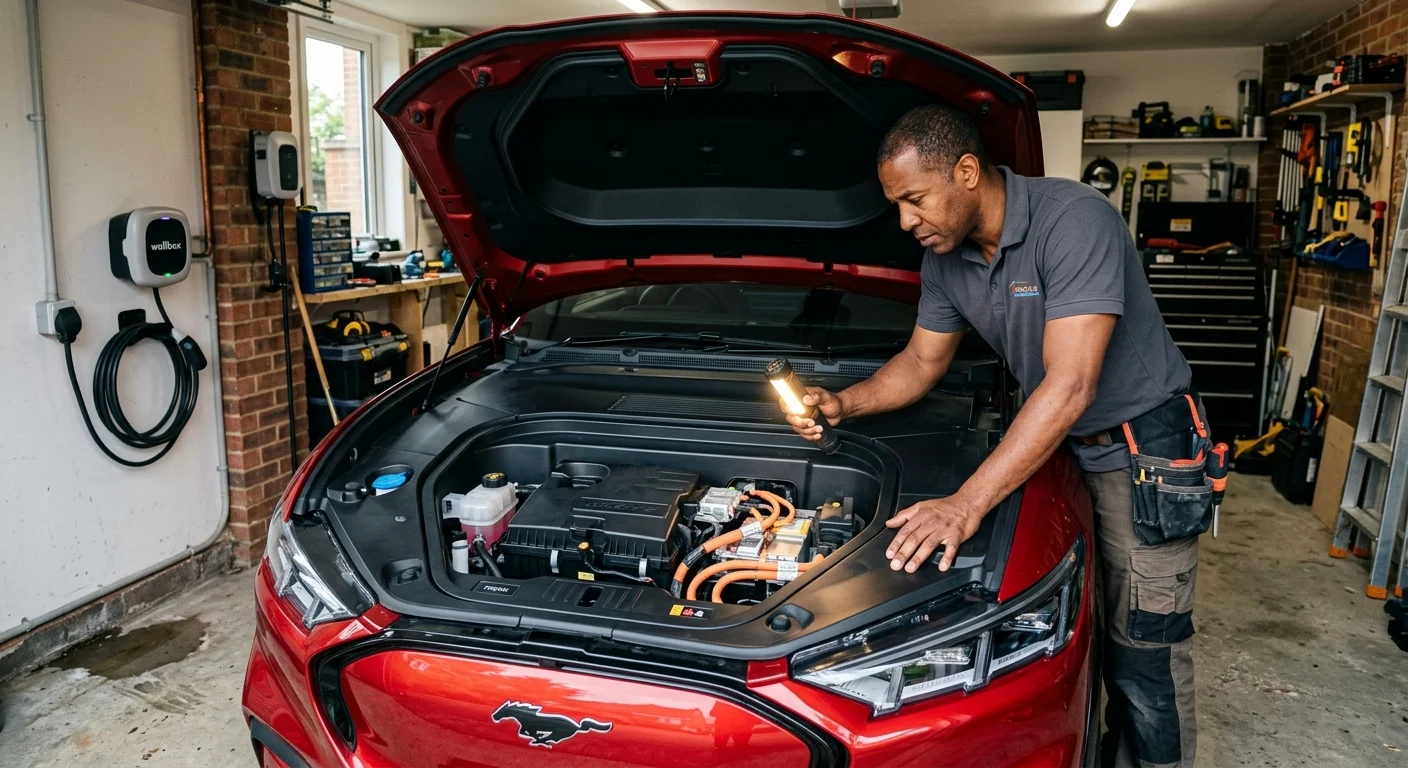
Why a cold curb night hits the 12V first
The Mach-E still uses a small 12-volt battery, like a gas car. That battery wakes the computers, locks, screens, and contactors. Contactors are the switches that connect the drive pack. If the 12V’s flat, a full pack still won’t move you. Street parking is the usual pattern in the East Bay core too. Berkeley’s pre-1980 share is 80.8% on that same Census table. San Bruno’s is 81.9%, and Pacifica’s is 81.1%. Those read as curb-and-apartment cities, not garage-first suburbs.
Coastal nights stay cool here even in midsummer. NWS 1961-1990 normals put San Francisco’s July average high at 71.5F. September sits at 73.1F at the same station. The inland valleys run a genuinely different summer climate. Livermore’s July high is 89.7F, and Antioch’s is 90.4F. A Mach-E on a foggy Daly City block isn’t living a Tri-Valley night. Accessory drain plus cool air is a 12V stall. It isn’t proof the drive pack is empty.
Read the car before you assume the pack is empty
A dead 12V and a low drive pack feel different. Learn that split before you call anyone for help. If nothing lights up, you’re looking at 12V. A blank screen, a silent fob, and dead handles point the same way. You might get a faint click or a flicker, then nothing. That’s still the small battery, not the pack. A low pack usually lets the car wake first. You’ll see a charge warning, and Drive may refuse to engage. Restricted power with a living screen is a pack story. A brick with no screen is a 12V story. We’ve got a longer walkthrough of what happens when an EV 12-volt battery dies.
Messages that show up, and what they usually mean
If the screen still works, read it before you guess. “System Off to Save Battery” is a weak 12V plea. A shutdown countdown is the same warning in other words. “Key fob not detected” can be a dead coin cell. It can also mean the car’s receiver is starved. Swap the fob battery first, then try the fob again. “Stop Safely Now” is a harder system fault. Treat it as a high-voltage or safety problem. Don’t keep cycling power on a busy street. “Service Vehicle Soon” is only a catch-all light. It rarely explains a total no-start by itself. No screen at all is the textbook dead 12V. The car can’t even draw a warning on the screen.
Ford Lightning owners hit the same 12V stall. The checks overlap with what to try when a Lightning won’t start.
What to try on the curb before you open the frunk
Stay with the car if the screens are already dark. A dark Mach-E often can’t start a charge session anyway. Try the fob from a few feet, then the backup key path. Your owner’s manual shows that backup key path. Check that a door didn’t sit ajar all night. Interior lights will drain a 12V on a curb. After a long SFO stay, the same no-wake pattern shows up. Airport lots don’t publish a playbook for a car that sat a week. Confirm current parking rules on the airport site. SFO has an EV charging page, but we couldn’t verify stall details. OAK and SJC parking pages listed lots and cell-phone waiting. They didn’t show EV charging on the pages we read.
If you’re on a freeway shoulder, different rules apply. CVC 21718 lets you stop when the car is disabled and help’s already been summoned. CVC 22651(f) allows removal after four hours on a full-access-control freeway. That’s if the car can’t move under its own power. Dial 511 and say “Freeway Assist” during FSP hours. FSP hours are Monday to Friday, 6 to 10 AM and 3 to 7 PM. You can confirm those hours on the 511 website before you call. MTC’s FSP page lists gas, jump-starts, and radiator refills. It doesn’t mention electric vehicles or an empty pack. Outside those hours, CHP Rotation Tow assigns the truck. You don’t pick the company on that rotation. Caltrans District 4 covers the nine Bay Area counties.
Find the 12V, then use the jump points Ford gave you
The Mach-E’s 12V sits under the hood, in the frunk. Ford hides it under a passenger-side plastic cover. Open the frunk with the fob if the 12V still has enough life. If the frunk won’t open, stop forcing panels. That’s a job for a tech, not a screwdriver.
If you can get in, look for the jump terminals first. There’s usually a positive post under a red cap. The negative is a nearby chassis ground, often a bare bolt. Those posts are the clamp points you should use. You’re waking the 12V, not feeding the drive pack.
A multimeter helps if you already carry one. Set it to DC volts on a low range. A resting 12V near 12.6V is in good shape. Under 12V, especially near 11.5V, it’s discharged or failing. A jump can still wake a discharged battery. If it dies again overnight, plan on a replacement. Confirm the exact terminal layout in your owner’s manual before you clamp anything.
Jump the 12V only, then keep the car awake
You need a jump pack or another 12V vehicle, plus cables. Keep both vehicles off while you connect the cables. Red goes to the Mach-E’s positive jump post. The black clamp goes to the Mach-E’s marked ground. Then the red clamp goes to the donor positive. The black clamp goes to the donor ground last. Let the donor run a few minutes, or switch the pack on. Try to wake the Mach-E after that wait. Disconnect in reverse order, black off the donor first.
Once it wakes, keep the systems on for a while. Drive if it’s safe to leave the curb. Or plug in so the DC-DC can refill the 12V from the pack. A jump is a wake-up, not a repair. The same overnight 12V death shows up on Teslas after a long park. That’s a different brand and the same curb pattern. See how to jump an EV on the 12V only for a slower clamp walkthrough.
Don’t jump a gas car from this EV. Don’t clamp any orange high-voltage gear you see. If you’re not sure which post is which, wait for an operator.
If the car woke but still won’t take you home
If the car wakes and then refuses to move, look at the pack gauge. A living screen with a zero-mile warning is a charge problem. Operators the network sends can bring a 240V Level 2 source. They use a CCS or J1772 adapter on a non-Tesla like yours. That typically adds 10 to 20 miles in 15 to 30 minutes of charging. That’s charging time, and never an arrival time. A non-Tesla EV rescue is the page for that path.
If the charge port is stuck, that’s a different job. Start with how to free a Mach-E charge cable.
Private lots follow their own posted tow rules. CVC 22658 requires a posted sign, 17 by 22 inches, with one-inch lettering. The operator has to notify law enforcement within an hour. California doesn’t cap ordinary consensual tow rates statewide. CHP sets the rates for its rotation vendors. Everyone else sets their own, unless a local ordinance says otherwise. Confirm the posted notice on the sign before you argue on the curb. San Francisco’s SFMTA contractor is TEGSCO, LLC, also called AutoReturn. Published tow pages on sfmta.com showed no effective date we could confirm. Check the current SFMTA page before you pay.
If you stall on a bridge approach, stay with the car. The Bay Bridge tolls westbound only, with all-electronic collection. We found no published policy for a disabled vehicle on a bridge. Confirm current directions with 511 SF Bay or Caltrans QuickMap.
BART park-and-ride Level 2 exists at Warm Springs / South Fremont with 42 plugs. Lafayette’s BART lot has 4 Level 2 plugs. Don’t treat those as a promise they’ll be open. Confirm the stall on bart.gov before you count on it.
Who actually comes, and who to call
Charge Pro SF is a referral line for the Bay Area. It matches you with independent local mobile rescue operators. It doesn’t own trucks or send its own staff. The operator quotes you before work starts, and bills you directly.
Street-parked cars in Daly City and San Francisco are the usual Mach-E call. The Peninsula’s older housing stock looks the same. San Mateo’s pre-1980 housing share is 72.0% on the Census table. Burlingame’s share is 80.2% on that same table. South Bay stock is newer in some cities. Milpitas is 39.0% pre-1980, and Gilroy is 36.0%. The 12V still dies after a cold night in a driveway. It just happens on the curb more often in the older cities.
PG&E still delivers the wires in most of these cities. CleanPowerSF, Peninsula Clean Energy, and Ava Community Energy supply generation. The outage number is still PG&E where PG&E owns the poles.
If you’ve tried the fob, the frunk, and a careful 12V jump, stop there. Don’t keep cycling a car that won’t wake. Call (415) 630-6268 and we’ll connect you with a local operator.