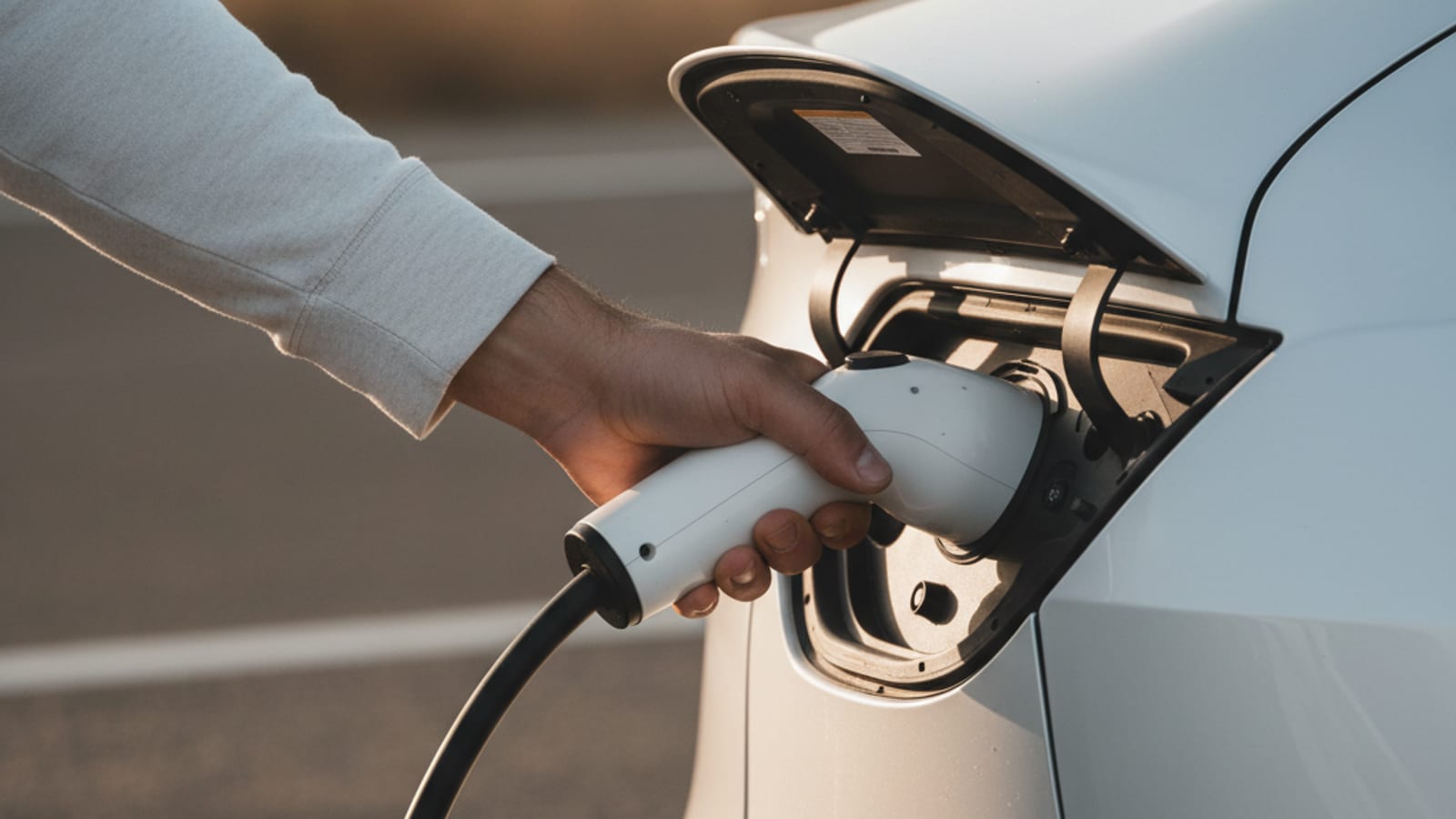
The connector won’t come out, even though charging looks finished. In the Bay Area that usually starts at a shared apartment stall. It’s less often a Supercharger island. The car still has the cable locked. Don’t yank it. End the session on the screen first. Wake the 12-volt system next. Then pull the manual release if the latch still holds.
Shared stalls in older Bay Area housing
Census ACS 2019-2023 housing age is the local pattern. San Francisco’s stock is 77.2 percent pre-1980. Daly City is 78.7 percent. San Bruno is 81.9 percent. Oakland is 77.9 percent. Berkeley is 80.8 percent. Dublin’s pre-1980 share is 21.0 percent. San Ramon is 23.8 percent. That pre-1980 share is the Census proxy for older, apartment-heavy buildings. Those garages often use assigned Level 2 posts. The cable or wall unit is shared, and you don’t own it.
Peninsula Clean Energy’s EV Ready Program covers multifamily charging in San Mateo County, including Daly City. CleanPowerSF runs EV Charge SF in San Francisco. San Jose Clean Energy publishes a Multifamily EV Charger Assistance Program. MCE’s Charge Up Contra Costa is a multifamily and workplace Level 2 rebate. Those pages don’t walk you through a stuck handle.
A Supercharger uses the same solenoid. The difference is a queue of cars, not a neighbor who needs the stall.
BART park-and-ride Level 2 sites use the same release steps if a handle sticks. bart.gov lists charging at Warm Springs / South Fremont with 42 plugs. Lafayette has 4 plugs. Confirm the current kWh price on bart.gov before you pay.
End the charge in software first
Ports lock for two plain reasons. A live DC or high-power AC pin shouldn’t come free mid-session. A home cable anyone can pull is an easy theft of your charging time.
The lock is a small solenoid. It retracts when the car commands release and has 12-volt power to move. If the session never closed, the command never comes.
On the center screen, stop charging. Wait for the car to confirm the session has ended. Then press the button on the handle. A paused session keeps the latch shut even when the post looks idle.
If a public post shows connected and the percent isn’t moving, stop. Treat it as a stuck session. Don’t assume the pin is broken. Use the connected but not charging checks first.
Get the car fully awake
A sleeping EV can ignore a release. Open and close the driver’s door. Let the displays come up. Try the handle again.
Then reboot if it still holds.
On a Tesla, hold both steering-wheel scroll wheels for ten seconds. On a Rivian, hold the cruise stalk down for ten seconds. On most other brands, hold the start button until the car restarts. Stop charging once more after the reboot. Retry the handle.
When the 12-volt battery is the real fault
The traction pack can still show range while the 12-volt battery is fading. The solenoid needs that small battery. A weak 12-volt can show unlocked on the screen while the pin stays home.
Dim lights, slow door handles, and a low-voltage warning are the tell. Jump the 12-volt, then send the release again. Stay on the 12-volt-only jump path so you don’t treat this like a gas-car jump.
Charge Pro SF connects you with independent local operators. Those operators can jump or replace that 12-volt on site. They can also bring a 240-volt Level 2 source to the car. That’s a native NACS plug, plus CCS or J1772 adapters for non-Tesla EVs. They typically add 10 to 20 miles of range in 15 to 30 minutes of charging. That window is charge time, never an arrival time. The operator quotes you before starting and bills you directly.
Manual release by where you stand
Makers know the electric latch fails. There’s a mechanical backup on every major model. Hold the release and ease the connector out at the same time.
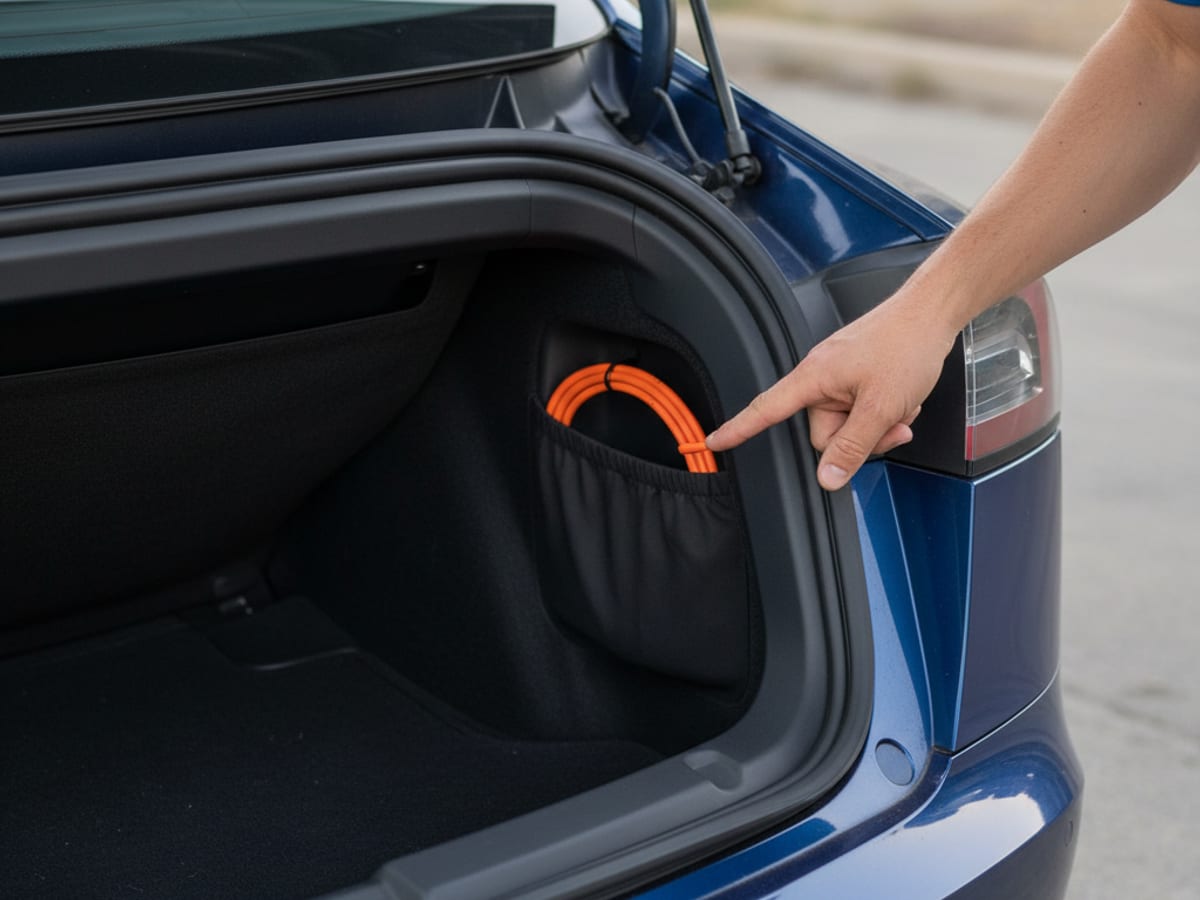
Tesla, VW, Polestar, and Bolt: trunk or hatch
For a Model 3 or Model Y, open the trunk. On the passenger side, peel the carpeted inner wall. Remove the small access panel. Pull the cable downward and hold it. Keep that tension while the handle comes free.
For a Model S or Model X, open the rear hatch. On older cars the cable sits on the driver’s side, behind the taillight trim. On 2021 and newer refresh S and X, look on the passenger-side trunk trim. That layout is closer to the 3 and Y.
On an ID.4, look for a labeled pull loop in the trunk. It’s on the passenger side, behind C-pillar trim. Lift the cargo cover to see it.
A Polestar 2 hides a cord near the driver’s-side tailgate hinge, behind a small trim panel.
On a Chevrolet Bolt, the cord sits under the rear cargo floor, next to the 12-volt area. Pull the cord and the handle together.
Rivian: under the rear seat
Open the rear passenger-side door. Lift the seat bottom. The service panel hides the cord. Pull it firmly. The full R1T and R1S sequence is in the Rivian stuck-cable guide.
Ford: a tab on the port
Lightning and Mach-E hide a small triangular unlock tab on the port housing. Open the charge-port door. Pull the tab away from the housing while you pull the cable. FordPass can send a release on a Lightning if the 12-volt still has life. Frozen cables and a dead 12-volt on the Mach-E are in the Mustang Mach-E charge-port steps.
Hyundai and Kia: cargo-wall button
Ioniq 5, EV6, and EV9 put a button under a plastic cover. It’s on the driver’s-side cargo sidewall. Press and hold it as you pull the connector. The Ioniq 5 sequence is in the Ioniq 5 charge-port release steps.
Cable latch versus a failed solenoid
Older Tesla Mobile Connector handles can fail to press the inner latch far enough. Some Supercharger cables have the same tired button. Swap to another cable if you can. If the next stall’s handle releases, your car is fine.
A seized solenoid is rarer. Don’t keep hauling on it. That’s a service job.
When the release moves and the handle still won’t
Make sure the car is awake. Pull the manual release again. Wiggle the connector gently side to side while you hold tension. The latch lip can hang on the handle.
Reboot one more time. Software sometimes drops the lock after a reset.
Then stop. If you tear the solenoid, you’ve turned a stuck session into a port replacement. Leave the cable in place. Don’t pry. Don’t cut the handle.
Read any private-property towing sign in the garage. CVC 22658 requires a sign at least 17 by 22 inches, with one-inch lettering. It has to name the tow company and the enforcement number. The operator must notify law enforcement within one hour. California doesn’t cap ordinary private tow rates statewide. Confirm the posted notice. Don’t assume a deadline that isn’t on the wall.
A Supercharger queue isn’t the freeway four-hour clock. CVC 22651(f) applies on a full-access-control freeway after four hours. That’s if the car can’t move under its own power. A garage stall is a different rule set.
If you’re already disabled on a freeway, CVC 21718 allows the stop. Help has to have been summoned. Freeway Service Patrol hours are Monday to Friday, 6 to 10 AM and 3 to 7 PM. That listing is on 511.org, read 2026-09-18. Dial 511 and say “Freeway Assist,” or use a call box. MTC’s FSP page lists gas, jump-starts, and radiator refills. It doesn’t mention electric vehicles or a stuck charge cable. That page was read on mtc.ca.gov on 2026-09-18. After those hours, CHP Rotation Tow assigns the vendor. You don’t pick the company.
Once the cable is out
Run a full charge at a quiet stall. A clean end-and-release usually means the session had glitched. A second failure means the solenoid needs a shop.
If a 12-volt jump was required to free the handle, replace that 12-volt soon. The latch was the warning.
Tesla coverage for this metro is on Tesla roadside rescue. Other brands are on non-Tesla EV rescue.
Call (415) 630-6268 if the manual release moved and the cable still won’t come out. Use that number if the car is too dead to reach the panel. Use it if a broken handle is holding the stall. Charge Pro SF is a referral line. It matches stranded EV drivers with independent local mobile rescue operators. It doesn’t perform the work, own trucks, or set prices. The operator quotes before starting and bills you directly.