When an EV is already stopped, EV charging levels aren’t a classroom chart. The level that helps is 240V Level 2, brought to the bumper. A DC stall only helps if the car can still roll there. Operators we connect you with carry that 240V source, not a Supercharger cabinet.
Charging levels that move a car that’s already stopped
A charging-level label is voltage and current. It isn’t a rescue plan. Level 1 is 120V AC from an ordinary outlet. Level 2 is 240V AC, the same class as a dryer circuit. DC fast charging is a separate system. It’s usually locked to a public stall.
The Department of Energy publishes the public charging-level specs. Most charts copy the Alternative Fuels Data Center. Level 1 sits near 1.9 kW on a J1772 connector. Level 2 runs from about 2.9 kW to 19.2 kW. Home Level 2 often sits near 7.2 kW. DC hardware can be rated as high as 500 kW. Those numbers are equipment ceilings. Your car still decides the session. Pack state and air temperature do too.
What a stranded driver needs is usable range here. A planning figure of about 25 miles per charging hour isn’t a promise. It can fail in Livermore heat. It can also fail on a cool San Francisco July. The 1961-1990 NWS normal high at SFO is 71.5F. Livermore’s July normal is 89.7F. See home 240-volt charging versus a roadside 240-volt rescue. That’s the split.
120-volt Level 1, and why it rarely saves you
Level 1 uses 120 volts. That’s the outlet in a kitchen or a garage. The Department of Energy lists about five miles of range per hour. Eight hours might add about 40 miles on a midsize EV. Pack size, emptiness, and heat all move those results.
Read what a Level 1 EV charger is before you cut it close. Once you’re on a shoulder, a random outlet isn’t a plan. The circuit may be shared or too light. A plug that fits still isn’t an approved circuit.
Older housing makes home Level 1 common and roadside Level 1 useless. Census ACS 2019-2023 figures put 77.2% of San Francisco housing before 1980. Berkeley is 80.8%, and Oakland is 77.9%. A lot of that stock never got a 240V EV circuit. Brentwood is only 10.9% pre-1980, and Dublin is 21.0%. Newer homes are more likely to have wall charging. That still doesn’t feed a car that’s already empty on SR-4.
If you’re parked legally, Level 1 can add a short hop overnight. It won’t refill you in a commute window. Don’t treat an untested garage outlet as a rescue.
240-volt Level 2 at the bumper
Level 2 is 240V at a house. Many commercial buildings supply 208V instead. Most non-Tesla cars still use J1772 for AC. Tesla uses NACS, also called J3400. Some newer non-Tesla models take NACS too. Confirm the port on your car. Don’t trust a year-old chart.
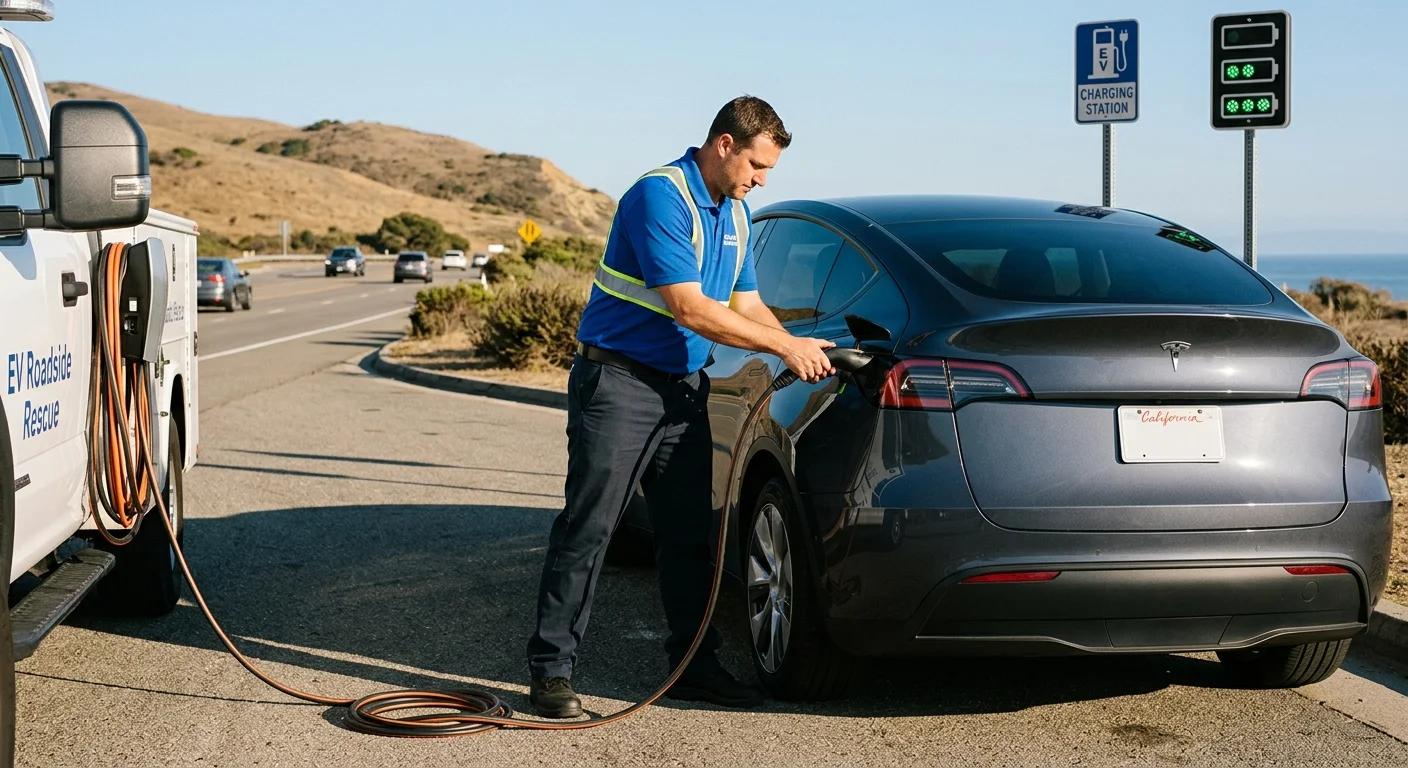
This is the level that actually arrives at a stranded car here. Independent operators we match bring a 240V Level 2 source to the vehicle. Tesla cars get a native NACS plug. Other EVs get a CCS or J1772 adapter. A typical session adds 10 to 20 miles of range. That happens in 15 to 30 minutes of charging. That’s charging time. It isn’t a clock for when someone shows up.
The usual goal isn’t a full battery. It’s enough range to reach a compatible post, or to get home. bart.gov lists Level 2 charging at Warm Springs / South Fremont with 42 plugs. Lafayette has 4 plugs. Caltrain doesn’t publish park-and-ride EV charging. We couldn’t read SFO’s charging page in this pass. Confirm airport stalls in a browser before you count on them.
Ask the operator to confirm the method, the plug, and the quote. That happens before work starts. The operator bills you directly. Charge Pro SF doesn’t set that price.
Request mobile EV charging when the traction battery is empty. The car also has to take that 240V feed. The operator still has to see the scene. A tight garage can block the cable. A live lane can end the plan.
DC fast charging you still have to reach
Drivers often call this Level 3. The stall supplies DC, not AC. Public posts use CCS and NACS. Some older cars still use CHAdeMO. Tesla Superchargers sit in this group. The Department of Energy lists equipment ratings up to 500 kW. Some cars add about 100 miles in 30 minutes. Your battery management sets the real rate.
None of that power rides with the rescue operator. A mobile unit here isn’t a DC cabinet on wheels. If the pack is already at zero, you can’t roll to the stall. The useful move is Level 2 at the car.
A full or down Supercharger is a separate mess. That’s covered in need a rapid charger near you, or a truck that comes over. Don’t assume the next map icon takes your plug.
How Bay Area places change the same voltage
The Bay Area isn’t one climate or one housing stock. July normals from 1961-1990 put San Jose near 82F. Gilroy is 88.3F. Antioch is 90.4F. Oakland Airport sits at 70.4F. Inland heat raises cabin load. It can also slow how much power the pack will accept. A Pacifica call and an Antioch call can share 240V. They’re still not the same job.
Newer Tri-Valley stock is more likely to have a wall charger. Dublin is 21.0% pre-1980. San Ramon is 23.8%. That wall unit still can’t reach a dead car on US-101. The 240V has to come to the bumper.
PG&E is the wires company almost everywhere. Generation may come from a community choice aggregator. That can be CleanPowerSF, Peninsula Clean Energy, or Silicon Valley Clean Energy. San Jose Clean Energy and Ava Community Energy cover San Jose and most of Alameda County. MCE covers many Contra Costa cities. Santa Clara, Palo Alto, and Alameda run municipal utilities instead. Those names matter for a home rebate later. They don’t pick the voltage on the shoulder. Don’t take bill advice from a rescue page. Confirm any rate with the provider that serves the meter. Antioch and Brentwood sit on bundled PG&E generation. We found no CCA on the member lists we could verify.
Connectors, adapters, and a dead 12-volt
J1772 is the common AC plug on Level 1 and Level 2. Many brands still use it. NACS is Tesla’s AC and DC port, and it’s spreading. CCS adds DC contacts beside an AC inlet. CHAdeMO is the older DC plug on some Nissan cars.
A familiar shape isn’t a match by itself. Tell the operator the make, model, and year. Say what the dash shows. Name the port if you know it. Tesla and every major EV brand can show up. The adapter still has to fit that car.
Sometimes the pack isn’t empty. A dead 12V battery can open the contactors. The car then looks bricked. Operators we connect you with can jump or replace that 12V on site. If the high-voltage pack is truly at zero, you need energy, not a jump. Use out-of-charge recovery for the empty-pack case. Don’t guess from a charging-level poster.
Freeway rules that sit next to the charging choice
If you’re stopped on a full-access freeway, California Vehicle Code 21718 is the rule. Stopping is prohibited except in limited cases. California Vehicle Code 22651(f) allows removal after more than four hours. That applies if the car can’t move under its own power.
The Freeway Service Patrol is an MTC, CHP, and Caltrans partnership. Published hours are Monday to Friday, 6 to 10 AM and 3 to 7 PM. Dial 511 and say Freeway Assist. MTC’s page lists gas, jump-starts, and radiator refills. It doesn’t mention electric vehicles or out-of-charge help. We couldn’t confirm an EV charge from FSP. Outside those hours, CHP Rotation Tow assigns a vendor. None of that gear is a 240V Level 2 plant.
What to say when you request a mobile session
Start with the vehicle, not the map pin. Name the brand, the port, and what the dash shows. Give a precise local location. Westbound I-80 in Richmond isn’t El Camino in Redwood City. The I-580 climb near Livermore isn’t a campus garage in Palo Alto. If the car is a hazard, call emergency services first. Don’t walk leads across traffic.
Charge Pro SF is a referral line. We don’t hold a contractor license, own trucks, or employ technicians. We match you with independent local operators across the Bay Area. They quote before they start and bill you. For city pages, start at EV charging in the Bay Area. For the truck, see what’s an EV charging truck, and who actually bills you.
Call Charge Pro SF at (415) 630-6268 for a mobile Level 2 session or a 12V wake-up. We’ll connect you. The operator confirms fit, quotes the work, and bills you directly.