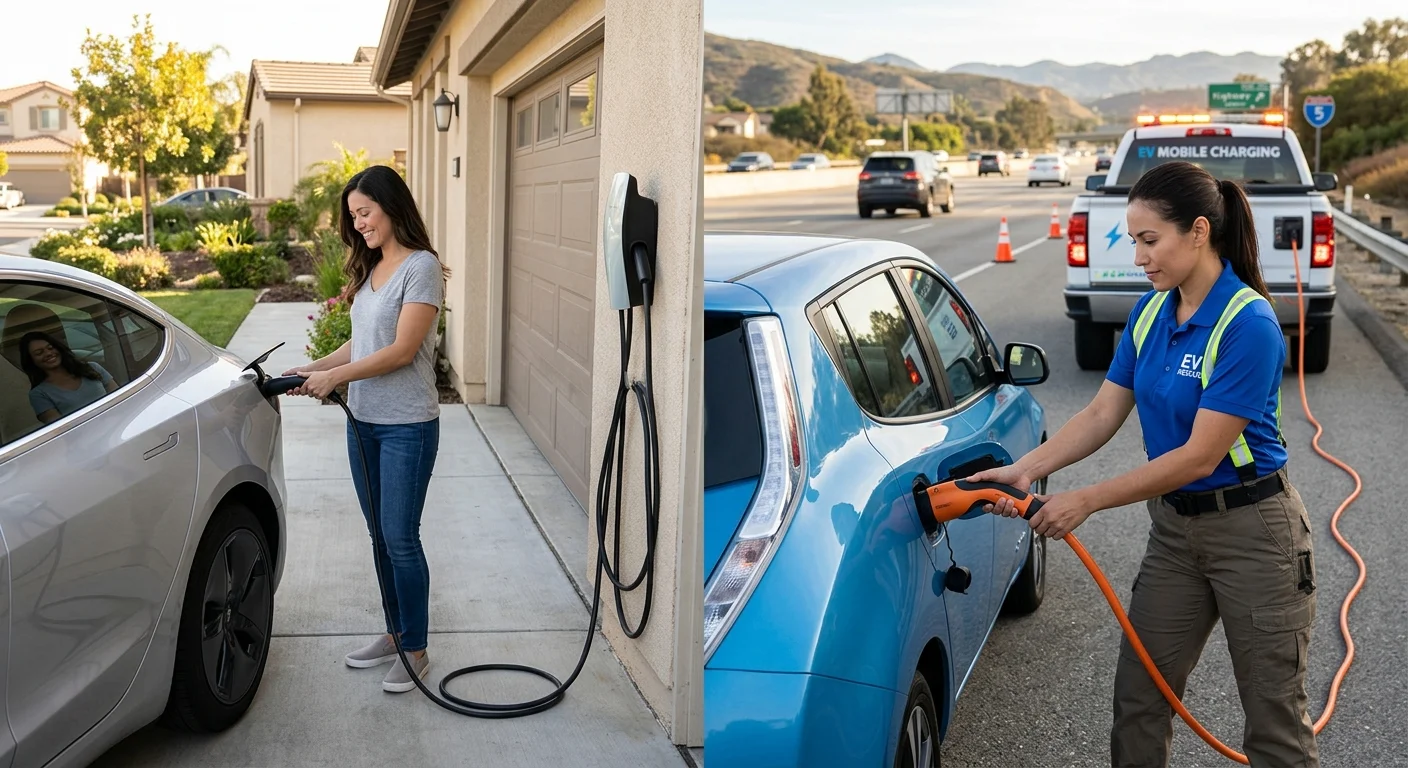
A 240 volt EV charging station is a home Level 2 setup that stays on the building. It doesn’t travel with the car, and that split is the whole search. In San Francisco, a lot of drivers park on the street. They live in older buildings with no dedicated 240-volt circuit at the curb. The wall unit in those search results can’t help a pack that’s already empty on a city street or a freeway shoulder. You need a roadside 240-volt rescue from an independent operator, not a garage install you don’t have.
Two jobs that share a voltage
The US Department of Energy describes Level 2 as 240-volt service in homes. Some commercial sites run at 208 volts. Voltage alone doesn’t set the charging rate. Circuit amperage and what the car will accept still decide the speed.
A home station is planned charging on a property you control. You have a regular parking space and time to sit. A licensed electrician checks panel capacity before anything is wired. A roadside 240-volt rescue is the other job. The car can’t reach a usable post. An operator brings a 240V Level 2 source to that stop.
Level 1 uses a regular 120-volt household outlet. It’s slower than Level 2. Our guide to what a Level 1 charger is covers that option. An outlet still has to match the cord and the building. A dryer receptacle isn’t a charging plan. A licensed electrician has to say the circuit is safe.
Why San Francisco housing makes home 240 volts hard
Census ACS 2019-2023 data puts 77.2% of San Francisco housing in structures from 1979 or earlier. That share is a proxy for older panels and plug-less stock. Daly City is 78.7% pre-1980, Oakland is 77.9%, and Berkeley is 80.8%. Those places share dense, older housing. Street parking is how many EV owners live there day to day.
The Tri-Valley and East Contra Costa picture is different. Brentwood’s pre-1980 share is 10.9%. Dublin is 21.0% and San Ramon is 23.8%. Newer tracts more often have garages and spare panel room. A Pleasanton or Cupertino driveway isn’t the same problem as a curb in San Francisco or Richmond. Swap the city and the electrical facts change. That’s why this page is built around Bay Area housing, not a generic voltage explainer.
Charge Pro SF doesn’t install wall chargers. We don’t own a yard, a fleet, or parts. We connect stranded drivers with licensed, independent local operators. A panel project later doesn’t move a car that’s already empty. If you’re mixing those jobs, read Berkeley panel upgrades versus an EV that’s already empty.
If you have a garage, start with the utility
San Francisco delivery is PG&E, with generation often from CleanPowerSF. San Mateo County cities use Peninsula Clean Energy on PG&E wires. Palo Alto, Santa Clara, and Alameda run municipal utilities. Don’t copy a neighbor’s rebate form.
PG&E publishes residential EV rate names: Home Charging EV2-A, Electric Vehicle EV-B, and Electric Home E-ELEC. CleanPowerSF lists EV Charge SF and the Driving Clean Assistance Program. Peninsula Clean Energy lists an EV Incentives Program. No single verified dollar figure for hardware or rates turned up for this page. Ask the utility that bills you before you budget a station.
No verified San Francisco EV charger permit bulletin turned up in the sources used here. The city or county that issues electrical permits for that address sets the current path. Confirm the forms with that office before anyone pulls a permit. You can check an electrical contractor on the Contractors State License Board lookup.
A 240-volt outlet on the wall still isn’t enough. Breaker size, wire, and household load have to fit the proposed charger. Charge Pro SF doesn’t inspect panels and doesn’t pull permits.
What a roadside 240-volt rescue actually is
Operators we connect you with bring a 240V Level 2 source to the car. Teslas take a native NACS plug, and other EVs use a CCS or J1772 adapter. The typical add is 10 to 20 miles of range in 15 to 30 minutes of charging. It isn’t an arrival time. The operator quotes you before work starts. The operator bills you directly.
Our mobile EV charging page is the referral path for that visit. For the truck itself, see how a mobile EV charging truck works. When you’re already stuck, charging levels for a stranded driver explains which level can actually help.
A home wall unit can’t follow you onto US-101, I-80, I-880, or the Bay Bridge approach. California Vehicle Code 21718 generally bans stopping on a freeway. A disabled vehicle is an exception when another vehicle has been summoned to assist. CVC 22651(f) allows removal after more than four hours on a full-access-control freeway if the car can’t move under its own power. Stay with the vehicle if you can do that safely. Don’t walk off looking for a building outlet.
The Freeway Service Patrol is a partnership of MTC, CHP, and Caltrans. Hours on 511.org are Monday to Friday, 6 to 10 AM and 3 to 7 PM. Dial 511 and say “Freeway Assist.” The MTC FSP page lists gas, jump-starts, and radiator refills. It doesn’t mention electric vehicles or out-of-charge help. Outside those hours, the CHP Rotation Tow Program is the highway path.
Coast weather isn’t inland weather
A home charge in the city doesn’t lock the same range inland. WRCC 1961-1990 normals put San Francisco’s July average max at 71.5F. Livermore’s July average max is 89.7F. Antioch is 90.4F. Gilroy is 88.3F. San Jose is about 82F. The inland heat gap over the coast is real and large. A pack that felt fine leaving San Francisco can sag on I-580 toward Livermore or on SR-4 toward the Delta. Treat the next fixed charger as a live check. Don’t treat a home 240-volt fill as a promise for the return trip.
Confirm the car, the plug, and the stop
Start with make, model, and year. Then read the owner’s manual for compatible charging. Don’t pick an adapter by the handle shape.
Tell the operator the remaining percent, any screen warning, and whether the car will shift or steer. Say whether you’re on a city street, a driveway, or a freeway shoulder. A San Francisco curb is a different access problem from a shoulder on I-880 in Hayward. Our San Francisco EV roadside guide covers city-street stalls.
A dead 12-volt battery can look like an empty pack. The car may not wake, unlock, or take a charge. Jumping or replacing the 12V on site is a different job from adding traction-battery miles. Don’t assume 240 volts will clear a fault. Smoke, fire, or a crash is a 911 call first.
When a wall outlet can’t save the stop
A receptacle at a shop or apartment only helps if you can reach it legally and the owner allows it. A familiar plug face isn’t permission. A home station on another property can’t serve a car that’s already somewhere else.
If you’re parked at home and the wall unit failed, call an electrician or the charger vendor. That isn’t automatically a roadside case. If you’re away from home and can’t reach a usable post, out-of-charge recovery is the path to discuss with the operator.
Public charging still needs enough remaining energy to arrive, a matching connector, and an open stall. Confirm the site on the network’s current map. This page doesn’t estimate how far the next post is. That distance couldn’t be verified as a single figure.
Ask the operator before anyone plugs in
Mobile charging fits when the traction battery will accept compatible power where you sit. The goal is enough miles to reach a fixed charger you choose. The matched operator assesses access, the plug, and the surroundings. Transport may be better when the car won’t take power, or when the stop can’t host a rescue rig.
Charge Pro SF doesn’t set prices, warranties, or a countywide rate. Those terms couldn’t be confirmed as one Bay Area figure. The provider and the stop determine them. Ask what equipment will be used, what miles or movement to expect, and what you’ll pay. Get that quote before work starts.
When to call us
Call when the car can’t reach a usable charger and you need an independent operator to assess a mobile charge or a tow. Charge Pro SF matches stranded EV drivers with licensed, insured local rescue operators across the Bay Area. Call (415) 630-6268 and we’ll connect you with a local EV rescue operator.