The truck on the I-880 shoulder isn’t the company you called. In the Bay Area, an EV charging truck is usually an independent operator’s rig. Charge Pro SF is the match, not the crew. The operator quotes the job, then bills you.
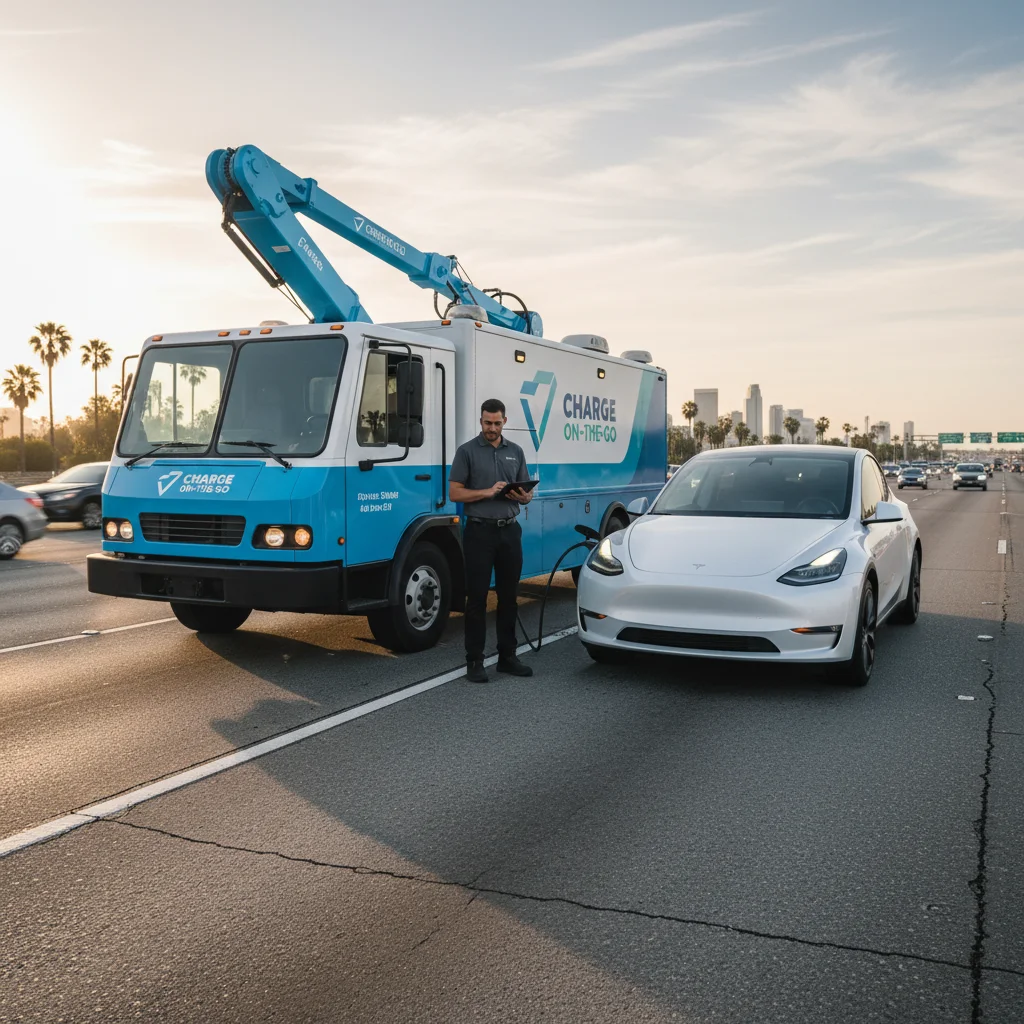
Who bills you when an EV charging truck shows up
Searchers type “ev charging truck” when the pack is already empty. They want a vehicle that brings power to the car. They also want to know who invoices them. Those are two different companies on this line.
Charge Pro SF doesn’t own the truck or employ the technician. It doesn’t set the price on the session. It matches a stranded driver with a local mobile rescue operator. The operator talks to you before any cable goes in. You hear the quote and you accept or you don’t. If you accept, that operator bills you directly.
That split matters on a Bay Area roadside. Tesla roadside, an insurer, and a referral line can all take a call. Only the person who charges the car should send the invoice. Ask for the quote before the session starts.
What the truck is doing, in plain terms
An EV charging truck is a van or truck with a 240V Level 2 source. The operator parks beside your car and plugs in. They use a native NACS connector on Tesla and other NACS ports. Non-Tesla EVs get a CCS or J1772 adapter. Power moves from their rig into your high-voltage pack. The goal isn’t a full refill of the pack. It’s enough range to reach a public DC charger, or to get home.
A typical session adds 10 to 20 miles of range. That happens in 15 to 30 minutes of charging. Those minutes are charging time after the operator is already with you. They aren’t a promise of when anyone arrives. Charge Pro SF doesn’t publish an arrival window. The operator also doesn’t promise one through this line.
Many EVs fail on the 12V battery, not the pack. The car looks dead and the screens stay dark. Doors may not wake, and the pack may still have range. Operators who take these jobs can jump or replace a dead 12V on site. Tesla and every major EV brand are in that mix. If the 12V is the problem, a pack charge won’t fix it. Say what the car is doing when you call. The operator can sort pack versus 12V before they quote.
Why a Bay Area stall isn’t one kind of stall
A page that only swapped city names would fail here. Coastal towns, the Peninsula, and San Francisco don’t share inland heat. The East Bay and the South Bay run hotter in July. Grades, housing stock, and bridge approaches all change the stall.
San Francisco’s July average high is 71.5F on 1961-1990 normals. Oakland Airport sits near 70.4F in July. San Jose is about 82F on that same vintage. Livermore’s July average high is 89.7F. Antioch’s July average high is 90.4F. Gilroy’s July average high is 88.3F. That inland gap over the coast is real and large. A pack that felt fine on a foggy Pacifica morning can drop harder inland. The climb toward Concord and the Altamont is where that shows up.
Housing stock matters long before you stall. About 77.2% of San Francisco’s housing was built before 1980. Daly City’s pre-1980 share is 78.7%. Berkeley’s share of pre-1980 housing is 80.8%. Older buildings often mean street parking and shared lots. A lot of drivers finish the day away from a home Level 2 plug. That’s when a mobile charge is the next step, not a wall install.
Bridges add another local wrinkle for a dead EV. The Bay Bridge tolls westbound only, and it’s all electronic. The Golden Gate Bridge tolls southbound only into San Francisco. No published disabled-vehicle-on-a-bridge policy turned up in this research. If you’re stopped on an approach, stay with the car if that’s safe. Follow CHP and Caltrans direction on the scene. Caltrans District 4 covers the nine Bay Area counties.
Express lanes run on I-80, I-580, I-680, I-880, US-101, and SR-237. FasTrak is required, and weekday hours are generally 5 AM to 8 PM. This research couldn’t confirm whether those lanes sit in the median. Don’t assume a left-shoulder pull is the safe move. Use the published shoulder after you’ve summoned help.
Two ways a rig can make the power
Not every EV charging truck stores energy the same way.
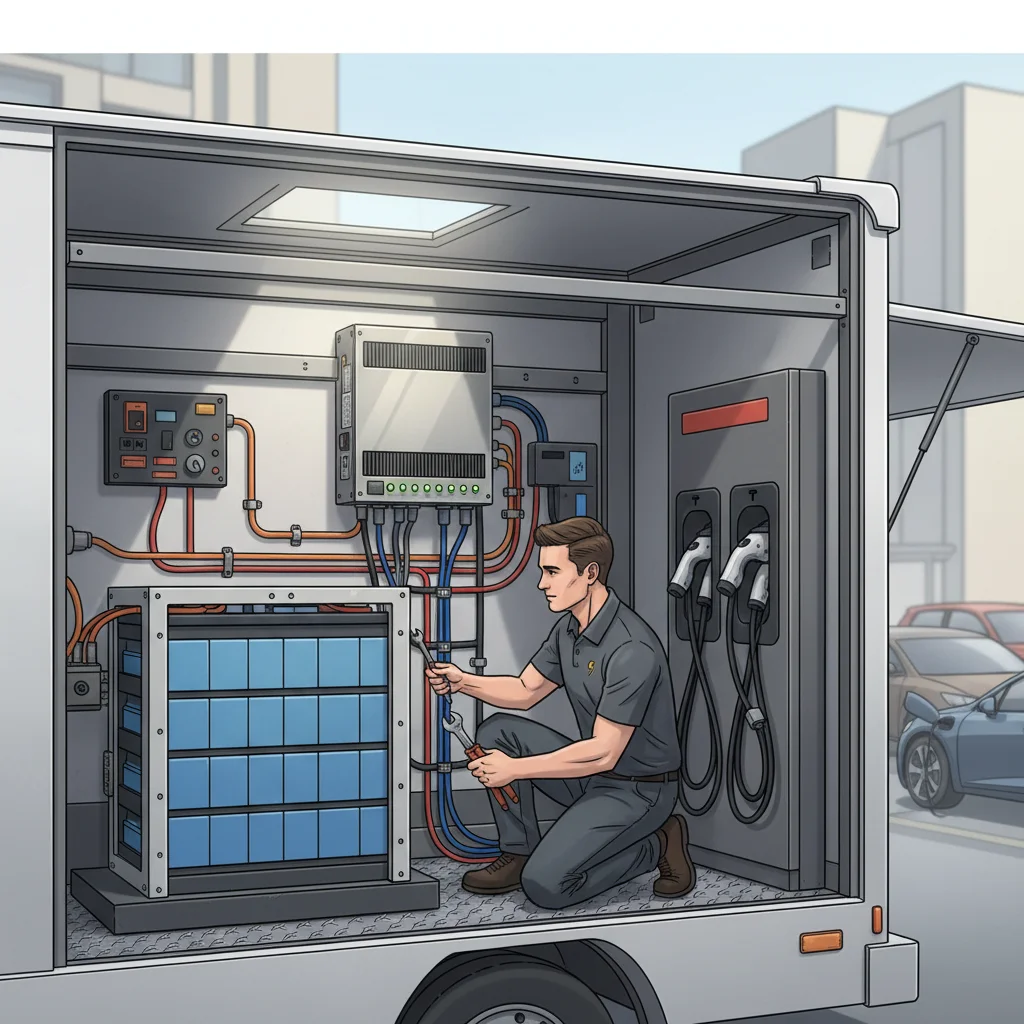
A battery bank on the truck
Some operators carry a separate battery pack on the vehicle. It isn’t the pack that drives the truck. Stored energy is already on board when they roll. They invert it to 240V and feed your car. The session doesn’t need a wall outlet at the stall. Charge Pro SF doesn’t specify which hardware each independent operator brings. Ask the operator what they’re rolling with when they quote.
A generator on the truck
Some older setups run a fuel generator on site. That makes AC power, then conditions it for the car. It’s noisier than a battery-only rig. It also burns fuel to charge an EV. This research doesn’t publish a Bay Area count of battery rigs versus generator rigs. Treat the design as a question for the operator, not a brand promise.
For cables, adapters, and onboard kit, see what’s on a mobile EV rescue rig.
The plug on your car still has to match
Tesla owners usually have a NACS charge port. Many newer Ford, GM, and Rivian models use NACS too. Operators who take mixed-brand jobs bring a native NACS plug. Non-Tesla EVs often need a CCS or J1772 adapter. Say the make and model when you call. That lets the operator confirm they can connect before they quote.
A mobile rescue here is Level 2 at the car, not a Supercharger on wheels. Public DC chargers still do the heavy fill after you can roll. Named BART Level 2 sites include Warm Springs / South Fremont. That Fremont BART lot lists 42 plugs. Lafayette BART lists 4 Level 2 plugs. This research couldn’t read SFO’s charging page. Confirm SFO stalls on flysfo.com before you leave a car there. OAK and SJC parking pages didn’t list EV charging in this fetch. Confirm those airport stalls on iflyoak.com or flysanjose.com.
If you’re already at zero and can’t move, that’s out-of-charge recovery. It isn’t a hunt for a new home charger.
What actually moves the quote
Charge Pro SF doesn’t set prices on these jobs. California also doesn’t cap ordinary private, consensual roadside rates statewide. The operator sets the number you hear. You hear that number before work starts.
Distance to your stall is the first mover. A stall on San Francisco surface streets is one kind of run. A shoulder on I-580 toward Livermore is another. Time of day is the second mover. Overnight, weekends, and peak commute change how far the operator has to come. How much range you need is the third. A short top-off to reach a public DC charger is one session. A longer push over a grade is another.
Ask what’s in the quote before you agree. Charging time on site is one piece of it. Travel to the pin you sent is another. A 12V jump or replacement is a different job than a pack top-off. If the operator can’t reach you, they should say so before you wait. For that conversation in plain words, read what a mobile EV charge quote covers.
Don’t use a tow-fee chart as a proxy. San Francisco’s SFMTA publishes city tow numbers on its own site. Those figures are for tows, not mobile charging. Confirm current tow rules with SFMTA or CHP if a hook is already coming. This page won’t reprint those dollar amounts.
Private-property tows have their own California statute. CVC 22658 requires a posted sign at least 17 by 22 inches. Lettering on that sign must be at least one inch. The sign must name the tow companies and an enforcement number. The operator must notify law enforcement within one hour. Overcharging beyond the approved private-property rate creates liability. That liability is four times the amount charged. Consensual mobile charging isn’t that private-property statute. Still, get the quote on the line before anyone starts.
California Penal Code 632 requires all-party consent to record a confidential call. A referral line may play a recording notice for that reason. Listen for that notice at the start of the call. Don’t assume a quiet line is off the record.
Freeway patrol isn’t a mobile EV charge
If you’re on a Bay Area freeway, the Freeway Service Patrol is a separate program. MTC, CHP, and Caltrans run it with private tow companies on assigned beats. 511.org lists those FSP hours Monday to Friday. The windows are 6 to 10 AM and 3 to 7 PM. Dial 511 and say “Freeway Assist,” or use a call box. MTC says FSP clears crashes and debris on its beats. It also lists a free gallon of gas, jump-starts, and radiator refills. The MTC FSP page, read 2026-09-18, doesn’t mention electric vehicles or out-of-charge help. Don’t count on FSP to fill an empty EV pack.
Outside those hours, CHP’s Rotation Tow Program assigns the tow vendor. You don’t pick the rotation tow company. A rotation tow and a mobile charge are different calls. CVC 21718 generally bans stopping on a freeway. There’s a disabled-vehicle exception when another vehicle has been summoned to assist. CVC 22651(f) allows removal after more than four hours on a full-access-control freeway. That applies if the car can’t move under its own power. Summon help, then stay aware of that clock.
511 SF Bay is the regional traveler line. Caltrans District 4 posts highway conditions for the region. None of those agencies bill you for a Charge Pro SF match. The operator still quotes the charge job to you.
How the call splits on this line
You call and you say where you are. Add what you drive and a number that rings. A cross-street, a freeway exit, or a map pin works. Charge Pro SF matches you to an independent local operator in the Bay Area. That operator contacts you with a quote first. If you agree, they bring the 240V source and the right plug. They bill you when the work is done.
The brand serves cities across the Bay Area. City pages for the match live under EV charging across the Bay Area. For the near-me version of this question, see mobile EV charging near me.
Stay with the car when that’s the safe choice. Put on hazards and stand away from traffic. Tell the operator if you’re on an express lane or a bridge approach. They quote from the facts you give them.
When the pack is empty and you need a 240V truck, call (415) 630-6268. Charge Pro SF will match you to a local operator. That operator quotes you before starting, then bills you directly.