Use a verified rapid charger you can still reach, if the plug matches. If you can’t, Bay Area Freeway Service Patrol won’t fill a dead traction pack. That patrol lists gas, jumps, and radiator refills. A mobile 240-volt charge from an independent operator is the other path.
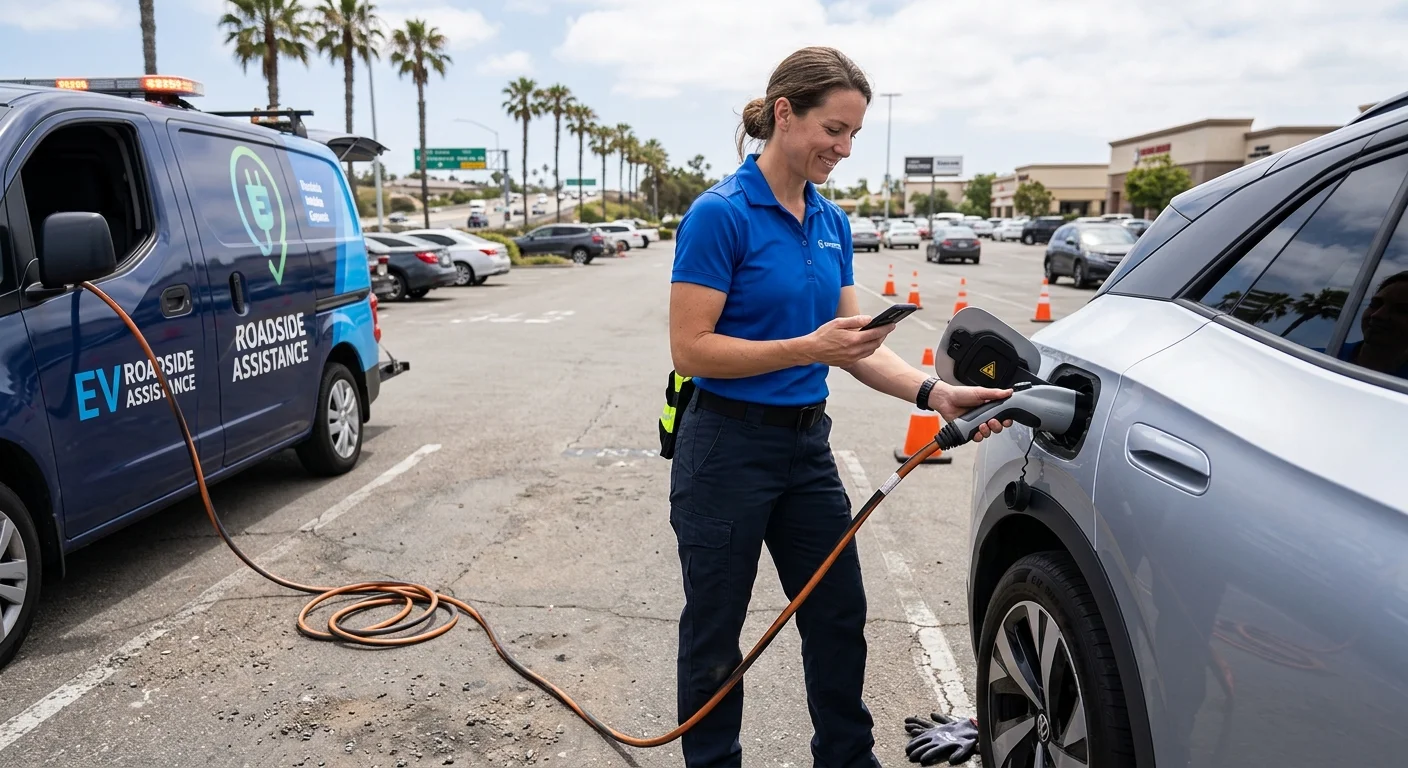
FSP covers gas and jumps, not an empty pack
The Freeway Service Patrol is a partnership of MTC, CHP, and Caltrans. Private tow companies run the beats during posted hours. Hours run Monday to Friday, 6 to 10 AM and 3 to 7 PM, per 511.org. Dial 511 and say “Freeway Assist,” or use a call box.
MTC says the patrol clears crashes and debris. It also gives a free gallon of gas, jump-starts, and radiator refills. MTC reports more than 100,000 incidents a year. The same MTC page, read 18 Sep 2026, doesn’t mention electric vehicles. It doesn’t mention out-of-charge help. An empty traction pack isn’t a gallon of gas.
A 12V failure can look like an empty pack. Many EVs go dark when the low-voltage battery dies. FSP lists jump-starts. The MTC page still doesn’t list a pack fill. A jump and a traction-pack fill are different jobs.
Outside those weekday windows, freeway calls go to the CHP Rotation Tow Program. You don’t pick the vendor. Caltrans District 4 covers the nine Bay Area counties on QuickMap.
Confirm the stall before you spend remaining range
An “ev rapid charger near me” pin is a start, not a finish. Confirm the listing before you burn the last miles.
Open the station operator’s own app or site. Aggregated maps help you spot options. They don’t prove a stall works today.
Check these items before you commit:
- The connector matches your car.
- The operator shows the stall as available.
- You can enter the lot or garage on arrival.
- Your car still predicts enough energy for the full route.
- You know the current session price before you start.
The U.S. Department of Energy charging guide lists CCS, CHAdeMO, and J3400 as DC fast-charging connectors. Your EV may not take every one. An adapter doesn’t make every stall compatible.
Live status is a signal, not a reservation. Another driver can take the stall. If you still have planning time, review EV charging apps before you’re stranded.
BART lists Level 2 at Warm Springs / South Fremont and Lafayette. Those aren’t DC fast stalls. Confirm current pricing on bart.gov.
The map pin is not the drive
Straight-line distance doesn’t tell you if you can arrive. Bay Area routes split by hills, bridges, and garage ramps.
In San Francisco, ask whether the stall sits on the street or inside a garage. ACS 2019-2023 puts 77.2% of city housing in buildings from 1979 or earlier. Confirm the garage mouth and your exit toward the next road. For city-by-city notes, start at EV charging in the Bay Area.
On the Peninsula, US-101 runs from Daly City through San Mateo and Redwood City. A bay-side 101 stall isn’t the same drive as one west of El Camino.
South Bay searches need the same care around SR-237, I-880, and US-101. San Jose covers about 178 square miles. Check which side of 237 the operator lists.
East Bay routes stack I-80, I-880, and I-580. Oakland, Hayward, and Fremont sit on different pieces of that tangle. Run turn-by-turn from your current lane.
Coastside SR-1 from Pacifica toward Half Moon Bay sits in cool marine air. July at SFO averages a max of about 71.5F on 1961-1990 normals. Livermore’s July average max is about 89.7F. Antioch’s is about 90.4F. Heat and grade both eat range.
Express lanes run on I-80, I-580, I-680, I-880, US-101, and SR-237. Don’t treat a left-side stall as a legal pull-off.
The seven state-owned spans use all-electronic tolling. The Bay Bridge and San Mateo-Hayward Bridge toll westbound only. The Golden Gate Bridge tolls southbound into the city. No published disabled-vehicle-on-a-bridge policy turned up in this research. If you’re still rolling, take the next legal exit.
When remaining range won’t cover the route
Treat the dashboard number as an estimate. Add freeway exits, local turns, and garage ramps. If that path leaves no buffer, more driving can stop you in a lane.
California Vehicle Code 21718 bars stopping on a freeway except in limited cases. One exception is a disabled vehicle that can’t keep going, once help has been summoned. If you can still roll, get to the shoulder or the next exit. If you can’t, stay with the car and call for help.
CVC 22651(f) allows removal after more than four hours on a full-access-control freeway. That applies when the driver can’t move the vehicle under its own power. That clock is why you don’t wait on a maybe stall two exits away.
First, check whether the car still acts like an EV with a low pack. Warning lights, charge faults, or a locked port may be a different problem. A public rapid charger won’t fix a dead 12V or a stuck port. Read the exact dash message.
Then verify at least one compatible stall through the operator’s own network. Don’t hop from one uncertain pin to another on a sliver of range.
When you arrive and the stall fails, write down the screen message. Try another compatible stall only if you can do it safely. If remaining range won’t cover a verified stall, stop hunting for a farther pin. Move to a legal spot if the car can still roll.
Our notes on an EV that died on a Bay Area freeway cover the shoulder and 511.
When a mobile 240-volt charge may fit
Mobile charging may fit when the car is in a safe legal spot and the traction pack is depleted. An independent operator can feed energy there. The usual goal is enough range to reach a fixed stall.
Operators we connect you with bring a 240-volt Level 2 source to the car. They use a native NACS plug, or a CCS or J1772 adapter for non-Tesla EVs. Charging time is typically 10 to 20 miles of range in 15 to 30 minutes. That’s charging time, never an arrival time. They can also jump or replace a dead 12V on site.
Charge Pro SF is a referral line. It matches stranded drivers with local mobile rescue operators. It doesn’t own trucks, set prices, or perform the work. The operator quotes you before starting and bills you directly.
Before you request mobile EV charging, gather what the operator needs:
- Year, make, and model.
- The exact dashboard message.
- Current pack percentage, if it still shows.
- Visible connector or port type.
- Precise location and how the car sits.
- Height, gate, garage, or property limits.
- Whether the car can shift, steer, and unlock.
“San Francisco” isn’t a location inside a garage. “East Bay” doesn’t name I-80 versus I-880. On a freeway, give the route, direction, nearest exit, and a pin if it’s safe. For more on what the rig carries, see how a mobile EV charging truck works.
Mobile charging may not fit when the car won’t accept power. It also fails if the port is damaged or the 12V blocks access. Describe symptoms. Don’t guess the cause.
When a tow is the honest next step
Transport may fit when charging won’t solve the stop. That includes a car that won’t accept charge, a stuck port, a serious fault, or crash damage. It may also be safer when the car has stopped in a dangerous lane.
A depleted pack and a dead 12V can look the same from the seat. A dark screen or locked doors don’t prove the traction battery is empty. Share the symptoms.
If every verified compatible stall sits beyond remaining range, don’t keep rolling because the pin looks close.
Out-of-charge recovery connects you with an independent local operator. Charge Pro SF doesn’t tow, set operator rates, or warrant the work. Confirm the proposed service, current price, equipment, and destination before you agree.
If a tow is the plan, follow the maker’s loading rules. Tell the operator if the car can go into transport mode, shift to neutral, and unlock.
On private property, CVC 22658 requires a posted sign before a non-consensual tow. California doesn’t cap ordinary consensual tow rates statewide. The operator sets the quote.
If you can’t reach a confirmed stall
Call when your EV can’t safely reach a confirmed rapid charger and a mobile charge may fit. We’ll connect you with an independent local operator.
Call (415) 630-6268 and we’ll connect you with a local EV rescue operator.