Two EVs on the US-101 shoulder don’t fix an empty pack. Most passenger cars can’t send traction power out at all. A few trucks and some Hyundai and Kia models can. Even those trickle too slowly for a Peninsula stall. A mobile 240V Level 2 source is what adds usable miles.
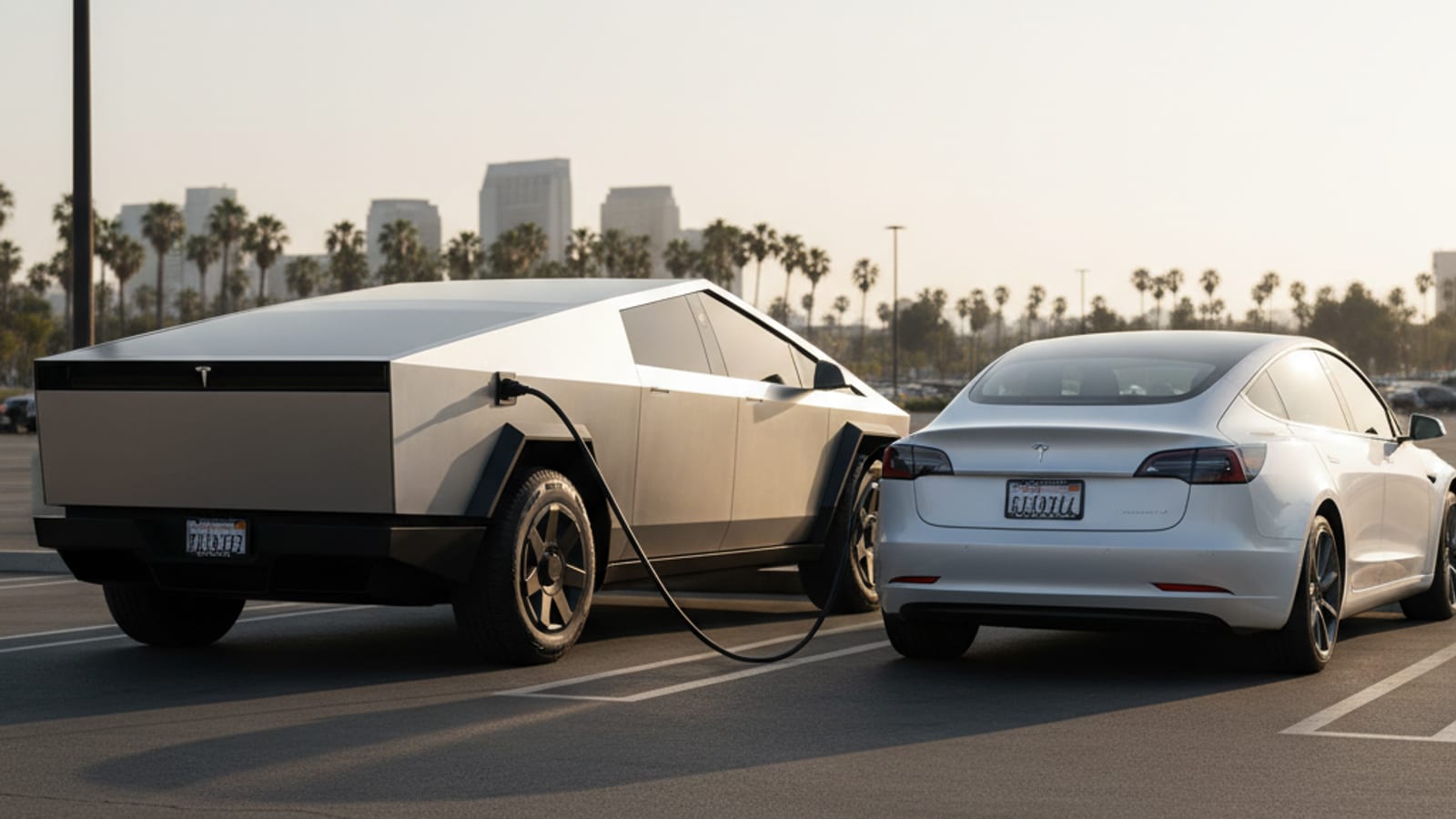
Car-to-car charging isn’t a Peninsula backup plan
The search is simple: can one EV charge another. The hardware answer is sometimes. The roadside answer on US-101 is rarely enough.
Express lanes on 101 use FasTrak. Hours are generally 5 AM to 8 PM on weekdays. MTC runs that regional network. Waiting between two cars while a neighbor’s outlet dribbles power isn’t a plan. California Vehicle Code 21718 bars freeway stopping in most cases. The disabled exception applies when you can’t avoid the stop. You’ve also summoned help.
The Freeway Service Patrol covers those beats on a clock. Hours are Monday to Friday, 6 to 10 AM and 3 to 7 PM. Dial 511 and say Freeway Assist, or use a call box. FSP lists a free gallon of gas, jump-starts, and radiator refills. The MTC page doesn’t mention electric vehicles or out-of-charge help. That absence was checked on 2026-09-18. A jump can wake a 12V. It doesn’t fill a traction pack.
Outside those hours, the CHP Rotation Tow Program takes the call. You don’t pick the vendor. Caltrans District 4 posts highway conditions for the nine Bay Area counties. CVC 22651(f) allows removal after four hours. That applies on a full-access-control freeway. It applies when the car can’t move under its own power. That’s a tow clock. It isn’t a charging plan.
What has to exist before power can move
Every EV stores a lot of energy. Moving some of it into another EV isn’t magic. It’s an interface problem.
The donor car needs an inverter that can run in reverse. It also needs an outlet, a bed plug, or a V2L adapter. That hardware has to expose the power. Then you need a cable the stranded car will accept. That’s NACS or CCS. Miss any piece and the pack stays closed.
Most commuter EVs have an onboard charger that only works one way. Cabin heat and the 12V system sip from the pack. They don’t feed the car in the next stall.
Which vehicles can export, and which stay sealed
Truck and adventure models are the ones that ship outlets. Tesla’s Cybertruck has Pro Power in the bed and frunk. The bed wall includes a 240V NEMA 14-50. Tesla rates that outlet up to 9.6 kW. Ford’s F-150 Lightning uses Pro Power Onboard. The standard setup exports 2.4 kW. The extended setup exports 9.6 kW. Chevrolet’s Silverado EV lists power takeoff at 10.2 kW. Those numbers are manufacturer ratings. They aren’t a rescue quote.
Hyundai’s Ioniq 5 uses a V2L adapter on the charge port. So do the Kia EV6 and EV9. Output is 3.6 kW. Rivian R1T and R1S trucks with the Camp Package add 120V bed outlets. Those sit at 1.4 kW. That’s camp power, not rescue.
Tesla Model 3, Model Y, Model S, and Model X don’t export traction power. If you want the Lightning path in more detail, see Can an F-150 Lightning charge the EV next to you.
Why two Teslas still can’t help each other
Peninsula drivers ask this after a long Supercharger line. A Model Y next to a Model 3 does nothing for the pack.
Those cars convert AC from a charger into DC for the battery. They aren’t built to invert pack power back out at useful levels. The 12V pigtail at the tow eye is 12 volts. It’s for waking another car’s 12V. It isn’t 240V. It isn’t a traction charge.
Tesla has shown bidirectional demos and talked about the idea. Current Model 3, Y, S, and X cars still don’t export. You can’t use that as a 101 plan.
A neighbor’s V2L still leaves you slow
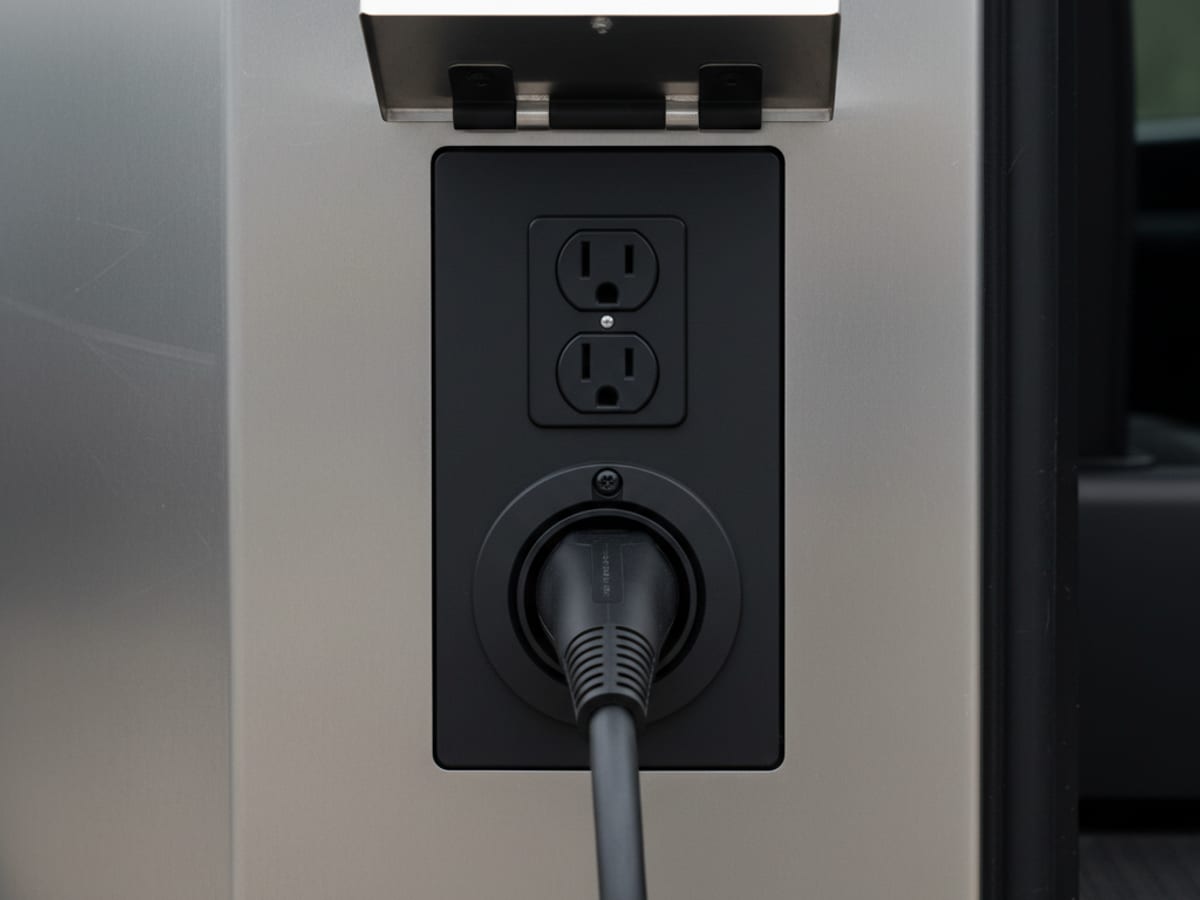
A Cybertruck or a Lightning might actually be behind you. That happens in San Mateo and Redwood City. A 9.6 kW 240V feed is in the same class as a Level 2 rescue. Operators we connect you with typically add 10 to 20 miles. That takes 15 to 30 minutes of charging. That’s charging time. It isn’t an arrival time.
An Ioniq 5 or EV6 on V2L is 3.6 kW. That’s a much slower AC trickle. A Rivian 120V outlet is 1.4 kW. You’d sit a long time for a thin buffer. Two cars on the 101 shoulder in Burlingame isn’t a small ask.
A Supercharger still delivers 150 to 250 kW. That’s many times faster than any passenger EV can push out today. Car-to-car charging is a bridge, if the hardware is even there. It isn’t a fill-up. Read EV charging levels that actually help a stranded driver for the stranded-car version.
South Bay heat makes the buffer thinner. San Jose’s July normal high sits around 82F, 1961-1990 NWS via WRCC. San Francisco / SFO is 71.5F in July. Livermore hits 89.7F. A pack can look fine leaving Gilroy or Morgan Hill. That still isn’t a reason to wait on a friend’s 3.6 kW adapter.
Older Peninsula housing, airport lots, and why people stall
Census ACS 5-Year 2019-2023 figures show older stock along this corridor. San Francisco is 77.2% pre-1980. Daly City is 78.7%. San Bruno is 81.9%. Millbrae is 78.8%. That’s the Census proxy for older, plug-limited stock. Many drivers never start from a wall box.
SFO has an EV charging page. The live stall list couldn’t be confirmed in this research pass. Check flysfo.com/parking/electric-vehicle-charging before you trust a post-trip top-up. Oakland International and San Jose Mineta parking pages don’t show EV charging. Confirm on those airport sites before you assume a post is waiting.
PG&E delivers the wires on the Peninsula. Peninsula Clean Energy supplies generation in San Mateo County. Don’t call the CCA about a stalled car.
Why a mobile 240V source still wins on 101
240V AC uses the stranded car’s own onboard charger. It also uses the car’s built-in protections. Independent local operators bring that Level 2 source to the car. They use a native NACS plug. Non-Tesla EVs get a CCS or J1772 adapter. They typically add 10 to 20 miles in 15 to 30 minutes of charging. That’s what mobile EV charging is for.
Charge Pro SF doesn’t own the trucks. It doesn’t employ the technicians. It matches you with a local operator. Gear and billing are in What’s an EV charging truck, and who actually bills you.
Don’t improvise a dryer cord between two charge ports. Mismatched plugs can trip protection or damage a port. A borrowed outlet isn’t a substitute for a proper 240V feed.
If the pack is empty, the car can’t roll. Out-of-charge recovery is the service that matches that job. On the freeway, start with Your EV died on a Bay Area freeway. What should you do?. City-level pages live under EV charging across the Bay Area.
What to do instead of waiting for a neighbor
Get out of the travel lane if you can do it safely. Summon help so the disabled-vehicle exception applies. FSP can jump a 12V during posted hours. It won’t charge the pack. An empty traction pack still needs energy on site or a tow. California doesn’t cap ordinary consensual tow rates statewide. Ask the price before the hook goes on.
Charge Pro SF is the referral line for this metro. Call (415) 630-6268 when you need a match. The operator who takes the job quotes it and bills you. No arrival time is promised from this number.