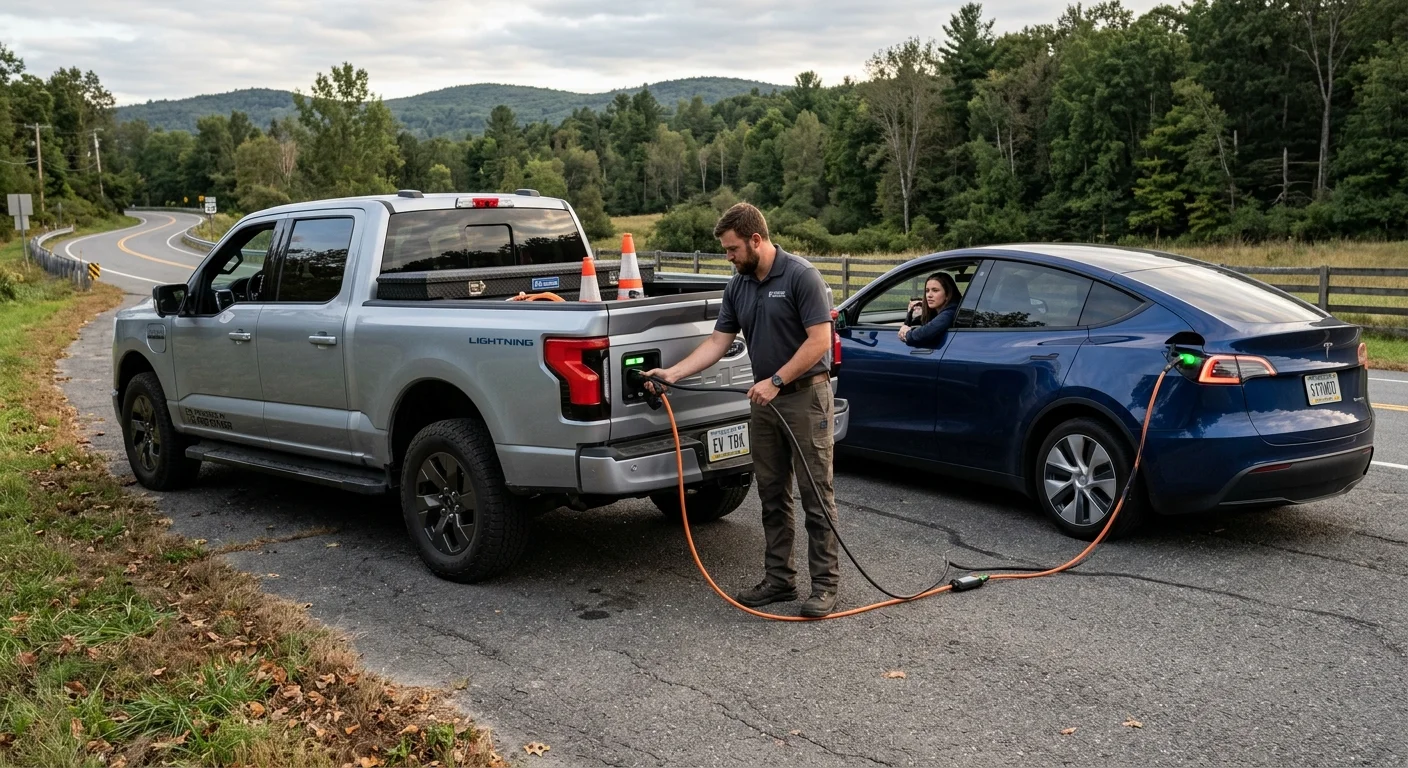
A Ford F-150 Lightning can charge another EV from Pro Power Onboard. That’s AC from bed outlets, not a DC reverse feed. You still need a portable EVSE and the right adapter. On I-580 over the Altamont, that sit is slow Level 2 work. It isn’t a shoulder rescue plan for that grade.
Why this ask shows up east of Livermore
Tri-Valley work trucks mix with commuter EVs all day. I-580 east of Livermore is the climb people remember. Pleasanton and Dublin feed that same I-580 run. A Lightning with bed outlets looks like a charger that already arrived.
Livermore counted 85,870 people in the ACS 2019-2023 file. The separate 2024 Census estimate is 84,867. Pleasanton sat at 77,500 in that ACS file. Dublin’s ACS population was 70,542 in the same file. Those are Alameda County cities in the Tri-Valley. PG&E still delivers the wires in all three cities. None of that powers a bed outlet on the grade.
July heat is the other fact that changes the pack. Livermore’s 1961-1990 July normal high sits at 89.7F. Antioch’s July normal high is 90.4F, and San Jose sits around 82F. San Francisco’s July normal high, at SFO, is 71.5F. The inland gap over the coast is real. A pack that felt fine on the Peninsula can sag on the Altamont climb. That’s when a Lightning in the next lane gets waved down.
Charge Pro SF doesn’t own those work trucks. We’re a referral line, not a fleet. The Lightning next to you is a private vehicle. Treat it as a favor, not a rescue unit.
What Pro Power Onboard is actually doing
Ford built Pro Power Onboard for tools, job sites, and backup loads. Outlets in the bed and cabin put 120-volt and 240-volt AC on tap. A portable EV charger can plug into that 240-volt receptacle and feed another car.
That path is vehicle-to-load, not a DC handshake with the other car. Speed follows the AC cap on your trim, not Supercharger math. Output varies by trim, so you’ll have to read yours. We couldn’t confirm a published kilowatt ceiling from Ford for this page. Check the sticker and the owner’s manual on your truck, not a forum screenshot. The lower packages sit in household-outlet territory. Higher packages land in portable Level 2 range. None of those packages are DC fast charging.
Confirm the other car will accept AC at all. A locked charge port can refuse the plug. A dead 12-volt can leave the car dark. A dash fault can stop the session before a mile lands. If the Lightning itself won’t wake, see Ford F-150 Lightning won’t start: the 12V checks.
The kit has to be in the bed
A lamp extension cord won’t do this job. You need a portable EVSE with a NEMA 14-50 plug. That plug has to match the Lightning’s 240-volt outlet. Then you need the connector the stranded car expects.
Most non-Tesla EVs here take J1772 from that EVSE. A Chevy, Hyundai, Kia, Mach-E, or Volkswagen usually plugs in as-is. A Tesla needs a J1772-to-NACS adapter on the same cable.
The wider version of this question is can one EV charge another. The Lightning is the work truck that makes a yes feel obvious. It still fails without the kit in the box.
Match the EVSE’s rating to the outlet you actually have. Look at the plug faces before you energize them. If a prong is burned or a cable is cut, stop. Stay with the hookup until the session ends. Don’t leave two vehicles joined on a shoulder while you walk away.
How long you’ll sit on that grade
This is the part most Lightning owners get wrong. Pro Power Onboard can move energy into another pack. It doesn’t do it like a highway DC stall. You’re running a portable Level 2 session from a work truck. That same pack still has to get you home.
There’s no verified miles-per-hour figure we can publish for every car. Time on the shoulder is the cost you feel.
Operators we connect you with bring a 240V Level 2 source to the car. They typically add 10 to 20 miles of range. That takes 15 to 30 minutes of charging, not travel time. They use a native NACS plug for Teslas. CCS or J1772 adapters cover the other brands. That’s mobile EV charging as a dispatched job, not a favor.
If they still have to finish the Altamont climb, miles matter. A slow AC trickle from a friend’s bed may not cover the rest. Same story if they still have I-680 miles left through Sunol. Already on that shoulder, use out of charge on I-580 over the Altamont.
Watch your own state of charge the whole time. Sharing power spends the Lightning’s pack as you sit. After a hot inland day and a grade, your own miles matter. You can strand yourself next to the person you meant to help.
Two vehicles on a live freeway isn’t a workshop
California Vehicle Code 21718 already limits when you can stop on a freeway. A disabled vehicle is one of the narrow exceptions. You’ve got to have summoned another vehicle to assist. The code doesn’t invite a second truck to sit there with a cable out.
CVC 22651(f) allows a tow after four hours on a full-access-control freeway. If the driver can’t move it under its own power, that clock applies.
The Bay Area Freeway Service Patrol is a partnership of MTC, CHP, and Caltrans. The published FSP hours are Monday through Friday. That’s 6 to 10 AM and 3 to 7 PM, per 511.org. Dial 511 and say “Freeway Assist,” or use a call box. FSP publishes a free gallon of gas, jump-starts, and radiator refills. MTC’s page, read 2026-09-18, doesn’t mention electric vehicles or an empty traction pack.
Outside those hours, the CHP Rotation Tow Program assigns a vendor. You don’t pick the company on that rotation. If the stalled car is in a travel lane, CHP says to call 911.
Express lanes run on I-580 and I-680 through the Tri-Valley. A stall there still puts you in moving traffic. We didn’t find a published disabled-vehicle policy for the state-owned bridges. Don’t treat a Bay Bridge shoulder as a charging stall.
When a Lightning top-off is actually the right call
A quiet lot in Pleasanton or Dublin is calmer than I-580. If a coworker is a few miles short, the Lightning can cover that. You’ve still got to keep the EVSE in the bed. Same story in a Livermore driveway after work, when nobody’s blocking a lane.
It’s a poor fit when the other car is on a live freeway. It’s a poor fit when you still need the Lightning’s own range. Drain your pack for a slow feed, and you can stall both trucks.
It’s also the wrong tool for a dead 12-volt battery. A car that won’t unlock or wake is often the 12V. That isn’t the same problem as an empty drive pack. Plugging into the charge port won’t fix that.
What a rescue operator brings that a bed outlet doesn’t
The Lightning is the truck you already drove to the site. A rescue operator’s setup is built to roll to a stranded EV. See what’s on a mobile EV rescue rig for that difference.
Charge Pro SF is a referral line, not a fleet. We match you with independent local mobile rescue operators. We don’t own trucks, employ technicians, or set prices. The operator quotes you before starting and bills you directly. The pros we connect you with are licensed and insured.
They handle Tesla and every major EV brand. They can jump or replace a dead 12-volt on site. A bed outlet won’t wake a car whose 12-volt is gone.
If you’re the stranded driver, get as far right as you can. Put the hazards on and stay out of the travel lanes. Don’t stand in a lane to aim a plug. If a Lightning with the full kit is already there, take the short AC session. If they’re missing the EVSE, the adapter, or spare range, don’t wait.
Call (415) 630-6268 to reach our referral line. We’ll connect you with a local operator who quotes before they start.