A Tesla charge lasts a day here if today’s estimate covers your loop. Hills, street parking, and inland heat all change that number. Treat the car’s current reading as the plan, not a brochure range.
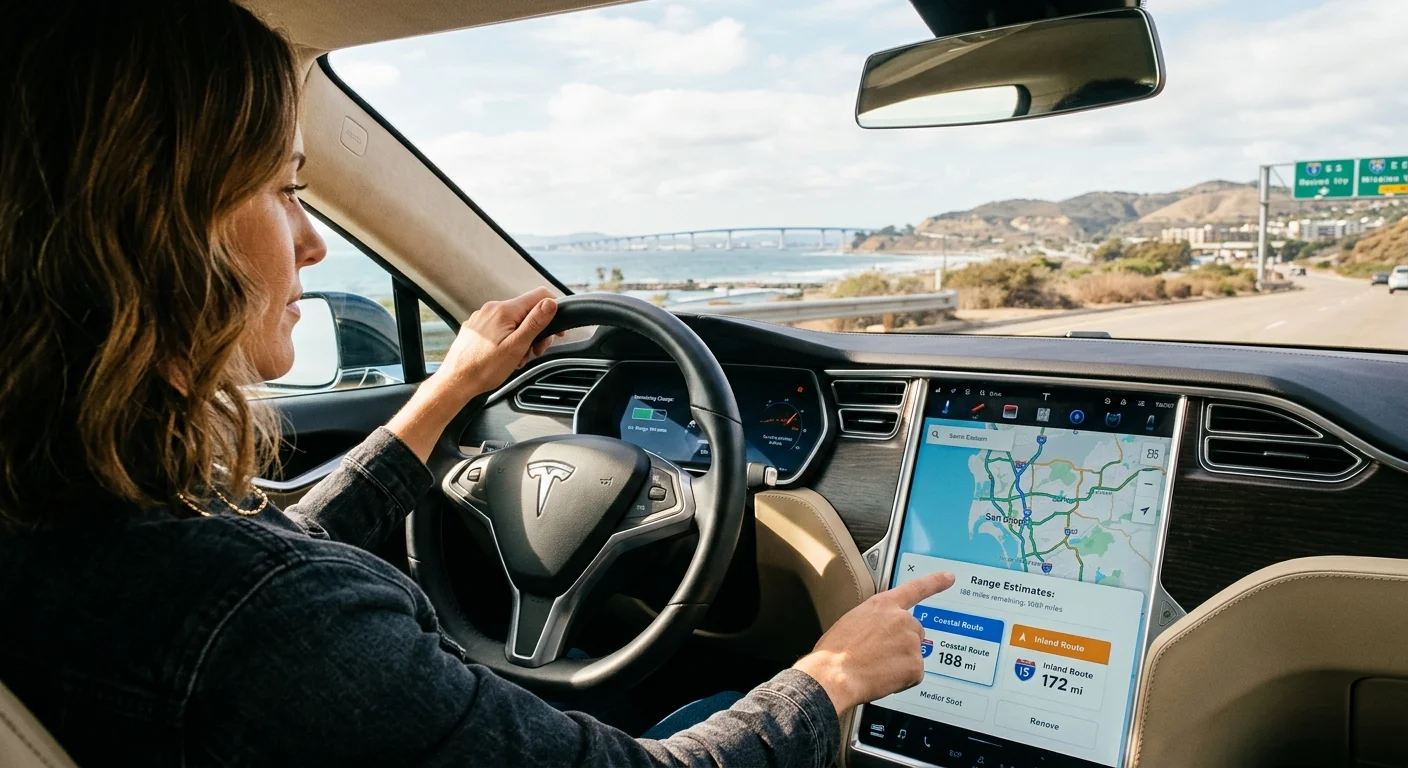
Daily miles and pack lifespan aren’t the same question
People type “how long does tesla battery last in a day” for two reasons. One is how far you can still drive before you plug in. The other is how long the main pack stays useful over years.
For today’s errands, use the charge that’s in the car. The display already factors your model, recent driving, and present state. A brochure number doesn’t describe this car right now.
Long-term pack life is a different topic. Read our guide to how long Tesla batteries last in real Bay Area use. A tight Thursday doesn’t prove the pack is worn out. A healthy pack also doesn’t promise you’ll finish tonight’s loop.
Keep those questions apart so the plan stays honest. Ownership talk doesn’t tell you whether this charge covers a San Francisco morning plus the drive home. One low day also doesn’t answer how the battery will age.
Before you leave, capture three facts. Write the Tesla model and configuration. Write the percentage and estimated miles on the screen. List every stop, including the return.
Trust the display, then test it against the day
Start with the car in front of you. Write the percentage and estimated distance before you move. Add the first destination so the nav can rebuild the number.
Treat that estimate as a planning input. A forum post about a different Model 3 may not describe your car.
Now lay the estimate next to the whole day. Count the commute, the midday hops, and the return. Then count the last stretch to a plug you can actually use. A curb-parked city car that never sees a wall connector starts lower. A Tri-Valley driveway that charged overnight starts from a different place.
Charging speed still shapes the next recovery, not this charge. The U.S. Department of Energy describes charging by level. Level 1 on 120-volt power adds about five miles per charging hour. Level 2 on 240-volt power adds about 25 miles per charging hour. Actual speed still varies with pack size, state of charge, and air temperature.
Those figures explain a plug. They don’t set today’s range. Check connector type and site access before you count on a stall.
If the estimate already looks thin for the full loop, change the day. Cut a stop while you still can. Pick a charger the car can still reach.
Hills and bridges rewrite a number that looked fine
This metro isn’t one grade. A US-101 run along the Peninsula spends energy differently than a climb.
SR-24 from Concord toward the Caldecott and Lafayette is a real hill. I-580 over the Altamont near Livermore is another. SR-17 into Los Gatos is another climb. The I-680 ridge through San Ramon does the same.
Don’t assign a made-up mile penalty to traffic, weather, or elevation. No verified figure here supports a universal adjustment. Watch the estimate as the route changes. If you need a model-specific note, use current Tesla documentation for that car.
Bridges change the loop too. The Bay Bridge, San Mateo-Hayward, and Dumbarton toll westbound. The Carquinez, Benicia-Martinez, and Antioch bridges toll eastbound. The Golden Gate tolls southbound into the city. A plan that only budgets the outbound miles then forgets the return gets tight.
Write every destination in order. Name a compatible charger near that path, then a second one. Confirm current access through the network that runs the stall. A charger somewhere else in the nine counties isn’t a backup. That holds if the estimate can’t get you there.
Your daily range is a route decision. It isn’t one permanent number.
Street parking decides what overnight charging even means
San Francisco housing is old. ACS 2019-2023 puts 77.2% of units in buildings from 1979 or earlier. Daly City, Berkeley, Oakland, San Bruno, and Pacifica all sit in that same older band. That stock is a proxy for apartments and curb parking. It isn’t a garage with a 240-volt plug.
Newer inland cities look different. Dublin is 21.0% pre-1980. San Ramon is 23.8%. Brentwood is 10.9%. A Tesla that slept in a garage there can wake with a recovered pack. The same model on a city street overnight starts from whatever is left.
If the car was at the curb, the morning percentage is the day. Cabin preconditioning, Sentry, and a cold pack all draw from it. Recheck the estimate after you wake the car. Don’t trust last night’s memory.
Office lots and airport sits do the same thing. A car that sat through a South Bay campus day can wake lower than you expected. So can a car left overnight near SFO. SFO’s charging page exists, but it wasn’t readable in our research pass. Confirm what’s actually on site before you count on a stall.
BART publishes Level 2 charging at Warm Springs / South Fremont, 42 plugs, and at Lafayette, 4 plugs. Those are real pins for a plan. They still have to sit inside the miles on the screen.
How you recover at home shapes tomorrow, not this charge. How long a Tesla charge takes on the coast vs inland covers that plug time.
Inland heat isn’t a coastal day
July normal highs from the 1961-1990 NWS record show a wide split. San Francisco at SFO averages 71.5F. Oakland Airport is 70.4F. San Jose is about 82F. Livermore reaches 89.7F. Antioch reaches 90.4F. Gilroy sits at 88.3F.
Climate control and pack temperature both work harder inland. There’s no verified mile-per-degree formula here, so don’t invent one. A Livermore afternoon on I-580 is a different energy day. A cool SR-1 run through Pacifica or Half Moon Bay isn’t the same. Recheck the estimate after the cabin cools. Recheck it after a long sit in a hot lot.
If you added a Delta errand on SR-4, rebuild the whole loop. Do the same for a south-valley hop toward Morgan Hill and Gilroy. Don’t keep the morning number.
Change the plan while a charger is still in range
Low charge is easier to handle before the last reachable plug falls off the estimate. Choose a compatible station the car can still make. Confirm it through that network, not a stale map pin.
Garage ramps, lot gates, and a closed entrance all sit after the pin. Your plan has to reach the actual stall.
If you’re already on a freeway, CVC 21718 still applies. It lets a disabled vehicle stop when another vehicle has been summoned. CVC 22651(f) allows removal after more than four hours on a freeway. That applies if the car can’t move under its own power. Don’t sit in a travel lane to make the location easier to describe. Note the road, direction, nearest exit, and a landmark.
The Freeway Service Patrol runs weekdays, 6 to 10 AM and 3 to 7 PM. Dial 511 and say “Freeway Assist.” MTC describes gas, jump-starts, and radiator refills. It doesn’t list out-of-charge EV help. After hours, CHP rotation tow is the highway default.
What to do before you’re stuck is the sequence for this stage. Don’t keep rolling toward a charger the estimate no longer supports.
A plug, a mobile charge, or a tow
The right next step depends on the car and the spot. Don’t assume every low-battery moment has the same fix.
If usable charge remains and a compatible station is still in range, go charge. Keep watching the estimate on the way.
If no reachable charger is left, ask about a mobile 240-volt charge. Operators typically add 10 to 20 miles in 15 to 30 minutes of charging time. That’s plug time, never a promise of when someone arrives. They’ll want the model, the percentage, the exact location, and how to reach the vehicle. Out-of-charge recovery is how we connect you with those local pros.
A Tesla that won’t wake may be a 12V problem, not an empty pack. Share the warning, the screen state, and what the car is doing. Tesla roadside rescue covers that referral.
Transport is on the table when a mobile charge isn’t possible, or isn’t the right tool. Let the operator explain the options. Don’t try electrical work or a hook yourself.
Before you agree, have the independent operator state the service and the price. Ask how you pay and what warranty they offer. Charge Pro SF doesn’t set those prices and doesn’t warrant the work. You contract with the pro directly. We don’t own trucks, employ technicians, or perform the charge.
When to call
Call when the estimate no longer supports a safe drive to a reachable charger. Call when you need an operator to sort a charge from a tow. Call (415) 630-6268 and we’ll connect you with a local EV rescue operator.