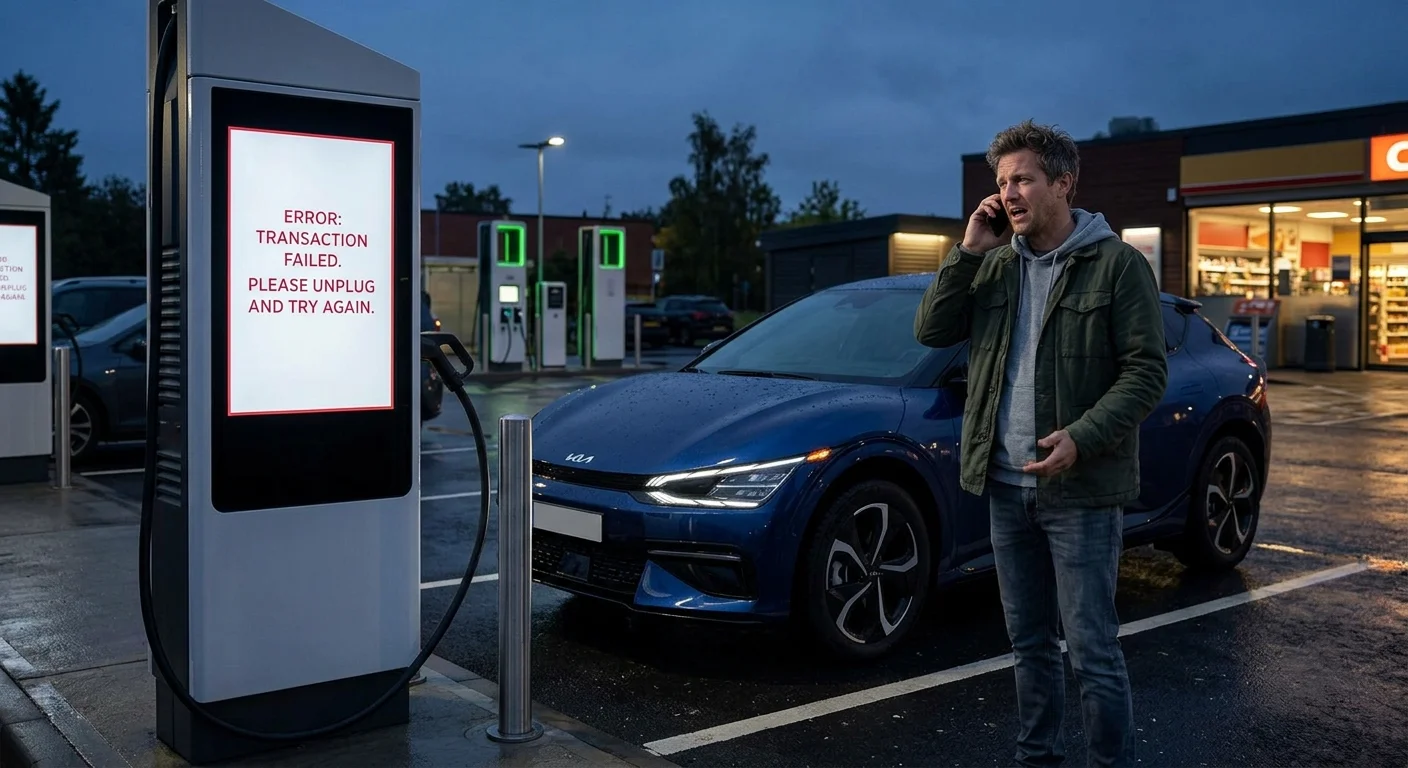
A Kia EV6 that won’t initiate a charge at a Bay Area post is usually a handshake problem, not a broken car. The cable, the station, your charging schedule, and the small 12V battery each have a way of stopping a session before it begins. Work through them in order before you assume the EV6 itself is at fault.
Start with the cable and the port
The EV6 charge port sits at the rear on the driver’s side. Open the port door, then push the CCS connector in until you hear a confident click. A half-seated connector will register as a fault on the station and refuse to lock. If the connector wobbles in the port or the latch never engages, lift the latch tab and try again. Bay Area fog and salt air at Pacifica, Half Moon Bay, and along the Great Highway leave a thin film on the port pins that can interrupt a handshake. A quick wipe of the port interior with a dry microfiber cloth, not a wet wipe, often solves the no-start.
If the cable is the EV6’s own portable charger, check the 120V plug end as well. A loose wall outlet is a common reason a session never begins, and an outlet on a GFCI breaker that has tripped will silently kill the charge without a warning on the car’s screen.
Try a different station before you blame the car
Bay Area charging networks each run their own backend, and one network being down does not mean the EV6 has a fault. If a station screen shows a red error, the cable is locked and won’t release, or the screen is completely dark, the station is the problem. Move to a different stall at the same site, then a different network. Electrify America, EVgo, ChargePoint, and Tesla Superchargers (with the NACS adapter on newer EV6 model years) all cover parts of the five core counties.
Public stations in San Francisco’s SoMa garages and along the Mission can sit fully occupied during weekday evenings. That is a queue problem, not a charging problem. A driver who plugs into a busy network at 7 PM and walks away expecting a session is going to come back to a full port and an unmoved car.
Check the schedule you may have set by accident
The EV6 has a departure-time and a charge-limit setting in the infotainment. If you set a schedule, the car will sit at the post and refuse to charge until the window opens. Open the EV settings and confirm no scheduled departure is active, and that the charge limit is not set below the cable’s current state of charge. Some owners set a 50 percent limit during a winter of cheap overnight charging and forget about it, then wonder why the car sits at a station and stops at half.
If you don’t remember setting a schedule, look for a clock icon on the dash near the charge indicator. That is the giveaway.
The 12V battery is the silent killer
The EV6 uses a small 12V lithium-ion or AGM battery to power the control modules that talk to the charger. If that battery is low, the screens wake, the lights come on, but the handshake to the charger never completes. You see the cable latch engage, then nothing. No error, no session start. The 12V is what wakes the car up before the high-voltage pack is allowed to engage.
Symptoms that point at the 12V before the charger handshake:
- The infotainment screen takes longer than usual to boot
- The walk-away door handle is sluggish to present
- The dashboard dims when you press the start button
- A recent 12V warning on the cluster
A dead 12V in the Bay Area is most common on cars that sit parked for a week or more at SFO long-term parking, a downtown garage near Oracle Park, or a Caltrain station lot in Millbrae. The parasitic draw on a modern EV is real, and the small battery is the one that pays for it.
A jump from a portable lithium pack on the under-hood jump posts usually brings the EV6 back. If the 12V is more than a few years old and the symptoms match, the battery itself is the cause and needs replacement at a Kia dealer or an independent EV shop.
Don’t ignore dashboard fault codes
When the EV6 refuses to charge and the dash shows a “Check EV System” warning, a yellow turtle, or a specific charging-fault message, the car has flagged a real fault. These are stored as diagnostic trouble codes and a standard OBD-II scanner can read them. The Kia dealer tool reads more. Either way, an unresolved fault is not something to keep plugging in to clear.
A common one on the E-GMP platform is a charge-port interlock fault after a partial session. The car thinks the cable is still engaged. Unlocking the cable, opening and closing the port door, and trying again usually clears it. If it does not, a manual reset at the under-hood jump posts may.
A slow charge on a hot day is not a fault
The EV6 throttles DC fast charging when the pack is hot or nearly full. A session that drops from 230 kW to 70 kW at 60 percent on a Gilroy or Brentwood summer afternoon is the battery management system doing its job, not a charger failure. Bay Area inland heat, particularly on the I-580 climb toward the Altamont or the I-680 climb up the Sunol Grade, runs the pack warmer than the coast. That heat carries into the next charge session. If your charge rate drops earlier than expected, give the car a few minutes before blaming the station.
For the broader context on Bay Area public charging and what to expect from a CCS handshake, see the ev charging hub and our mobile EV charging service.
When you’re stranded and a station won’t help
If the EV6 is genuinely out of range on a curb in the Mission, in a Half Moon Bay weekend traffic jam, or in a Castro Valley apartment lot, the next step is not another station. It’s a mobile charge. An independent operator can bring a 240V Level 2 source to the car with a CCS adapter, add enough range to reach a working post, and quote you before any cable goes on. That covers the same problem a tow solves, without the tow. Our non-Tesla EV rescue page covers what an operator brings, and the out of charge recovery page covers the empty-pack path.
For the full procedure on jump-starting any EV safely, see how roadside help jump starts an EV. For the broader Bay Area roadside hub, see EV roadside assistance in the Bay Area.
Call (415) 630-6268 when the troubleshooting is done and the car still won’t take a charge.