You can jump start an EV if the 12-volt battery died. You can’t jump an empty traction pack back to life. Bay Area Freeway Service Patrol lists jumps, gas, and radiator refills. It doesn’t list a charge for a pack at zero.
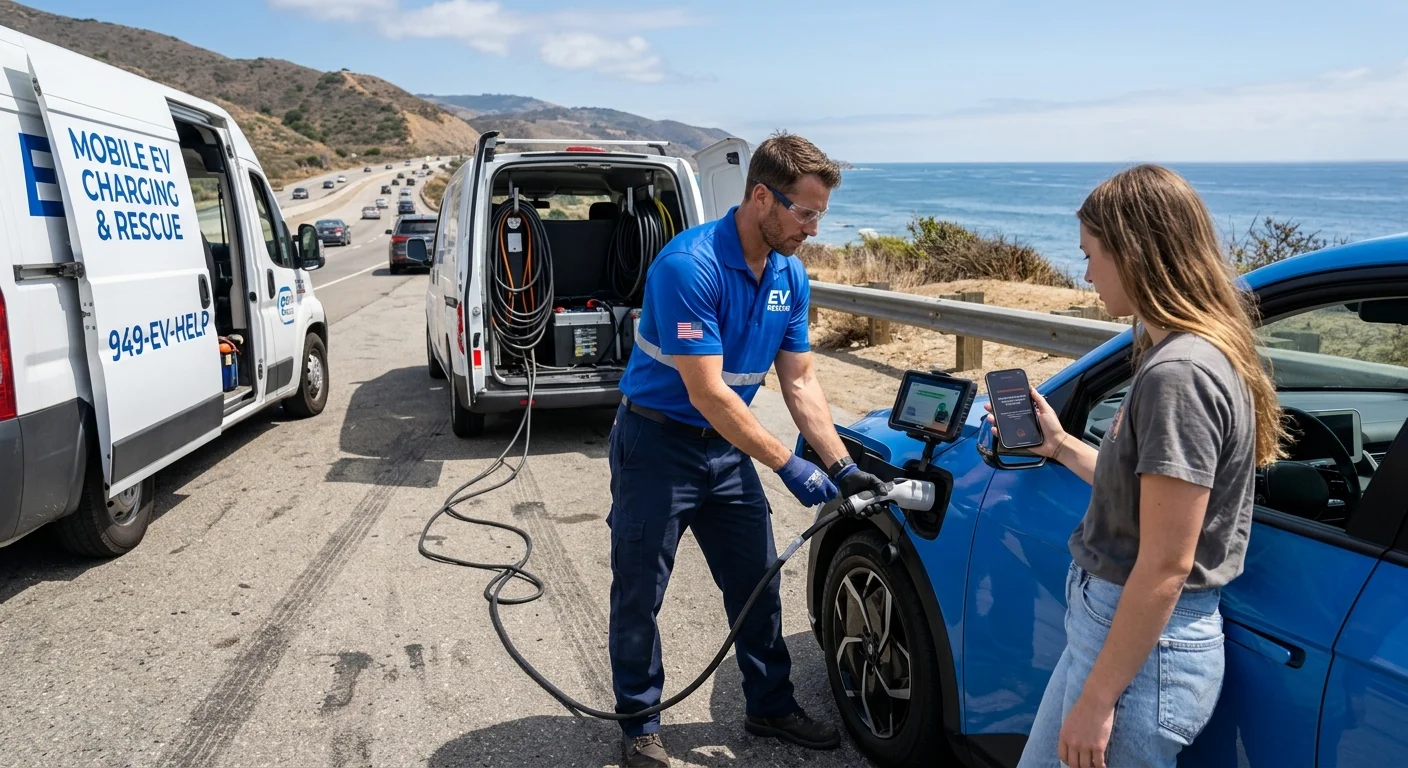
Freeway patrol lists a jump, not a pack charge
The Freeway Service Patrol is a Bay Area partnership of MTC, CHP, and Caltrans. Private tow companies run dedicated freeway beats after a bid. They work weekdays, 6 to 10 a.m. and 3 to 7 p.m. You reach them by dialing 511 and saying “Freeway Assist.” MTC’s FSP page lists a free gallon of gas, jump-starts, and radiator refills. It reports more than 100,000 incidents a year. The same page, checked September 18, 2026, never mentions electric vehicles. It never mentions help for an empty traction pack. That published menu is why this question keeps coming up. A jump-start on that list can still help some EVs. It helps when the small 12-volt battery is flat. It doesn’t add range to a pack that already reads zero. If you sit dark on I-880 in Hayward, say which battery failed. Then let the matched operator confirm it from the symptoms. Outside those weekday windows, the CHP Rotation Tow Program takes freeway calls. You don’t choose the tow vendor on that rotation. California Vehicle Code 21718 bars stopping on a freeway. A disabled car is an exception once you’ve summoned help. CVC 22651(f) allows removal after four hours. That applies on a full-access-control freeway if the car can’t move itself. Call for help before that clock becomes the next problem.
The car has two batteries, and only one takes a jump
Every mainstream EV still carries a small 12-volt battery. It wakes the computers, locks, lights, and contactors. The traction pack is the one that moves the wheels. People say “dead” for both kinds of failure. That one word can send the wrong kind of help. A 12-volt failure often looks total from the curb. Screens stay black, and door handles may not present. The phone app may not connect, and Drive won’t engage. The pack can still hold tens of miles. You just can’t reach them until the small battery wakes the car. An empty pack looks different on the dash. The screen may still light and show zero miles. It may show a can’t-drive alert with a healthy 12-volt. Clamps on that small battery won’t put miles in the pack. That’s the job mobile EV charging is built for. Tesla, Rivian, Ford, Hyundai, Chevy, and the rest all keep this split. Clamp points and approved steps still change by model year. Your owner’s manual is the authority for those steps. Read how you jump start an electric car for the 12-volt path.
How the stall usually presents
Don’t diagnose the pack yourself from the curb. Report what you can see, not what you assume. Start with the last percentage the car showed. Then read every warning on the dash exactly as written. If the screen is dark, say the screen is dark. Don’t turn “electrical system” into “dead battery.” Say whether the key fob is still recognized. Say whether the car will enter Drive. Say whether lights or windows still work. Those notes help an operator sort a 12-volt job from a pack job. More on that split is in what happens when an EV 12-volt battery dies. Tesla won’t wake: empty pack or a dead 12V walks the Tesla version. Make, model, and year matter on this call. The word “Tesla” isn’t a procedure by itself. A Model 3 with a lithium 12-volt isn’t an older Model S. Share the full badge before anyone brings a pack or a jump box.
When a jump is the wrong ask
Ask for a jump only if the 12-volt side looks like the failure. If the car showed zero range before it quit, say you’re empty. Don’t dress an empty pack up as a jump request. Operators we connect you with can jump a Tesla 12-volt on site. They can jump or replace a dead 12-volt on other brands too. They can’t refill a traction pack with jumper cables. If the pack is empty, they bring a 240-volt Level 2 source. Tesla uses a native NACS plug, and other EVs use CCS or J1772. A typical session adds 10 to 20 miles of range. That takes 15 to 30 minutes of charging time. That number is charging time, never an arrival time. A jump also may not fit when the warning is unfamiliar. It may not fit when the manual bars a roadside boost. Crash damage, smoke, heat, or standing water change the call. Tell the operator those facts before anyone connects cables. Access changes the job as much as the battery does. A car on an I-680 shoulder in San Ramon is a freeway problem. A car behind a gate in Menlo Park is an access problem. Give the exact pin, not a region name. “Oakland” isn’t a pin, but I-880 south at San Leandro is. Mention a gate, a low garage, or a narrow stall. Mention an express lane on I-80, I-580, I-680, I-880, US-101, or SR-237. If you’re on a bridge approach, name the bridge and the direction. This research found no published disabled-vehicle policy for those spans. If the car can’t take a charge on site, transport may be left. The matched operator explains that choice and quotes it.
Heat, hills, and a long sit are different stories
The Bay Area isn’t one climate for an EV. San Francisco’s July normal high at SFO is 71.5F on 1961-1990 normals. Livermore’s July normal high is 89.7F. Antioch’s July normal high is 90.4F, and Gilroy is 88.3F. Inland heat on I-580 toward Livermore pulls range down. SR-4 toward the Delta and the south valley around Gilroy do the same. A jump won’t put that range back. Coastside sits along SR-1 go the other way. Pacifica, El Granada, and Half Moon Bay stay cooler. Cars still go dark there after a long park. That’s often the 12-volt, not a cooked pack. Census ACS 2019-2023 puts pre-1980 housing at 77.2 percent in San Francisco. Daly City is 78.7 percent, and Berkeley is 80.8 percent. Cars sit at the curb for days in that stock. The small battery sags while the pack may still be fine. A week in an SFO, OAK, or SJC garage can do the same. You come back, and the car won’t wake. Describe the sit and the last percent you remember. If the car can already roll, named Level 2 sites exist. BART lists 42 Level 2 plugs at Warm Springs / South Fremont. Lafayette BART lists four plugs, also Level 2 only. If you can’t roll, you need a truck at the bumper. For a freeway zero, read your EV died on a Bay Area freeway.
Who actually shows up
Charge Pro SF is a referral line for stranded drivers. We match stranded EV drivers with independent local operators. We don’t hold a trade license or employ technicians. We own no trucks and no chargers. We set no prices and we don’t promise when someone arrives. The EV roadside assistance page is the starting point for that match. You describe the stall in the first call. We pass it to an operator who can review the car and the site. They decide whether a 12-volt jump, a mobile charge, or a tow fits. They quote you before they start, and they bill you directly. Ask them to repeat the work and the price before you approve it. Keep the owner’s manual handy if you can reach it. Some models restrict a roadside boost in the manual. If the book says no, the operator should hear that too. Call when the EV won’t start and you need a mobile assessment. Have the model, the warning, the last percent, and the pin ready. Call (415) 630-6268 and we’ll connect you with a local operator.