The GMC Sierra EV is a work truck first. It still stops when the traction pack hits empty. Picture a crew packing up in Fremont after a long site day. The bed outlets ran saws and lights since morning. Cabin cooling fought East Bay heat the whole afternoon. You roll toward I-880 and the truck won’t take the merge. Nothing in the drivetrain is broken on this call. The pack is empty, and you need a way to roll again.
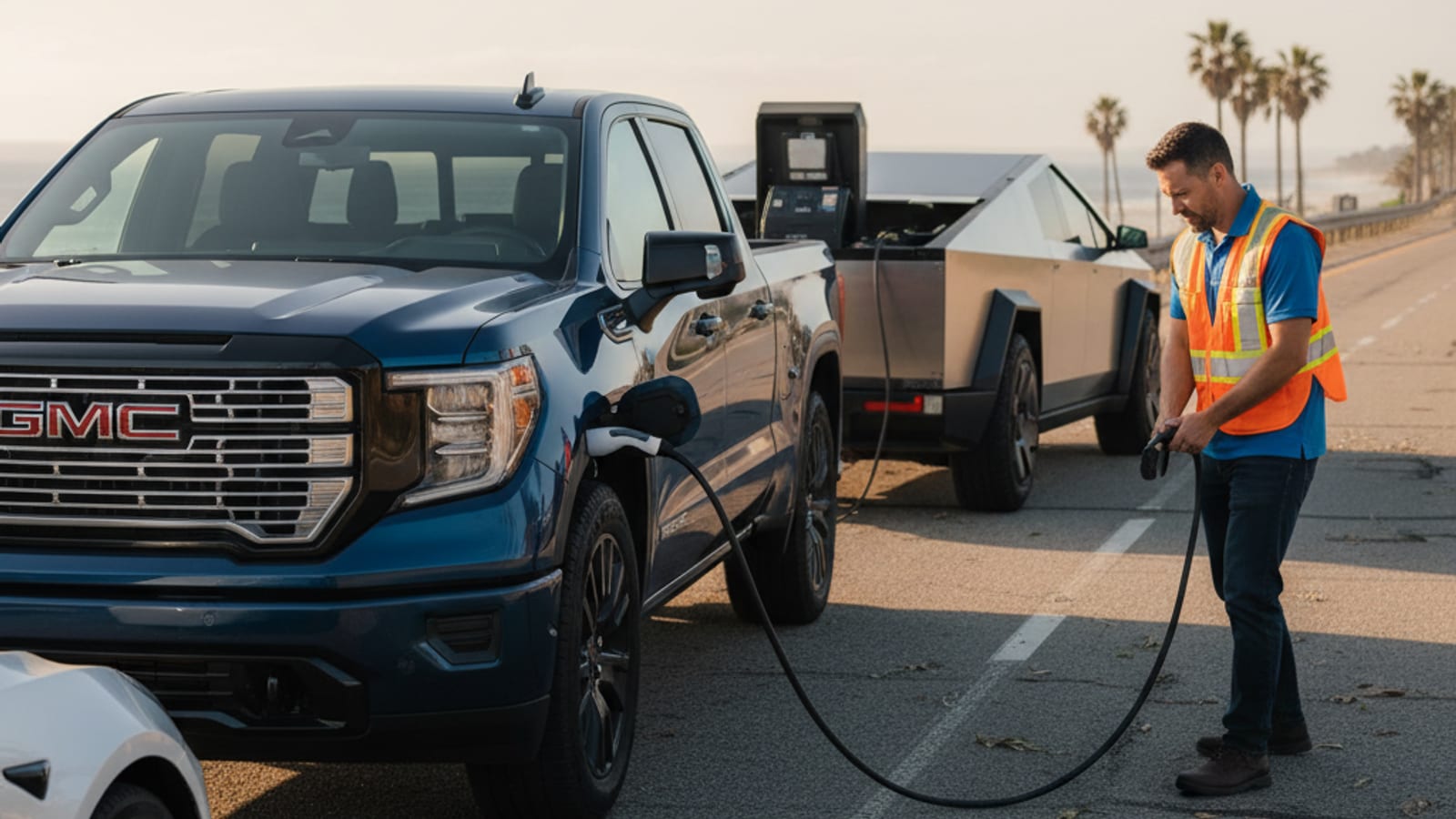
You’re not trying to fill the battery on the shoulder. You need GMC Sierra EV emergency charging that adds enough range to reach a plug. A mobile Level 2 source does that job. An independent operator brings 240-volt power to the charge port you already know. Fifteen to thirty minutes of charging typically adds 10 to 20 miles. That figure is time on the cable, not a dispatch clock. It’s not a promise of when a rig appears.
A mobile Level 2 source is what gets a Sierra EV rolling
The operators we connect you with bring a 240-volt Level 2 source to the truck. They carry a native NACS plug, plus a CCS or J1772 adapter for non-Tesla EVs. The Sierra EV takes the CCS path for a roadside session, so the adapter is part of the job. The cable locks into the same port you use at a public post.
This isn’t a Supercharger on wheels, and it isn’t a dealer visit. It’s a short energy top-off where the truck already sits. The goal is simple and local. Add enough range to drive to a plug you can occupy. Then you finish the charge there, or you make it home to a wall unit.
Charge Pro SF is a referral line. We match stranded EV drivers with independent local mobile rescue operators. We don’t hold a trade license for this work. We don’t own the truck that shows up. We don’t employ the technician, and we don’t set the price. The operator quotes you before starting, and that operator bills you directly. The pros we connect you with are licensed and insured.
Read how the session works on our mobile EV charging page. For the hardware on the rig, see what’s on a mobile EV charging truck.
A full-size electric truck drinks more energy than a compact crossover. That doesn’t change the rescue shape. You still want a Level 2 cable at the bumper. You still want a short session, not a long wait on a flatbed. Out-of-charge recovery is the name of that job. The out-of-charge recovery page walks through the same empty-pack case for every EV we refer.
The Sierra EV will usually warn you before it quits. Power gets pulled back. Climate control may drop out to save the last bit of propulsion. Speed caps as the truck protects the pack. That window is when you should already be picking a safe place to sit. Once the traction pack hits its minimum, the truck stops to protect the cells. Sitting there and hoping for a bounce-back doesn’t refill anything.
Empty pack and a dead 12-volt are different problems
The Sierra EV has a high-voltage traction pack that moves the truck. It also has a 12-volt battery for computers, lights, locks, and the wake-up modules. When the big pack is empty, the truck may still talk to you. Hazard lights can stay on for a while. The screen may still show a low-charge warning. Doors can still unlock while the 12-volt holds.
When the 12-volt is dead, the truck can look fully bricked. Screens stay dark, and the charge port may not release. The high-voltage pack can still hold energy you can’t reach. A jump on the 12-volt is the first move in that case. A Level 2 cable won’t wake a truck whose computers are offline.
If you’re not sure which battery failed, say so when you call. The operator can sort a 12-volt jump from a pack top-off. GMC’s other electric trucks fail in the same split way. A dark dash isn’t always an empty pack. Stay out of the high-voltage orange cables. Those aren’t a driveway project, and they aren’t a shoulder project.
A truck that sat for days at SFO, SJC, or a BART lot is a classic 12-volt scene. The pack may still have range. The small battery gave up first. A truck that died on a grade after a work day is more often the pack. Tell the operator how long it sat and what the last display showed.
Bay Area roads spend a Sierra EV’s range in uneven ways
This region isn’t one climate, and a Sierra EV feels the split. Coastal San Francisco sits near 71.5F in a typical July, on the 1961-1990 normals. Oakland Airport is similar, around 70.4F, while San Jose runs warmer, about 82F. Livermore’s July average max is 89.7F. Antioch sits at 90.4F, and Gilroy is 88.3F. Inland heat is a real draw on a truck that cools a large cabin and a large pack.
Hills matter as much as air temperature on a loaded truck. Eastbound I-580 over the Altamont toward Livermore is a long grade. A Sierra EV with tools in the bed spends range on that climb. The map can look easy from Dublin and still lie. I-680 through Sunol is another grade that surprises people coming up from the South Bay. SR-24 toward the Caldecott from Concord, Walnut Creek, and Lafayette asks for power. SR-17 out of Los Gatos does the same on a loaded run. Regenerative braking helps on the way down. It doesn’t pay you back one-for-one on the way up.
Towing and payload cut range further, and that’s the point of this truck. A trailer or a bed full of material shows up on the energy screen. So does a generator load off the outlets. Plan extra buffer when the Sierra EV is working, not commuting. That’s not drama. It’s how a heavy EV behaves on Bay Area grades.
Peninsula traffic on US-101 adds time with the climate system running. South Bay campus lots in Sunnyvale, Mountain View, Palo Alto, and Santa Clara keep a truck sitting. Accessories stay awake in those lots. East Contra Costa runs on SR-4 toward Pittsburg, Antioch, and Brentwood are longer and hotter. Coastside SR-1 between Pacifica, El Granada, and Half Moon Bay is a different problem. Fog, grades, and few safe pull-offs make a late warning worse.
Use the truck’s nav and a live charging app. Don’t guess miles to a plug from memory. Keep a buffer so a closed stall doesn’t end the day on the shoulder.
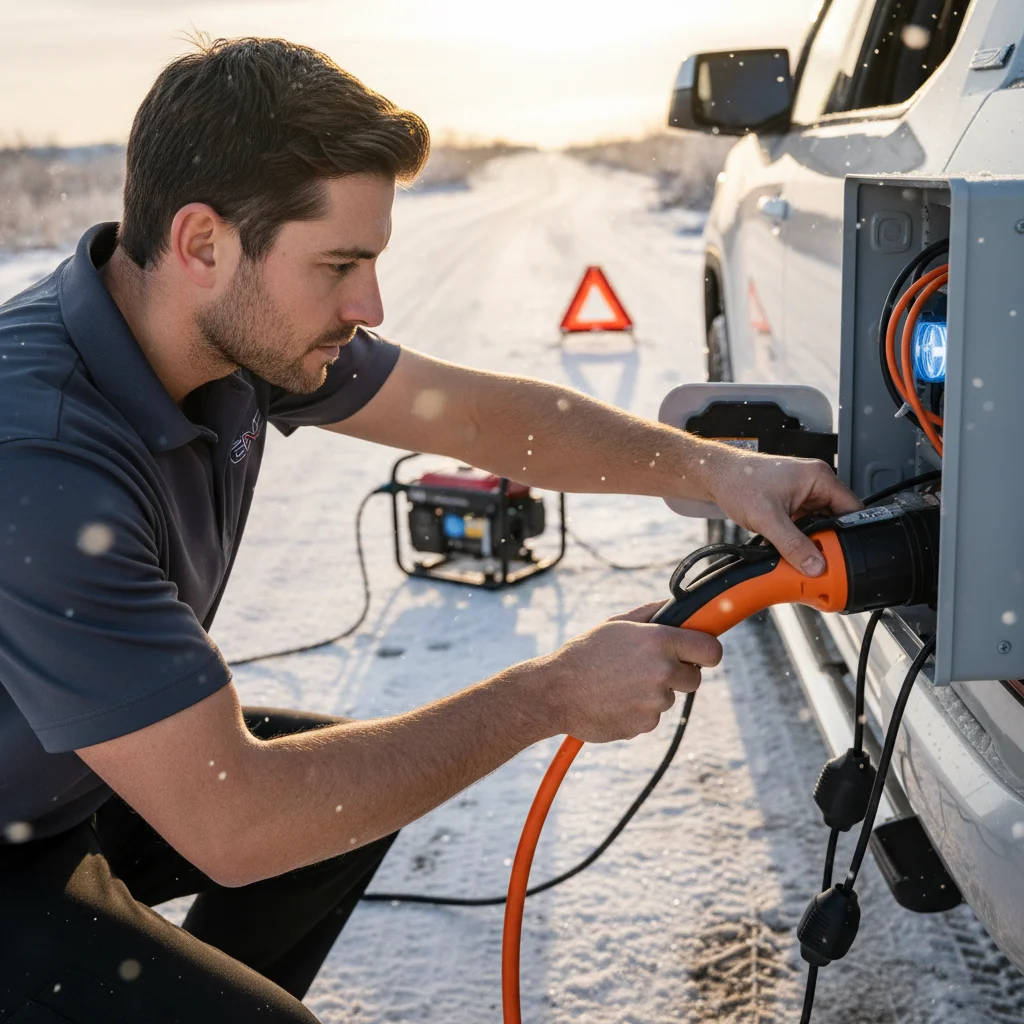
The truck works job sites from San Jose through Fremont, Oakland, and the Tri-Valley. A stall after a delivery near Levi’s Stadium is a different wait than a ridge job in San Ramon. The rescue shape stays the same. Bring 240 volts to the port. Add enough range to reach a plug.
If you used ProPower all day, start the drive home with more pack than a commute needs. The outlets were drawing while you worked. The energy screen already told you. Believe it before you point the truck at I-580, I-880, or SR-24.
If the truck is still rolling, leave the travel lane
California Vehicle Code 21718 bars stopping on a freeway except in tight cases. A vehicle so disabled that stopping is unavoidable is one of those cases. Another vehicle must have been summoned to assist. Hazard lights go on as soon as you know you won’t make the next exit. Ease onto the shoulder if you can still steer. Stay in the cabin unless the spot itself is unsafe.
Note the freeway, the direction, and the nearest exit. I-880 through Hayward and I-80 in the East Bay look the same at dusk. US-101 on the Peninsula and I-280 do too from a passenger seat. A mile marker or an exit name is what a dispatcher needs. If you’re on a bridge approach, say so clearly. The Bay Bridge, San Mateo-Hayward, and Dumbarton collect westbound. Antioch, Benicia-Martinez, and Carquinez collect eastbound. The Golden Gate collects southbound into San Francisco. Cash ended in March 2020. All of those spans use all-electronic tolling. There’s no published disabled-vehicle policy for those spans that we could confirm. Treat the shoulder as a short, exposed wait.
The Freeway Service Patrol covers many Bay Area beats. MTC, CHP, and Caltrans run it with private tow firms on contract. Hours are Monday through Friday, 6 to 10 a.m. and 3 to 7 p.m. You reach it by dialing 511 and saying Freeway Assist, or from a call box. FSP lists a free gallon of gas, jump-starts, and radiator refills. The MTC page doesn’t mention electric vehicles or an out-of-charge cable. Don’t wait on FSP for a Level 2 session.
Outside those hours, freeway removal often goes through the CHP Rotation Tow Program. You don’t pick the company on that rotation. Caltrans District 4 covers the nine Bay Area counties. 511 SF Bay is the traveler line for conditions. CVC 22651(f) lets a vehicle be removed after more than four hours on a full-access-control freeway. That applies if it can’t move under its own power. That clock is why you call for a charge instead of sitting tight until morning.
If you died on the Altamont, start with out of charge on I-580. The grade and the shoulder are the whole problem there.
A household outlet isn’t a Sierra EV rescue
Some owners keep a travel cord in the cab. A 120-volt Level 1 cord can trickle energy into the pack. You still need a legal outlet and a lot of time. On a full-size truck battery, that trickle is the wrong tool for a live lane. You need an outlet you can occupy without blocking traffic. You need hours you don’t have on a freeway shoulder. You need range measured in miles you can drive tonight.
A 240-volt dryer or RV outlet is a different story at a house or a yard. It still isn’t something you find on I-680. Don’t walk a cord across a shoulder. Don’t knock on a stranger’s door from a gore point. The mobile Level 2 session exists because the outlet won’t come to you.
A tow shouldn’t be the first call on an empty pack
A Sierra EV is a heavy truck. It shouldn’t be flat-towed if the drive units are engaged. That usually means a flatbed, not a simple hook. The truck still needs energy at the other end. You haven’t solved the empty pack. You’ve only moved it, and you still wait for a plug at the destination.
Towing has a place when a wheel is bent. It also fits if the truck won’t go into the right transport mode. It fits if the pack won’t accept a charge. For a clean out-of-charge stop, a mobile cable is the smaller intervention. Compare the two in mobile EV charging or a tow.
Private-property tows follow CVC 22658. A posted sign has to meet size and text rules. That includes a 17 by 22 inch face and lettering at least one inch. The operator has to notify law enforcement within one hour. California doesn’t cap ordinary consensual tow rates statewide. The operator sets the quote. That’s one more reason to know whether you need a bed or a cable before anyone hooks up.
Once you can roll, a public plug finishes the job
The Sierra EV uses CCS for DC fast charging. Level 2 public posts that take J1772 also work with the right adapter. Use the truck’s map, then cross-check with a live app. Don’t drive to a stall that’s offline. Filter for a connector the truck can lock onto. A green icon on a stale map is how people stall a second time.
BART publishes Level 2 charging at Warm Springs / South Fremont, with 42 plugs, and at Lafayette, with 4 plugs. Those are park-and-ride posts, not freeway shoulder posts. They only help if you can already drive there. SFO has an EV charging page at flysfo.com, but an automated read of stall detail didn’t go through. Confirm in a browser before you count on a specific garage. OAK and SJC parking pages didn’t show EV charging when checked. An airport cell lot is a bad place to learn the pack is empty after a trip.
Levi’s Stadium, Oracle Park, and Chase Center lots fill after an event. A truck that sat with climate pre-conditioning and lights can be empty when the crowd leaves. So can a truck that arrived with a low state of charge. A mobile session in the garage or the lot is still a top-off so you can reach a public post. It isn’t a full charge.
Non-Tesla rescue is a normal call in this metro. The Sierra EV isn’t a Tesla. The adapter on the rig is the whole difference at the port. See non-Tesla EV rescue for that path.
What actually moves the quote
No published menu price belongs on this page. The independent operator quotes you before the cable goes in. What changes that quote is ordinary and local. Distance to your pin matters. Time of day matters. How much range you need matters. A shoulder on I-580 is a different job from a quiet street in San Mateo. A truck that only needs enough to reach a plug is a shorter session. A truck that still has to climb a grade needs more on the cable.
Ask for the number before they start. Ask what the session includes. Ask whether a 12-volt jump is a separate line if the dash is dark. Penal Code 632 is why a forwarding line plays a recording notice. California requires all-party consent for a confidential recording. That notice is normal. It isn’t a stall tactic.
Home charging is how you avoid the shoulder, not how you leave it
A wall unit at home is the daily fix. It does nothing for a truck that’s already empty on SR-237. If you can still reach a driveway, go there. If you can’t, call for a mobile top-off.
PG&E delivers power almost everywhere in this metro. Generation often comes from a community choice aggregator. San Francisco is CleanPowerSF. San Mateo County cities sit with Peninsula Clean Energy, including Daly City, San Mateo, Redwood City, Menlo Park, and Half Moon Bay. Silicon Valley Clean Energy covers Mountain View, Sunnyvale, Cupertino, Campbell, Los Gatos, Milpitas, Morgan Hill, and Gilroy. San Jose Clean Energy covers San Jose. Ava Community Energy covers much of Alameda County, including Oakland, Berkeley, Hayward, Fremont, Dublin, Pleasanton, and Livermore. The City of Alameda is different. It’s Alameda Municipal Power. MCE covers many Contra Costa cities, including Richmond, Concord, Walnut Creek, and Pittsburg. Antioch and Brentwood have no CCA on the list we could confirm.
Santa Clara, Palo Alto, and Alameda run municipal utilities. Silicon Valley Power, City of Palo Alto Utilities, and Alameda Municipal Power each publish their own EV programs. PG&E lists Home Charging EV2-A, Electric Vehicle EV-B, and Electric Home E-ELEC as residential EV rate names. This page isn’t bill advice. Confirm the current schedule with the utility that prints your statement.
Older housing makes a 240-volt install harder. San Francisco’s stock is 77.2 percent pre-1980, and Daly City is 78.7 percent. Berkeley is 80.8 percent, San Bruno is 81.9 percent, and Pacifica is 81.1 percent. Newer Tri-Valley and Delta cities look different. Dublin is 21.0 percent pre-1980, San Ramon is 23.8 percent, and Brentwood is 10.9 percent. Apartment density in the core cities is why a lot of Sierra EV owners charge at work or at a public post. Then they get caught when the last errand runs long.
CleanPowerSF, Peninsula Clean Energy, Silicon Valley Clean Energy, San Jose Clean Energy, Ava, and MCE all publish EV incentive program names. Those programs don’t rescue a truck that’s already sitting. They’re for the next install, the next rebate, the next wall unit. Don’t wait on a rebate when you can’t merge.
Another EV won’t charge your Sierra EV on the road
GMC’s ProPower Onboard feeds tools and site loads. It’s AC power for saws, lights, and coolers. It isn’t a traction-to-traction hookup for another EV. Bidirectional charging between two EVs isn’t a standard roadside method. Don’t daisy-chain a friend’s truck into your charge port. You can damage both packs and still sit there.
If you want the longer explanation, read can one EV charge another. The short version is the one that matters on a shoulder. Call for a dedicated Level 2 source.
After the cable comes off, spend those miles on purpose
The session is a bridge, not a fill-up. Ten to 20 miles is enough to reach a plug if you don’t waste it. Keep climate modest. Skip a side errand. Drive to a post you’ve confirmed in an app, not a memory of one that used to work.
If a grade sits between you and that post, say so before the operator unplugs. I-580 east of Livermore, SR-24, and I-680 through Sunol all spend range. A little extra on the cable beats a second stall. Once you’re on a public post, you can finish the charge and reset the day.
The operator isn’t your utility, and Charge Pro SF isn’t the crew on site. You’re buying enough electrons to roll. Then you plug in like you would on any other stop.
What to say so the operator can work
Give the city and the road. Fremont, Hayward, San Jose, Livermore, Concord, Oakland, and San Francisco all have different access. Say whether you’re on a freeway shoulder, in a garage, or in a driveway. Say if the truck still wakes. Say if the charge port door opens. Say if you were towing or running the bed outlets. Say how much range the display showed before it died.
Stay with the truck if it’s safe. Keep hazards on. Keep kids on the side away from traffic. Don’t stand in a gore point to flag anyone down.
Charge Pro SF serves the Bay Area. The Sierra EV call is a non-Tesla, out-of-charge job. The operator brings the adapter. You get a quote. Then you get enough range to reach a plug.
If you need that match, call (415) 630-6268. It’s the number that starts the referral. It isn’t a promise of when a rig will roll up.
Frequently asked questions
How long does a mobile charge take on a GMC Sierra EV?
Charging time on the cable is typically 15 to 30 minutes. In that session you often gain 10 to 20 miles of range. That’s enough to reach a plug in most local cases. It isn’t a full charge, and it isn’t a clock for dispatch. The operator stops when you have a workable buffer, or when you agree the session is done.
Does GMC roadside bring a charger, or only a tow?
New Sierra EV coverage varies by model year and plan. Many factory and club plans still think in tows, jumps, and lockouts. A dedicated mobile Level 2 top-off is a different service. Read your card. If the plan only sends a bed, you can still request a local charging operator. The quote is separate. The operator bills you directly.
Can I charge a Sierra EV from another EV with ProPower?
No. ProPower is for site tools and household-style AC loads. It isn’t a method for filling another vehicle’s traction pack. Vehicle-to-vehicle charging isn’t a normal Bay Area roadside practice. Use a purpose-built Level 2 source at the bumper.