When a GMC Hummer EV won’t start, start with the 12V. The Ultium pack is usually still holding charge. The truck just can’t wake its computers or close the contactors. You get a dark cabin, dead handles, and no Watts to Freedom screen.
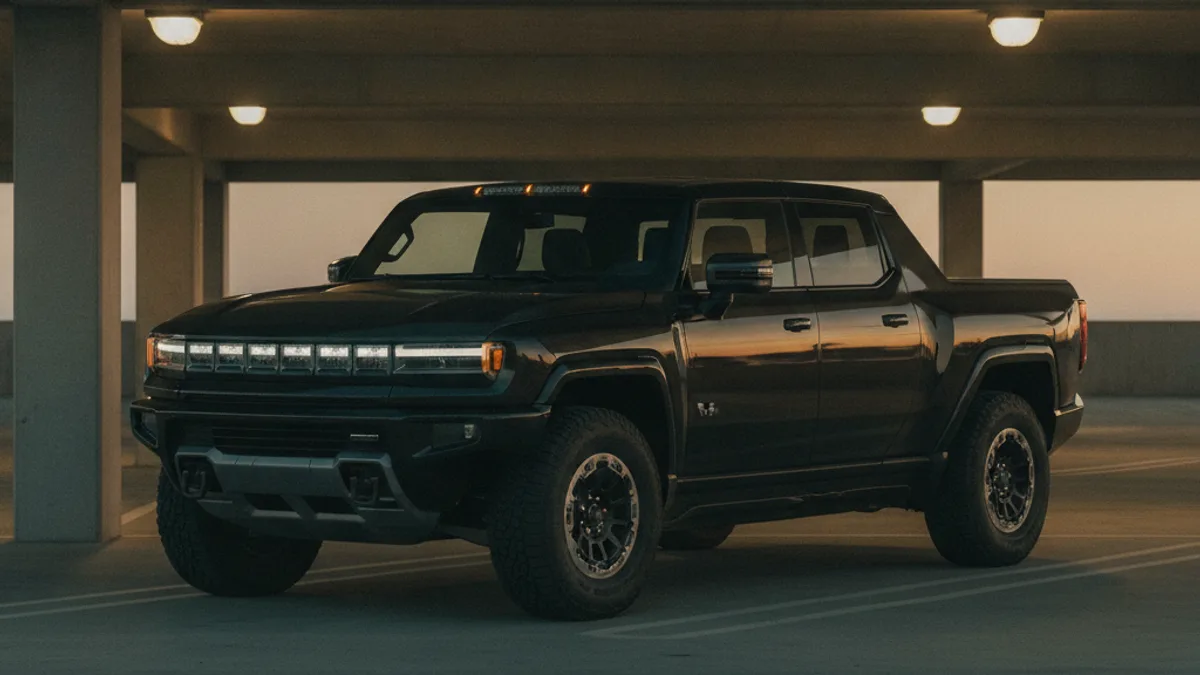
Stay with the truck if you’re on a public street. Turn on the hazards if they still work. Don’t slam a door out of habit. The Hummer EV’s windows need power to index, and that power is gone. A hard close can crack glass on the sky panel or the A-pillar trim. Leave the doors as they are until the 12V is live again.
If you’re on a freeway shoulder, treat the truck as disabled. California Vehicle Code 21718 bans most freeway stops. A disabled vehicle is an exception when you’ve already summoned help. Stay out of the travel lanes while you wait. Vehicle Code 22651(f) allows removal after four hours. That applies on a full-access-control freeway if you can’t move. Don’t sit on that clock if a 12V jump can wake it.
What a dark Hummer EV is actually telling you
A no-start on this truck looks total. The dash stays black, and the power doors ignore the fob. Climate and the center screen never boot either. The last range reading can still look healthy. That figure is the high-voltage pack, not the 12V. See what happens when an EV 12V dies for that split. One small battery can take down a huge truck.
Weeks of sitting is the usual setup here. The alarm and the cabin computers keep sipping current. An aging 12V also just wears out on its own. A jump can wake the truck for a drive. A worn 12V often dies again within days.
The Ultium pack can’t finish the handshake
GM built two electrical worlds into the Hummer EV. Ultium moves the wheels once the truck is awake. The 12V boots the modules that let Ultium connect. Door computers, shifter logic, and the contactors all live on the low-voltage side. If that side sags, the handshake never finishes. You never reach a ready state, even with a full pack.
That’s why a public charge post can’t talk to a dark truck. The port and the session both need a live 12V. Wake the small battery first. Then you can decide if the pack itself needs energy.
Conditions unable to shift, and the voltage band
Hummer EV drivers often see conditions unable to shift first. Other electrical warnings can stack on top of it. GMC’s spec puts a resting 12V at 12.4 to 12.8 volts. A running system sits at 14.4 to 14.8 volts. Drop under that resting band and the low-voltage brain throws junk messages.
Cycling power won’t clear those errors. Reloading the infotainment won’t clear them either. Bring the 12V back into its normal range. A jump or a slow charge on the 12V terminals is what resets the stack.
The window indexing trap
The Hummer EV drops each window a hair when you open a door. The glass rises again as the door shuts. That indexing keeps the window off the roof seal. It runs on 12V, and it stops when the battery is dead. The glass stays stuck high. A normal close can drive it into the sky panel or the A-pillar trim. Chip and crack damage is a real risk on this truck. Treat every door as a manual door until the 12V is jumped. Ease it shut, and don’t let the door’s weight finish the swing.
This hits harder in tight city stalls. San Francisco’s housing is old by Census measure. ACS 2019-2023 data puts 77.2 percent of city structures in the pre-1980 buckets. Oakland sits at 77.9 percent on the same tables. Berkeley is 80.8 percent. Daly City is 78.7 percent. San Bruno is 81.9 percent. Pacifica is 81.1 percent. Those buildings mean low beams and doors that sit inches from a pillar. Confirm later ACS figures on the Census summary file. You’ve got less room to fight a door, and more trim to hit.
Open the eTrunk with the hidden loop
GMC put the 12V in the front trunk, the eTrunk. It sits on the passenger side under a plastic cover. Three tabs hold that cover in place. The lid release is electric. A dead 12V kills the button and the fob.
There’s a mechanical workaround built into the truck. Sit in the driver’s seat and look left of the brake pedal. Reach up behind the wiring harness in that footwell. Find the silver wire with a loop on the end. Pull the loop until you feel it give. You should hear the eTrunk unlatch from the front. It’s tucked back, so the first try can miss the loop. No electrical power is involved in that pull. Once the lid is up, lift the three-tab cover. The battery and the jump terminals sit under it.
Clamp the terminals in the right order
Two terminals sit under that cover. The positive post hides under a red sliding door. Flip the door open and clamp onto the post. The negative terminal sits to the left, next to a green connector. Clamp it like any other 12V ground point.
Connect positive first, then the ground terminal. Give the system about a minute before you try a start. A small jump pack sometimes can’t lift a deeply discharged Hummer EV. An AGM-rated charger on those terminals for about an hour often restores enough voltage. Then you can attempt a start without cooking the modules. See our 12V-only jump guide for cable order.
Symptom to likely cause
| Symptom | Likely cause |
|---|---|
| Dash dark, doors ignore the fob | 12V fully discharged |
| Conditions unable to shift | Resting 12V under 12.4 to 12.8 volts |
| eTrunk button and fob do nothing | 12V too low for the electric release |
| Window hits trim on a close | Indexing is off because the 12V is dead |
| No-starts return within days of a jump | 12V has failed and needs replacement |
If you’ve jumped the truck more than once in a short stretch, stop. A 12V that won’t hold a charge needs to be replaced. EV 12V replacement signs walks through that pattern.
Once the truck wakes, don’t treat the jump as a repair. Drive it to a GM service department and have the 12V tested. Confirm hours and intake rules with the store you pick.
Long sits after a trip, and inland heat
Long sits are the common Bay Area trigger. A Hummer EV left after a flight is a frequent one. Airport sites don’t publish a playbook for this. Confirm current lot rules on flysfo.com, iflyoak.com, or flysanjose.com before you leave the car. SFO has an EV-charging page. This research pass couldn’t verify stall counts or posted rules. Don’t assume a plugged session keeps the 12V healthy. Many trucks still go dark after a long sit. That can happen even when the pack had charge at park.
Peninsula garages around the airport see the same sit. San Bruno, Millbrae, Burlingame, and South San Francisco are short hops from SFO. A truck that sat there for ten days has the same 12V problem. So does a truck that sat downtown.
Inland heat is a different drain on the same battery. 1961-1990 NWS normals via WRCC put San Francisco’s July average max at 71.5F. September’s figure is 73.1F. Oakland Airport’s July figure is 70.4F. San Jose sits near 82F on that vintage. Livermore’s July average max is 89.7F. Antioch’s is 90.4F. Days at or above 100F weren’t verified here, so we won’t invent a count. The inland-to-coast temperature spread is still large and real. A 12V that baked in Livermore or Antioch for a week takes more heat. One that sat in Pacifica or Half Moon Bay sits cooler.
Freeway help, and what the patrol page lists
The truck can also die on I-80, I-880, I-580, or I-680. The Freeway Service Patrol may be on duty. It’s a partnership of MTC, CHP, and Caltrans. Roadside work is run by private tow companies on dedicated beats. Hours published on 511.org are Monday to Friday. The windows are 6 to 10 AM and 3 to 7 PM. Dial 511 and say Freeway Assist, or use a call box. MTC’s FSP page, read 2026-09-18, lists gas, jump-starts, and radiator refills. It doesn’t mention electric vehicles or out-of-charge help. A beat truck may still put 12V on your terminals. Ask what they can do when they walk up. Beat and truck counts aren’t published on that page.
Outside those hours, the call goes to the CHP Rotation Tow Program. You don’t pick the vendor on that rotation. Caltrans District 4 covers the nine Bay Area counties. 511 SF Bay is the regional traveler line for conditions. Express lanes on I-80, I-580, I-680, and I-880 need FasTrak. So do the lanes on US-101 and SR-237. Hours are generally 5 AM to 8 PM on weekdays. This research didn’t confirm lane position. Don’t pull into an express lane on a guess. If you’re on a bridge approach, follow CHP and Caltrans on scene. No published disabled-vehicle-on-a-bridge policy turned up in this pass.
Who actually comes to a Hummer EV
Charge Pro SF is a referral line. It matches stranded EV drivers with independent local mobile rescue operators. It doesn’t own trucks or equipment. It doesn’t employ technicians or hold a license. It doesn’t set prices or promise an arrival time. The operator quotes you before starting and bills you directly.
The pros we connect you with handle Tesla and every major EV brand. GM’s Ultium trucks are in that set. On a Hummer EV they can use the manual eTrunk release. They can jump the 12V at the eTrunk terminals. They can tell you if it’s holding a charge or needs a replacement. If the pack itself is low, they can bring a 240V Level 2 source. Non-Tesla trucks use a CCS or J1772 adapter on that lead. That typically adds 10 to 20 miles of range. The charging window is 15 to 30 minutes. That’s charging time, never an arrival time.
Start with non-Tesla EV rescue if you want that path. EV roadside assistance in San Francisco covers the city 12V-versus-pack split. See the GMC Sierra EV stranded guide for a mobile charge on the same Ultium family. The Chevy Silverado EV 12V checks are the closest GM truck writeup.
Call (415) 630-6268 if you want a local operator quote. The operator confirms what they can do at your pin. Don’t force a door shut while you wait.
Frequently asked questions
Why won’t my Hummer EV start if the pack shows range?
The range figure is the Ultium pack. The 12V is a separate battery that boots the truck. If that 12V is dead or weak, the startup sequence never finishes. A jump on the 12V is what usually brings the cabin back.
How do I open the eTrunk with a dead 12V?
Look in the driver’s footwell, left of the brake pedal. Reach up behind the wiring and find the silver loop. Pull until it gives, and the lid should unlatch. The eTrunk opens with no electrical power on that pull.
What does conditions unable to shift mean?
It means the 12V has dropped under GMC’s 12.4 to 12.8 volt resting range. Low-voltage modules start throwing shift and screen errors. Jump or charge the 12V back into range. Restarting the truck over and over doesn’t fix the voltage.