Your EV 12V battery replacement search usually starts after the screens go dark. If you’re already on a Bay Area shoulder, a swap isn’t the next step. You need the 12-volt system awake so the car can roll. The new battery belongs in a driveway or a shop bay. It doesn’t belong in a live lane.
Why the 12-volt battery can stop the whole car
The traction pack moves the wheels. The 12-volt battery wakes everything else. Door latches, screens, and computers run on that small pack. The contactors that connect the high-voltage system need 12-volt power too. If that feed is too low, the car won’t boot. You can’t select Drive, and the charge port may stay shut. The dash can go blank, so it looks like a dead traction pack. Often it isn’t. For the chain of failures, read what happens when an EV 12-volt battery dies.
Think of the 12-volt unit as the car’s ignition, without a starter motor. Tesla, Rivian, Ford, Hyundai, and the rest still use this layout. Some newer Teslas use a lithium 12-volt pack instead of an AGM unit. Either way, the car won’t close its high-voltage loop without that small battery.
Signs it’s the 12V, not an empty pack
A dark screen doesn’t prove the traction battery is empty. Check the last range you remember, then look for 12-volt tells.
Tesla and several other brands show a 12-volt replacement message. Don’t ignore it. The center display can boot slowly, freeze, or go black. The key fob can stop answering, and door handles may not present. Interior lights can flicker, and windows can crawl. You press the brake and nothing wakes. Random service alerts can pile up when modules starve for stable 12-volt power.
Tesla owners can compare those early warnings in Tesla 12V failure signs before you’re stuck. The pattern is similar on a Rivian, a Mach-E, an ID.4, or an i4. The pack meter isn’t the whole story.
If the car sat for days, start with the 12-volt. That’s true after a long park at SFO. It’s also true on a San Francisco street overnight. It’s true in a Mountain View campus lot after a week away. Airport sites don’t publish a dead-12-volt playbook. The car just won’t wake.
Where this shows up around the Bay
The Bay Area isn’t one climate or one parking pattern.
San Francisco’s housing stock is old. ACS 2019-2023 data puts 77.2% of units in pre-1980 buildings. Daly City is 78.7%. San Bruno is 81.9%. Berkeley is 80.8%. Oakland is 77.9%. That older core means more street parking and fewer private garages. A 12-volt pack drains while the car sits overnight.
The Peninsula still isn’t one place. East Palo Alto and San Carlos don’t share housing or trip patterns. Redwood City and San Mateo mix apartments with office parks. A car can sit in a garage all day, then fail at 6 p.m.
South Bay campuses add another sit. Mountain View, Sunnyvale, Santa Clara, and Palo Alto fill lots for long days. Palo Alto runs on City of Palo Alto Utilities, not a CCA. Santa Clara runs on Silicon Valley Power. That doesn’t change a dead 12-volt. It only tells you who handles home power later.
East County and the Tri-Valley run hotter. WRCC 1961-1990 normals put Livermore’s July average max at 89.7F. Antioch is 90.4F. Gilroy is 88.3F. San Francisco at SFO is 71.5F in July. Oakland Airport is 70.4F. San Jose is about 82F. Heat ages a 12-volt battery faster. A coast car can fail after a Livermore work week.
Newer inland housing looks different too. Brentwood’s pre-1980 share is 10.9%. Dublin is 21.0%. San Ramon is 23.8%. The failure mode is still a long sit or heat. If the 12-volt is dead, a public post won’t wake the car. The contactors never close.
Coastside trips add overnight sits in Pacifica, El Granada, and Half Moon Bay. A dark Tesla in a downtown San Francisco garage is the same 12-volt problem as a Mach-E on I-680. The road changes the next step, not the diagnosis.
A shoulder isn’t a replacement bay
California Vehicle Code 21718 bars stopping on a freeway except in tight cases. A disabled vehicle that can’t keep moving is one of them. You still need help on the way. CVC 22651(f) lets officers remove a vehicle left more than four hours. That applies on a full-access-control freeway. The car has to be unable to move under its own power. A battery swap on the shoulder burns that clock. A jump that wakes Drive gets you off the pavement.
The Freeway Service Patrol is a partnership of MTC, CHP, and Caltrans. Private tow vendors run the beats. 511.org lists weekday hours of 6 to 10 a.m. and 3 to 7 p.m. Dial 511 and say “Freeway Assist,” or use a call box. MTC says FSP handles crashes, debris, a free gallon of gas, jump-starts, and radiator refills. It logs more than 100,000 incidents a year. The MTC FSP page, read 2026-09-18, doesn’t mention electric vehicles or out-of-charge help. An FSP jump may help a 12-volt. Confirm with the driver on scene. Don’t assume they carry an EV procedure.
Outside those hours, the CHP Rotation Tow Program assigns the truck. You don’t pick the company. Caltrans District 4 covers the nine Bay Area counties. 511 SF Bay is the traveler line. None of that is an EV 12-volt replacement.
Express lanes run on I-80, I-580, I-680, I-880, US-101, and SR-237. FasTrak is required. Hours are generally 5 a.m. to 8 p.m. weekdays. If you’re stopped, stay with the car if it’s safe. Don’t wander across live lanes. No published disabled-vehicle-on-a-bridge policy turned up in this research. Confirm with CHP or Caltrans if you stall on a span.
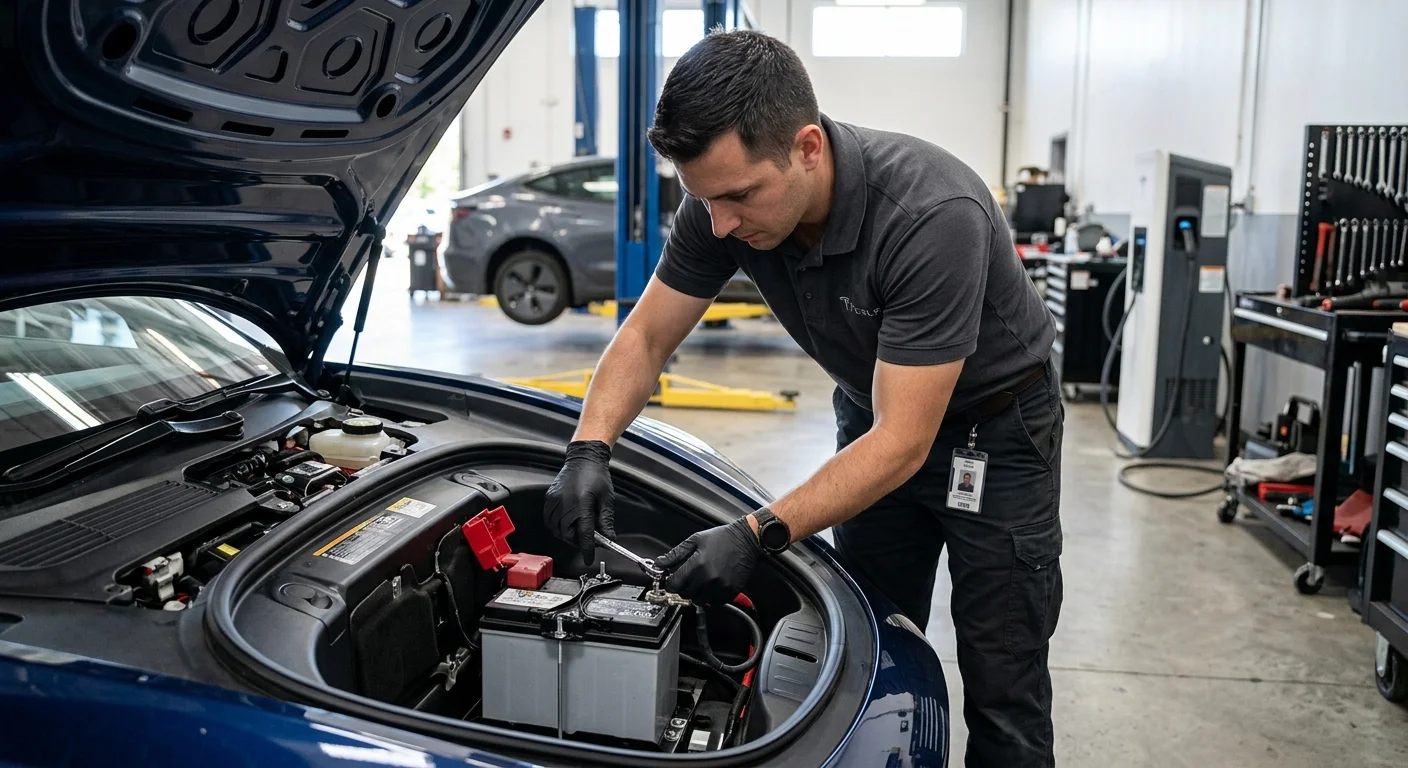
A 12-volt replacement needs space, trim tools, and a quiet car. Tesla Model 3 and Model Y batteries often sit under frunk cowl trim. A Mach-E may hide it in the frunk or under a seat. An Ioniq 5 can sit near the cowl. That’s garage work. It isn’t I-880 in Hayward. It isn’t the SR-24 climb toward the Caldecott. It isn’t the I-580 Altamont shoulder west of Livermore. It isn’t the I-80 waterfront in Richmond, or SR-237 through the South Bay.
Tesla 12V replacement versus a jump when you’re stranded is the split. On a live freeway, wake the car first.
What a jump does from the shoulder
Most EVs have 12-volt jump points. They aren’t the orange high-voltage service plugs. Teslas often hide small terminals behind a front cover or tow-eye area. Rivian and Mach-E manuals show their own posts. Use a 12-volt jump pack on those points. Never try to jump the traction battery. Follow the owner’s manual for polarity and sequence.
Once the computers boot, the high-voltage pack can support the 12-volt system again. That’s a bridge, not a repair. Drive to a shop while the car is awake. Sitting in traffic with a dying 12-volt risks another blackout. This 12-volt jump guide walks through the method.
If you can’t reach the jump points, don’t pry panels in a live lane. A dark, locked car is the same call. Charge Pro SF is a referral line. It matches you with an independent local operator. The brand owns no trucks and employs no technicians. The operator quotes before starting and bills you directly. Operators can jump a 12-volt on site. They can replace a dead 12-volt on site when the spot is safe. On a narrow shoulder, the first job is still to wake Drive and leave.
For Tesla-specific jump work, see Tesla 12V battery jump. Operators also handle CCS and J1772 cars. A 12-volt failure isn’t a Tesla-only problem. After a jump, the car can die again. That’s why the shop visit still matters. Don’t treat a successful start as a finished repair.
Replacement is a driveway or service-center job
If you’re home in Foster City, Concord, or San Jose, a replacement can happen in place. If you’re on US-101 or I-680, get the car somewhere flat and legal first.
DIY is possible for people who already work on cars. It isn’t a freeway task. You need the manual, insulated gloves, and eye protection. Many EVs want a service mode before you lift the negative cable. Disconnect negative first, then isolate the terminals. The hold-down clamp comes off next. Fit the new unit so it can’t shift. Positive goes back first, then negative. Trim returns last. Temporary errors can clear after a short drive. If nothing wakes, stop and reverse your steps.
If that list already feels like too much, skip DIY. A dealer or an independent EV shop will quote parts and labor. No verified 12-volt parts-and-labor figure for Tesla, Rivian, or Mach-E turned up for this page. Don’t guess. Ask the service center for the current OEM or equivalent part, and for labor. Tesla Mobile Service, a dealer, or a local shop sets that number. Confirm it before they order the battery.
Warranty coverage depends on the brand contract. This page doesn’t restate warranty terms that weren’t checked in the research file. Ask the manufacturer or read the glove-box booklet.
Long parking, airports, and a car that won’t wake
A week at the airport is a classic 12-volt killer. SFO’s EV charging page exists, but it couldn’t be verified in this research. Confirm current parking and charging rules on flysfo.com before you leave the car. OAK’s parking page lists Economy, ValuPark, Hourly, and the Park & Call cell-phone zone. It doesn’t show EV charging on that page. SJC lists economy, hourly, and daily lots, plus a cell-phone waiting area. That page also doesn’t show EV charging. None tell you what to do if the car won’t wake. Tesla 12V failure after a long park covers that gap.
BART park-and-ride is a different story. bart.gov lists Level 2 charging at Warm Springs / South Fremont with 42 plugs, and Lafayette with 4 plugs. That doesn’t help a car whose 12-volt pack can’t close the charge circuit. If the car is dark in a BART lot, treat it as a 12-volt or lockout problem first.
Private-property tows follow CVC 22658. The lot needs a posted sign at least 17 by 22 inches. Lettering must be at least one inch. The operator must notify law enforcement within one hour. California doesn’t cap ordinary consensual tow rates statewide. If a garage is about to hook your dark EV, ask for the posted rate and the lot’s enforcement number. A fee isn’t published here because it isn’t a statewide number. Read the sign.
When the traction pack is empty too
A dead 12-volt and a truly empty traction pack can show up together. The jump may wake the computers. The car still won’t go far. That’s a charge problem, not a battery-swap problem. The operators we connect you with can bring a 240-volt Level 2 source to the car. Tesla uses a native NACS plug. Other EVs use a CCS or J1772 adapter. Charging time is typically 10 to 20 miles of range in 15 to 30 minutes. That’s charging time, never an arrival time. The operator quotes before they start.
If you only need the 12-volt awake, say so. Don’t order a mobile charge for a car that already has range. Don’t order a 12-volt swap when the pack is at zero. Name the road. Let the operator pick the tool.
For city-level charging context, start at the Bay Area EV charging hub. It won’t replace a jump on I-80. It will help you plan the drive after the car wakes.
Call for a local operator, then get the swap done
From a shoulder on I-880, SR-4, or the Bay Bridge approach, your first job is simple. Make the car visible. Stay out of traffic. Decide whether this is a 12-volt blackout or an empty pack. Then get the car awake and off the freeway. Do that before the four-hour clock becomes a tow.
Charge Pro SF connects stranded EV drivers with independent local mobile rescue operators. It performs no work. It holds no license. It sets no prices. The operator can jump a 12-volt or replace one in a safe spot. They can add roadside range if the traction pack is empty. They quote you first. They bill you directly.
If you’re already home, skip the freeway logic. Book the replacement with a shop. Use a jump only to move the car into a bay. The search term is still ev 12v battery replacement. The next step depends on where the car sits.
Call (415) 630-6268 and we’ll connect you with a local operator who quotes before starting.