Towing a Tesla with no power is not like towing a gas car, and getting it wrong can cause thousands of dollars in damage. The electric motors are directly connected to the wheels through a single-speed gearbox. If the drive wheels spin while the car is off, the motors generate electricity with nowhere to go. That can overheat them, damage internal components, or send uncontrolled current back into the battery system. The right approach is a flatbed, Transport Mode, and a clear conversation with the operator before any cable goes on the car.
Transport Mode, and how to enable it when the screen is dead
Transport Mode disengages the parking brake and neutralizes the drivetrain so the wheels can spin freely without engaging the motors. Normally, you activate it from the touchscreen under Controls > Service. The catch is that Transport Mode lives inside the touchscreen, and the touchscreen lives inside the 12V system. If the 12V is dead, the screen is dark and you cannot get to it.
The fix is a temporary 12V jump. On Model 3 and Model Y, pop the tow eye cover on the front bumper, driver’s side, and connect a lithium jump pack to the red positive pigtail and the ground stud. On Model S and Model X, the jump posts moved inside the frunk for the refresh; use the manual cabin release to pop the frunk. The jump gives the low-voltage electronics just enough power to boot, which is enough to open the touchscreen and engage Transport Mode. This is not a charge. It is a temporary wake-up to enable safe movement. If you are locked out because of a dead 12V, see how to jump start a Tesla that won’t wake.
Flatbed only, and why dolly tows damage Teslas
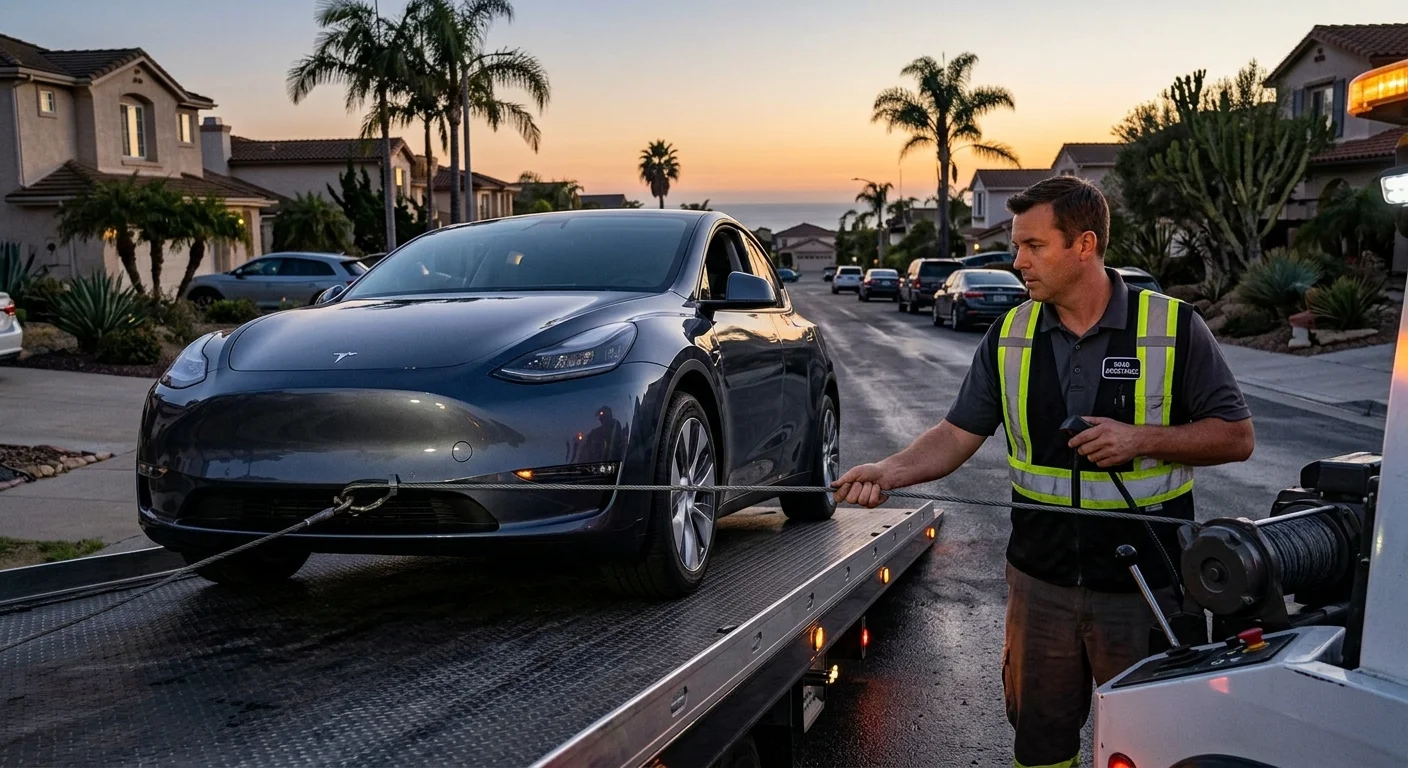
A flatbed truck is the only safe way to tow a Tesla. Any other method, especially a dolly tow or a hook-and-chain tow, guarantees severe damage.
A dolly tow lifts either the front or rear wheels while the other pair stays on the ground. If the drive wheels spin while the car is off, the electric motors generate electrical current. With the battery management system inactive, that current cannot be safely dissipated. The result is rapid overheating and irreversible damage to the motors and other sensitive electronics. Even a short dolly tow can cause thousands of dollars in repairs. Dolly towing also stresses the suspension and steering in ways they are not designed for. Always insist on a flatbed, with all four wheels lifted off the ground.
What to tell the tow operator before they hook up
A clear conversation prevents the wrong equipment from ever touching the car. Before anyone connects a cable, the operator needs to hear these points.
First, say plainly: it is a Tesla, and it must be transported on a flatbed truck, no dolly towing. That single sentence rules out the equipment that causes the damage.
Second, explain the power situation: the 12V battery is dead, so we will need to jump it temporarily to enable Transport Mode. Be ready to guide the operator to the 12V jump points if they are unfamiliar.
Once Transport Mode is enabled and the parking brake is released, confirm the proper winching procedure. The wheels must be pointed straight ahead, and the winch should pull the car smoothly onto the flatbed. The operator should use Tesla’s designated tow points. These are specific reinforced areas designed to handle the vehicle’s weight. Avoid any operator attempting to attach chains or hooks to suspension components or the underbody. A professional EV-experienced operator will already know these steps. If they hesitate, do not proceed. For a Bay Area operator matched to your model, see Tesla roadside rescue.
Freeway Service Patrol is not the same help
The Freeway Service Patrol is a partnership of MTC, CHP and Caltrans that runs Monday through Friday, 6 to 10 AM and 3 to 7 PM. You reach it by dialing 511 and saying Freeway Assist or by using a call box. The MTC FSP page lists gas, jump-starts and radiator refills. It does not mention electric vehicles or out-of-charge help. FSP will not bring a Level 2 charger to your Tesla.
Outside FSP hours, calls go to the CHP Rotation Tow Program. The rotation distributes tows among approved vendors. You do not pick the company on rotation. The rotation truck is not guaranteed to carry a flatbed or to know Tesla procedures.
The Freeway Service Patrol can still help with safety. They will set flares and clear a lane. What they will not do is add range to a dead Tesla. CVC 21718 limits stopping on a full-access freeway. CVC 22651(f) allows removal of a vehicle that has been stopped or left standing for more than four hours and cannot move under its own power. That rule still applies when the cause is a dead battery rather than a collision.
When mobile charging beats towing entirely
A dead Tesla does not always need a tow. It sometimes just needs power. Distinguishing between a dead 12V and an empty traction pack matters here.
If the touchscreen is black and the car will not respond, it is most likely the 12V. A quick 12V jump brings the systems back online, allowing you to drive to a Supercharger or home charger. That is faster than a flatbed, cheaper than a flatbed, and avoids any risk of tow damage. See Tesla 12V battery jump.
If the traction pack is genuinely depleted, a flatbed to a charger is the obvious answer, but mobile EV charging is often faster. A 240V Level 2 source brought to the car can add enough range to reach the nearest Supercharger without transporting the vehicle at all. You skip the tow, the wait at the charger, and the cost of both. For a stranded Tesla anywhere in the Bay Area, see mobile EV charging and out of charge recovery.
Bay Area corridors where this comes up
The same places generate most no-power Tesla calls around the Bay.
- The Bay Bridge approach on I-80. Stop-and-go with climate control burns a low pack. A car that looks fine in Emeryville can run dry in the Yerba Buena Island tunnel.
- The Altamont climb on I-580 eastbound. A sustained grade out of Livermore with crosswind. A driver who started the climb on a thin percent is the classic Tri-Valley call.
- 19th Avenue and SR-1 toward the Golden Gate Bridge. Hills, traffic, and a fog bank at the bridge approach.
- US-101 down the Peninsula. A long stationary commute with the heater running is how the percent drops without warning.
- The Caldecott Tunnel on SR-24. Climbing four bores westbound out of Oakland into Contra Costa burns more range than the flat distance suggests.
A Tesla that goes dark on any of these roads needs a flatbed if it cannot move under its own power. The operator quotes you before any cable goes on. Nobody on this line promises an arrival clock.
Call (415) 630-6268 when you want a match to a Bay Area operator with Tesla-specific tools. For more on what a roadside rescue rig actually carries, see what is on a mobile EV rescue rig.