How long it takes to charge a Ford Lightning is not one number. It depends on the pack, the plug, and the air around the truck. Ford’s published figures put a 15 to 80 percent DC fast charge near 41 minutes. That’s the Extended Range pack, under mild conditions. A home Level 2 fill for that same pack often runs 8 to 10 hours. Inland heat around Livermore can stretch a fast session. A cooler stop on the coast often stays closer to those published minutes.
Two packs sit on two different clocks
The Lightning ships with two traction batteries. They don’t fill on the same schedule.
The Standard Range pack holds about 98 kWh total. About 89.5 kWh of that is usable. The Extended Range pack is larger, about 131 kWh total. About 120 kWh of that is usable.
A larger pack takes more hours to fill at home. At a DC stall it can also take a higher peak rate. Ford’s published 15 to 80 percent times sit close together. Extended Range is about 41 minutes. Standard Range is about 44 minutes. Both assume the stall can actually feed that peak.
Pack, charger, and pack temperature all change the clock. That last one is how this metro splits a session.
Livermore heat is not coastal air
The Bay Area isn’t one climate. July’s average max at San Francisco / SFO is 71.5F. That’s the 1961-1990 NWS normal, via WRCC. Oakland Airport’s July average max is 70.4F. Livermore’s July average max is 89.7F. Antioch’s is 90.4F. San Jose sits around 82F.
That inland gap is large, and it’s real. A truck parked in Livermore can start a DC session with a warm pack. So can one climbing I-580 toward the Altamont. Fast charging isn’t a flat line. The battery management system pulls power back when the cells are hot. Spec-sheet minutes assume a mild starting temperature. A Tri-Valley afternoon often isn’t that.
The coast is the other end of the same metro. Pacifica and Half Moon Bay sit in marine air. A stop after an SR-1 run often starts closer to Ford’s mild window. Same truck, same charger class, different clock. Pleasanton and Dublin sit in that inland bowl. San Ramon sits on the I-680 ridge.
We couldn’t confirm how many days hit 100F. Don’t plan around a round count from a forum. Check the day’s forecast before a long inland pull. Towing or a loaded bed adds heat of its own. After a grade, the charge rate can look stuck low at first. That’s often the pack protecting itself, not a failed stall. Home Level 2 is a lower-power session. Heat rarely changes an overnight fill the way it changes a DC stop.
Winter still slows a first plug. Treat an inland dawn session as slower until the pack warms.
Overnight at home: 120 volts versus 240 volts
A regular 120-volt outlet will charge a Lightning. It won’t keep up with a truck this size. From empty, a Level 1 fill can take several days. Treat that cord as a backup, not a daily plan.
Level 2 at 240 volts is the weekday clock. Ford’s Charge Station Pro is rated up to 80 amps on a dedicated circuit. Ford’s figures put empty to full around 8 to 10 hours on Extended Range. Standard Range sits around 6 to 8 hours. A 48-amp wall unit stretches a full fill into about 12 to 14 hours. Plug in when you park and overnight still covers a normal commute.
Wall time also depends on the house. Census ACS 2019-2023 data, table B25034, puts pre-1980 housing at 77.2% in San Francisco. Livermore is 53.1%. Dublin is 21.0%. Older stock is a proxy for tighter panels and fewer 240-volt circuits already in the garage. That doesn’t mean a Livermore house already has a charger. It means a Peninsula bungalow may need an electrician first. Confirm panel capacity before anyone buys hardware.
Charge Pro SF doesn’t install wall units. If you need a 240-volt circuit, that’s a licensed electrician’s job. If the truck is already empty, a wall project won’t move it tonight. Compare a home 240-volt session with a roadside 240-volt rescue before you wait on an install.
PG&E is the wires utility in Livermore, with Ava Community Energy on generation. San Francisco is PG&E plus CleanPowerSF. Those names matter for home rate plans. They don’t set a public stall’s speed. Confirm any home charging rate with your provider. We don’t quote bills.
DC fast charging, and why stops end at 80 percent
On a stall that can feed the truck’s peak, Ford lists about 41 minutes. That’s 15 to 80 percent on Extended Range. Standard Range is about 44 minutes. Those are ideal-condition numbers. A busy public stall often runs below its rated output. Your session then takes longer, even if the truck is ready.
The curve isn’t flat. Like most EVs, the Lightning takes power fastest in the middle of the session. It tapers as the pack fills. The last 20 percent can eat as much clock as the rest. That’s why trip planning aims at 80 percent, not 100, on a DC visit.
Starting already high in the pack adds less range than the percent climb suggests. Starting low on a hot inland afternoon can look slow at first. Cooling is still catching up. Neither case matches the brochure minute count.
Named Level 2 sites you can verify include BART’s Warm Springs / South Fremont lot, with 42 plugs. Lafayette has 4 plugs. Those are Level 2 only, per bart.gov. They won’t match a DC stop’s minutes. SFO’s EV charging page exists, but the facility detail couldn’t be verified here. Ava Community Energy publishes an Ava Charge fast-charging network in Alameda County.
If the session isn’t slow, it’s stuck
A charge that never starts isn’t a time problem. A Lightning that won’t wake is often the 12V battery. So is a truck that won’t accept a plug. Walk through the Ford F-150 Lightning 12V checks before you blame the traction battery.
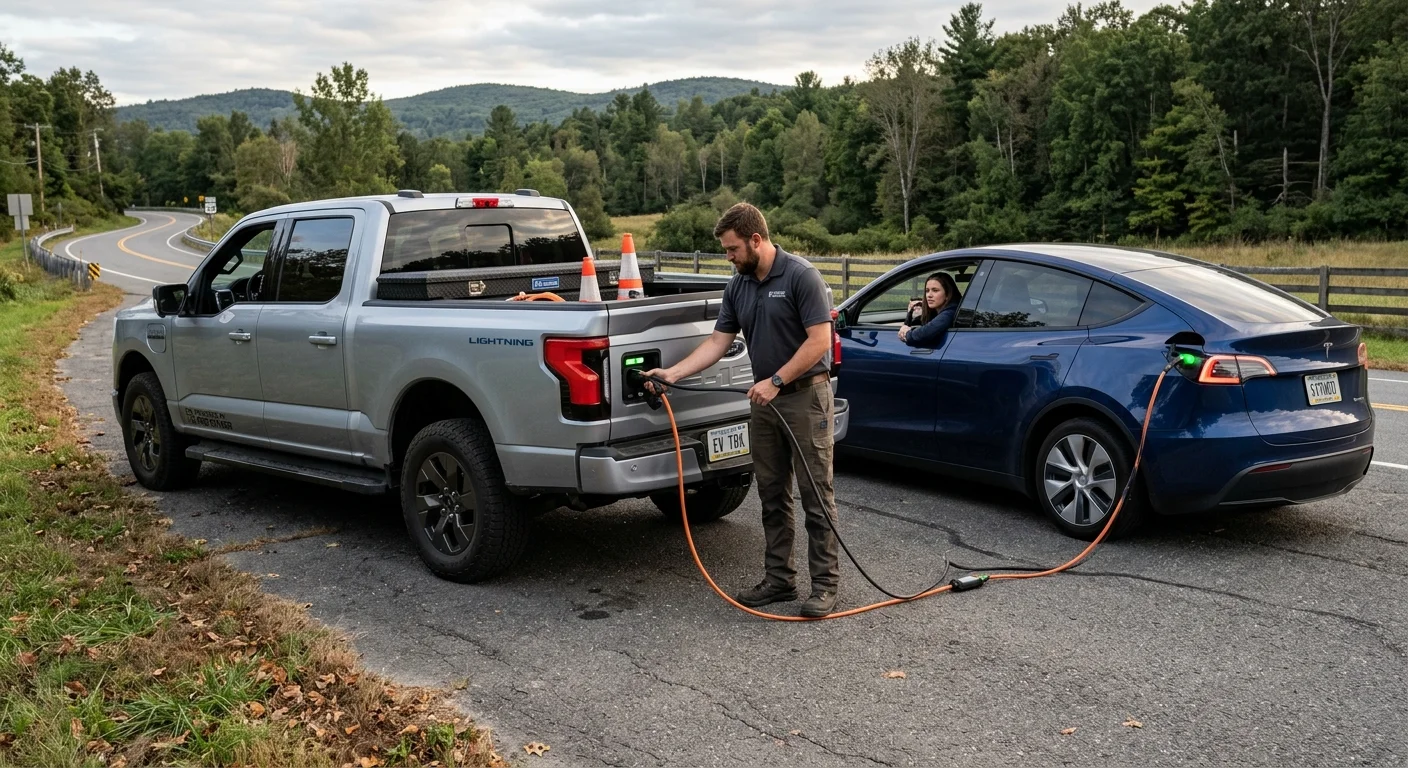
Whether the truck can push power into another EV is a separate question. We cover it in whether an F-150 Lightning can charge the EV next to you.
Empty on I-580, not just late to a stall
Sometimes the question isn’t how long a charge takes. It’s that the truck already stopped. On a full-access-control freeway, CVC 21718 still allows a stop. The vehicle has to be so disabled that stopping is unavoidable. Help has to have been summoned. CVC 22651(f) lets a vehicle be removed after four hours. That’s if it can’t move under its own power. Stay with the truck if you can do it safely. Call for help before that window closes.
The Freeway Service Patrol is a partnership of MTC, CHP, and Caltrans. It runs Monday to Friday, 6 to 10 AM and 3 to 7 PM. Dial 511 and say “Freeway Assist.” The MTC FSP page lists gas, jump-starts, and radiator refills. It doesn’t mention electric vehicles or an out-of-charge fill. Outside those hours, CHP Rotation Tow assigns the truck.
Charge Pro SF is a referral line. We don’t own trucks, and we don’t charge the Lightning ourselves. We connect you with independent local operators who can bring a 240-volt Level 2 source to the vehicle. Typical onboard charging adds about 10 to 20 miles of range. That’s 15 to 30 minutes of charging, not a clock for when someone arrives. The operator quotes you before work starts and bills you directly.
If you’re already empty near the Altamont, start with out of charge on I-580 over the Altamont. Livermore drivers can also use the Livermore city charging page. For a truck that can’t make the next stall, use mobile EV charging. Non-Tesla EV rescue covers Lightning owners who aren’t in a Tesla network.
Frequently asked questions
How long does it take to charge a Ford Lightning at home?
On Ford’s Charge Station Pro, Standard Range is about 6 to 8 hours full. Extended Range is about 8 to 10 hours from empty. A 48-amp home unit can stretch a full fill to about 12 to 14 hours. A 120-volt outlet can take several days from empty.
How long does a Ford Lightning DC fast charge take?
Ford’s published figures list about 41 minutes for Extended Range, from 15 to 80 percent. Standard Range is about 44 minutes on a stall that can match the truck’s peak. Real sessions run longer when the stall is weak or the pack is hot. Inland Livermore heat is a common reason the curve stays below the spec sheet.
What should I do if my Lightning is empty on the road?
Stay safe, then get help moving before a four-hour freeway removal becomes an issue. FSP may not charge an EV. Charge Pro SF connects you with an independent operator. Call (415) 630-6268 and we’ll match you with a local pro who quotes before they start.