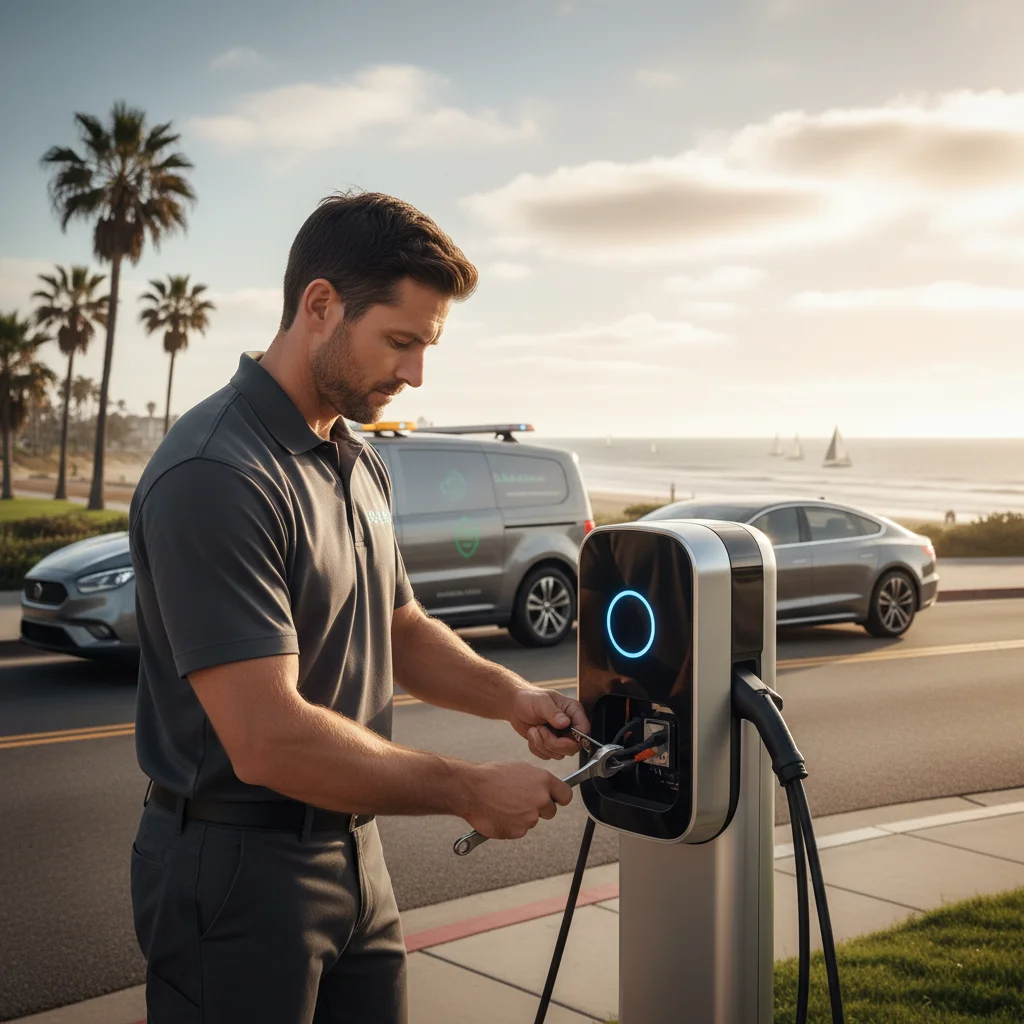
A dead EV on Santa Clara County’s south edge is a thin-margin problem. Heat, AC, and a long US-101 run spend range you thought you had. EV roadside assistance in Gilroy means a mobile charge or a 12V jump. Charge Pro SF doesn’t roll trucks or employ techs. We match stranded drivers with independent local operators who quote and bill you directly.
Why Gilroy spends range faster than the rest of the South Bay
Gilroy sits at the far south end of the US-101 market. The Census 2024 estimate is 60,390 people, and ACS 2019-2023 counted 58,561. The city covers 16.536 square miles in ZIP 95020. It’s an incorporated Santa Clara County city, not a freeway rest stop.
July’s 1961-1990 normal high here is 88.3F, from WRCC cooperative-station normals. San Jose’s July normal sits near 82F, against San Francisco at 71.5F. That inland gap is the whole story in summer. Cabin AC and pack cooling both pull from the traction battery. A Peninsula commute estimate won’t match Leavesley Road at 4 p.m.
The Gilroy Premium Outlets pull day-trip traffic off the freeway. Downtown, Christmas Hill Park, and Garlic Festival heritage add weekend volume. Eagle Ridge, Glen Loma, Sunrise, and Las Animas sit off that local grid. They share the same south county heat and the same 101 access. A car that left San Jose with “enough” can arrive thin.
The 101 run, Pacheco Pass, and Hecker Pass
US-101 is the north-south spine through town. Monterey Road and Leavesley Road feed local trips onto it. Once the gauge is already low, that freeway doesn’t give the buffer back. Express lanes run on US-101, and FasTrak is required. MTC lists weekday hours generally as 5 a.m. to 8 p.m. We couldn’t verify which side of the roadway those lanes occupy. Get to a safe shoulder or the next exit instead.
SR-152 is the cross-valley gamble, with climbs in both directions. East, it climbs the Pacheco Pass toward I-5. West, Hecker Pass heads toward Watsonville and the coast. Climbing with a thin pack is a different job than a flat 101 cruise. We didn’t find a verified published grade for that pass in this research. We won’t invent a grade to fill that gap. You’ll still feel the draw on the way up.
Morgan Hill sits just north on the same valley floor. Hollister is east of the pass, and Watsonville sits west over Hecker Pass. EV roadside help in Morgan Hill is the sibling piece.
Stay out of a live lane if you can still roll. California Vehicle Code 21718 bars freeway stopping in most cases. The disabled exception applies when stopping is unavoidable and you’ve summoned help. CVC 22651(f) allows removal after more than four hours on a full-access-control freeway. That applies when the car can’t move under its own power. Call while you still have a safe place to wait.
Empty pack versus a 12V that won’t wake the car
A Tesla that won’t open at the outlets may not be at 0%. Most EVs still use a 12-volt battery to wake computers, locks, and contactors. If the screen is dark and the port won’t release, start with the 12V. If you rolled to a stop at 0%, the high-voltage pack needs energy.
The pros we connect you with handle both jobs, and they’re licensed and insured. They bring a 240V Level 2 source to the car. Teslas take a native NACS plug. Other brands use a CCS or J1772 adapter. Typical on-site charging adds 10 to 20 miles of range. That takes 15 to 30 minutes of plug time. The operator quotes you before they start and bills you directly.
If the 12V is dead, they can jump it or replace it on site. Read EV roadside assistance for how that call is framed. For the empty-pack path, mobile EV charging is the matching page. Don’t assume a public stall will save a car that won’t wake. A dead 12V can block charging even when a cable is close. Check the dash and the app before you pick a plan.
What 511 can do on this stretch of 101
If you’re on the freeway during patrol hours, try the Bay Area Freeway Service Patrol. It’s a partnership of MTC, CHP, and Caltrans. 511.org lists weekday hours as 6 to 10 a.m. and 3 to 7 p.m. Dial 511 and say “Freeway Assist,” or use a call box. MTC says the patrol handles over 100,000 incidents a year.
MTC’s FSP page lists a free gallon of gas, jump-starts, and radiator refills. It doesn’t mention electric vehicles or out-of-charge help. We read that MTC page on 2026-09-18. A 12V jump might still fit the jump-start item. An empty traction pack isn’t a gallon of gas. Don’t wait on a service that never listed this job.
Outside those hours, CHP’s Rotation Tow Program assigns a vendor you don’t pick. Caltrans District 4 covers the nine Bay Area counties for cameras and highway conditions. None of those agencies set a mobile-charge price. The operator you get through us quotes their own rate.
California doesn’t cap ordinary consensual tow rates statewide. CVC 22658 covers private-property tows and posted-sign rules. CHP sets rates only for its own rotation vendors. Ask the mobile operator for a quote before they plug in. We don’t publish a fee, and we don’t set one. Outlet lots are private property, so posted-tow rules can apply.
Heat, home power, and a car that’s already empty
Gilroy’s inland summers are the hottest in the South Bay. That’s the climate against the Pacheco Pass and the valley floor. Battery thermal systems run harder in that heat too. We couldn’t confirm a count of 100F days from the sources we checked. Don’t plan around a forum number for 100F days. Use the National Weather Service forecast the morning you drive. A car sitting in outlet parking is already warm before you merge. Pre-cool from the app while you’re still plugged in at home when you can. Once you’re rolling with a thin gauge, ease the cabin setpoint. Don’t spend the last bar on the pass if you can still exit.
A wall box at home doesn’t help a car that’s empty on Monterey Road. ACS 2019-2023 puts 36.0% of Gilroy housing as built before 1980. That’s a Census proxy for older panels and plug-limited stock, not a permit tally. A home battery that’s up still can’t reach a car that’s dead in a lot. Gilroy home batteries, and the EV that’s already empty covers that mismatch.
PG&E runs the wires here. Silicon Valley Clean Energy is the community choice aggregator. Neither one dispatches a rescue truck to a stranded EV. PG&E lists residential EV rate plans and a Residential EV Charging rebate on pge.com. We’re not quoting a dollar figure we didn’t verify on those pages today. Check pge.com and svcleanenergy.org for current program text.
Lots, downtown, and the 12V that dies while you shop
Outlet lots and downtown street parking are where 12V failures hide. Cameras, cabin overheat protection, and a hot soak nibble the small battery for hours. You come back, the app is silent, and the charge port won’t open.
That’s a roadside job, not a drive to a fast stall. You can’t reach a post if the contactors won’t close. A local operator can wake the 12V first. They can then add enough Level 2 range to reach a public charger you choose. We won’t name a specific site or a mileage to one. Maps change, and this research pass didn’t lock a verified charger list for Gilroy.
If you’re still rolling with a low percentage, take the next safe exit. Leavesley Road and the 101 ramps beat a live lane, so call from there. Sitting in traffic until the car dies doesn’t help. Have the year, make, and model ready. Say whether it’s a Tesla or another brand. Say whether the screen is dead or you hit 0%. Pin downtown, the outlets, Eagle Ridge, or an SR-152 shoulder. If you’re on the freeway, say so, because that changes the CHP overlay. Stay with the car if it’s safe, and set hazards. The operator bills you, and Charge Pro SF doesn’t.
For how a truck-side 240-volt session actually works, read what’s an EV charging truck. Use what to do when the EV is running low while you can still roll. City-level notes live on the Gilroy charging and rescue page.
Frequently asked questions
Does Charge Pro SF send a truck to Gilroy?
No, Charge Pro SF is a referral line for the Bay Area, including Gilroy. We connect you with independent local mobile rescue operators. They bring the 240V source or a 12V jump. They quote before they start and bill you directly. We don’t hold a contractor license, own equipment, or promise an arrival window.
What can the operator do on US-101 or SR-152?
They can add 10 to 20 miles of range with Level 2 charging. That takes 15 to 30 minutes of plug time. They can jump or replace a dead 12V on site. NACS is native for Tesla, and CCS and J1772 adapters cover other EVs. If you’re on the freeway, that call still summons help under CVC 21718.
Should I wait for Freeway Service Patrol instead?
You can try 511 during weekday FSP hours and ask for Freeway Assist. MTC’s page doesn’t list out-of-charge EV help. A gas can and a 12V jump are the published extras. If the traction pack is empty, don’t assume the beat truck will charge it. Call a mobile operator too if the car can’t move.
Charge Pro SF serves Gilroy and the rest of the Bay Area. When you’re stuck, call (415) 630-6268 and we’ll match you with a local operator.