Brentwood sits at the eastern edge of the in-scope market, where the East Bay opens onto the Sacramento-San Joaquin Delta and the suburbs thin out along SR-4. New subdivisions in Brentwood and east Antioch sit ahead of the retail DC fast charging that usually follows rooftops, and Delta heat punishes range in summer. Charge Pro SF connects drivers with licensed, independent local operators who review the details before recommending mobile charging or transport.
Brentwood at a glance
Brentwood covers 14.865 square miles. Census ACS 2019 to 2023 counted 64,609 residents; the 2024 Census estimate is 66,286. Median household income is 139,567, Hispanic or Latino share is 24.8 percent, and only 10.9 percent of housing was built before 1980. The brand-new subdivisions and master-planned neighborhoods east of SR-4 shifted that share substantially in the last decade.
The climate is genuinely inland Delta heat. NWS 1961 to 1990 normals via WRCC put Antioch’s July average max at 90.4F, the hottest of any city in the launch 50. Brentwood runs the same inland pattern. AC load on a stopped EV in Brentwood in July is not the same as AC load in San Francisco’s 71.5F fog.
Why a depleted EV in Brentwood needs a specific plan
Brentwood’s network facts shape the call.
SR-4 is the spine. Every east-county commute runs on SR-4, and a single stalled lane can back the freeway up for miles. Stop on a shoulder only if you can do so safely, turn on the hazards, and stay out of traffic while you call.
Distances are long. Antioch to the west, Oakley and Discovery Bay to the east, the Bethel Island ferry and the Delta to the north. A driver who runs the SR-4 corridor on a low battery and finds the nearest DC station full has limited options.
Delta heat stresses the pack. A July average max near 90F and a parking-lot AC cycle in a stopped EV run the battery management system harder than the coast. Even a 90-degree day with windows up can take a noticeable bite out of range during a long sit.
Vasco Road is the back way south. A long, hot, empty road that runs from Brentwood toward Livermore and the Tri-Valley. A driver who runs low on this stretch has cell signal that drops in places. Confirm coverage before you call.
BART does not reach Brentwood. The Antioch BART station is the eastern end of the line, so Brentwood commuters drive. That puts more cars on SR-4 each morning.
What an operator brings to Brentwood
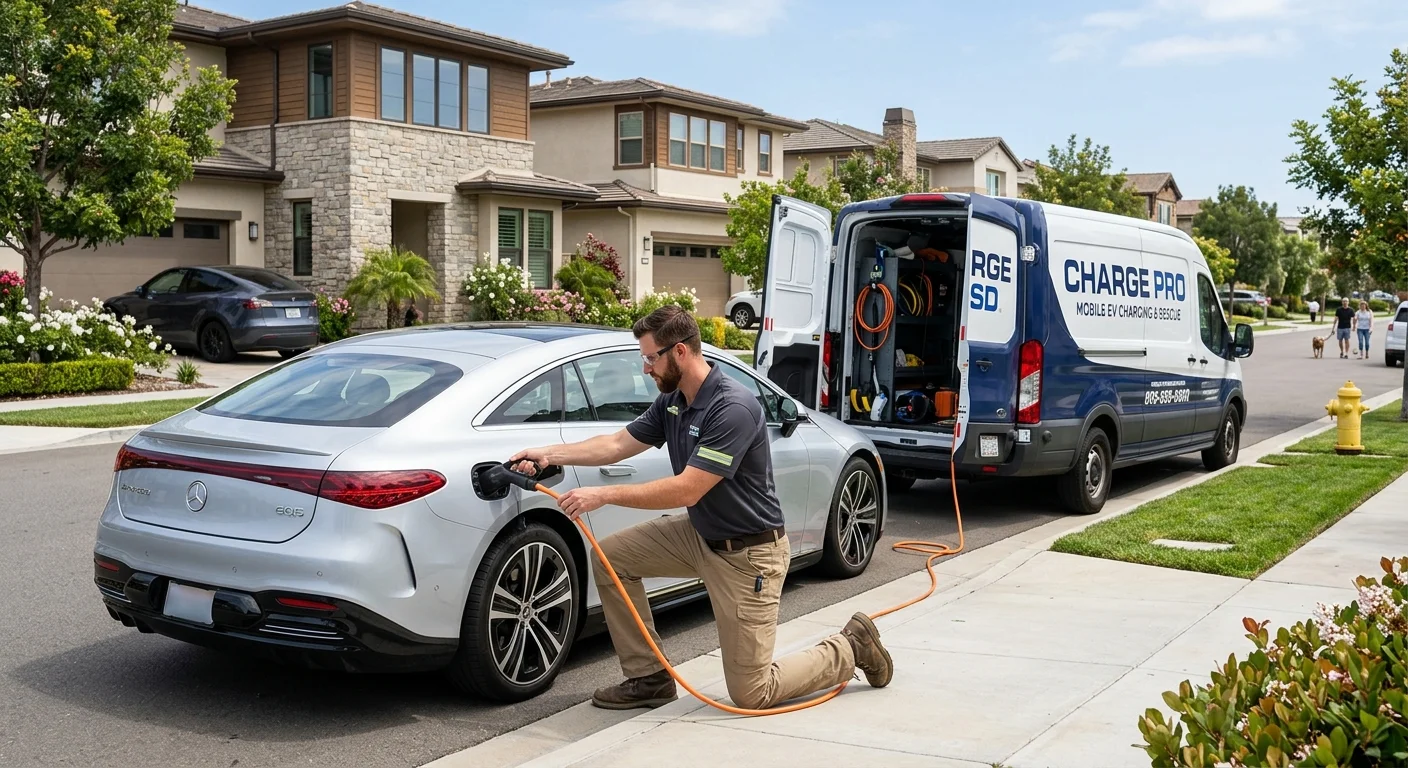
The operator we connect you with runs an operator vehicle equipped with a 240V Level 2 bed outlet, a native NACS plug, and a CCS adapter for non-Tesla EVs. For an empty traction pack, the operator delivers enough range to reach a working DC station or get you home. For a dead 12V, the operator carries portable jump packs and confirms the car boots before leaving.
The pros we connect you with are licensed and insured. They bring a 240V Level 2 source to the car. Tesla cars take a native NACS plug on the port. Non-Tesla EVs use a CCS or J1772 adapter. A typical session adds about 10 to 20 miles of range. That takes 15 to 30 minutes of charging, which is charging time, not an arrival time.
The operator quotes before any cable goes on. Nobody on this line promises an arrival clock.
Share the right location detail
A precise location helps the operator assess the request before accepting it. Start with the nearest named landmark, your direction, and the side of the roadway. Include a dropped map pin when possible.
If you are off SR-4, say which road you used. “Near Balfour Road” still covers several possible access points. Add the nearest business, parking entrance, cross street, or visible sign. Describe whether the vehicle is on a public lot, a private driveway, the Streets of Brentwood parking, or a street curb.
Access details matter beyond the street name. Tell the operator if the EV is inside a parking garage, gated community, or shopping center lot. Share the garage level, entrance name, gate instructions, and clearance signs you can see. Do not assume a service vehicle can enter every space.
In the newer subdivisions east of Balfour Road, residential driveways can be narrow with cul-de-sac turnarounds that limit a long rescue vehicle. Tell the operator if the EV is on a curb, in a driveway, or in a small lot.
Also identify the vehicle before the operator arrives. Share the make, model, model year, and charge-port location if known. Tell them whether you have a charging adapter, but don’t assume it matches their equipment. The operator must confirm vehicle and connector compatibility.
Tell empty charge from low-voltage failure
“Dead battery” can describe two different problems. The traction battery may be depleted, or the vehicle may have a low-voltage electrical failure. Those situations can look similar from the driver’s seat, but the recovery path may differ.
Tell the operator what happened before the vehicle stopped. Share the last battery percentage or estimated range you saw. Mention any low-charge messages, power reduction, charging errors, or low-voltage warnings. Exact dashboard wording is more helpful than your diagnosis.
Next, describe what still works. Does the main screen turn on? Do the doors unlock normally? Can the car shift into drive or neutral? Does the charge port respond? Report what you observe without taking panels apart or touching electrical components.
A blank screen doesn’t prove that the traction battery is empty. Likewise, a visible battery percentage doesn’t explain every no-start condition. The matched operator reviews the symptoms, vehicle, and location before deciding what service fits. Some problems may need transport instead of an on-site charge.
The out-of-charge EV recovery service covers requests where the main battery appears depleted. The operator still confirms whether mobile charging is suitable for that particular vehicle and location.
Brentwood-specific stranding angles
Streets of Brentwood. A long parking lot on a Saturday. If a DC station is occupied or out of service, an EV with a marginal state of charge that pulls in may not pull out.
The Harvest subdivision. A master-planned community with newer charging infrastructure, but it sits east of Balfour Road with limited cell signal in places. Confirm coverage before you call.
Rural roads toward the Delta. A driver who runs SR-4 east into Oakley or further out toward Discovery Bay on a low battery has very limited backup. Mobile rescue is the right call.
Brentwood Boulevard corridor. A long commercial spine with newer retail charging, but a stalled EV on a curb here has to share the lane with traffic until the operator arrives.
When to call us
Call when your EV has stalled in Brentwood or anywhere along the SR-4 corridor and you need an operator to assess mobile charging or transport. Have your location, vehicle details, battery reading, and dashboard messages ready. Call us at (415) 630-6268 and we will connect you with a local operator who knows east Contra Costa. For the broader pattern, see out of charge on the SR-4 Delta and EV roadside help Bay Area 2026.