Past Concord, SR-4 turns into a hot inland run toward the Delta. If your EV is sitting at zero on that spine, start with a pin. Then share the exact dash wording, and whether the car can still roll. Those three facts decide a mobile charge versus a tow.
This stretch isn’t the coastal commute
SR-4 east of Concord is East Contra Costa weather, not a foggy bayshore cruise. NWS 1961-1990 normals put Antioch’s July average high at 90.4F. San Francisco’s July max sits at 71.5F on the same vintage. That inland heat gap is large. It shows up in range on a loaded eastbound run.
The cities on this spine aren’t one market either. Concord’s ACS 2019-2023 population sits at 124,260. About 74.7% of that housing stock predates 1980. Pittsburg is 75,868 people, and 43.9% are Hispanic or Latino. Farther east, Antioch’s ACS count is 115,759 people. Brentwood is 64,609, with only 10.9% of homes built before 1980. You’re leaving an older central-county core for newer Delta-edge stock. That changes where cars start the day. It doesn’t tell you to invent a story about public plugs.
PG&E still delivers the wires along the whole corridor. Concord, Martinez, and Pittsburg sit in MCE territory for generation. Antioch and Brentwood aren’t on MCE’s member list. Generation there looks bundled with PG&E. Use that only as local grounding, not as bill advice.
If you usually drive Concord, this eastbound SR-4 run is a different climate. The SR-24 and I-680 climbs don’t match this Delta heat. Treat it that way when you describe the stop.
Stay out of moving traffic first
The pack can wait, but the travel lane can’t. If the car is already clear of live traffic, say exactly where it sits. If it isn’t, describe the scene before you try another move.
This page can’t tell you to stay inside, step out, or cross a lane. Every shoulder and merge area is different. No verified SR-4 evacuation playbook turned up in the research. Immediate danger means 911, then follow the people who show up.
California Vehicle Code 21718 bars stopping on a freeway except in limited cases. One allowed case is a vehicle so disabled that stopping is unavoidable. You also need another vehicle summoned to help. A disabled EV on SR-4 can fit that exception. You still need a real request for help on the record.
The Bay Area Freeway Service Patrol is a partnership of MTC, CHP, and Caltrans. Beats run Monday through Friday, 6 to 10 AM and 3 to 7 PM. Dial 511 and say “Freeway Assist,” or use a call box. FSP handles crashes, debris, a free gallon of gas, jump-starts, and radiator refills. The MTC FSP page, read 2026-09-18, doesn’t mention electric vehicles or out-of-charge help. Don’t plan on a patrol truck filling a traction pack.
Outside those hours, freeway removal often goes through the CHP Rotation Tow Program. You don’t pick the vendor on that rotation. Caltrans District 4 covers the nine Bay Area counties. 511 SF Bay and QuickMap are the traveler feeds. None of those sources publish a disabled-EV policy for this route.
If an officer or road worker is already there, repeat their instructions to the operator. Report whether the car can select drive, roll, steer, or release the parking brake. Don’t test those things if the test would put anyone in a lane.
Pin the city, the direction, and the side
“I’m on the 4” isn’t a location. Concord to Brentwood is a long east-county line. Name the city you last passed, or the one on the next sign.
Share every detail you can actually see:
- Eastbound toward Pittsburg, Antioch, and Brentwood, or westbound back toward Concord
- A cross street, interchange, or named exit
- A phone map pin, plus a screenshot that still shows SR-4
- Which side of the road you’re on
- Roadway, shoulder, turnout, or a private lot
- A barrier, median, closed gate, or split driveway
If the nav pin and a posted sign disagree, send both. Don’t guess a mile marker you can’t see. If you’re aiming at the Antioch Bridge, say so. That span is state-owned, all-electronic, and tolled eastbound only. A plan that assumes a cash booth will stall you twice.
Our Pittsburg roadside page covers the same SR-4 Delta spine in town. The Antioch and Brentwood guides sit farther east. This post stays on the highway stop itself.
Copy the warning. Don’t rename it.
A car that won’t move hasn’t diagnosed itself. Zero miles isn’t the same as a dead 12-volt. Read the screen and repeat the wording.
Send the operator:
- Displayed percent or estimated range
- Any out-of-energy wording
- Any low-voltage warning
- Whether the main screen is still on
- Whether doors and the charge port still respond
- Make, model, and year
- Connector: NACS, CCS, or J1772
Use the vehicle app if it still connects. A stale app reading isn’t a diagnosis. Note when that app last updated. A screenshot keeps wording that later vanishes.
If the car reports a low-voltage problem, say that. Don’t call it an empty traction pack unless the car also reports depleted charge. Don’t open panels or jump from a gas car on a guess. Independent operators in the network handle Tesla and the other major EV brands. They can jump or replace a dead 12V on site. That’s only when low voltage is the actual fault.
Charge Pro SF doesn’t diagnose the car and doesn’t do the work. We match you with a local operator. The out-of-charge recovery page is the service path for an empty pack. A 12V no-start is a different job.
Ask whether a truck can charge you there
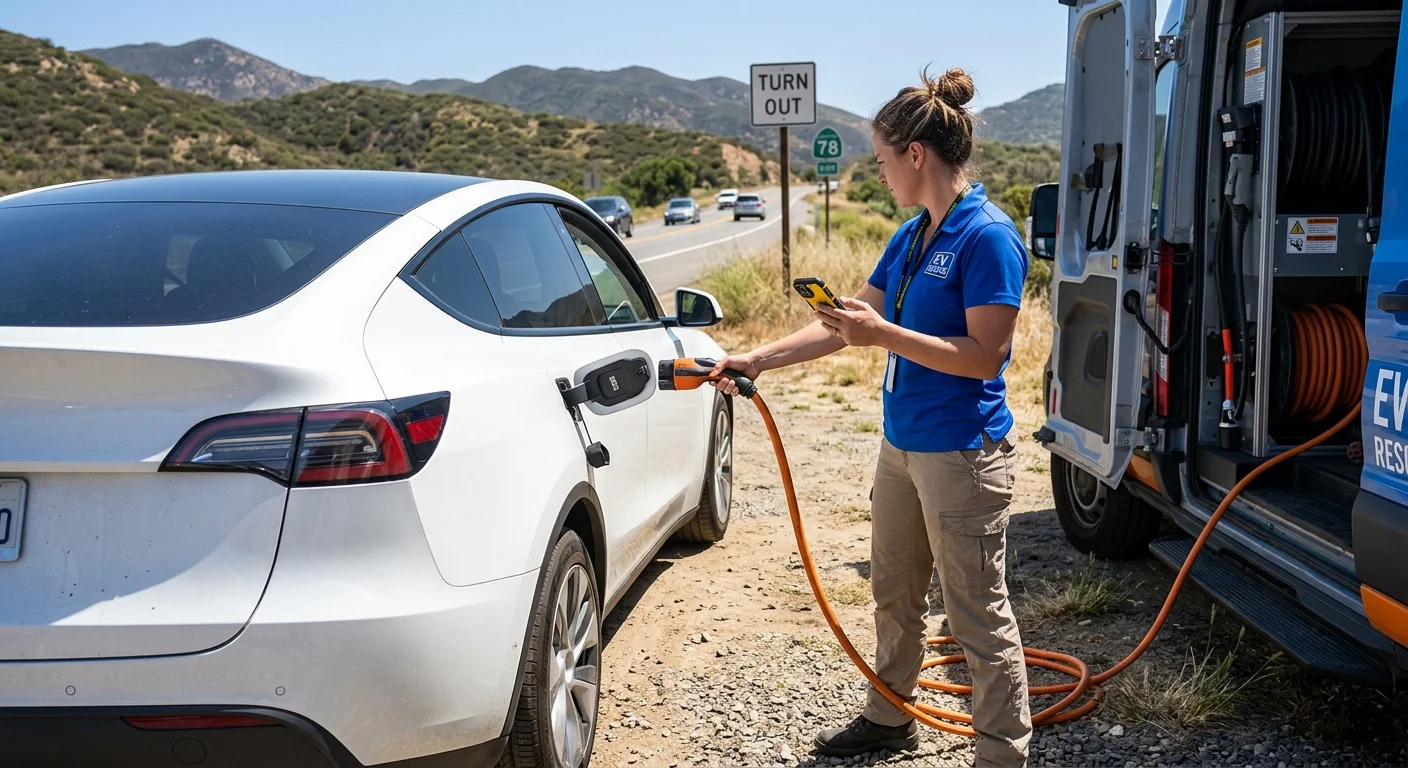
Mobile charging is one recovery path, not an automatic answer. The operator has to reach the charge port and match the plug. They also need room to park without blocking a live lane.
Operators we connect you with bring a 240V Level 2 source to the car. Tesla uses a native NACS plug on that session. Other EVs typically use a CCS or J1772 adapter. A typical session adds about 10 to 20 miles of range. That’s in 15 to 30 minutes of charging. That’s charging time, never an arrival time. The operator quotes you before starting and bills you directly.
Before you agree, ask:
- Whether the symptoms fit a charge, a 12V jump, or a tow
- Whether their connector matches your port
- Where the rig would sit relative to the port
- What output they can actually deliver
- Where you intend to drive after the session
Don’t assume a set number of miles. Output depends on their gear and your car. Confirm the goal of the session in plain words.
Access details matter as much as the pin:
- Active lane, marked turnout, or private property
- Height limits, gates, or another car blocking the port
- Locked doors, a missing key, or wheels that won’t roll
- Whether you can admit the operator onto private land
California Vehicle Code 22651(f) covers a stalled vehicle on a full-access-control freeway. It may be removed after more than four hours. That applies when the car can’t move under its own power. That clock is a reason to decide. It isn’t a promise that a truck is close.
If charging won’t work at that spot, transport may be the honest path. The tow provider should confirm loading method, destination, and price. Charge Pro SF sets none of those terms. CHP rotation tows are assigned, so you don’t shop the list. For the wider freeway checklist, use the Bay Area freeway out-of-charge guide. Use mobile EV charging when the operator says the car can take energy.
Don’t treat an unconfirmed lot as your next plug. No specific charging sites along SR-4 were verified for this article. Name a destination you can actually reach. Then check it live with the operator before you roll.
When to call
Call when the EV has stopped on SR-4. You need a local operator to weigh a mobile charge against a tow. Charge Pro SF is a referral line. We don’t own trucks, employ technicians, or perform the recovery.
Call (415) 630-6268 and we’ll connect you with an independent local operator. The pros we connect you with are licensed and insured.