Apps for EV charging help you plan a stop while you still have miles. They don’t send a 240-volt truck to the car. 511 SF Bay reports the road. It doesn’t summon a Level 2 rescue.
511 SF Bay reports traffic, not a charge truck
511 SF Bay is the regional traveler-information line. Caltrans District 4 posts highway cameras and QuickMap conditions for the nine Bay Area counties. None of those feeds dispatch a 240-volt source to your bumper.
The Freeway Service Patrol is a separate roadside program run by MTC, CHP, and Caltrans. Published hours on 511.org are Monday through Friday, 6 to 10 AM and 3 to 7 PM. Dial 511 and say Freeway Assist, or use a call box. FSP lists a free gallon of gas, jump-starts, and radiator refills. MTC’s FSP page, read 2026-09-18, doesn’t mention electric vehicles or out-of-charge help.
Outside those weekday windows, freeway tows often go to the CHP Rotation Tow Program. You don’t pick that vendor. A rotation hook moves the car, and it doesn’t add range.
Out of charge on a Bay Area freeway covers the shoulder call. 511 still won’t send the charge truck that post describes.
Open the car’s own app while you still have range
Start with the app your vehicle maker built. It talks to the car’s own systems, so it can see your actual pack state. A third-party map only knows where stations sit. It doesn’t know how your car is doing right now.
We’re not naming a maker’s app here. Feature lists change with software updates, and we can’t verify every model’s current screen. Check the owner’s manual or the maker’s site.
Treat the suggested stop as a plan. Then confirm the stall before you spend the miles. The pin can be occupied, broken, or offline when you arrive. The app can’t promise a free working plug.
Bay Area climate shows up in that routing math. 1961 to 1990 NWS normals put San Francisco’s July high at 71.5 F. San Jose’s July high is about 82 F. Livermore’s July high is 89.7 F. Inland heat spends a low pack faster than the fog belt.
A US-101 run down the Peninsula isn’t an I-580 Altamont climb. SR-1 between Pacifica and Half Moon Bay is its own corridor. I-680 through Sunol and the Tri-Valley is another. SR-237 cuts Silicon Valley. I-80 runs the East Bay shore. SR-4 heads toward the Delta. Express lanes also run on I-80, I-580, I-880, and US-101. FasTrak is required in those lanes. Hours are generally 5 AM to 8 PM weekdays. This page doesn’t claim where those lanes sit in the roadway.
If the percent is already sliding, stop planning a last hop. EV running low before you’re stranded walks that window.
Check each network’s own app, then a government locator
Most public charging networks run their own app or site. That feed is usually the freshest view of their hardware.
A network app only knows its own stations. One icon set will miss another company’s posts. Checking two or three networks before a longer trip is more useful than checking the one you already have.
We’re not ranking network apps, because coverage and features change. A blog that asserts a current feature without a source is guessing. The network’s own site is the accurate check.
For a wider inventory, use the DOE Alternative Fuels Data Center. That locator is a government list of reported stations, not a live availability feed. Use it to see what has been reported, then verify the stall in a network app.
A few lots publish plug counts we can name. BART lists Level 2 charging at Warm Springs / South Fremont, with 42 plugs on bart.gov. Lafayette lists 4 Level 2 plugs, and both lots are Level 2 only. A USDOT grant is funding more BART lots by 2027. Don’t treat that grant as plugs that exist today. Caltrain publishes no park-and-ride EV charging, so confirm at the lot before you plan around a post.
SFO has an EV-charging page at flysfo.com/parking/electric-vehicle-charging. Automated fetch couldn’t read that page, so confirm the current stalls in a browser. OAK’s parking page on iflyoak.com lists Economy, ValuPark, Hourly, and the Park and Call zone. That page doesn’t show EV charging. SJC’s flysanjose.com parking page lists Economy Lot 1 through Lot 5 and a cell-phone area. That page also doesn’t show EV charging. Confirm the lot in a live app. An unread page doesn’t tell you what’s on the pavement.
The Bay Area charging hub is local context next to those national maps.
Treat crowd pins as last week’s rumor
Aggregator maps mash several networks into one view. Some add driver notes about a plug that worked last time.
A pin isn’t a live session. A station can be listed and still be occupied, out of service, or removed since the last update. A comment from three weeks ago is one driver’s one visit, not today’s status. That’s how listings work when the app doesn’t own the hardware.
Older housing makes the overnight sit more common. San Francisco’s ACS 2019 to 2023 count is 836,321, and about 77.2 percent of its housing predates 1980. That stock is apartments and curb parking more often than a new garage. Brentwood is 10.9 percent pre-1980, and Dublin is 21.0 percent. Those newer inland cities have a different driveway mix. None of those figures tell you a public stall is free tonight.
Airport sites don’t publish guidance for a car that won’t wake after a week at SFO, OAK, or SJC. The dash can go dark with range still in the pack. That’s often the 12V, not an empty traction battery. Apps for EV charging won’t diagnose that failure.
If you plug in and nothing starts, that’s a session problem. Public charger connected but not charging covers the unstick steps.
If you stop on a freeway, the clock is legal, not digital
CVC 21718 generally bars stopping on a freeway. A disabled vehicle is an exception when stopping is unavoidable and help has been summoned. CVC 22651(f) allows removal after more than four hours. That applies on a full-access-control freeway when you can’t move under your own power. Don’t treat an I-880 or I-680 shoulder as overnight parking.
The seven state-owned bridges use all-electronic Open Road Tolling. Cash ended in March 2020. Antioch, Benicia-Martinez, and Carquinez toll eastbound only. Dumbarton, Richmond-San Rafael, the Bay Bridge, and San Mateo-Hayward toll westbound only. The Golden Gate Bridge is a separate district. Tolling there is southbound only into San Francisco. No published disabled-vehicle-on-a-bridge policy turned up in this research. Confirm current BATA rules on bayareafastrak.org. Confirm Golden Gate rules on goldengate.org.
Keep the car legal and visible, then stop refreshing apps that already failed.
When the map has no reachable, working pin
Checking another app stops helping at some point. The question isn’t which map to trust anymore. It’s how to add energy without driving farther on a thin pack.
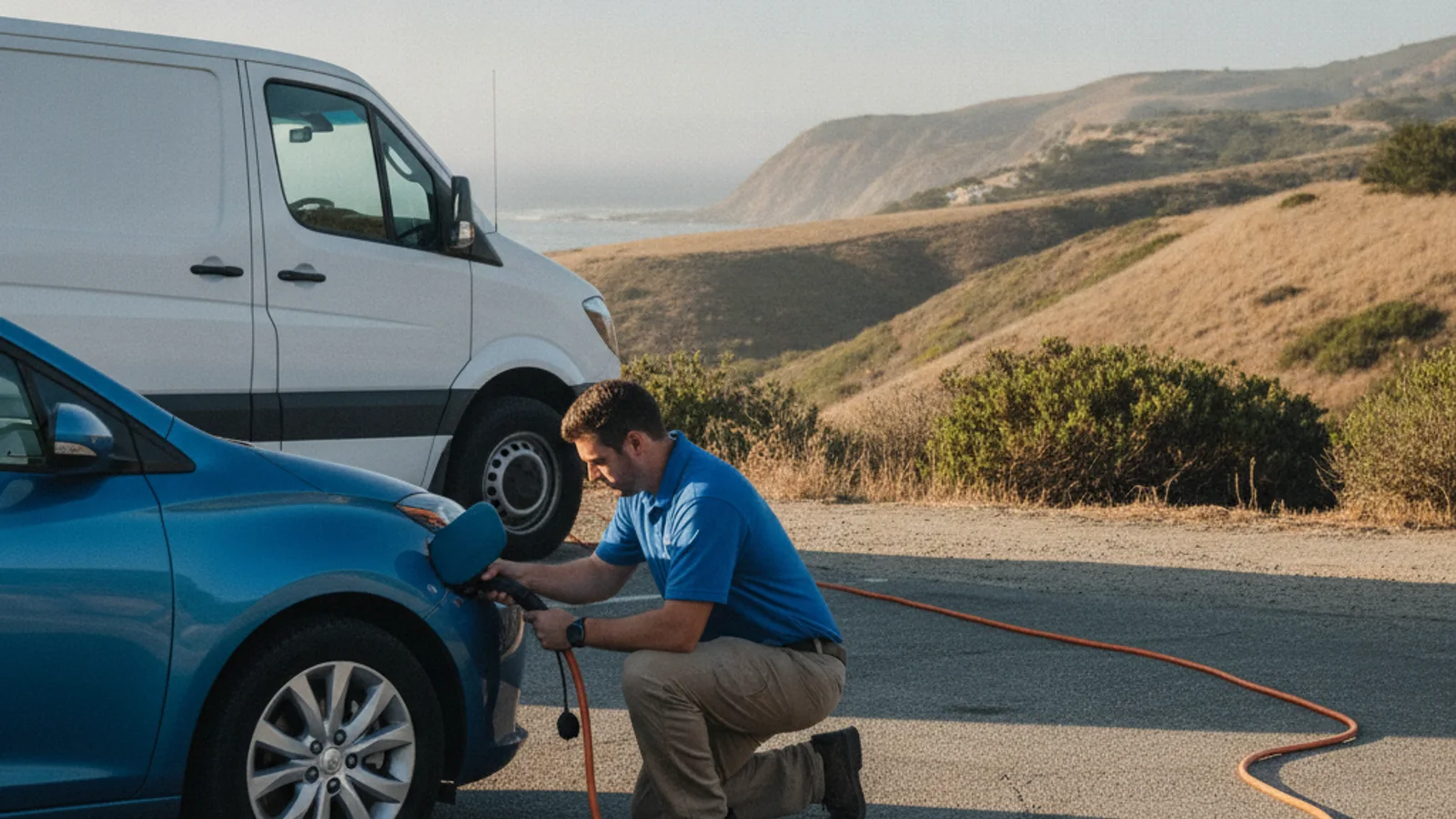
Mobile EV charging brings a 240-volt Level 2 source to a car that’s parked safely. Teslas take a native NACS plug. Other EVs use a CCS or J1772 adapter. A typical session adds 10 to 20 miles of range. That’s 15 to 30 minutes of charging time, not an arrival time.
If the pack is already at zero, ask about out-of-charge recovery. The independent operator we match you with looks at the car and the spot. That person quotes you before starting, and they bill you directly.
Charge Pro SF is a referral line. We don’t own trucks or employ technicians. We don’t set prices or publish hours. The pros we connect you with are licensed and insured. They handle Tesla and every major EV brand. They can also jump or replace a dead 12V on site.
Don’t keep rolling on a shrinking percent. A stale pin isn’t a plan. If the apps are out of reachable options, stop and call.
Call (415) 630-6268 when you want a match to a local operator.