The lot is emptying and your fob does nothing. After hours in Levi’s Stadium parking, a dead EV is often the 12-volt battery. EV charging at Levi’s Stadium starts with whether the car can even wake.
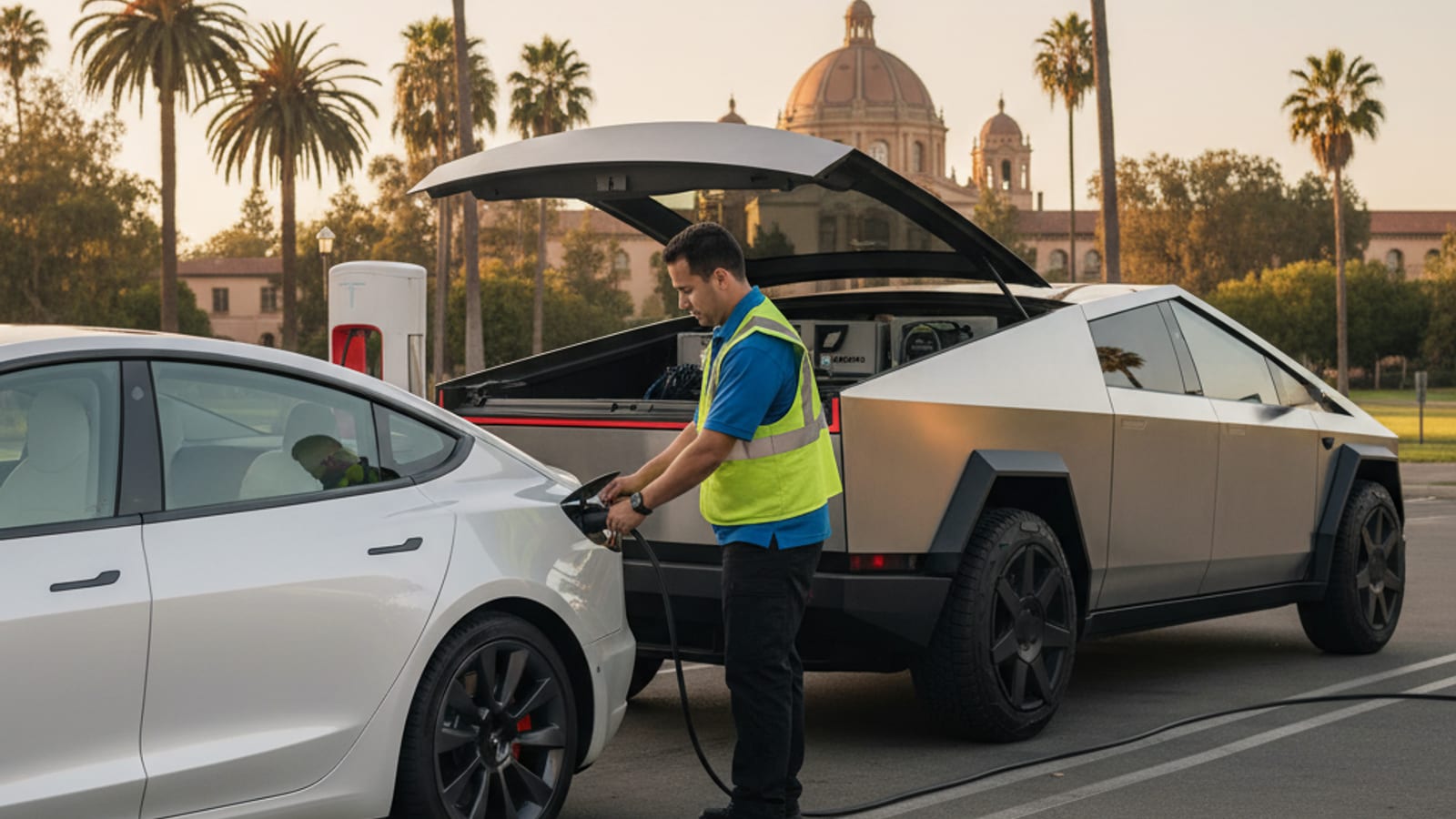
A game, a concert, or a long tailgate is a long sit. Cabin climate, Sentry Mode, and phone pings all draw from the small battery. That battery wakes the computers. The traction pack can still hold miles. The contactors that connect it can still be asleep.
You’re not hunting a map pin yet. You’re looking at a car that won’t boot. Sort that before you chase a public stall.
A long sit in Santa Clara hits the 12-volt first
Levi’s Stadium is in Santa Clara, in the South Bay and Silicon Valley. The ACS 2019-2023 count for the city is 129,239 people. The 2024 Census estimate is 133,132. This isn’t the fog belt. Nearby San Jose’s July average max is about 82F on the 1961-1990 NWS normals. San Francisco’s July max on that same vintage is 71.5F. Interior climate keeps running while you’re in your seat.
Event days stack that load. You precondition on the way in. You sit in the car before gates open. Then the car waits for hours with Sentry or cabin protection on. That’s a week’s 12-volt work packed into one afternoon. San Jose next door holds about 990,054 people on the same ACS file. The 2024 estimate is 997,368. The lot mixes both cities. The electrical failure doesn’t care which ZIP you drove from.
The car isn’t off the way a gas car is off. The 12-volt battery runs locks, the screen, the charge-port door, and the contactors. Drain it and a full pack sits there useless. That long-park failure is spelled out in Tesla 12V failure after a long park. A stadium lot is the same physics with worse timing.
Older Model 3 and Model Y cars used a lead-acid 12-volt battery. Later cars moved to a lithium 12-volt unit. Both can go quiet after hours of accessory load. Other brands fail the same way. An Ioniq, a Mach-E, a Rivian, or a Bolt can look bricked in that stall. For the broader failure mode, read what happens when an EV 12-volt battery dies.
Don’t assume you need a Supercharger because the dash is black. A black dash isn’t a state of charge. It’s a computer that didn’t boot.
Silicon Valley Power can’t reach this stall
Santa Clara’s utility is Silicon Valley Power. It’s a municipal utility. It isn’t a CCA riding PG&E generation. Palo Alto has City of Palo Alto Utilities. Alameda has Alameda Municipal Power. Santa Clara sits in that small municipal club. That matters at home. It doesn’t matter in this lot.
SVP publishes a Residential Electric Vehicle Charging Station Rebate. It doesn’t publish a dedicated residential EV rate. Home charging rides the standard residential rate. Confirm current rules on siliconvalleypower.com before you plan any panel work. Don’t ask this page for a bill number. We aren’t going to invent one.
None of that helps a car that already sat through the event. A wall unit in a Santa Clara garage can’t reach the stall you used. About 59.9% of Santa Clara housing is pre-1980 stock. San Francisco’s share is 77.2% on the same ACS table. Some South Bay driveways still share a tight panel. That’s a home-install story. It isn’t a lot-rescue story. For campus and stadium calls in this city, see EV roadside help in Santa Clara.
San Jose uses San Jose Clean Energy on PG&E wires. Sunnyvale, Mountain View, Cupertino, Campbell, and Milpitas sit in Silicon Valley Clean Energy territory. Those names help on the drive home. They don’t change what’s under your frunk right now.
Don’t ask a rescue operator to read your bill. The person you’re connected with isn’t your utility.
What a dead stadium car actually does
You tap the phone. Nothing happens. You try the card. The handles don’t present. The charge port doesn’t pop. You might hear a click. You might hear silence.
That pattern is 12-volt. An empty traction pack usually still lets the car talk. You get a charge warning. You get a turtle icon. You might creep a few feet. A dead 12-volt gives you a brick. It won’t authenticate.
If the app shows the car but commands fail, that’s still 12-volt. If the app can’t find the car at all, it can still be 12-volt. Loss of connectivity isn’t proof the car is gone. Check your stall before you assume the worst.
If the car did wake, and the range is actually zero, that’s a different job. Then you need energy into the pack. You don’t need a jump on the small battery. Sort the two failures before you wave down a wrecker.
Event parking also means private property. The stadium isn’t a freeway shoulder. The Freeway Service Patrol doesn’t run this lot. CHP rotation rules don’t either. Those programs are for the state highways. If a tow truck is already circling, read the posted sign first.
Checks you can run while the crowd is walking out
Stay with the car if you can. A dark EV in a thinning lot is easy to miss. After the event, cell service in the lot can sag. The app may look dead because the phone has no data. Wait for a bar. Move a few feet and try again. Then try the key card. Don’t wander off for signal and lose the stall.
Try the phone key with Bluetooth on, close to the pillar. Try the key card if your Tesla has one. Try the physical key on models that hide one. None of this charges the pack. It only asks the 12-volt system to wake.
If you had a low-voltage warning on the drive in, believe it. Random screen reboots and odd door behavior are early tells. After a four-hour sit, those tells become a no-start.
Walk around the car. Look for a cable already plugged in from before the event. If a cable is stuck, don’t yank it. A dead 12-volt can freeze the port. Forcing the handle can break it.
Don’t jump a neighboring gas car from your EV. You can hurt both electrical systems. Don’t let a stranger put booster cables on high-voltage orange. The 12-volt posts are a small battery. They aren’t the pack.
If you can open the hood or frunk, find the jump posts your manual names. If you can’t open anything, stop. A locked, silent EV needs the right pack and the right adapters. The Tesla 12V jump path is how you request that. Independent operators in the Charge Pro SF network can jump a dead 12-volt. They can also replace it on site. They handle Tesla and every major EV brand.
A jump that takes isn’t always a lasting fix. If the small battery is worn out, the car can die in the next lot. Get it tested after you’re home. Don’t treat a stadium jump as a new battery.
EV charging at Levi’s Stadium: what we couldn’t confirm
You searched ev charging Levi’s Stadium, so here’s the honest version.
We couldn’t verify a published charger inventory for Levi’s Stadium parking. The sources we could read didn’t list a stall count we can cite. They also didn’t list a network name or a plug mix. That isn’t a claim that the lot has no chargers. It’s a claim that a blog shouldn’t be your stall list. A post might be reserved. It might be occupied.
Confirm on the ground. Read the lot signs. Open your charging app while you still have signal. If a Level 2 post is in your row, check it. Use it only if the car can start a session. A dead 12-volt often won’t. The port stays shut. The handshake never starts.
If you do get a session going, remember what public Level 2 is for. It’s a slow top-off during a long stay. It isn’t a five-minute rescue. DC fast charging is a different class of hardware. We didn’t confirm a DC fast site on the stadium campus from this research. Don’t drive in circles looking for one we named. We didn’t name one.
North American cars use NACS, CCS, or J1772. Tesla pioneered NACS. Many newer non-Tesla cars now ship with NACS. Others need a CCS-to-NACS adapter for Tesla Superchargers that allow it. Teslas can use a NACS-to-CCS adapter at non-Tesla DC sites. Pack the adapter before you leave home. Don’t assume a stadium post will loan you one.
BART publishes Level 2 charging at Warm Springs / South Fremont with 42 plugs. Lafayette has 4 plugs. Those are BART park-and-ride facts, not stadium facts. We’re not telling you those lots are your next stop. We’re not estimating the distance. Check your own map if you were already heading that way.
If the pack is actually empty
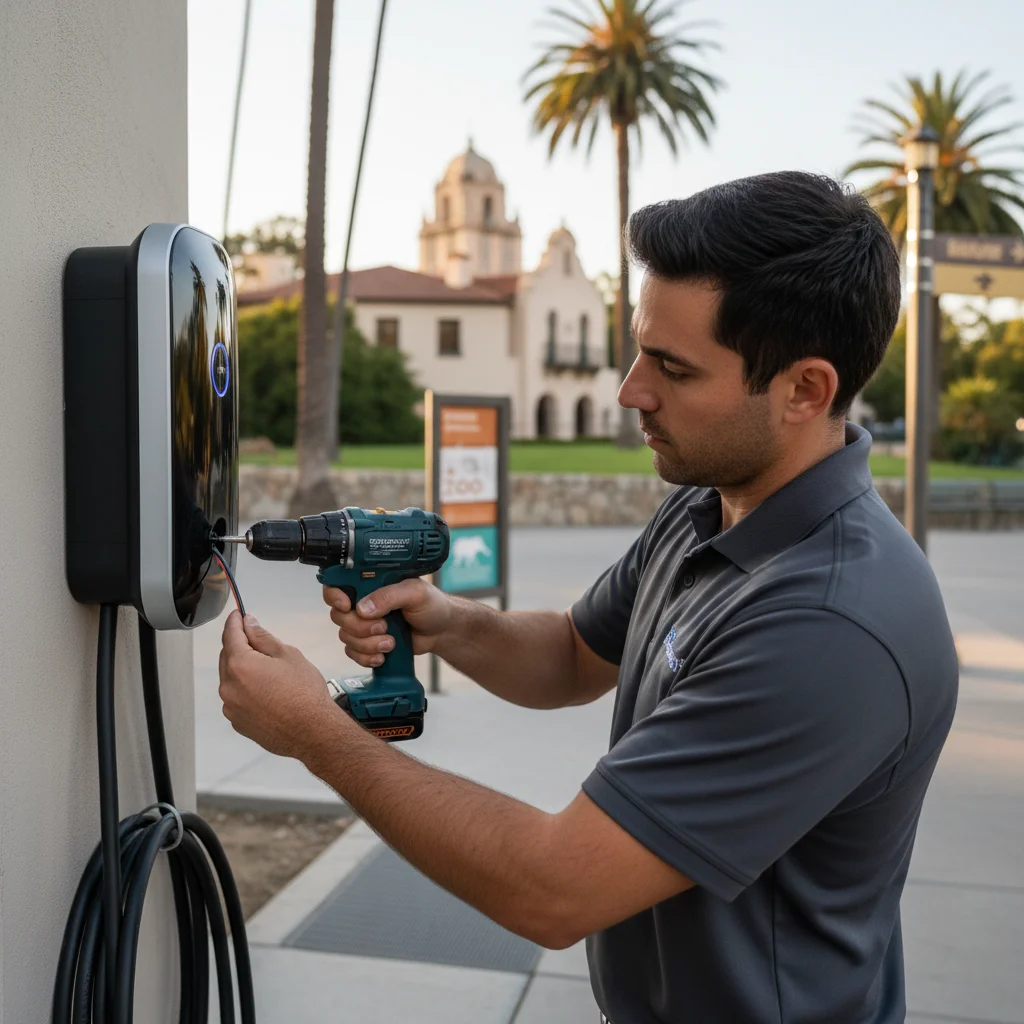
Sometimes the 12-volt is fine and you arrived already low. Or climate ran the whole event. The car talks. The number is ugly. You won’t make San Jose, Sunnyvale, or a Peninsula run on what’s left.
Don’t treat a tow as the first tool. A flatbed can move a silent EV. It doesn’t add miles. If the car will accept charge, a mobile 240-volt Level 2 source can. Independent operators in this network bring that source to the car. They use a native NACS plug. They also carry a CCS or J1772 adapter for non-Tesla EVs. They typically add 10 to 20 miles of range. That’s in 15 to 30 minutes of charging time. That’s plug time, never a promise of when someone arrives. Charge Pro SF doesn’t set arrival times.
The operator quotes you before starting. The operator bills you directly. Charge Pro SF is a referral line. It matches you with local mobile rescue operators. It doesn’t hold a contractor license. It owns no trucks.
A mobile rescue rig isn’t a dealer on wheels. It isn’t Tesla Mobile Service. If you need a part the operator doesn’t carry, you still need a shop later. The job tonight is wake the car, then add enough miles to leave.
Read mobile EV charging for what that rig actually does. If you’re choosing between energy and a hook, start with this split. Use charge it, jump it, or tow it.
Going home to San Jose is a different remaining-mile problem than going toward the coastside. The San Francisco station’s July max on the 1961-1990 normals is 71.5F. San Jose sits near 82F. Don’t copy a cool-shore range guess onto a South Bay night.
Private-property tows in a stadium lot
Levi’s Stadium parking is private property. California Vehicle Code 22658 governs those tows. The lot must post a sign not less than 17 by 22 inches. Lettering has to be at least one inch. The sign has to state removal at the owner’s expense. It also needs the enforcement phone number and each tow company’s name and number. The operator must notify law enforcement within one hour. They also have to give written notice. Overcharging beyond the approved rate in that private-property context creates liability. The multiplier is four times the amount charged.
California doesn’t cap ordinary private or consensual tow rates statewide. The 22658 ceiling is tied to the CHP-approved or law-enforcement rate. CHP sets rates only for its own rotation vendors. Otherwise operators set rates, subject to local ordinance. We didn’t verify a Santa Clara stadium-specific tow ordinance for this pass. We also didn’t verify a named contractor. Confirm the sign on the lot you parked in. San Jose Municipal Code Chapter 6.66 and Title 23 exist as private-property frameworks. Oakland’s towed-vehicle pages do too. Their specific text wasn’t verified on this pass. They’re neighboring cities, not this lot.
If someone is already hooking the car, ask for the written notice. Ask which company is on the sign. Don’t guess a number we invented.
After you leave: SR-237, US-101, and I-880
If you roll out on a weak pack, the next stall may be the freeway. Santa Clara event traffic often feeds SR-237 and US-101. I-880 is the East Bay spine if you’re headed toward Milpitas or Fremont. Express lanes run on US-101, SR-237, and I-880. A FasTrak Flex tag gives carpool discounts. Hours are generally 5 AM to 8 PM weekdays. MTC runs the regional network. Alameda CTC runs I-880, plus I-580 and the I-680 Sunol lanes. We didn’t verify whether those lanes sit in the median. Don’t pull left on a rumor.
If you’re driving back to San Francisco after the event, the Bay Bridge tolls westbound only. The San Mateo-Hayward Bridge also tolls westbound only. The Dumbarton Bridge does too. Cash ended in March 2020. Those seven state-owned bridges use all-electronic Open Road Tolling. Pay with FasTrak, a license-plate account, or an invoice. Don’t stall in a lane that isn’t a plaza. Get the car healthy in the lot first.
If you become disabled on a freeway, CVC 21718 generally bans stopping except in limited cases. A vehicle so disabled that stopping is unavoidable is one exception. Another vehicle has to be summoned to assist. CVC 22651(f) allows removal after more than four hours. That applies on a full-access-control freeway. It applies when the car can’t move under its own power. Get help on the clock. Don’t wait it out on the shoulder.
The Freeway Service Patrol is a partnership of MTC, CHP, and Caltrans. Private tow companies run dedicated beats during published hours. Those hours are Monday to Friday, 6 to 10 AM and 3 to 7 PM. That’s per 511.org. FSP clears crashes and debris. It provides a free gallon of gas, jump-starts, and radiator refills. MTC says it handles over 100,000 incidents a year. The MTC FSP page, read 2026-09-18, lists gas, jump-starts, and radiator refills. It doesn’t mention electric vehicles or out-of-charge help. Dial 511 and say Freeway Assist, or use a call box. Do that if you’re on an FSP beat during those hours. Don’t expect a Level 2 charge from that truck.
Outside those hours, calls go to the CHP Rotation Tow Program. You don’t pick the company. Caltrans District 4 covers the nine Bay Area counties on QuickMap. 511 SF Bay is the regional traveler line. CHP Golden Gate Division boundaries weren’t verified on this pass.
If you’re still in the stadium driveway, that freeway machinery doesn’t apply yet. Ask for a lot-capable operator. Don’t ask for a highway patrol rotation unless you’re already on the state system.
Heat on the way home isn’t the San Francisco shore
South Bay afternoons run warmer than the San Francisco shore. San Jose’s July normal sits near 82F. Livermore’s July max on the same 1961-1990 normals is 89.7F. Antioch is 90.4F. If you’re heading inland after the event, climate control will eat pack energy. That happens once the car is awake. We couldn’t verify a count of 100F days, so we aren’t publishing one.
The 12-volt failure can still be the first failure on a hot day. Cabin overheat protection is trying to save the interior. It can also flatten the small battery that lets you leave.
Start the drive with a number you believe. A guess from this morning is stale after hours with systems on.
Santa Clara isn’t a coastal overnight. If you’re going home to Daly City or Pacifica, you’ll drop toward cooler air. If you’re going deeper into San Jose, you won’t. Plan the remaining miles for the climate you actually drive.
Tesla, other EVs, and what the operator brings
Tesla owners hit this first because the phone is the key. When the phone stops talking to the car, it feels like a lockout. It’s usually the 12-volt. Other makes hide the same battery and fail the same way. If your stranded car isn’t a Tesla, the network still connects you with a compatible operator. Native NACS for Tesla. CCS or J1772 adapters for everyone else.
Charge Pro SF serves Santa Clara and the rest of the Bay Area. The pros we connect you with are licensed and insured. The brand isn’t. When the 12-volt is the problem, they jump or replace it on site. You get a quote first.
What to say when you call, then what to do once you’re moving
Give a clean picture. Event night at Levi’s Stadium in Santa Clara. Your row if you have it. Your stall if you have it. Tesla or another brand. Whether the screens are dark or the range reads zero. Whether the port will open. Whether a tow sign is already in play.
Stay on the line through the recording notice. California Penal Code 632 requires all-party consent to record a confidential communication. That’s why forwarding lines play a notice. Charge Pro SF doesn’t quote you a price. The operator does, before work starts. We don’t publish business hours. We don’t promise when a truck appears.
If a jump brought the computers back, look at the real pack number. Do that before you join exit traffic. If you need miles, a short mobile charge can cover the next plug. Pick that plug in your own app. If you only needed the 12-volt, go home and get that small battery tested.
Don’t aim at a charger we listed next to the stadium. We didn’t list one we could verify. For city-level charging and rescue context, use the Santa Clara EV charging page. Those home and workplace programs don’t rescue a dark car in a stadium stall. Use them later if you’re planning a wall unit. Check siliconvalleypower.com, svcleanenergy.org, or sanjosecleanenergy.org for current names and rules.
Frequently asked questions
Is a dead EV after Levi’s Stadium parking usually the 12-volt?
Often, yes. A long sit with cabin climate, Sentry, and phone pings drains the small battery. That’s the battery that wakes the car. The traction pack can still hold range. If the screens are dark and the port won’t open, treat it as 12-volt. Wait for an operator to prove otherwise.
Can I plug in at the stadium if the car won’t wake?
Only if the car can start a charging handshake. We couldn’t confirm a published charger list for Levi’s Stadium parking. A dead 12-volt may keep the port closed, even with a post in your row. Wake the car first. Then confirm any stall on the signage and in a live app.
What if I stall on SR-237 or US-101 after I leave the lot?
If you’re on the freeway, CVC 21718’s disabled-vehicle exception can apply. Help has to be on the way. FSP runs weekdays 6 to 10 AM and 3 to 7 PM. Its published menu is gas, jumps, and radiator refills, not an EV charge. Outside those hours, CHP rotation tow is the highway default. For an out-of-charge EV, you still want a mobile Level 2 operator. You don’t want a gas can.
Call for a quote, not a mystery truck
You don’t need a viral charging map to leave Levi’s Stadium. You need the car awake. Then you need enough miles to reach a plug you can actually use. Charge Pro SF connects stranded EV drivers with independent local operators across the Bay Area. Call (415) 630-6268 when you’re ready for a quote. The operator who’ll do the work gives that quote.