You fly back into SFO after two weeks away. The Tesla sits dark in the long-stay lot. Door handles stay flush and the screen stays black. The app never connects, no matter how many times you retry. That’s Tesla 12V battery failure more often than a drained pack. The high-voltage battery can still hold plenty of charge. The small 12V is what went quiet on you.
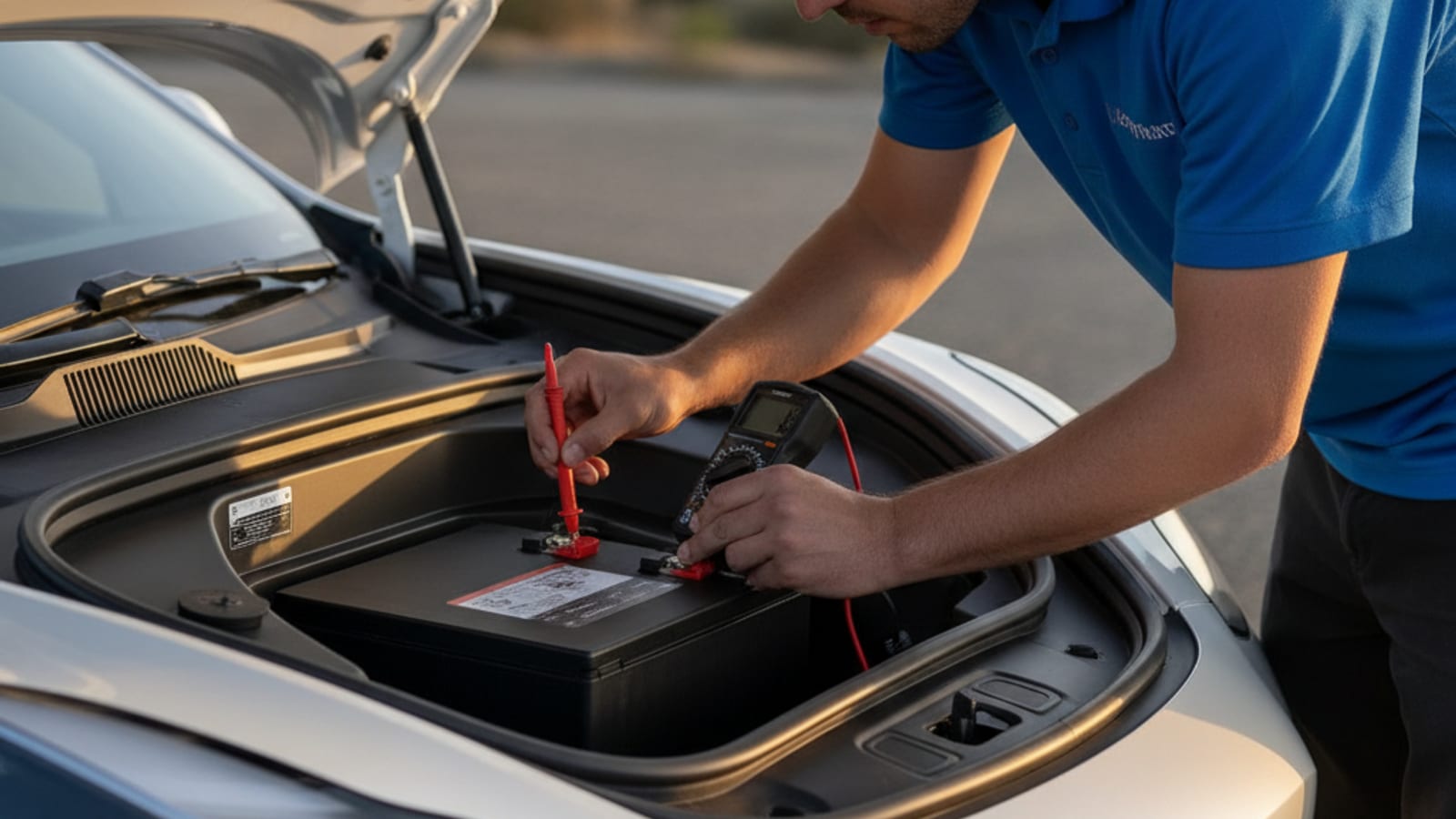
A two-week SFO park drains the wrong battery
Tesla tops up the 12V from the traction pack through a DC-DC converter. That converter doesn’t run the entire time the car sleeps. Locks, clocks, and the alarm still sip power in the lot. Two weeks of that sip is enough to strand you. By the time you land, the 12V may not close the BMS relay.
SFO doesn’t publish a walkthrough for this stall. An EV charging page exists at flysfo.com, but this research pass couldn’t read it. Confirm parking rules on the airport site before you leave the car. This page covers the dark-car case the airport doesn’t.
The same stall shows up in Peninsula hotel lots after a flight. San Bruno, Millbrae, and Burlingame sit on the US-101 approach. South San Francisco and Daly City sit on the run into the city. People leave a Tesla for a work trip and come back to a brick.
A South Bay trip can do the same thing. SJC lists Economy Lot 1, Daily Lot 4, and the Terminal A and B garages. OAK lists Economy Parking, ValuPark, and the Hourly lot. Those pages don’t tell you what to do when the car won’t wake.
What the 12V actually runs
In a gas car, the 12V cranks a starter. The 12V still runs the car’s nerves. It powers door-handle motors, trunk latches, and the display. It also powers the BMS relay that lets the pack feed the motors.
That last job is the one that strands you. If the 12V is dead, the relay stays open. The pack can sit at a high state of charge. The car still won’t unlock, drive, or talk to the app. See Tesla won’t wake: empty pack or a dead 12V for that split.
Model S and Model X cars have long used a lead-acid 12V. Later Model 3 and Model Y cars moved to lithium. Lithium holds a rest charge longer in storage. It still dies after a dark, multi-week park. Your year-by-year spec lives in Tesla’s manual.
Tesla 12V tickets show up in NHTSA’s complaint database at nhtsa.gov. A clean percentage by model wasn’t confirmed in this pass.
Cool lots at SFO, hot lots inland
SFO’s July normal high is 71.5F on the 1961-1990 NWS record. Oakland Airport sits near 70.4F in July. San Jose’s July normal is about 82F. Livermore hits 89.7F in July, Antioch 90.4F, and Gilroy 88.3F.
A car stored at SFO sees a cool marine layer most summer days. A car stored after a week in Livermore or Gilroy sees real heat. Heat and a long sleep both wear a weak 12V. A count of 100F days wasn’t verified in this research pass.
Sentry Mode and cabin climate features keep modules awake while you fly. That extra wake time can empty a marginal 12V faster. Tesla’s app is the place to see what you left on.
Two ways the failure shows up
Sometimes you get a warning before the trip even starts. The Tesla app pings “12V battery low,” and the cluster may show it too. That’s your window to act. Get the car to a charger, or get 12V service, before it dies. Catch it early in Tesla 12V failure signs you can catch before you’re stuck.
Sometimes there’s no ping, and you walk up to nothing. Model S handles stay flush. The phone key does nothing, and the cabin stays black. Owners often assume the pack failed, but it’s usually the 12V. A totally dark car is the 12V pattern after a long park.
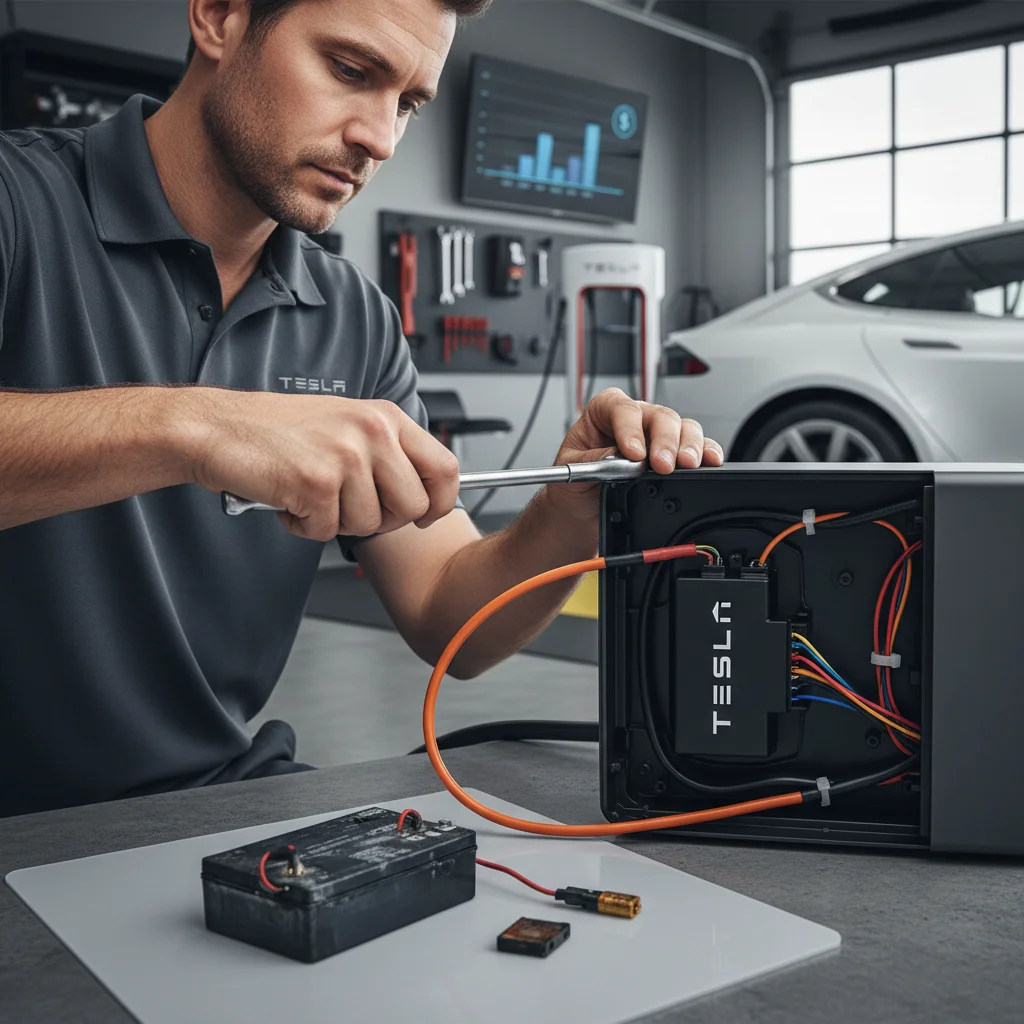
Jump to diagnose. Replace to keep it awake.
Tesla puts a 12V jump point on most cars. On Model S and Model X it sits in the frunk near the firewall. On Model 3 and Model Y it sits under the hood, front right. Use that port only, and never clamp cables onto the high-voltage charge inlet.
A jump pack on those posts will often wake the car. Screens come on, doors unlock, and the app reconnects. If the display then shows a healthy pack, you have the answer. The 12V failed, and the traction battery didn’t. See How to tell your Tesla 12V is dead, then jump it for the checks.
That wake-up is a test, not a repair. Pull the jump source and a failed 12V often dies again. The lasting fix is a replacement to the right spec. Older S and X cars often take a lead-acid 51R. Later 3 and Y cars often take a Tesla-spec lithium unit. The operator at the car should confirm the spec before they start. See Tesla 12V replacement versus a jump when you’re stranded.
Tesla service can do this work too. Public wait times weren’t confirmed in this pass, so this page doesn’t quote them. An operator we connect you with can jump or replace a Tesla 12V on site. They quote you before any work begins, and they bill you directly.
If the pack itself is empty, a 12V jump won’t add range. Then you need a mobile Level 2 charge. Operators bring a 240V source with a native NACS plug for Tesla. CCS or J1772 adapters cover other EV brands. That charge typically adds 10 to 20 miles in 15 to 30 minutes of charging. That’s charge time, not an arrival window.
If the car dies on 101, not in the lot
A dark Tesla in a garage is a parking problem. A Tesla that dies on US-101 or I-380 is a freeway problem. CVC 21718 bans stopping on a freeway in most cases. The disabled exception applies when stopping is unavoidable and help is already on the way.
CVC 22651(f) covers a car left more than four hours on a full-access-control freeway. Officers can remove it if it can’t move under its own power. Don’t sit on the shoulder hoping voltage comes back.
The Freeway Service Patrol covers Bay Area beats Monday through Friday. Hours are 6 to 10 AM and 3 to 7 PM. Dial 511 and say “Freeway Assist.” MTC’s FSP page lists gas, jump-starts, and radiator refills. It doesn’t mention electric vehicles or an out-of-charge rescue. Outside those hours, CHP’s Rotation Tow Program assigns the truck.
Private lots follow CVC 22658, so read the posted sign before you argue. California doesn’t cap ordinary consensual tow rates statewide. Get the quote before the hook goes on.
San Bruno roadside help covers the lots by the airport. Millbrae roadside help is the same airport edge.
What moves the quote
Charge Pro SF is a referral line, and we don’t own trucks. We don’t employ techs, and we don’t hold a contractor license. We match you with independent local operators. The pros we connect you with are licensed and insured. They handle Tesla and every major EV brand.
For a 12V that won’t wake, you want a jump on site. If needed, they replace the battery there too. For a pack at zero, you want a mobile charge. The operator tells you which job it is after they see the car.
What moves the price isn’t a number on this page. Distance to the lot and time of day both matter. A jump only is a different job than a battery swap. If they also need to add range, how many miles you need matters. The operator quotes you before they start, then bills you directly.
San Francisco and the Peninsula around SFO are common calls. So are San Jose lots after SJC, and Oakland lots after OAK. We serve the Bay Area, including those lots.
Questions after a dark Tesla at SFO
If the car is fully dark, is it the 12V?
A fully dark Tesla is usually the 12V. Jump the 12V posts first. If it wakes and the pack shows charge, the small battery failed. If it wakes at zero percent, you need a charge, not just a jump.
Can I jump a Tesla from another car?
You can use another car or a jump pack on the Tesla 12V posts. Don’t touch the high-voltage charge port. Don’t try to feed another car from a Tesla’s traction battery.
Who do I call from an SFO lot?
If you’re on a freeway beat during FSP hours, 511 is the public line. For a dark Tesla in a lot, call (415) 630-6268. We’ll connect you with a local operator. They quote you before they start. They don’t work for Charge Pro SF.