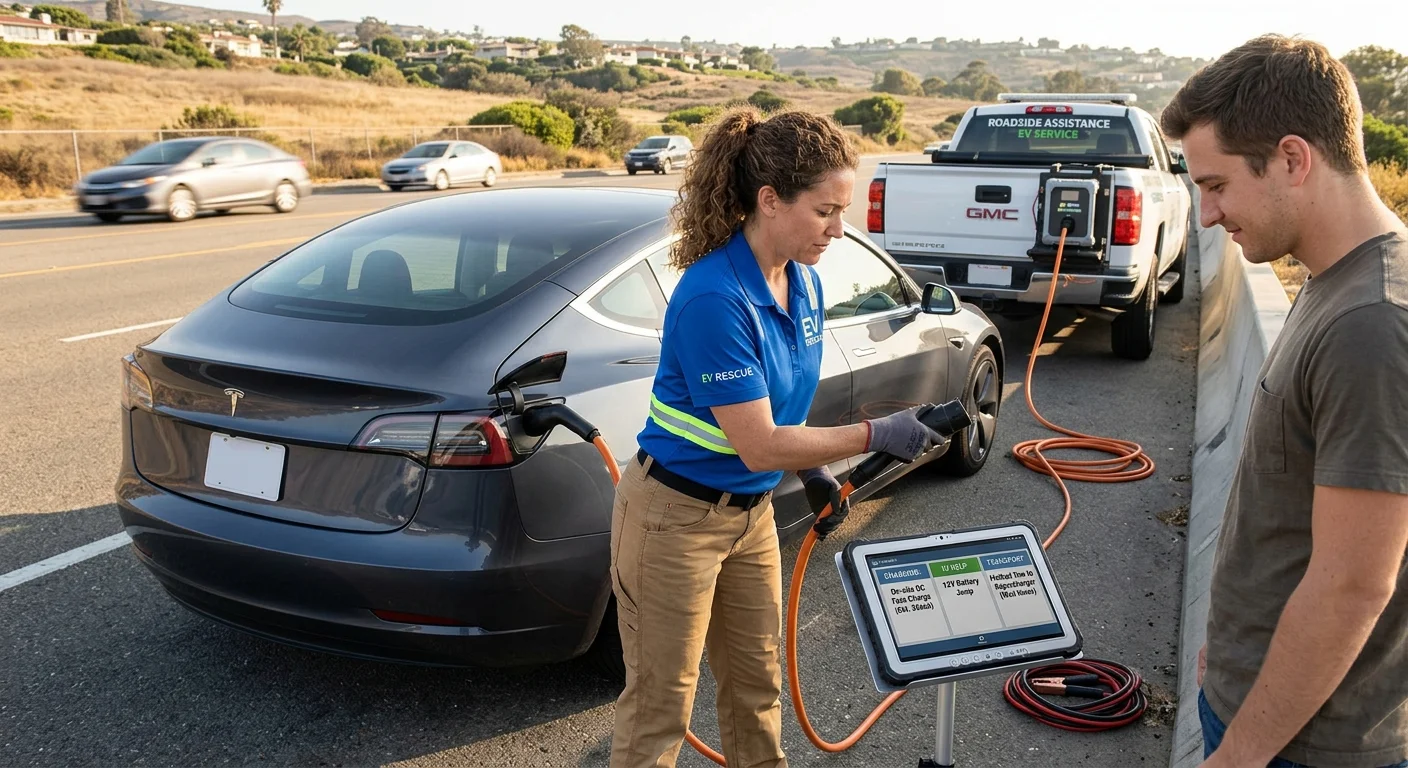
Your electric car died. You’re on a Bay Area freeway. California’s four-hour removal clock is why you don’t wait. Charge a confirmed empty pack. Jump a confirmed dead 12V. Tow when neither one fits. Sitting it out can end in a CHP rotation tow you didn’t choose.
The four-hour clock is why this isn’t a wait-and-see
California Vehicle Code 22651(f) covers freeway removal. A vehicle can be taken after more than four hours on a full-access-control freeway. The car has to be unable to move under its own power. That’s the rule as published on LegInfo, read 2026-09-18. It isn’t a courtesy pause. It’s the removal window.
CVC 21718 already bars most freeway stops. The disabled exception applies when stopping is unavoidable. Another vehicle also has to have been summoned to help. Calling for help is part of staying inside that exception. Waiting on the shoulder without a request doesn’t extend the clock.
Name the road, the direction, and the next exit. Eastbound I-580, northbound I-880, and westbound I-80 are different beats. US-101 on the Peninsula is its own call. So are I-680 near Sunol and SR-237 in the South Bay. “Near the Bay Bridge approach” is useful. “Somewhere in the East Bay” isn’t.
The Freeway Service Patrol is an MTC, CHP, and Caltrans partnership. 511.org lists Monday to Friday, 6 to 10 AM and 3 to 7 PM. Dial 511 and say “Freeway Assist,” or use a call box. FSP clears crashes and debris. MTC’s FSP page, read 2026-09-18, doesn’t mention electric vehicles or an empty traction pack. Don’t assume that truck can refill your drive battery.
Outside those hours, CHP’s Rotation Tow Program assigns the vendor. You don’t pick the company. Caltrans District 4 covers the nine Bay Area counties. 511 SF Bay is the regional traveler line. If officers are already managing the scene, follow them. Their instructions beat phone troubleshooting.
No disabled-vehicle policy for the state-owned bridges turned up. That’s from the same 2026-09-18 pass. That includes the Bay Bridge, San Mateo-Hayward, Dumbarton, Richmond-San Rafael, Carquinez, Benicia-Martinez, and Antioch spans. The Golden Gate Bridge is a separate district. Follow the people in uniform on the span.
Empty pack, dead 12V, or something you can’t name yet
“Died” doesn’t tell anyone which system quit. One car shows 0% and a pack-empty warning. Another shows black glass and dead locks. Those are different requests.
Read every dash line out loud, word for word. Note whether the cluster, cabin lights, locks, phone app, or charge-port door still answer. If a percent still shows, report that number. Don’t translate it. Say whether the car quit while rolling or refused to wake after a park.
A displayed empty-pack warning supports a talk about mobile EV charging or out-of-charge recovery. Dark screens and silent controls steer the operator toward 12V. That still isn’t permission to open a cover or clip on cables.
Use the owner’s manual for this exact car. Check roadside, 12V, towing, and charging. If the booklet isn’t in the car, say that before work starts. Our guide to what happens when an EV 12-volt battery dies can sort symptoms. It can’t certify your vehicle.
Get the scene safe, then describe it with boring precision
People out of live lanes come first. If the car is a hazard, call 911 and follow that crew. This page isn’t traffic control.
If the car can still move under its own power, obey the dash. Follow the maker’s instructions too. If it won’t roll, don’t invent a push or a roll. Don’t try a homemade neutral release. Tell the operator where it sits and which controls still work.
A freeway shoulder and a San Francisco curb aren’t the same job. Neither is a gated Daly City garage. A Hayward lot and an SFO-area hotel driveway differ too. Name the surface: lane, shoulder, lot, driveway, curb, or structure. Mention gates, height bars, tight ramps, and who can authorize entry.
Older street-parked housing is common around the core. Census ACS 2019-2023 puts pre-1980 stock at 77.2% in San Francisco. San Bruno is 81.9% and Daly City is 78.7%. That’s a housing-age fact, not a claim about plugs. It does explain tight curb spaces and garages a service vehicle may not fit.
Airport parking after a long trip often looks like a dead car. flysfo.com has an EV-charging page, but the 2026-09-18 automated read couldn’t open it. Confirm stall locations in a browser before you hunt the garage. OAK and SJC parking pages we could read didn’t list charging. Treat that as unconfirmed. Ask the airport, then talk through a jump versus a charge.
Inland heat isn’t a coastal problem. 1961-1990 NWS normals via WRCC put SFO’s July average high near 71.5F. Livermore hits 89.7F. Antioch hits 90.4F. Heat doesn’t pick the service for you. A pack that looked fine in fog can still sag on an inland climb.
For freeway-specific next steps, see your EV died on a Bay Area freeway.
Charge it, jump it, or tow it from what you can confirm
Talk charging when the traction pack looks empty. Give make, model, year, the displayed percent, the warning text, and whether the port opens. The independent operators in this network bring a 240V Level 2 source to the car. They use a native NACS plug. Non-Tesla EVs get a CCS or J1772 adapter. Typical charging time is 15 to 30 minutes. That’s about 10 to 20 miles of range. That’s charging time, never an arrival time. The operator quotes you before work starts and bills you directly.
Charging still isn’t a fit for every stop. The car may refuse a session. The stall may be unreachable. The fault may not be stored energy. Walk that fork in mobile EV charging or a tow before you authorize either.
Talk a 12V jump only after low-voltage trouble is actually on the table. Dark glass is a clue, not a diagnosis. Don’t clip cables from a gas-car habit. Don’t borrow steps from a different model. The operator matches your symptoms to the maker’s current procedure. Tesla and every major EV brand are covered. Some 12V packs get jumped. Some get replaced on site. That call belongs to the operator and the manual.
Talk a tow when roadside work doesn’t fit. Unknown fault and collision damage belong in the first minute. So does a car that won’t accept charge. Say so if the maker requires transport for that message. So does a location the service vehicle can’t legally enter.
Tow method has to follow this vehicle’s current instructions. Don’t coach a hook operator on dollies or parking pawls. Don’t invent a release unless the manufacturer wrote it. Hand them the manual. On a freeway, a CHP rotation tow may already be in play. The four-hour clock is why. On private property, CVC 22658 requires a posted 17-by-22-inch sign with inch-high lettering. Confirm the quote before the hook goes on. California doesn’t cap ordinary consensual tow rates statewide.
Short version: charge a confirmed empty pack. Jump a confirmed 12V problem the maker allows. Tow when the scene or the fault won’t take roadside work.
Give the operator facts, not a theory
Start with make, model, year, and the displayed percent. Read the warnings exactly. Skip your own diagnosis. Then say what just happened, and only what you saw. Impact, smoke, heat, or leaking fluid goes to 911 first.
List what still works: screens, locks, lights, the app, the charge port, gear selection. Pin the place with road, direction, exit, garage level, or a dropped pin. If you’re in a BART lot, check Warm Springs / South Fremont. It lists 42 Level 2 plugs. Lafayette lists 4. Those are Level 2 only, per bart.gov, 2026-09-18. A public post still isn’t a rescue plan if the car won’t wake.
Say how a truck gets in. Gate code, workplace badge, hotel ticket, or a height bar. After you’re moving, use the Bay Area EV charging hub. It can help you plan the next plug.
What this referral line does, and what it doesn’t
Charge Pro SF is a referral line. We connect stranded drivers with independent local mobile rescue operators. We don’t hold a contractor license, own trucks, or employ techs. We don’t set prices or arrival times. We serve cities across the Bay Area.
The pros we connect you with are licensed and insured. They handle Tesla and every major EV brand. You contract with the operator. You pay the operator. Ask for the scope, the current quote, payment terms, and credentials before you say yes. You’ll hear a recording notice on the call.
If the cause is unknown, say unknown. If the first service can’t finish the job, ask what the manufacturer requires next.
Our EV roadside assistance page is the referral path when the car has already stopped. Call when the car won’t wake, won’t roll, or shows a message you can’t classify. The independent operator decides whether a charge, a 12V jump, or a tow fits.
Call (415) 630-6268 and we’ll connect you with a local EV rescue operator.