Antioch sits in the hottest slice of this market. A July afternoon here averages 90.4F, using 1961-1990 NWS cooperative-station normals. San Francisco’s July high for that same vintage is 71.5F. Oakland Airport’s July max is 70.4F. A pack that lives in Deer Valley feels that inland gap all summer. Electric vehicle battery maintenance in Antioch starts with heat, not a generic checklist.
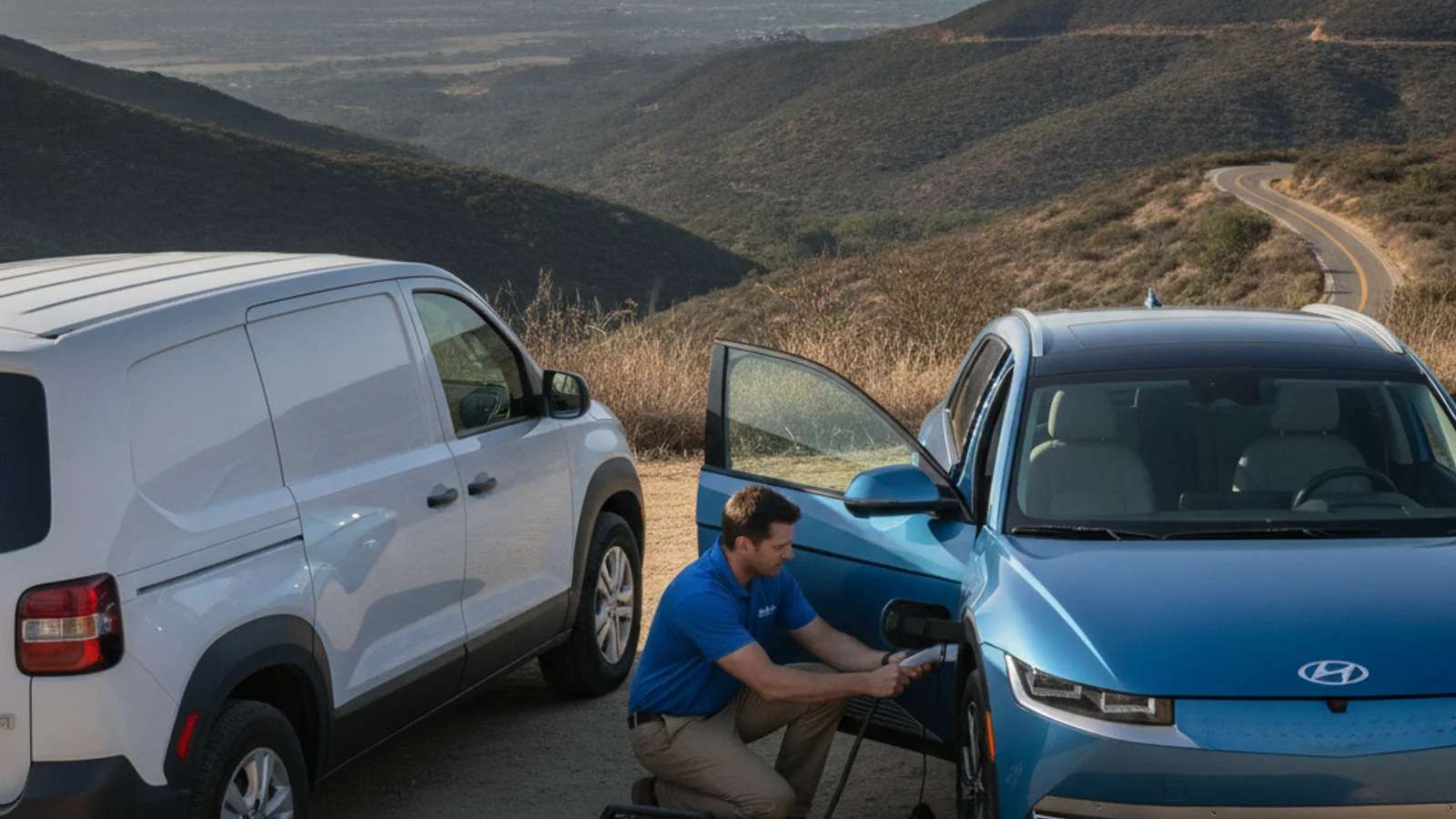
Heat is the local variable, not a county average
The Delta edge of Contra Costa doesn’t share the marine layer. Antioch, Pittsburg, and Brentwood sit well inland of the Bay. Livermore’s July high is 89.7F, nearly even with Antioch. A westbound SR-4 commute still ends in that hot air. Cabin cooling is a constant summer load on Lone Tree Way and Hillcrest Avenue. Range shrinks when the air conditioner stays on.
Mira Vista, Deer Valley, downtown, and Rivertown share that same July air. Nearby Oakley, Bay Point, and Bethel Island sit in the same hot pocket. A trip that looks short on a map still runs the AC the whole way.
We can’t quote a verified miles-lost number for your model. No public source publishes one that covers every pack. Days at or above 100F weren’t confirmed in those station normals. Don’t treat a blog as a heat-day count. The July average is the figure we can stand behind. Treat hotter afternoons as extra stress, then open the car’s own guidance.
Follow the maker, not a one-size charge window
Tesla, Rivian, Ford, Hyundai, Chevrolet, and Kia each publish pack care. Charge limits, software updates, and service intervals differ by chemistry and year. Those pages change, and a percentage you saved last summer may be stale now.
We can’t confirm one degradation rate for every EV in east Contra Costa. We can’t confirm one daily charge cap either. Any post that assigns a heat penalty in percent is guessing. If your manual says to keep the pack off the top in hot weather, follow that. If the app offers preconditioning or a scheduled departure, use it before a Hillcrest start.
Tires, cabin filters, and brake fluid still have their own calendars. Our EV maintenance schedule covers those non-pack items. This piece stays on the traction battery and the 12V that wakes it.
Antioch miles aren’t coast miles
The city covers about 29 square miles in Contra Costa County. The ACS 2019-2023 count is 115,759 people. The 2024 Census estimate is 118,453. Callers in 94509, 94531, or 94565 may still be in town. Those ZIPs can also spill past the city line, so don’t treat them as a boundary. Neighborhoods run from Rivertown and downtown to Lone Tree, Hillcrest, Deer Valley, and Mira Vista. Somersville and the Delta waterfront sit on the older edge. Black Diamond Mines Regional Preserve rises south of town.
The commute spine is SR-4, including the Bypass. SR-160 crosses the Antioch Bridge toward the Delta. That bridge is Caltrans-owned, with eastbound-only electronic tolls. Cash collection ended in March 2020. Hillcrest Avenue and Lone Tree Way feed the east-side tracts. Antioch BART is the end of the line. A pack that sits in that lot all day still comes home through July heat.
About 41.9% of local housing was built before 1980. Older stock can mean a tighter electrical panel for a wall charger. Confirm panel capacity with a licensed electrician. Charge Pro SF doesn’t install equipment and doesn’t hold a contractor license. In Brentwood, only 10.9% of housing predates 1980. The two cities don’t share the same housing mix.
Grade still matters on a loaded run toward the hills. We won’t assign a verified range cost to those climbs. Heat plus grade is extra work for the pack. Check the maker’s notes more often than you would on a flat coast commute.
A car near the water sees milder July highs. Charging speed and pack temperature both respond to ambient air. Inland sessions can slow on a hot afternoon, and cabin cooling adds load. Our coast versus inland charge-time note explains that split without inventing minutes for your VIN.
Check a live charging map before a long SR-4 run toward Concord. Do the same before an SR-160 crossing. Confirm the stall yourself. We aren’t estimating how far the next plug sits.
The DOE Alternative Fuels Data Center publishes connector and power specs. Level 2 uses 240V at home, or 208V at many workplaces. It typically adds about 25 miles of range per hour, through J1772 or NACS. DC fast charging can reach up to 500 kW at some stalls. Some cars can add roughly 100 to more than 200 miles in 30 minutes. That only holds if the car and the stall both support it. Those are equipment ceilings, not a promise for your session. Acceptance rate, state of charge, and air temperature still set the real speed.
Split the traction pack from the 12V
Drivers often treat every battery warning as the same failure. An EV has two systems, and they fail differently.
The traction pack moves the car. It’s the range number on the screen. When it runs down, you still get warnings first. Then the car stops under its own power.
The 12V battery is much smaller. It runs locks, the screen, and the computer that wakes the high-voltage system. When that 12V dies, the car can look fully dead with a healthy pack. Doors may not answer, and the display stays dark.
A low traction pack on SR-4 is a charge or recovery job. A silent 12V in a Hillcrest driveway is usually a jump. If the car last showed decent range and now won’t wake, start with the 12V.
Home charging here runs on PG&E wires
PG&E delivers power in Antioch. The city isn’t on MCE’s published Contra Costa member list. Pittsburg is on that list, and Concord is too. Confirm your generation provider on your own bill. Don’t take a blog as a rate quote.
PG&E names residential EV schedules: Home Charging EV2-A, Electric Vehicle EV-B, and Electric Home E-ELEC. It also names a Residential EV Charging rebate. We aren’t publishing dollar amounts. Confirm current rates and rebate rules on pge.com before you enroll.
Overnight charging still helps a pack that works through 90F days. It doesn’t replace the maker’s charge-limit advice. Preconditioning while plugged in is often kinder than a hot, empty start on Lone Tree Way. A shaded stall still helps more than a sun-soaked one. We don’t have a verified temperature-drop figure for local lots. Use shade when you can find it, then follow the car’s own thermal settings.
If you’re already empty, a wall unit at home can’t reach you. That’s a roadside call, not an install appointment. See EV roadside assistance in Antioch for how that call works in this city. The Antioch charging hub is the local starting page.
If you stall, match the help to the battery
A disabled vehicle on a freeway may stay put only under tight rules. California Vehicle Code 21718 generally bans stopping on a freeway. It allows a disabled-vehicle exception when another vehicle has been summoned to assist. CVC 22651(f) allows removal after more than four hours on a full-access-control freeway. That applies if you can’t move under your own power. Those are the statutes, not a tow-price list.
The Bay Area Freeway Service Patrol covers set weekday windows. Hours are 6 to 10 a.m. and 3 to 7 p.m., Monday through Friday, per 511.org. Dial 511 and ask for Freeway Assist. MTC’s FSP page lists gas, jump-starts, and radiator refills. It doesn’t mention EV out-of-charge help. Outside those hours, CHP’s Rotation Tow Program assigns the truck. You don’t pick the vendor.
Independent operators on the referral line bring a 240V Level 2 source to the car. They use a native NACS plug, or a CCS or J1772 adapter for non-Tesla EVs. A typical session adds 10 to 20 miles in 15 to 30 minutes of charging. That’s charging time on scene, never an arrival time. The operator quotes you before work starts and bills you directly. Charge Pro SF doesn’t own the truck and doesn’t set the price.
Request out-of-charge recovery when the traction pack is empty. General EV roadside assistance covers 12V jumps and other on-the-spot work. If you’re still rolling but the gauge is thin, read what to do while you’re running low. Do that before you sit on the shoulder.
A service center is the right call when the car still drives and still charges. State-of-health tests, warranty questions, and pack repair belong there. A roadside operator’s job is getting you moving. Long-term pack health isn’t a shoulder diagnosis.
When a local operator is the next step
If the traction pack is empty in Antioch, that’s a roadside situation. The same is true if the car won’t wake and you suspect the 12V. Call Charge Pro SF at (415) 630-6268. The line matches you with an independent local operator. The pro quotes before starting, and you pay the operator directly.