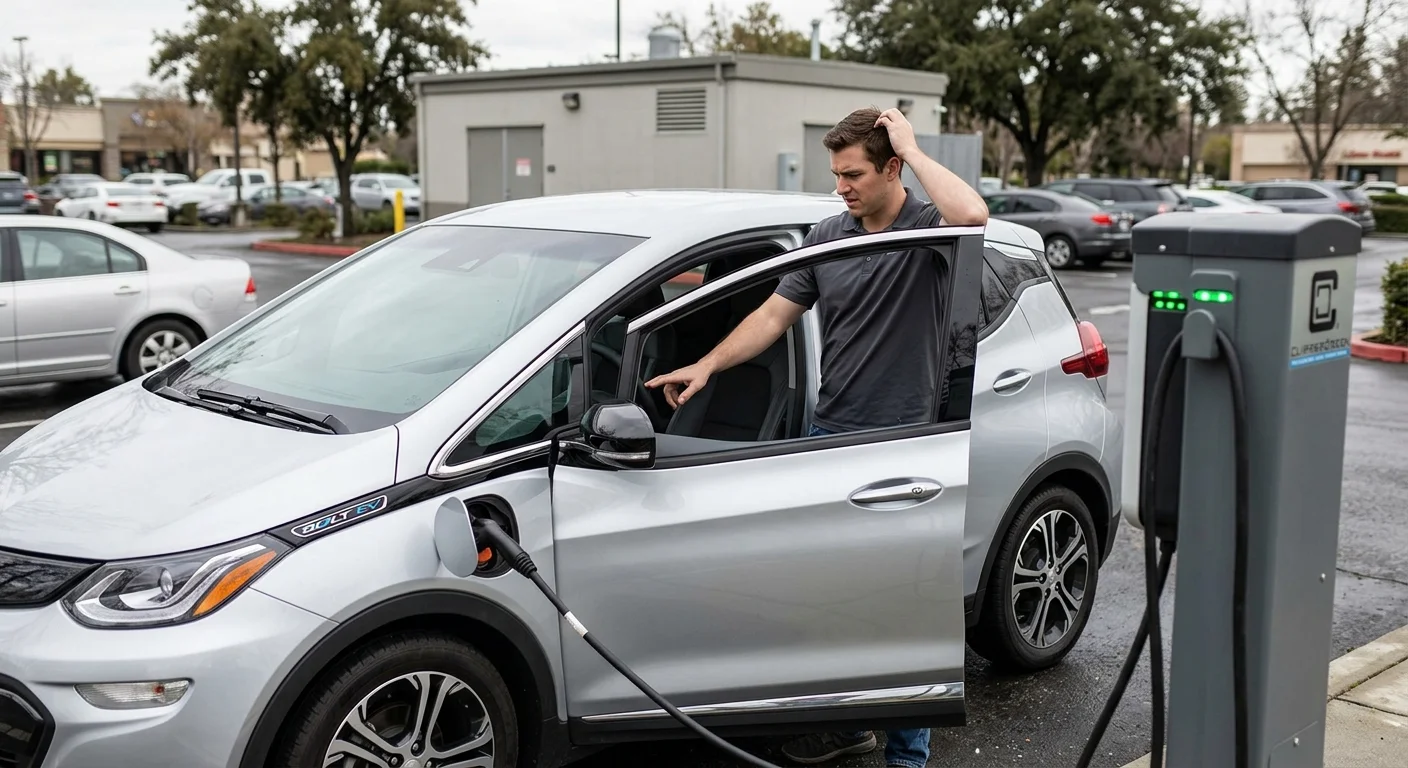
Your Chevy Bolt won’t charge when the public stall never starts a session. In the South Bay that’s often a Sunnyvale campus lot. It can be a San Jose garage. It can be a Santa Clara post after an event. The cable is seated. The screen stays quiet. You don’t need a pack replacement for that silence. You need a short order that splits the post, the 12V, and the car.
South Bay stalls fail for local reasons
A Bolt on a J1772 post has to finish a handshake before it takes power. The cabinet, the cable, and the charge-port module all have to agree. When they don’t, you get silence. You may also get a blunt “Unable to Charge” alert. That’s a session that never began. It isn’t a range reading.
San Jose is the big South Bay grid, with an ACS population of 990,054. San Jose Clean Energy supplies generation inside the city. Silicon Valley Clean Energy covers Sunnyvale, Mountain View, Cupertino, and Campbell. It also covers Los Gatos, Milpitas, Morgan Hill, and Gilroy. Santa Clara sits on Silicon Valley Power. That’s a municipal utility with no CCA. Palo Alto has City of Palo Alto Utilities. Those names matter for a home bill later. They don’t decide which public stall wakes your Bolt tonight.
Inland heat belongs on the same map. San Jose’s July average high is about 82F on the 1961-1990 normals. Gilroy’s July max is 88.3F. San Francisco’s is 71.5F. A Bolt that sat in a Morgan Hill lot all afternoon starts warmer. That’s a different pack temperature than a car nearer the bay. Watch the dash for a thermal message. If none shows, treat it as a stall or 12V problem.
Older west-valley housing changes the home half of this search. Los Gatos is 73.2% pre-1980. Campbell is 67.9%. That’s a different housing story than Milpitas at 39.0%. Morgan Hill is 35.7%. It doesn’t change the public stall in front of you. Keep those two problems separate.
Start with the post in front of you
Assume the hardware first. Unplug the J1772 handle. Wait a few seconds. Seat it until the latch clicks. Look at the charge-port door and any LED on the car. A half-latched handle is a session that never starts. Try the neighboring port on the same cabinet. Then try a different cabinet in the same lot. A dead stall next to a live one is a common public-charger pattern. It isn’t proof your onboard charger failed.
If the station wants an app session, start that session first. A cable can sit in the port with no kilowatts. That happens if billing never finished. End the session in the app. Start a new one. Then reseat the handle. For a connected-but-not-charging stall, use the same isolation steps as other EVs. Walk through public charger connected but not charging. Chevy’s Equinox EV throws a similar stall problem. The checks overlap more than the badges do. See Chevy Equinox EV won’t charge if you drive both.
BART publishes Level 2 charging at Warm Springs / South Fremont, with 42 plugs. If you’re already in that lot and the session fails, isolate that stall. Don’t guess how far another charger sits.
If the Bolt sat at San Jose Airport after a trip, start with the published lots. flysanjose.com lists Economy Lot 1. It lists Hourly Lot 2 at the Terminal A Garage. It lists Hourly Lot 3 at the Terminal B Garage. It also lists Daily Lot 4 and Lot 5. There’s a Cell Phone Waiting Area too. The airport parking page doesn’t publish a wake-up script. It doesn’t tell you what to do when a charge won’t start. Confirm charging on site if you need a stall. A week in a garage can also flatten the 12V. Treat that as a wake problem first.
A Santa Clara stadium lot after an event is the same boxed-in stall. The car is wedged in a row. You can’t roam for another cabinet if the lot is packed. That’s when isolation ends and a mobile source has to come to the bumper.
Level 2 and DC fast are different tests
A Bolt that refuses a DC fast stall can still take J1772 Level 2. The protocols differ. If the fast stall errors out, try Level 2 in the same lot. If Level 2 fails after a second cabinet, suspect the 12V or the car. Don’t mix those results into one story. A DC fault can be the cabinet. It can be the connector latch. It can be a session that never authorized. A Level 2 fault is often the handshake, the app, or the 12V. Write down which one failed. That note saves the operator a guess later.
A weak 12V can block the whole handshake
Move the 12V before you restart the car on a loop. The high-voltage pack can still hold miles. The small 12V battery can still be too weak to close the charge relays. Then the post looks dead. The Bolt looks dead. The charge port never wakes.
On most Bolts the 12V sits under the hood. It’s on the driver’s side, like a gas-car battery. Look for corroded terminals. Don’t touch the orange high-voltage cables. A jump or a replacement of that 12V is a low-voltage job. The operators we connect you with handle Tesla and every major EV brand. That includes Chevy. They can jump or replace a dead 12V on site. They quote you before they start. They bill you directly.
If the car is dark and locked, you’re past DIY. Call for non-Tesla EV rescue instead of standing on the latch.
Home Level 2 is a different “won’t charge”
The South Bay search is a public stall. Home is the other half of the same complaint. Older west-valley houses, especially in Los Gatos and Campbell, often share tight panels. A tripped breaker on a Level 2 circuit looks exactly like a dead car. Check the garage breaker. Reseat the wall connector. Swap to a known-good cable if you have one.
In Santa Clara, Silicon Valley Power has no dedicated residential EV rate. Charging there rides the standard residential rate. Silicon Valley Power does publish a Residential Electric Vehicle Charging Station Rebate. Confirm current terms on siliconvalleypower.com before you count on them.
PG&E still delivers the wires in SVCE cities. Peninsula Clean Energy covers San Mateo County, not Santa Clara County. San Jose Clean Energy is the San Jose generation provider. Don’t treat a CCA name as a charger diagnosis.
PG&E publishes residential EV rate names if you later sort a home schedule. Those names are Home Charging EV2-A, Electric Vehicle EV-B, and Electric Home E-ELEC. That’s a bill conversation with the utility. It isn’t a roadside fix. Don’t ask a mobile operator to interpret your rate.
Soft-reset the charge system after the physical checks
A soft reset clears a stuck module after the cable and 12V look sane. Do it once. Don’t loop it.
- Unplug the J1772 handle and wait for the session to end.
- Power the Bolt fully off.
- Open and close the driver’s door.
- Wait a few minutes so modules actually sleep.
- Power back on.
- Plug in and watch for a real session, not just a click.
If nothing changes, stop. You’ve isolated a stubborn post. You’ve isolated a 12V that won’t hold. Or the car needs a shop. Repeating the door trick won’t invent a new result.
What “Unable to Charge” is actually saying
“Unable to Charge” is a catch-all. It means the handshake failed, or a safety check aborted the session. It doesn’t name the part. Communication errors are the usual public-stall version. That’s a dirty latch. That’s a half-seated pin. That’s a cabinet in a fault state. That’s an app session that never started. Unstable power can abort the same way. The Bolt’s onboard charger is built to refuse a dirty feed.
If it repeats after a new stall and a seated cable, suspect the car. Do that only after a 12V check and one reset. That can be the onboard charger. It can be the charge-port module. It can be a high-voltage pack fault. Those are shop jobs. A roadside operator can’t rewrite a failed onboard charger in a lot. If the car still accepts AC, a mobile 240-volt charge can add range. If the 12V is the block, a jump is the first move.
Chevy’s public pages don’t pin one code to every “Unable to Charge” screen. Photograph whatever your dash shows. Read it to the operator.
Shoulder rules if you never made the stall
Some Bolts never reach the stall. They go quiet on SR-237 through Milpitas, Sunnyvale, and Mountain View. Others stop on US-101 or I-880 at the South Bay edge. California Vehicle Code 21718 bans stopping on a freeway in most cases. A disabled vehicle is an exception when stopping is unavoidable. Help has to have been summoned. Hazards on. Stay out of traffic.
Dial 511 and say “Freeway Assist” if you’re inside Freeway Service Patrol hours. FSP is a partnership of MTC, CHP, and Caltrans. Private tow companies staff the beats. Hours are Monday to Friday, 6 to 10 AM and 3 to 7 PM. That’s per 511.org. MTC’s FSP page lists gas, jump-starts, and radiator refills. It makes no mention of electric vehicles or out-of-charge help, as of 2026-09-18. Confirm on the spot what that truck can actually do. Outside those hours, CHP’s Rotation Tow Program assigns the tow. You don’t pick the company.
CVC 22651(f) allows removal after four hours on a full-access-control freeway. That applies when the vehicle can’t move under its own power. That’s a clock, not a rescue plan. If you’re still on the SR-237 shoulder, treat movement as the goal. Caltrans District 4 covers the nine Bay Area counties. 511 SF Bay is the traveler line.
Express lanes run on US-101 and SR-237, among others. FasTrak is required. A disabled Bolt there is still a disabled vehicle under CVC 21718.
A mobile Level 2 visit versus a hook
A tow moves a silent Bolt to a shop. It doesn’t start a charge session. If the 12V is the block, a jump on site is the shorter path. If the pack is low, bring power to the bumper. That’s a mobile Level 2 visit, not a hook.
The operators in this network bring a 240-volt Level 2 unit. The rig is native NACS. They use a CCS or J1772 adapter for non-Tesla EVs. A Bolt takes the J1772 path for this kind of roadside charge. They typically add 10 to 20 miles in 15 to 30 minutes of charging. That’s charging time. It isn’t an arrival time.
Charge Pro SF is a referral line. It matches stranded EV drivers with independent local operators. The operator quotes before starting and bills you directly.
San Jose’s downtown event lots create the same boxed-in stall. Santa Clara’s stadium parking does too. A mobile charge versus a tow is the decision.
Private-property tows in a garage follow CVC 22658. Confirm the posted sign and the enforcement number on the placard. San Jose has a private-property tow framework in Municipal Code Chapter 6.66 and Title 23. Specific fee text wasn’t verified in this research. California doesn’t cap ordinary consensual tow rates statewide. The operator sets the price. You hear it before work starts.
Call when the order is done
You’ve tried a second port. You’ve seated the latch. You’ve looked at the 12V. You’ve reset once. The session still never starts. That’s the moment to call, not the tenth reset.
Call (415) 630-6268. Charge Pro SF will connect you with a local operator who quotes before any work begins. Tell them it’s a Chevy Bolt. Tell them the stall never started. Tell them whether the 12V looks weak. That’s enough for the right rig.
The pros we connect you with are licensed and insured. Charge Pro SF serves the South Bay and the rest of the Bay Area. It isn’t a promise that a given stall will start.