Two Teslas sit overnight on a San Francisco curb. In the morning the left one won’t wake. The neighbor in the next stall pops a frunk and grabs jumper cables. That looks like a simple favor. A Tesla can’t jump-start another car. On Bay Area streets, that neighbor is often just as dead.
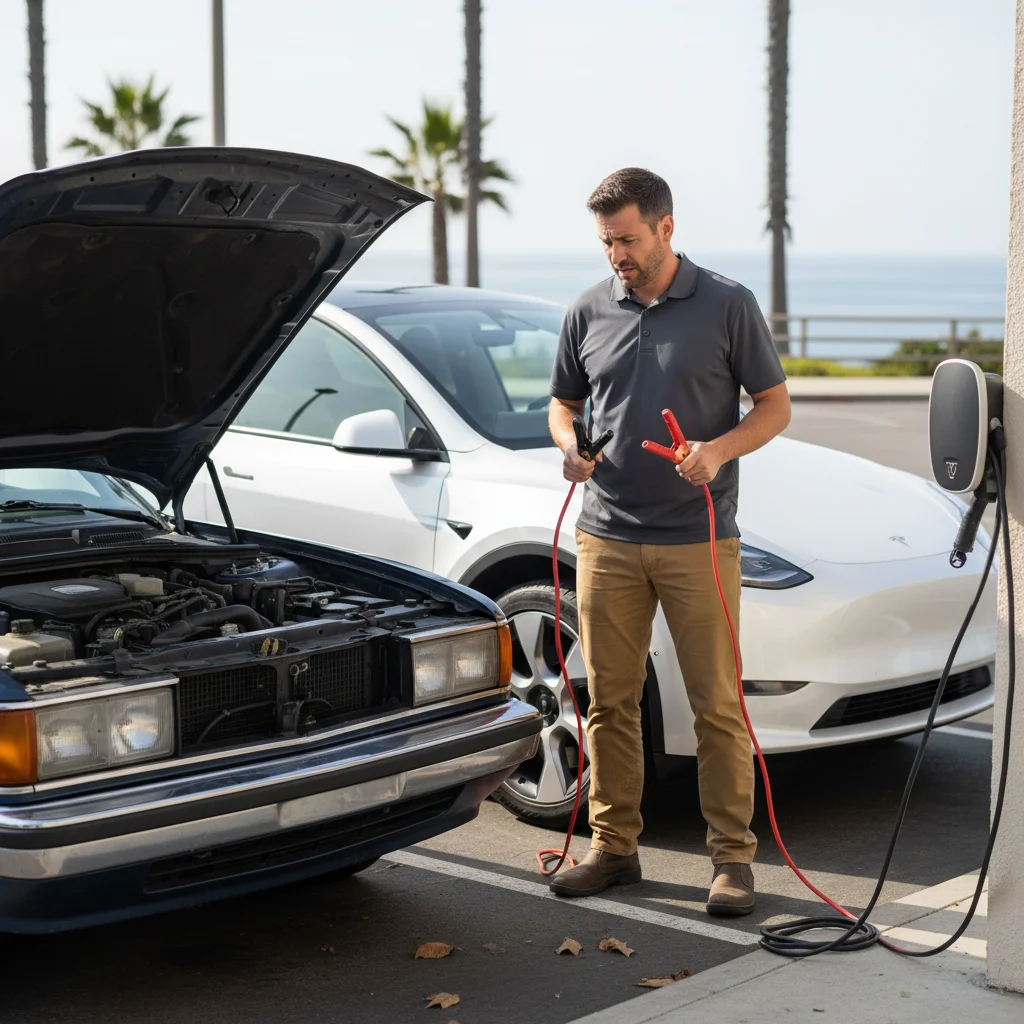
The next stall is not a donor
The hardware still looks like a gas-car jump. That’s why people try it. A Tesla still has a 12V battery. Jump posts show up once the hood is open. Drivers copy the old cable ritual in street parking, campus lots, and airport rows.
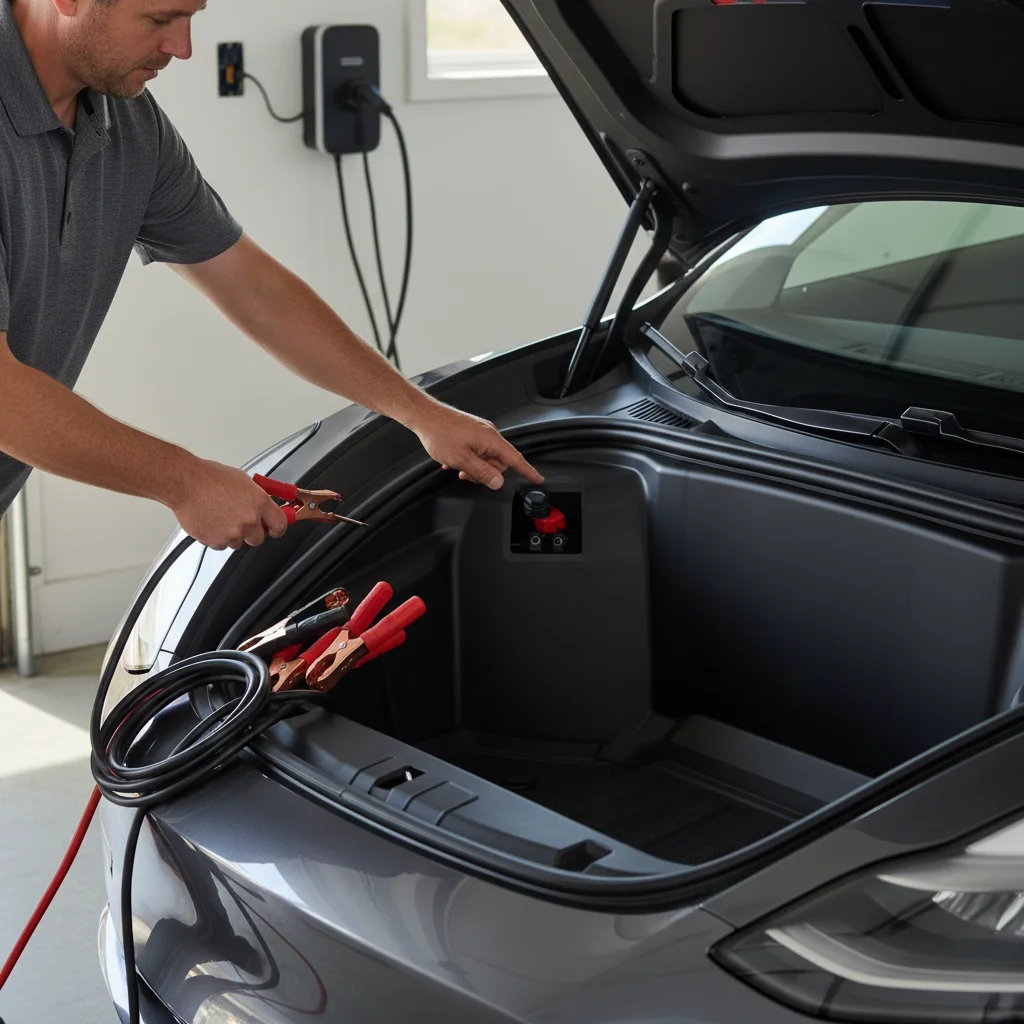
Those posts exist so an outside source can wake your Tesla. Tesla’s Model Y manual identifies the positive and negative jump posts after the hood is open. It also warns that Model Y can’t be used to jump-start another vehicle. Check your own model’s manual before you assume a different rule.
A second Tesla in the stall beside you doesn’t change that. If both cars sat through a long park, both 12V batteries can be tired. Clamping them together doesn’t invent a healthy donor. It just ties two low-voltage systems that already failed to hold a charge. That’s why Tesla-to-car jumps still fail on Bay Area streets when both are dead.
What the 12V is doing in a Tesla
A gas car’s 12V battery is built to crank. It dumps a hard burst of current into a starter motor. Then the alternator takes over. That battery is made for that pull.
A Tesla’s 12V is the wake-up battery for the computers. It runs locks, lights, and the screen. It also closes the contactors that connect the high-voltage pack to the drive unit. Without a healthy 12V, the car won’t wake. The traction pack can still hold plenty of range. The car still looks fully dead. See do Teslas have a 12V battery.
The 12V is kept topped up by a DC-to-DC converter from the main pack. That loop is meant for a steady, small draw. It isn’t meant to shove starter-level current into the car beside you. Older Teslas used a lead-acid 12V. Newer ones, including the current Model Y, use a lithium-ion low-voltage battery.
The car in the next stall can fail in two different ways. The 12V can be dead while the pack is fine. The pack can be empty while the 12V still wakes the screens. Jump cables never touch the traction pack. They only see the small battery. Read Tesla dead pack or just the 12V.
Tesla’s rule, in plain words
Tesla documents how to receive a low-voltage jump. The current Model Y jump page assumes an external supply, such as a portable jump starter. If you jump Model Y from another vehicle, Tesla says to follow that other vehicle’s instructions. Model Y still can’t be used to jump-start another vehicle. Power is supposed to come in, not go out.
Rivian says the same thing on its side. Don’t use a Rivian to jump another vehicle. Polestar’s jump points are only for waking that Polestar.
Jumping isn’t charging. Clamps on a 12V don’t refill a traction pack. If you were hoping one EV could feed another, that’s a different question. See can one EV charge another EV.
If your own Tesla is the dead one, you can receive a jump from an external 12V source. Follow that model’s manual. Don’t copy a gas-car clamp map from memory. Don’t use the wires behind the tow-eye cover as a charge path. On Model Y, those leads only release the hood latches. Tesla says they can’t charge the low-voltage battery. Disconnect them as soon as the hood unlatches.
Why both cars go flat on Bay Area streets
This metro isn’t one parking pattern. Coastal San Francisco and the northern Peninsula still live with curb parking and older buildings. Inland cities add heat. The South Bay adds all-day campus sits. East Contra Costa adds long, hot commutes. Each one can drain a 12V without emptying the pack.
San Francisco’s housing stock is old. About 77.2% of units predate 1980, per ACS 2019-2023. Daly City sits at 78.7%. San Bruno sits at 81.9%. Berkeley is 80.8%, and Oakland is 77.9%. That older stock often means street parking and cars that sit between trips. The next stall is a curb space, a stacked apartment lot, or a row after a week at SFO. Airport sites don’t publish guidance for a car that won’t wake after a trip. Tesla 12V failure after a long park is the pattern.
San Bruno, Millbrae, and Burlingame sit in that SFO pattern. Flysfo.com has an EV-charging parking page. That page couldn’t be verified in this research pass. Confirm stall details on the airport site. The Tesla next to you after a trip has been sitting too. It isn’t your jumper pack.
The Tri-Valley looks different. Dublin’s pre-1980 share is 21.0%. San Ramon is 23.8%. Brentwood is 10.9%. More of those homes have driveways and garages. Two Teslas can still sit side by side after a trip. A driveway doesn’t turn your car into a safe donor.
Heat makes a weak 12V a worse spare. San Francisco’s July average max is 71.5F on the 1961-1990 NWS normals. Livermore’s July normal high is 89.7F. Antioch is 90.4F. San Jose is about 82F. Gilroy is 88.3F. A Tesla that sat in inland sun is a poor donor. The electrical limit doesn’t change.
Campus days stack the same risk in Palo Alto, Mountain View, Sunnyvale, Santa Clara, and San Jose. San Jose is the largest city in this metro by ACS population. The car sits from morning to evening. Lights and computers keep a small draw on the 12V. Two campus Teslas don’t make a jump pair. East Bay cities repeat the curb pattern on I-80 and I-880. A Tesla that sat in a Walnut Creek lot doesn’t become a donor on the SR-24 climb.
If the next stall is a gas car
The instinct is even stronger when the neighbor’s hood is already up. A gas car needs that starter burst. Your Tesla’s 12V isn’t built to supply it. Don’t clamp the two together. Why you shouldn’t jump a gas car with a Tesla covers that warning.
A portable jump pack is the tool for a gas starter, if you carry one. It’s a self-contained pack with its own leads. It doesn’t pull from your Tesla. If you don’t have one, help the driver call for ordinary roadside help. Don’t make your EV the power source.
The Bay Area Freeway Service Patrol still thinks in gas-car terms. MTC, CHP, and Caltrans run it with private tow companies on assigned beats. Hours are Monday to Friday, 6 to 10 AM and 3 to 7 PM. Dial 511 and say “Freeway Assist,” or use a call box. FSP lists a free gallon of gas, jump-starts, and radiator refills. MTC’s page, read 2026-09-18, doesn’t mention electric vehicles or an empty pack. FSP may wake the gas car. It isn’t a plan for your Tesla if you flatten your own 12V trying to help.
Don’t turn a street stall into a freeway problem
If this scene moves to a freeway shoulder, stop thinking about cables. California Vehicle Code 21718 already limits freeway stopping. A disabled vehicle is a narrow exception. Another vehicle has to have been summoned to assist. That isn’t an invitation to jump a second car in a live lane.
CVC 22651(f) lets a vehicle be removed after four hours on a full-access-control freeway. That clock starts when the car can’t move under its own power. Two Teslas with hoods up burn that time. They don’t create a donor.
Express lanes run on I-80, I-580, I-680, I-880, US-101, and SR-237. A stall there is still moving traffic. No published disabled-vehicle policy turned up for the state-owned bridges. That includes the Bay Bridge and the San Mateo-Hayward Bridge. Don’t treat a bridge shoulder as a workshop. Call 911 if the car is in a lane or a dangerous spot. CHP says that in its FAQ. In metro areas, other roadside requests can go through 511.
Outside FSP hours, the CHP Rotation Tow Program assigns a vendor. You don’t pick the truck. Caltrans District 4 covers the nine Bay Area counties. A tow may move a dead Tesla. It doesn’t jump the 12V the way an EV operator does.
What actually gets either car moving
Sort the failure before anyone reaches for cables. If the neighbor is a gas car, they need a gas-style jump or FSP during patrol hours. If your Tesla, or theirs, won’t wake, start with the 12V. If the screens work and the pack is empty, that’s a charge problem, not a jump.
The operators Charge Pro SF connects you with jump or replace a dead 12V on site. They also bring a 240V Level 2 source to the car. That’s a native NACS plug, or a CCS or J1772 adapter for non-Tesla EVs. That charge typically adds 10 to 20 miles of range in 15 to 30 minutes of charging time. That’s charging time, never an arrival time. The operator quotes you before starting and bills you directly. Charge Pro SF is a referral line. It matches stranded EV drivers with independent local mobile rescue operators. It doesn’t own trucks or send its own techs. The pros we connect you with are licensed and insured.
For a Tesla 12V that won’t wake, that’s a Tesla 12V battery jump. Tesla warns that jumping another vehicle can result in damage. If you’d rather not guess, get a quote from a local operator who works on Teslas.
A San Francisco curb, a Daly City lot, a Sunnyvale campus stall, and a Livermore driveway after a hot day all look different. The electrical limit doesn’t. A Tesla can’t jump-start the car in the next stall. When both are dead, stop pairing them. Get the 12V help that actually wakes one car.
Frequently asked questions
Can a Tesla jump start another car?
No. A Tesla shouldn’t be used to jump-start another vehicle. Tesla’s Model Y manual says the car can’t be used to jump-start another vehicle. Check your model’s manual for the wording that applies to you.
Can two Teslas jump each other after a long park?
No. If both sat, both 12V batteries can already be flat. Clamping them together doesn’t create a donor. You need an external 12V source, or an operator who can jump or replace the 12V on site.
What should you do if the next stall is dead too?
Leave the cables in the frunk. Confirm whether the 12V or the pack failed. Help a gas-car driver call ordinary roadside help. For a Tesla that won’t wake, call (415) 630-6268. We’ll connect you with an independent local operator who quotes before work starts.