Yes, every Tesla has a 12V-class battery besides the traction pack. After a long sit at SFO, that hidden battery is often the one that dies. The pack can still show range while the car stays dark and silent.
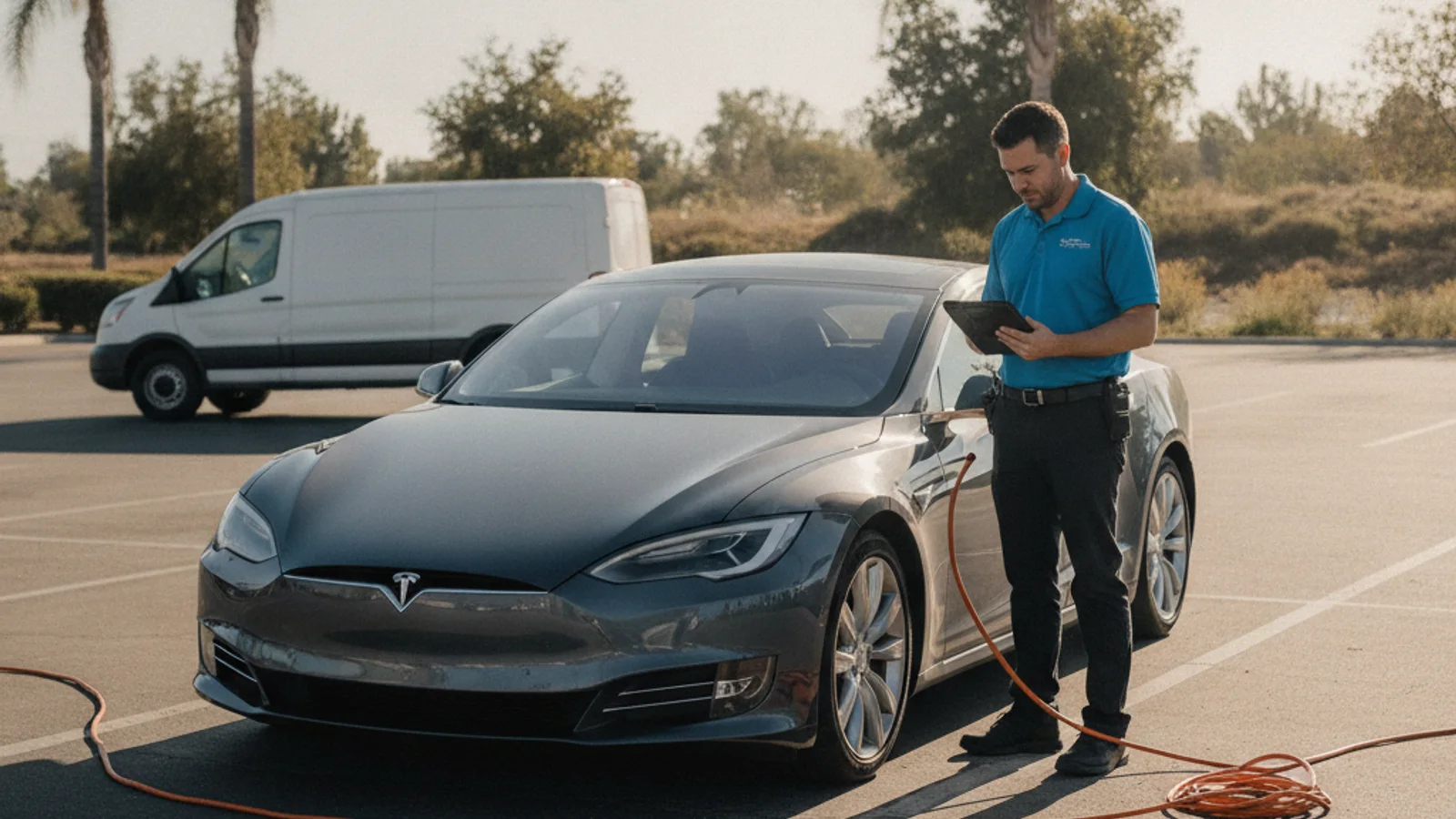
The SFO walk-back that doesn’t add up
You land, ride to the garage, and the Tesla does nothing. Door handles stay flush. The screen never lights. The phone app can’t find the car. You remember a healthy range figure from the day you parked.
That split is the 12V talking, not an empty pack. SFO’s parking pages don’t tell you what to do when the car won’t wake after a week or two. Confirm current lot rules on flysfo.com before you leave it. The airport doesn’t publish a 12V playbook.
The same stall shows up in San Bruno hotel lots after a late flight. It shows up on Millbrae streets and in Burlingame overnight lots. South San Francisco office parks see it after a long work trip. The car sat. Cabin overheat, Sentry, and app checks kept sipping power. The small battery emptied first.
San Bruno EV roadside help covers that Peninsula sit if you’re still near the airport. A home battery in Foster City can’t reach a car you left at SFO. That’s another city, and another problem.
Two batteries, and only one is on the sticker
A Tesla isn’t a one-battery machine. The big traction pack drives the motors. It sets the range number people watch on the app. A second, much smaller battery runs everything that has to work before the pack is even connected.
That small pack is 12-volt class. It feeds the computers, cameras, and door handles. It also feeds the contactors that close the high-voltage circuit. If it’s dead, nothing in the cabin responds. Plenty of range can still sit in the floor pack.
Other EVs do this too. It’s not a Tesla-only design. Owners miss it because the brochure talks about “the battery” as if there’s only one.
Why the car still needs that small battery
The traction pack lives at several hundred volts. Motors need that. Door latches, cabin lights, and airbag modules don’t. Those parts are built for ordinary low-voltage car electronics.
Tesla keeps the high-voltage pack behind contactors. Contactors are heavy relays. They need low-voltage power to close. Until they close, the traction pack can’t feed the car. That’s why a flat 12V leaves a “full” Tesla sitting there.
While the car’s awake or plugged in, a DC-DC converter steps pack voltage down. It keeps the small battery topped off. Once the Tesla sleeps, that converter stops. The 12V-class battery then carries Sentry, scheduled preconditioning, and the computers waiting for your key.
A week in an SFO garage is a long unattended draw. So is a San Francisco street spot while you’re out of town. So is a campus lot in Palo Alto through a conference week. The U.S. Department of Energy publishes an overview of how electric vehicles work. It covers this two-layer layout without naming Tesla parts.
Model by model, the 12V is not one part
Don’t treat every Tesla as the same 12V setup. Tesla has changed the low-voltage chemistry more than once. Some cars still use a lead-acid 12V. Others use a lithium 12V. They age on different clocks. They fail with different warning signs. They aren’t replaced with the same procedure.
Placement moves around the lineup too. On some Model S and Model X years, a tech can picture the box from the manual diagram. On many Model 3 and Model Y cars, access means trim or underbody work. That’s not a curb DIY.
There’s no single cutoff year that covers Model S, 3, X, and Y together. Tesla makes running changes mid-production. A blog table that lists ratings by year goes stale fast. Wrong chemistry means the wrong part in someone’s trunk.
Your owner’s manual for that VIN is the first document. Tesla’s current service notes beat any article, including this one. If your 3 or Y uses the lithium 12V, start here. Read our Model 3 and Y lithium 12V guide.
Refreshed cars and older cars don’t share one jump map. Say the exact year and trim when you ask for help. Don’t point a helper at a video shot on a different model.
How Bay Area sitting actually drains it
San Francisco’s housing is old. ACS 2019-2023 puts 77.2 percent of units built before 1980. Daly City is 78.7 percent. San Bruno is 81.9 percent. A lot of Teslas in those cities sit on the street or in shared garages for days. Sentry keeps watching the block. Then the car won’t wake.
The coast and the interior are not the same climate. San Francisco’s July normal high is 71.5F on the 1961-1990 NWS record. Livermore’s July normal high is 89.7F. Antioch is 90.4F. San Jose sits around 82F. Heat is harder on a low-voltage battery. A Concord driveway sit isn’t the same case. A Pacifica fog sit isn’t either.
Downtown San Jose event parking produces the same dark-car stall. So do Oakland street spots. The geography changes. The 12V math doesn’t.
If you’re already on a freeway shoulder, stay put only if the car can’t move. CVC 21718 allows a stop when the vehicle is so disabled that stopping is unavoidable and help has been summoned. CVC 22651(f) allows removal after four hours on a full-access-control freeway if you can’t move under your own power. Call for help, then stay out of live lanes.
Bay Area Freeway Service Patrol runs weekdays 6 to 10 AM and 3 to 7 PM. Dial 511 and say “Freeway Assist.” MTC’s FSP page lists a free gallon of gas, jump-starts, and radiator refills. It doesn’t mention electric vehicles or an empty traction pack. Don’t assume the FSP truck on that beat is set up for a Tesla. The published list doesn’t mention EVs.
A black screen isn’t a zero-percent pack
Treat the symptoms as two different failures. A dead 12V is usually total silence. No chime. No handles. No app. You may not get in from the phone at all.
A low traction pack usually still wakes the cabin. You get a range warning. You can often still use the screen. That’s an energy problem, not a wake problem.
Don’t guess which one you’re looking at from last week’s percentage. If the car is dark, start with the 12V. Our guide to Tesla 12V failure after a long park walks that airport-sit path. If you need the checks in order, use how to tell your Tesla 12V is dead, then jump it.
What to have ready before anyone touches the car
Give the exact model, model year, and trim. That’s what sets chemistry, location, and access. Add how many days it sat. Add whether Sentry or cabin overheat was left on. Add whether the app failed first or the handles did.
Don’t let a driveway shortcut from another model year talk you into opening the wrong cover. If you’re not sure which 12V you have, say so. Guessing the part is how people buy the wrong battery.
Charge Pro SF is a referral line for Bay Area drivers. It matches you with independent local operators. It doesn’t hold a contractor license. It doesn’t own trucks or tools. It doesn’t employ techs. It doesn’t set the price or promise an arrival time. The operator quotes you before work starts and bills you directly.
The pros we connect you with can jump a Tesla 12V on site. They handle Tesla and every major EV brand. If the pack itself is empty, they can bring a 240V Level 2 source instead. Native NACS, with CCS or J1772 adapters for non-Tesla cars. That session typically adds 10 to 20 miles of range in 15 to 30 minutes of charging. That’s charging time, never an arrival time. Broader Tesla roadside rescue is the other path when the 12V isn’t the whole story.
For a jump walkthrough by model family, see how to jump start a Tesla when it won’t wake.
When the Tesla stays dark
Call when the car has gone silent and the last range reading looked fine. That mismatch usually points at the low-voltage battery. Call (415) 630-6268 and we’ll connect you with a local operator.