A street-parked Tesla in San Francisco can’t sit through a membership tow cycle. You need a charge or a 12V jump at the curb. That’s what people mean when they search AAA for Tesla San Francisco. The club is a generalist, and a local EV operator comes to the car.
Why a City Tesla stalls at the curb
San Francisco is one consolidated city and county on the peninsula tip. The city’s land area is 46.7 square miles. Census ACS 2019 to 2023 counted 836,321 residents. The 2024 Census estimate is 827,526. About 77.2 percent of housing was built before 1980. That older stock is apartments, flats, and street parking, not new garages with plugs. Most residents park on the street, so the Tesla has no home charger waiting overnight.
You live on public charging between work, hills, and a busy weekend. A busy weekend of occupied posts can leave a thin percent on the dash. A leftover few percent on a flat block may not climb. That pattern shows up in the Mission, the Sunset, and the Richmond District. It shows up Downtown, in SoMa, and on Marina and Pacific Heights grades. North Beach and Bayview see the same street-parked overnight sit. PG&E still runs the wires. CleanPowerSF is the default generation provider. Neither one can wake a car that’s already empty.
Hills spend range a membership card can’t add
Cool fog keeps summer air-conditioning load low here. 1961 to 1990 NWS normals cover San Francisco and SFO. The July average high in that vintage is 71.5F. The hills still spend a low pack. The climb from the Marina toward Pacific Heights is a classic drain. Twin Peaks spends range the same way on a thin percent. A car that looked fine on Lombard can stall on the next grade. Geary and Market hide the same math. 19th Avenue, SR-1 toward the Golden Gate Bridge, does too.
Damp cold nights wear down a weak 12V battery. The dash can go dark with range still in the pack. That’s a jump job, not a tow to a Supercharger.
What AAA can actually send
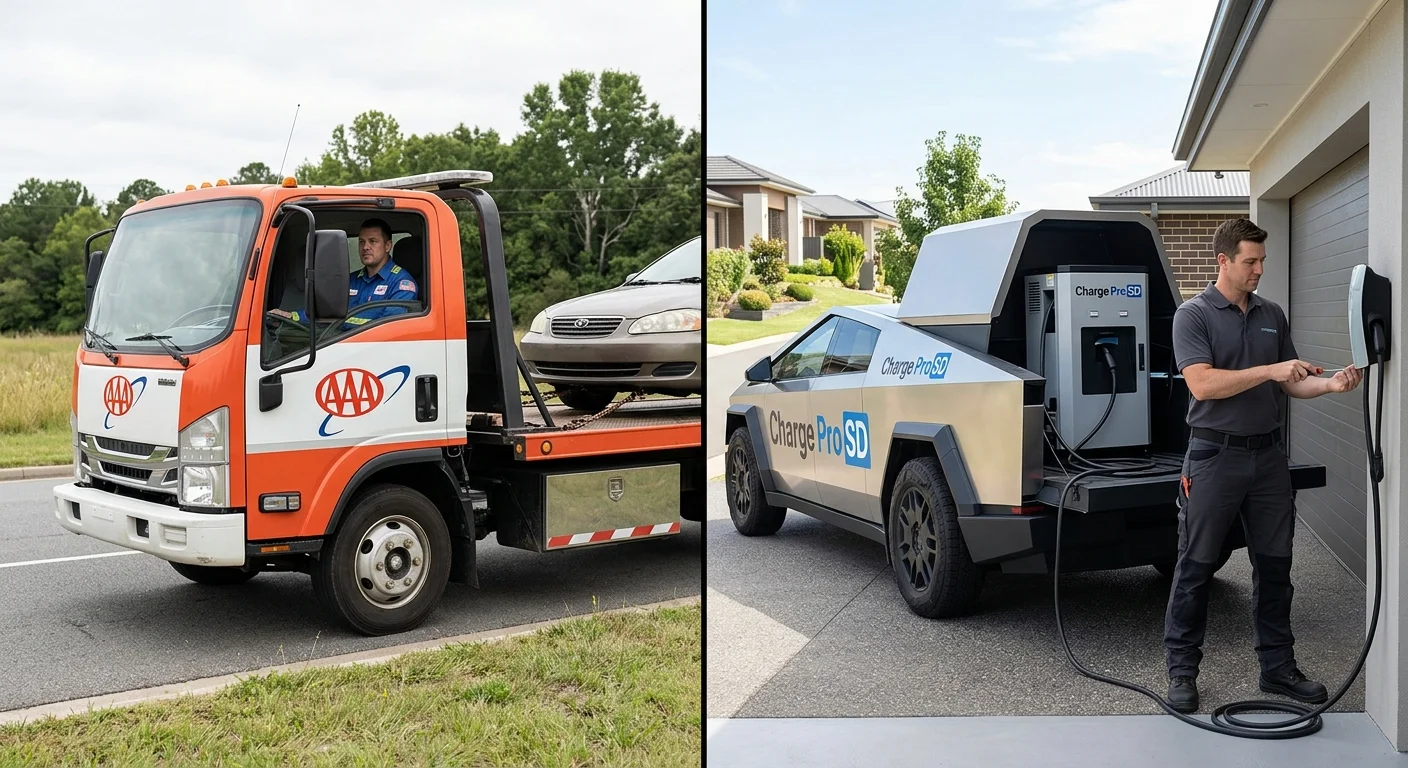
AAA runs on membership, and you pay whether you call or not. Coverage, call limits, and EV handling are AAA’s to set. This page couldn’t verify a published AAA Tesla procedure for San Francisco. Confirm current terms, dispatch rules, and equipment with AAA before you rely on them. A generalist truck is built for flats, lockouts, and gas-car boosts. An empty Tesla traction pack is a different problem. If they send a standard tow, the next step is often a charger. Confirm with AAA what they dispatch for an empty Tesla. Don’t assume the truck carries a 240V Level 2 source.
For the broader club versus charge split, read AAA versus a mobile charge when your EV won’t move.
SFMTA won’t wait on your membership card
A stalled Tesla on a City street has a second clock. SFMTA towing is aggressive, and street-cleaning rules are unforgiving. The City’s towing contractor is TEGSCO, LLC, known as AutoReturn. A car left in the wrong spot can be towed, then stored. That’s a different problem from an empty pack. Confirm current administrative, tow, and storage amounts on sfmta.com before you leave the car.
Private-property tows follow CVC 22658 sign and notice rules. California doesn’t cap ordinary consensual tow rates statewide. The operator who hooks you sets that quote, subject to local ordinance. A membership tow that leaves you sitting still invites that clock.
What a local Tesla rescue brings to the block
Charge Pro SF is a referral line, not a fleet. It matches stranded EV drivers with independent local operators. Those operators quote you before they start, then bill you directly. The pros we connect you with are licensed and insured. They bring a 240V Level 2 source to the car. Tesla cars take a native NACS plug on the port. Non-Tesla EVs use a CCS or J1772 adapter. A typical session adds about 10 to 20 miles of range. That takes 15 to 30 minutes of charging, which isn’t an arrival time. They can jump or replace a dead 12V on site. That work covers Tesla and every major EV brand.
The Tesla roadside rescue page is the Tesla-specific match. Mobile EV charging is the empty-pack path.
Two failures that look the same from the sidewalk
An empty pack won’t move the car, even if the screens wake. A dead 12V can lock you out with a pack that still holds range. Guessing wrong is how people request a tow they didn’t need. If the car is silent after a long curb sit, start with the 12V. Foggy nights and older street-parked cars see that failure a lot. If the app shows a near-zero traction battery, you need energy in the pack. A mobile charge can add enough to reach a Supercharger or a working post. A tow still makes sense when the car can’t take a charge.
Tesla at zero percent walks that fork. For how the plans split in 2026, see Tesla, AAA, or local rescue.
Freeway beats aren’t City blocks
US-101 and Van Ness cut through the core. I-80 feeds the Bay Bridge approach, where stop-and-go plus climate control burns a low pack. I-280 runs the west side, and 19th Avenue carries SR-1 toward the Golden Gate Bridge. On a full-access-control freeway, CVC 21718 limits stopping. A disabled vehicle is an exception when help has already been summoned. CVC 22651(f) allows removal after more than four hours. That applies when you can’t move under your own power.
The Freeway Service Patrol is a partnership of MTC, CHP, and Caltrans. FSP runs Monday through Friday, 6 to 10 AM and 3 to 7 PM. Dial 511 and say Freeway Assist, or use a call box. MTC’s FSP page lists gas, jump-starts, and radiator refills. It doesn’t mention electric vehicles or out-of-charge help. That reading is from mtc.ca.gov as of 2026-09-18. Outside FSP hours, the CHP Rotation Tow Program assigns the truck. You don’t pick that company on rotation. Caltrans District 4 covers the nine Bay Area counties.
A Tesla on a SoMa curb isn’t on an FSP beat. SFMTA rules apply there, not the freeway patrol. No published disabled-vehicle policy for the Bay Bridge turned up in this research. Don’t plan on a special EV exception on the span. Westbound Bay Bridge tolls are all-electronic, with no cash. Confirm current BATA rules on bayareafastrak.org if you stall on the approach.
The Golden Gate Bridge is a separate district. Tolling is southbound only into San Francisco. Confirm current district rules on goldengate.org. None of those agencies dispatch a Level 2 rescue to a curb in the Mission.
Event lots, parks, and the first miles south
Oracle Park and Chase Center parking add another long sit. The car can go quiet after a game or a concert. The Ferry Building and Salesforce Transit Center see long sits. So do Golden Gate Park and the Presidio. Daly City and South San Francisco sit on the first miles south. A peninsula return doesn’t change the curb math in the City.
For neighborhood-level next steps, use EV roadside assistance in San Francisco. The San Francisco charging hub sits on the same local map.
Which call fits a street-parked Tesla
Keep AAA if you want a broad membership net for flats and lockouts. Call a local EV operator when the Tesla won’t take you to a charger. The search AAA for Tesla San Francisco is really that fork. Charge Pro SF serves every city in the Bay Area, including the City. The operator quotes before any cable goes on. Nobody on this line promises an arrival clock.
Call (415) 630-6268 when you want a match to a local operator.