The best roadside assistance for Tesla is the desk that matches the failure. An empty pack on I-580 needs energy at the bumper. A dead 12V in a San Francisco garage needs a jump. A long tow still belongs on a club card. Tesla’s own line knows the car. It can still lag when you need a charge in place. That lag is why Bay Area drivers keep a local operator.
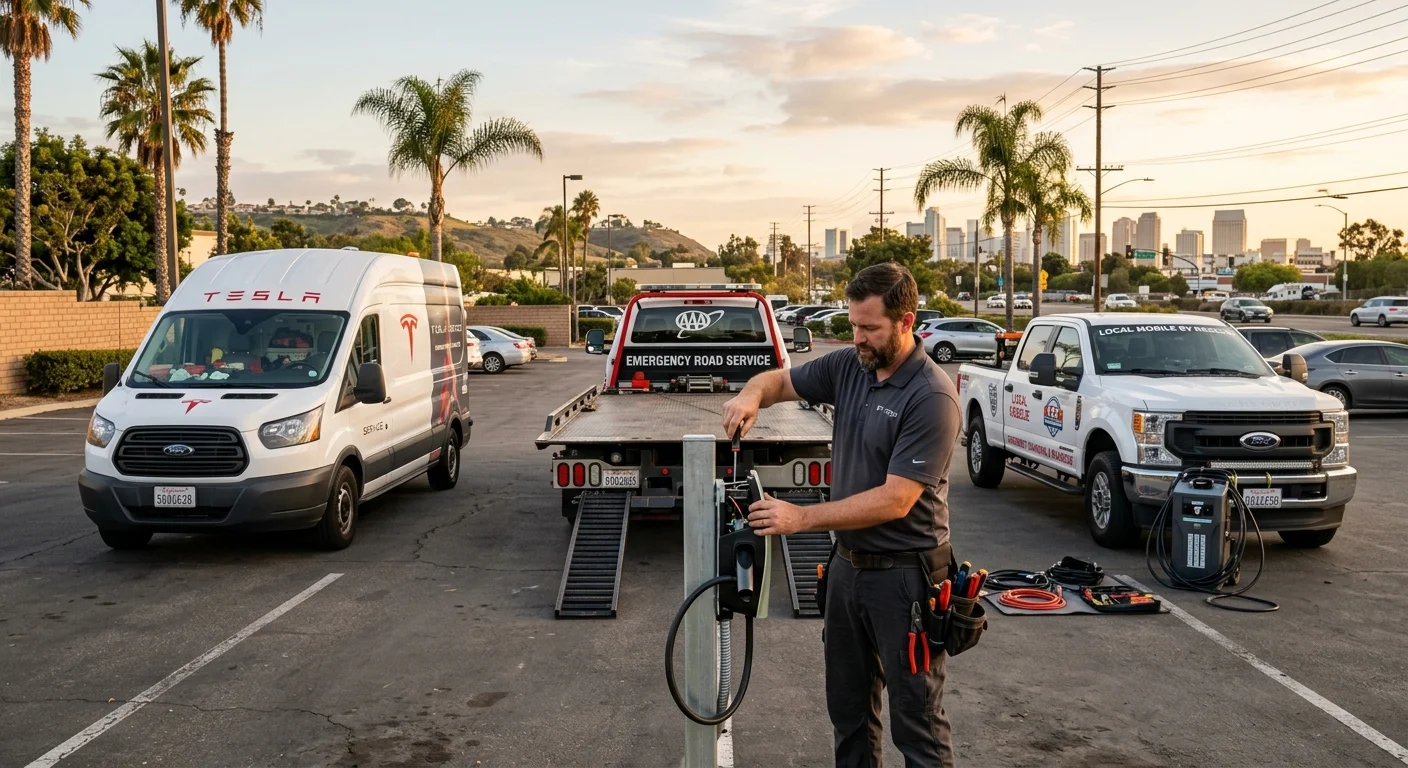
Best doesn’t mean one phone number
Searchers want a single winner. The car doesn’t work that way. Tesla roadside, a motor club, and a local mobile rescue operator sell different jobs. The right call finishes the job in front of you.
A Supercharger is still the right tool if you can roll to it. BART publishes Level 2 charging at Warm Springs / South Fremont. That lot lists 42 plugs. Lafayette lists 4 plugs. If the car can’t move, a map pin doesn’t finish the night.
Start with what failed, then pick a desk
The traction pack is empty
The big battery is what moves the wheels. At zero percent, a 12V jump won’t create range. You need energy into the pack, or a bed. The operators we send bring a 240-volt Level 2 source to the car. Tesla gets a native NACS plug. Other EVs use a CCS or J1772 adapter. They typically add 10 to 20 miles of range. That takes 15 to 30 minutes of charging. That interval is plug time. It’s never a promise of when someone arrives.
The 12V is dead and the car looks bricked
Every Tesla still runs a low-voltage battery. When it fails, screens stay dark. Door handles may not present. The high-voltage pack can still hold range you can’t use. This is a jump or a 12V replacement at the car. It isn’t a Supercharger errand. Factory and club desks may log it as a no-start. Ask them what they’ll actually do at the bumper.
You need a hook, not a cord
Crash damage is still a tow. So is a car that won’t accept charge. Tesla may route that toward a service center. A club membership is built around tow miles. A local rescue operator isn’t a long-haul broker. Don’t call a charger for a bed ride.
Tesla’s desk: factory knowledge, a different clock
Tesla roadside is the factory channel. New cars usually include it inside a coverage window. Confirm the current terms in the Tesla app for your VIN. Don’t trust a screenshot from last year.
The desk knows the car’s jack points. It knows you shouldn’t jump a gas car from the pack. You may need a bumper charge, not a repair slot. That’s covered in Tesla mobile service or a roadside charge.
What it doesn’t automatically mean is a Level 2 truck beside you. Tesla mobile service is a scheduled repair. It isn’t the same job as an out-of-charge rescue. A service appointment can sit days out. The car may already be dead in a lot. That’s the lag this page is about. The factory path may still be a tow toward a Supercharger. Ask them which one they’re sending. Our notes on Tesla roadside help when service is days out walk that fork.
On a Bay Area freeway, that fork has a legal timer.
A motor club is a tow net first
AAA is the club most owners already pay for. Insurers sell similar roadside add-ons. Charge Pro SF doesn’t publish another company’s 2026 EV menu. Those menus and contractors change. Read your card. Then call the number on it. Ask three questions while you still have range.
Ask if they’ll charge the pack at the car. Ask if a Tesla 12V jump is in scope. Ask how far they’ll tow if the car must ride.
If the honest answer is a conventional tow, keep the card for that job. Don’t pretend it’s a mobile charge. We compared that split for San Francisco Tesla drivers. The empty-pack version is AAA versus a mobile charge when your EV won’t move.
The yellow freeway truck isn’t an EV charger
Caltrans District 4 covers the nine Bay Area counties. If you stall on a freeway in commute windows, you may see Freeway Service Patrol. MTC, CHP, and Caltrans run it together. 511.org lists weekday hours. They run 6 to 10 AM and 3 to 7 PM. Dial 511 and say “Freeway Assist,” or use a call box.
MTC’s FSP page lists a free gallon of gas, jump-starts, and radiator refills. It doesn’t mention electric vehicles. It doesn’t mention an out-of-charge boost. A 12V jump might still be in that truck’s muscle memory. A pack top-off isn’t what the page offers.
Outside those hours, disabled-vehicle calls go to the CHP Rotation Tow Program. You don’t pick the vendor.
California Vehicle Code 21718 bars stopping on a freeway except in tight cases. A disabled Tesla can stop if help is already summoned. That’s the 21718 exception that covers you. CVC 22651(f) lets officers remove the car after four hours. That applies on a full-access-control freeway. The car has to be unable to move under its own power. Sitting still isn’t a plan. Call the desk that can add range or move the car.
What a local operator does, and what this brand doesn’t
Charge Pro SF is a referral line. We match stranded EV drivers with independent local operators. We don’t hold the trade license for the work. We own no trucks. We employ no technicians. We set no prices. We publish no arrival time. The operator quotes you before they start. They bill you directly.
The job they come to do is Tesla roadside rescue at the bumper. Level 2 at 240 volts. Ten to twenty miles in fifteen to thirty minutes of charge time. A 12V jump or replacement on site. Tesla and every major EV brand.
They aren’t Tesla Service. They aren’t your collision tow. They won’t promise a clock. If the car has to ride a long hook, keep the factory desk. Keep the club card too.
City-by-city notes live on the Bay Area EV charging hub. Use them for local roads. Use this page for which phone to pick.
Coast, Peninsula, South Bay, and inland heat aren’t the same stall
The Bay Area is several climates and several housing stocks sharing one Tesla badge.
San Francisco and the inner Peninsula
San Francisco’s ACS 2019-2023 population is 836,321. About 77.2 percent of housing predates 1980. Daly City is 78.7 percent pre-1980 on 7.6 square miles. A lot of cars live on street parking and older panels. Home Level 2 isn’t a given. The stall you get is often a car that sat, then wouldn’t wake.
SFO has an EV-charging parking page. An automated read of flysfo.com failed on 2026-09-18. This site won’t invent stall counts. Confirm in the airport’s own tools. Oakland and San Jose airport parking pages showed no EV charging on that date. A 12V that died after a trip is the scenario those pages don’t answer.
South San Francisco, San Bruno, Millbrae, and Burlingame sit on US-101. That’s the airport hotel belt. The car that dies there is often a trip car.
Peninsula towns from Daly City through Menlo Park sit on PG&E wires. Peninsula Clean Energy supplies the generation. That split doesn’t change a bumper charge. It’s just how the bill is built when you finally plug in at home.
South Bay and Silicon Valley
San Jose’s ACS count is 990,054. July’s normal high there is about 82F, against 71.5F at San Francisco / SFO. Campus lots in Palo Alto, Mountain View, and Sunnyvale hold cars for long days. Santa Clara and Cupertino do too. SR-237 is a short freeway. It’s a long shoulder if you can’t roll.
Gilroy’s July normal high is 88.3F. Morgan Hill and Gilroy sit on the south county edge. Heat and a long US-101 run will spend a pack. That pack felt fine in the morning.
East Bay, the Tri-Valley, and the Delta
Oakland’s ACS count is 438,072. Berkeley housing is 80.8 percent pre-1980. I-80, I-880, and the tubes off Alameda change how you wait. You can’t wander to the next block when water is on both sides.
Livermore’s July normal high is 89.7F. Antioch’s is 90.4F. San Francisco’s is 71.5F. That inland gap is the 1961-1990 WRCC normal, not a guess. The same indicated miles do less work on I-580 over the Altamont. They also fade on I-680 through Sunol. SR-4 toward the Delta is the same story. Already on that shoulder. See out of charge on I-580 over the Altamont.
How to use three numbers without paying twice
Keep Tesla’s app for factory roadside and for service. Keep a club card if you want tow miles you’ve already paid for. Keep a local EV operator for empty-pack and 12V jobs.
When the car already sits dead, work in this order.
Turn on the hazards first. If you’re on a freeway during published FSP hours, try 511 first. That truck may not charge an EV pack.
Then decide pack versus 12V. A car that drove to empty is a charge job. A car that went silent after sitting is often 12V.
If it’s zero and you can’t roll, call a local mobile charge. Don’t wait on a future slot to create range.
If the car must be towed, use Tesla or the club. Don’t wait on a charger that can’t lift it.
Don’t ring all three at once. You’ll get two vendors for one job. California Penal Code 632 is why a forwarding line plays a recording notice.
When the car won’t move
If the pack is empty, we connect you with a local operator. Same if the 12V is silent. They quote before they start. They bill you directly. Call (415) 630-6268.