Tesla roadside assistance is free while you’re inside the Basic Vehicle Limited Warranty. After that, Tesla bills the job. Tesla doesn’t publish a public fee we could verify. The quote Tesla shows you before a truck rolls is the number that matters. A local operator is a separate job. They quote a mobile charge or a 12V jump at the car. Then they bill you directly.
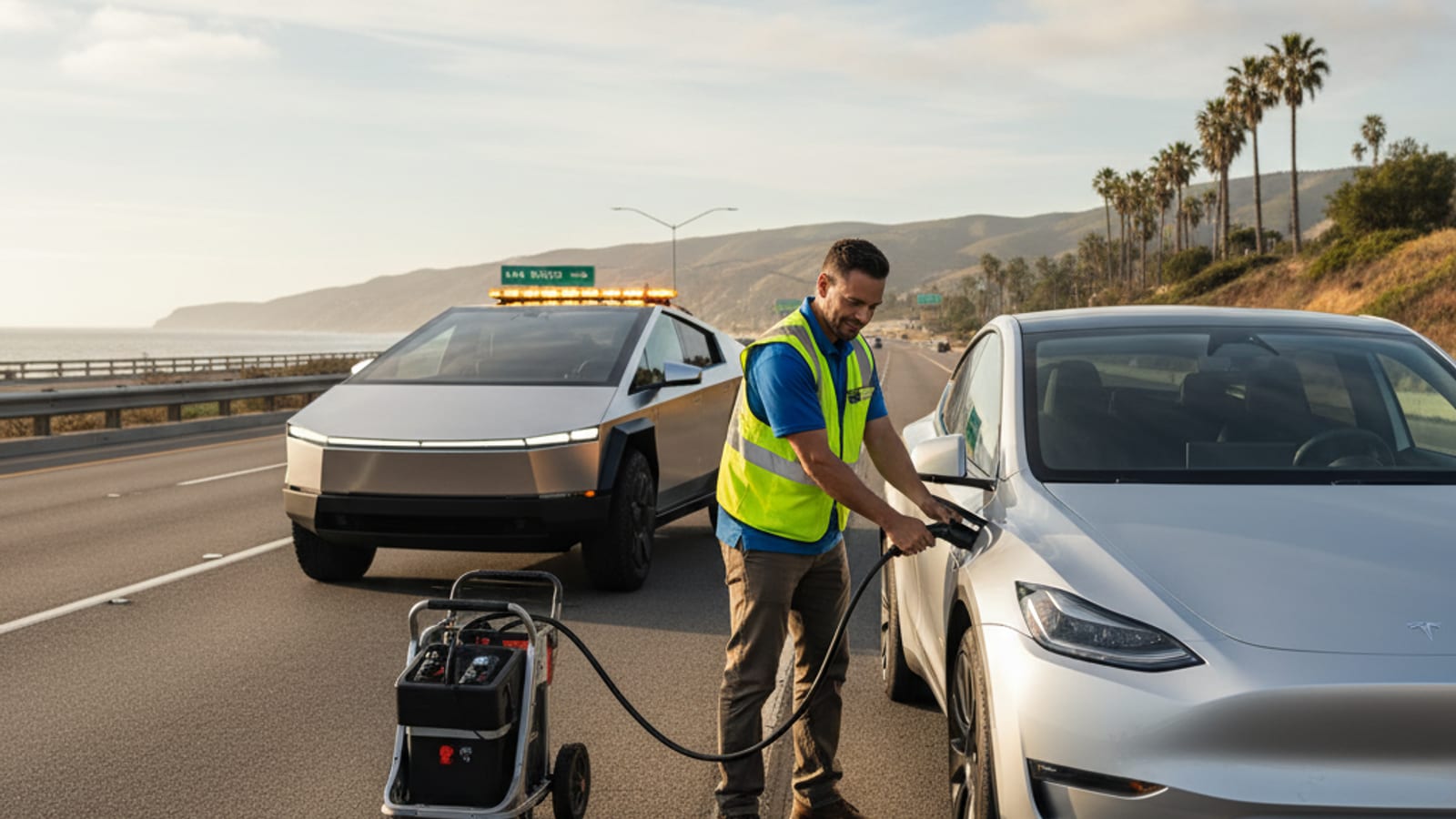
Two paths, not one price
People search “how much is Tesla roadside assistance” because they want one figure. Tesla doesn’t sell help that way.
Tesla’s own plan is bundled with the car for a set term. Inside that term, many roadside jobs carry no extra bill. Outside it, Tesla still comes, and Tesla bills. The other path is a local mobile rescue. Charge Pro SF connects stranded drivers with independent operators. Those operators bring 240V Level 2 to the car. They quote before they start. They’re not Tesla Service, and they don’t use Tesla’s rate card.
Treat them as two invoices. Mixing them in your head is how you get surprised.
What Tesla covers while the basic warranty is open
Tesla’s Basic Vehicle Limited Warranty includes roadside help. The window is four years or 50,000 miles, whichever comes first. Open the Tesla app or Tesla’s support site and check your car. Model year and purchase date change what you still have.
Tesla’s published roadside menu, while that window is open, usually includes the jobs below. Tesla can change the wording. Read the current page before you assume a job is included.
Flat tires
Tesla can send a vendor to patch a puncture. If the tire can’t be repaired, they tow to a shop or a Tesla Service Center. Most Teslas don’t carry a spare, so a shop visit is common.
Lockouts
A dead phone key or a lockout can get a remote unlock or a technician. Confirm that in the app. Remote unlock isn’t a given on every account.
An empty pack
Tesla may tow an empty Tesla to the nearest Supercharger or Tesla Service Center. That’s a tow, not a charge at the curb. Dispatch can treat a zero pack as owner error, so coverage isn’t automatic. Check Tesla’s current out-of-charge language before you count on it.
A dead 12-volt battery
Every Tesla still has a 12-volt battery. It wakes the screens, the locks, and the high-voltage contactors. When that 12V dies, the car looks fully dead even if the pack has range left. Tesla may jump it or replace it on site.
A warranty defect that leaves the car stuck
If the car won’t move because of a defect the warranty covers, Tesla tows it to a service center. An Extended Service Agreement or a Certified Pre-owned contract can extend or rewrite those terms. Read that contract. Forum screenshots aren’t your coverage.
After warranty, Tesla still dispatches. You pay.
Once the Basic Vehicle Limited Warranty ends, roadside is no longer included. Tesla can still send help. The bill is yours.
We couldn’t confirm a public 2026 Tesla roadside price list. Tesla doesn’t post a single statewide fee we can cite. The job type, the miles, and the vendor all change the number. Confirm the current rate in the Tesla app before you accept the dispatch.
California doesn’t cap ordinary consensual tow rates statewide. The vendor sets the figure. The one statutory ceiling we verified sits in the private-property context under California Vehicle Code 22658. That’s a posted-lot tow, not a driver who called for help.
That’s why a search for “how much is Tesla roadside assistance” can’t return one honest sticker. The quote you get that day is the price.
The job type changes the bill more than the city does
Start with what’s actually wrong. An empty pack, a dead 12V, a flat, and a mechanical tow are four different invoices.
You ran the pack to zero
You used the last miles on US-101, I-880, I-80, or the I-580 climb toward Livermore. Tesla’s usual answer is a flatbed to a Supercharger or a service center. A local operator can instead plug in at the car.
Operators bring a 240V Level 2 source. Tesla takes a native NACS plug. Other EVs use a CCS or J1772 adapter. Typical charging adds about 10 to 20 miles of range in 15 to 30 minutes of charge time. That’s charging time, never an arrival time. The operator quotes you first. Out-of-charge recovery is that job.
The 12V won’t wake the car
The Tesla sat on a San Francisco street or in a San Jose garage. Daly City and San Bruno apartments see the same stall. A lot of the region’s housing is older. San Francisco’s stock is 77.2 percent pre-1980. Daly City is 78.7 percent. Those buildings often mean street parking and long sits, not a dedicated garage circuit.
A flat 12V won’t wake the car. Tesla may jump it. A local operator can jump it where it sits. Tesla 12V battery jump is the on-site version.
Campus lots in Palo Alto, Mountain View, Sunnyvale, and Santa Clara produce the same stall after a long workday. So do hotel lots along the Peninsula after a late SFO landing.
You have a flat
Tesla roadside can patch or tow. Local mobile charging operators aren’t tire shops. If the pack and the 12V are fine, Tesla or a tire shop is the right call.
A mechanical failure or a crash
You need a flatbed that can carry a Tesla. Tesla can arrange that. On a freeway outside Freeway Service Patrol hours, the CHP Rotation Tow Program assigns the truck. You don’t pick the company.
What changes on Bay Area roads
The Bay Area isn’t one climate and isn’t one commute.
Coastal San Francisco July highs sit around 71.5F on the 1961-1990 normals. Inland Livermore hits 89.7F in July. Antioch is 90.4F. San Jose is about 82F. Heat eats range on Tri-Valley and East Contra Costa runs. A pack that felt fine leaving Oakland can look tight on the Altamont. The coast run on SR-1 through Pacifica and Half Moon Bay is cooler.
Peninsula traffic on 101 and 280 is stop-and-go. South Bay campus loops in Cupertino and Santa Clara add hours of climate control. You get little pack recovery if you never plugged in. East Bay grades on SR-24 toward the Caldecott pull range on the climb. So does I-680 through Walnut Creek and Concord.
Freeway Service Patrol covers many Bay Area beats Monday through Friday, 6 to 10 AM and 3 to 7 PM. Dial 511 and say “Freeway Assist,” or use a call box. MTC, CHP, and Caltrans run it with contracted tow companies. The published menu is gas, jump-starts, radiator refills, crash clearance, and debris. MTC’s page doesn’t mention electric vehicles or out-of-charge help. Don’t wait on FSP for a mobile EV charge.
Outside those hours, freeway tows go through the CHP Rotation Tow Program. Caltrans District 4 covers the nine Bay Area counties. 511 SF Bay is the regional traveler line.
If you’re stopped on a freeway, Vehicle Code 21718 lets you stay only when the car is disabled and help is already coming. Vehicle Code 22651(f) lets the car be removed after four hours if it still can’t move. Call before that clock runs out.
The seven state-owned bridges use all-electronic tolling. The Bay Bridge and the San Mateo-Hayward Bridge toll westbound. The Golden Gate Bridge tolls southbound into San Francisco. No published disabled-vehicle-on-a-bridge policy turned up in our check. If you stall on an approach, stay in the car if it’s safe. Put on hazards. Then call.
A car that sat through a long trip at SFO, OAK, or SJC is a common 12V failure. Airport sites don’t publish guidance for a Tesla that won’t wake after a week in a lot. That’s the question those pages don’t answer.
Tesla’s plan is one path. A local quote is another.
Charge Pro SF is a referral line. It matches stranded EV drivers with independent local mobile rescue operators. It doesn’t own trucks, employ technicians, or set prices. The operator who takes the job quotes you before starting and bills you directly.
That quote is for a mobile charge or a 12V jump at the car. It isn’t Tesla roadside. It doesn’t replace Tesla’s warranty. It’s the job Tesla usually doesn’t do: add range where the car sits.
Operators handle Tesla and every major EV brand. For the shape of that bill, read what a mobile EV charge quote covers. For Tesla’s included window versus billed dispatch, see Tesla roadside in 2026: what’s included and what isn’t.
Mobile EV charging and Tesla roadside rescue are the two service pages for those calls.
How to pick which number to call
Stay with Tesla when you’re inside the Basic Limited Warranty, or you need a warranty tow or tire help.
Call a local operator when the pack is empty or the 12V is dead. Call them when Tesla is quoting a tow you don’t want.
You can compare Tesla, AAA, and local rescue in Tesla, AAA, or local rescue: how help actually splits in 2026.
If you’re already stuck, call (415) 630-6268. We’ll connect you with a local operator. That operator quotes before they start. We don’t promise when they’ll arrive.
Common questions
How much is Tesla roadside assistance out of warranty?
Tesla bills you after the Basic Vehicle Limited Warranty ends. We couldn’t confirm a public 2026 fee schedule. Confirm the current rate in the Tesla app or with Tesla roadside before you accept the job.
Does Tesla roadside include a mobile charge?
Tesla’s usual empty-pack path is a tow to a Supercharger or a Tesla Service Center. Tesla doesn’t generally send a truck that charges the pack at the curb. A local operator quotes that mobile charge as a separate job.
When should I call a local operator instead of Tesla?
Call a local operator when you want range added where you sit, or a 12V jump at the car. Stay with Tesla for warranty tows, tire work, and jobs on Tesla’s own menu.