Picture this: you are driving your Polestar 2 down the I-880 Nimitz through Hayward and a warning light flashes, or your battery dips too low near the San Mateo Bridge. Whether it is a flat tire near Jack London Square or a depleted pack on SR-24 climbing to the Caldecott, getting stranded in a premium EV is frustrating, especially when you are not sure who your real options are. This guide walks through what Polestar’s official service typically includes and introduces the Bay Area local alternative for getting back on the road faster.
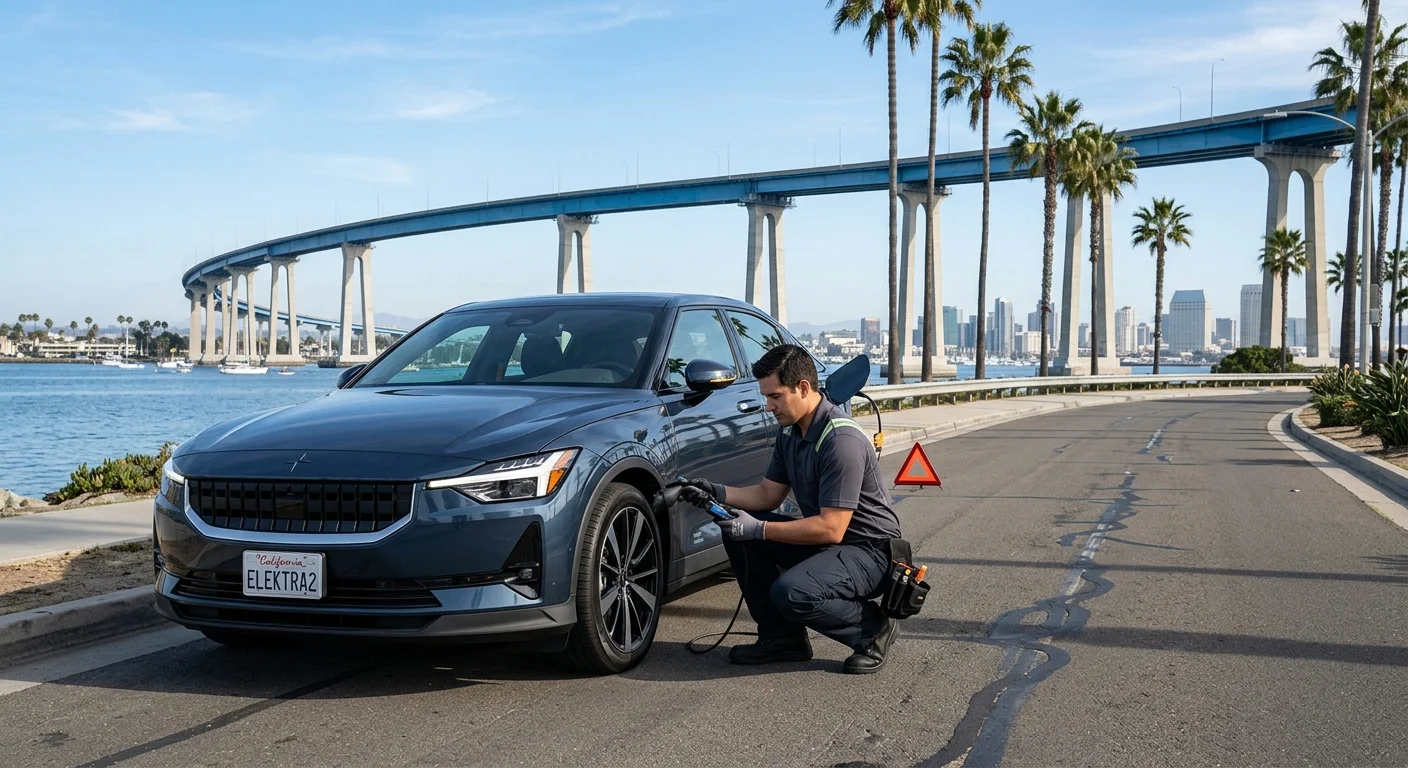
What Polestar’s official roadside help tends to include
Polestar provides a roadside assistance program, typically bundled with the vehicle for a defined coverage period from the original in-service date. The program is designed to cover common roadside issues. The published scope generally covers flat tires, running out of charge, a dead 12V battery, and minor mechanical problems. If the operator cannot resolve the issue on the spot, the service arranges towing to the nearest authorized Polestar service point.
While the coverage is broad, the actual service delivery often relies on a third-party network. That means the technician dispatched may not be an EV specialist, which can lead to longer diagnosis times or an incomplete understanding of Polestar’s specific systems. Towing may take the car to a service center farther than the closest one, which adds to the delay.
This page could not verify a current Polestar roadside policy text for the Bay Area. Confirm current terms, dispatch rules, and equipment with Polestar before you rely on them.
Common reasons Polestar drivers get stranded in the Bay Area
Even with a top-tier EV like a Polestar 2, roadside incidents happen. We see a few common reasons Polestar drivers in the Bay Area call for help. The most obvious is running out of charge. Despite advanced range estimates, unexpected detours, heavy use of climate control during summer heat, or simply misjudging your remaining range can leave you with a depleted battery. The Bay Area’s varied coastal and inland terrain affects energy consumption more than a flat stretch of highway does.
Another frequent culprit is a dead 12V battery. This small auxiliary battery powers crucial low-voltage systems like your infotainment, door locks, and the vehicle’s computer. Even if your main high-voltage battery is full, a dead 12V can leave your Polestar completely immobilized. Flat tires are a persistent problem. Potholes, construction debris, and unexpected punctures are regular occurrences on Bay Area roads, and Polestars, like many EVs, do not carry a spare. Charge port issues can also leave you unable to plug in or unplug at a public station, trapping you in place until the problem is resolved.
Why wait for the dealer? A faster local alternative
When your Polestar needs roadside attention, waiting for a dealer-dispatched service can be a significant pain point. Their reliance on generalist towing and repair networks often means longer wait times, especially if the dispatched technician is not familiar with the specific requirements of a premium EV like your Polestar. They may need to tow your vehicle a considerable distance to an authorized service center, further delaying your return to the road. This can be particularly frustrating when you are stranded far from home or on a busy Bay Area freeway.
Charge Pro SF offers a dedicated, faster, and more specialized alternative. We connect drivers with independent local EV rescue operators through our non-Tesla EV rescue service tailored for vehicles like Polestar. Operators are trained for EV systems, ensuring they understand the unique weight distribution for towing, the proper protocols for battery issues, and the intricacies of EV components. Operators come with the right adapters and the right tools for an EV. You do not have to settle for generic roadside assistance when your Polestar deserves specialist care. To learn more about how we help other EV drivers, see our non-Tesla EV rescue in the Bay Area post.
Mobile charging for Polestar 2 and Polestar 3
One of the most anxiety-inducing scenarios for any EV owner is running out of charge. With Polestar 2 and Polestar 3 vehicles, depleting your battery can mean being stranded far from a charging station, leaving you reliant on a tow. Our mobile EV charging service is the answer. The operator brings the charging power directly to your location, wherever you are in the Bay Area.
The operator’s mobile units are equipped to deliver a Level 2 top-up, giving your Polestar enough range to comfortably reach the nearest public charging station or even make it home. This on-demand charging solution is significantly faster and less disruptive than traditional towing, which can often add hours to your wait. Whether you are stuck on a freeway, in a remote area, or simply misjudged your range in a residential neighborhood, our mobile charging service provides a convenient and efficient way to get your Polestar powered up and moving again.
What to do if your Polestar has a dead 12V battery
If your Polestar suddenly will not start, displays low-voltage warnings, or has non-responsive electronics like the infotainment screen or door locks, you likely have a dead 12V battery. This does not mean your main high-voltage propulsion battery is empty. The 12V is a separate system essential for booting up the car’s computers and engaging the high-voltage contactors.
Do not attempt to jump-start your Polestar with a gasoline-powered car’s battery. EVs have specific jump points and sensitive electronics that require specialized care. Incorrect procedures can cause significant damage. The best course of action is to call for professional assistance. Charge Pro SF connects you with independent operators who provide safe, professional 12V battery jump services for Polestar vehicles and other EVs. Operators know exactly how to access the proper jump points and restore power without risking damage to your vehicle’s sophisticated electrical systems. A quick and correct jump can often resolve the issue, allowing you to continue your journey or safely drive to a service center for further inspection if needed.
For more on the broader pattern, see our Polestar 2 won’t start: 12V checks post.
Bay Area paths a Polestar can stall on
The I-880 Nimitz between Oakland and San Jose is a chronic low-pack corridor. Stop-and-go through Hayward, AC load on a hot afternoon, and a long climb out of Fremont toward Milpitas can finish off a marginal pack. I-580 over Altamont Pass eastbound out of Livermore adds wind load on top of the climb.
The Caldecott Tunnel on SR-24 between Oakland and Walnut Creek is a grade that spends range. So is the Sunol Grade on I-680 between Fremont and Pleasanton. SR-92 over the hill from San Mateo toward Half Moon Bay is another sustained climb with no chargers near the summit.
The Dumbarton Bridge on SR-84 connects Menlo Park and Newark. Wind on the span and traffic on either approach can pull a low pack faster than the dashboard predicts.
Bay Area weather does not give your Polestar a free pass either. Heat near Livermore hits the upper 80s to low 90s in July. Cold nights in Antioch drop into the mid-30s in January. Both edges stress a battery’s range and a 12V’s hold.
When to call a local operator
When your Polestar needs fast, knowledgeable, and specialized roadside assistance in the Bay Area, do not wait for a potentially slow, generic service. Whether you are out of charge, facing a dead 12V battery, or dealing with a flat tire, Charge Pro SF connects you with local operators who quote you before any cable goes on.
Call (415) 630-6268 and we will connect you with a local operator who quotes you before starting.