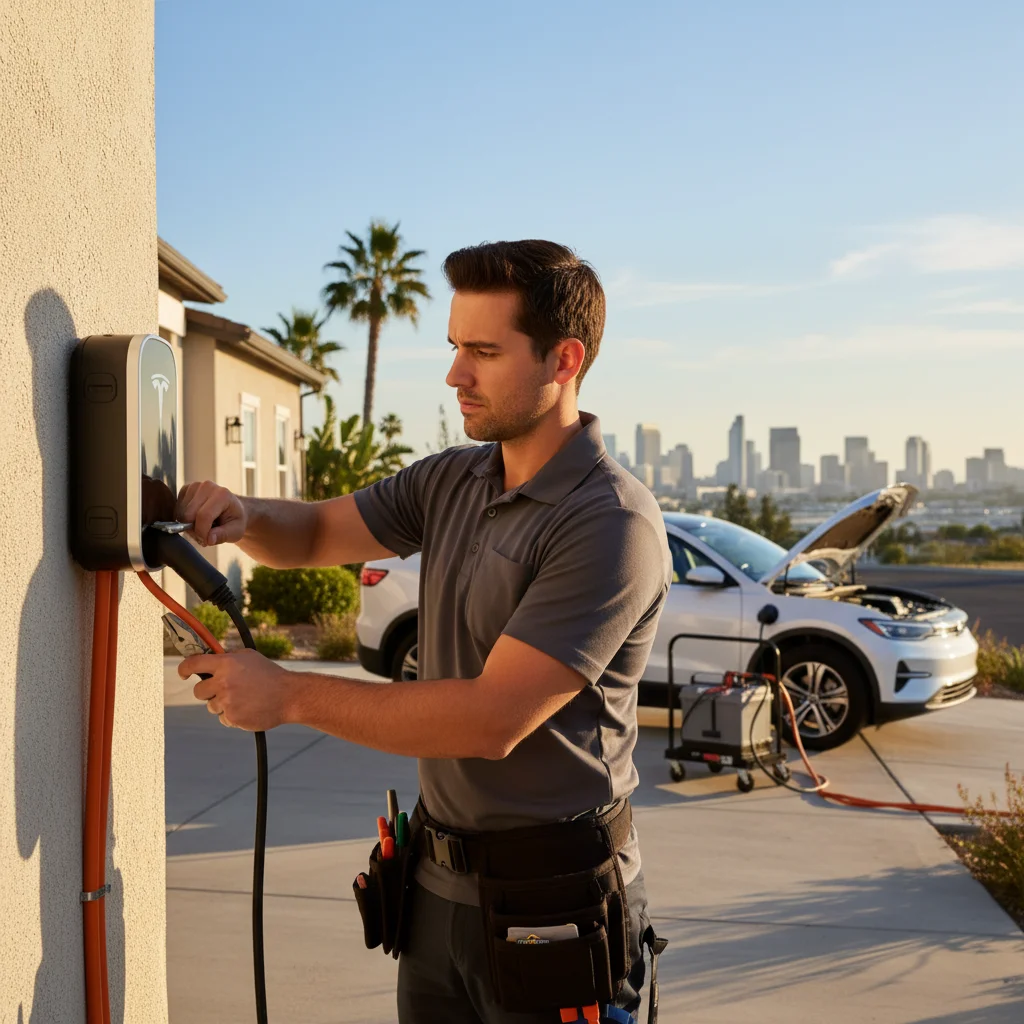
You sit at the curb with 0% on a Hyundai Ioniq 5 and the roadside app says their truck “may not have the right adapter.” That is not a rare edge case. Non-Tesla EV owners across the Bay Area run into it when they need rescue, because the infrastructure built around Tesla’s network does not automatically extend to the rest of the EV market, and that gap matters when you are actually stranded. The reason is simple: most generalist tow operators carry a J1772 cable at best, and many carry nothing for a DC fast charge port at all. The result is a tow to a charger and a wait, when a 20-minute mobile top-up at the curb would have been enough.
The non-Tesla rescue gap
Tesla’s roadside coverage works well because it is vertically integrated. The company controls the cars, the app, the Supercharger network, and the dispatch. A Tesla Model 3 with an empty pack gets a Tesla operator who knows exactly what connector to bring.
Every other automaker runs differently. Ford, Hyundai, Kia, Rivian, GM, Polestar, Lucid and BMW all rely on a mix of first-party and third-party roadside networks. The truck that rolls to a non-Tesla driver may or may not stock mobile charging equipment. The US Department of Energy’s Alternative Fuels Data Center tracks public charger deployment nationally and CCS and J1772 infrastructure still trails Tesla’s NACS network in density.
The Bay Area’s non-Tesla fleet is unusually dense. Cupertino, Mountain View, Palo Alto and Fremont sit at the heart of a high-income EV corridor. Fremont is the home of the Tesla factory, and a large share of the surrounding renter population drives a non-Tesla EV because the factory town rewards early adopters across brands. Older garage-built pre-1980 housing limits home charging in much of the East Bay core, so renters depend on public charging and on a fast mobile rescue when a public post fails.
Our non-Tesla EV rescue service exists specifically because of this gap. Operators carry multiple connector types on every dispatch. The truck that arrives knows what your car needs.
What charging connectors operators carry
CCS1 (Combined Charging System)
CCS1 is the dominant DC fast charging standard for non-Tesla EVs sold in the US before 2025. Rivian, Ford, Hyundai, Kia, GM, Polestar, BMW, Volkswagen, Lucid and Mercedes all use CCS1 for fast charging. The plug is the large handle with two circular DC pins below the standard J1772 AC section. Mobile rescue units support CCS1 delivery for emergency top-ups, enough range to reach a proper public charger.
J1772
J1772 is the universal AC Level 2 connector. Almost every non-Tesla EV sold in North America has a J1772 port, or a CCS1 port that accepts a J1772 plug for AC charging. It is slower than DC fast charging, but it works reliably for a rescue where the goal is 10 to 20 miles of range, not a full charge.
NACS (North American Charging Standard)
Ford, GM, Rivian, Hyundai and several other brands have committed to NACS for newer model years, and some 2024 vehicles shipped with NACS ports. Operators carry NACS-compatible equipment and adapters to cover the transition, which is still ongoing in the Bay Area’s mix.
Not sure which port your car has. CCS1 has a larger lower section. NACS looks like a smaller rectangular plug similar to a Tesla connector. J1772 alone, without the DC pins below, is AC only.
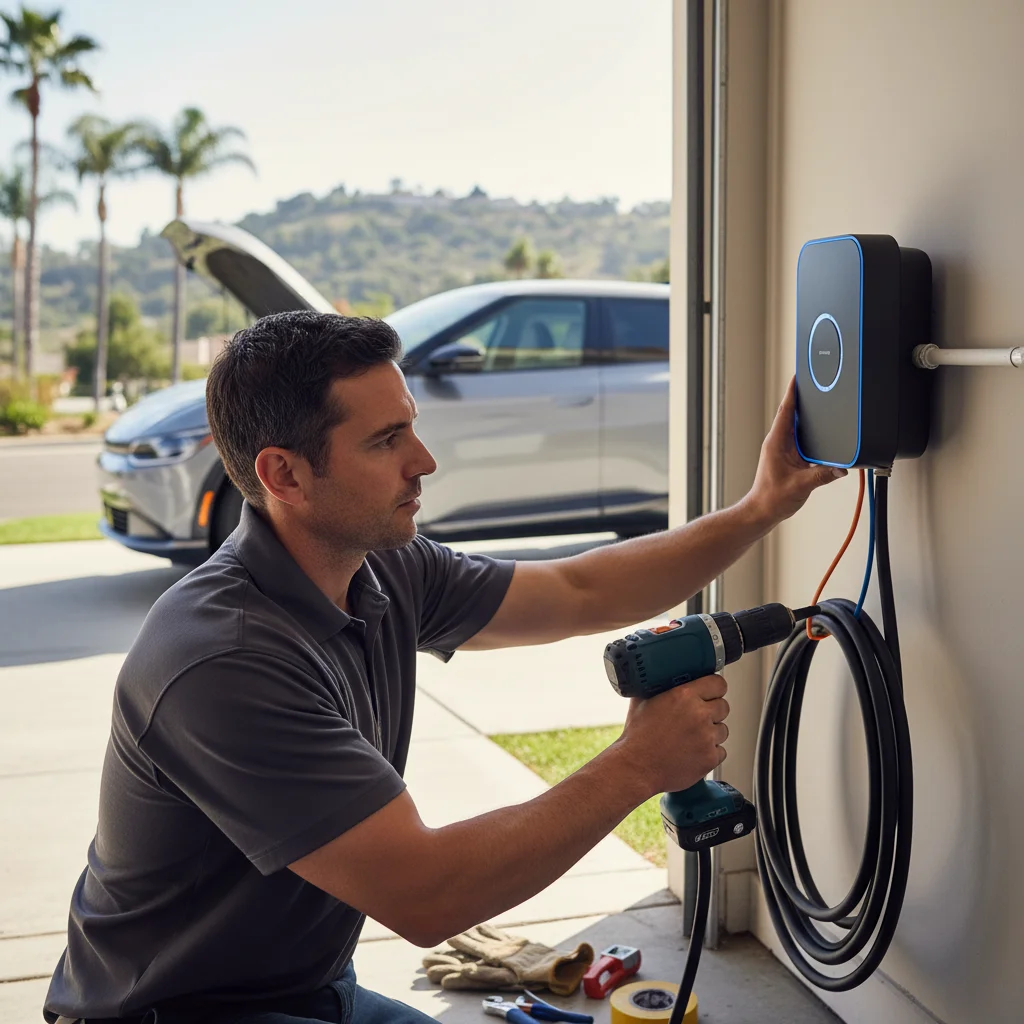
Our mobile EV charging vans carry all three.
Brand-by-brand notes that matter roadside
Rivian R1T and R1S
Rivian’s charge port is on the driver’s side rear. The vehicle needs to be powered on, or at least in accessory mode, for the charge port door to open, which is tricky if the 12V aux battery is also depleted. A Rivian with a stuck port has a manual release cable accessible behind the rear driver’s side trim panel. Older R1T and R1S trucks use CCS1, and 2024 and newer model years are transitioning to NACS. Check your model year before assuming.
Ford Mustang Mach-E and F-150 Lightning
The Mach-E’s charge port release is electronic, which means a dead 12V battery can lock it closed. Ford included a manual release on the Mach-E, with a pull tab inside the front trunk that releases the port mechanically. The F-150 Lightning has a similar setup. 2024 Lightning models came standard with NACS. Earlier models use CCS1.
Hyundai Ioniq 5, Ioniq 6 and Kia EV6
These cars have large battery packs. A mobile rescue top-up will add enough to reach a charger, not necessarily to top the battery. Both brands currently use CCS1.
GM: Chevy Equinox EV, Silverado EV, GMC Sierra EV
GM committed to NACS for 2025 model year and is rolling out adapters for older vehicles. Earlier Bolt EV and Bolt EUV models use CCS1 and remain common on Bay Area roads.
Polestar 2
Polestar uses CCS1. The charge port is on the driver’s side rear. If a rescue charge is not initiating, a soft reset on the center console button often clears a fault state.
Lucid Air
Lucid uses CCS1 on current production. The 900V architecture accepts a DC fast charge at high power when a working CCS station is reachable, but roadside Level 2 is the realistic top-up.
What to do while you wait
If you are stranded and have already called for rescue, here is how to make the wait safer and shorter.
Stay in the car if you are on a freeway. US-101, I-280, I-880, I-580 and I-680 have fast-moving traffic. Pull as far right as you can, turn on hazards, and stay inside with your seatbelt on until help arrives. Exit on the passenger side if you must get out.
Check your remaining 12V power. Your EV has two batteries: the traction pack that drives the wheels, and a small 12V auxiliary battery that runs the car’s electronics. If the 12V is low, your charge port may not open and your hazard lights may dim. Tell the dispatcher.
Open the charge port manually if needed. Most EVs have a manual release. Check the glove box card or the owner’s manual.
Use PlugShare to find the nearest working charger. Knowing where you are going after a rescue top-up avoids a second stop.
Do not try to push the car yourself on a freeway shoulder. EVs are heavy. Wait for the operator vehicle.
Where Bay Area non-Tesla drivers get stuck
The Altamont climb on I-580 eastbound out of Livermore is the flagship road call. A driver in a Rivian R1S or a Hyundai Ioniq 5 who started that climb at 20% into the wind watches the pack fall faster than the miles.
The Sunol Grade on I-680 between Pleasanton and Fremont spends range southbound. Some recovers northbound.
The I-880 Nimitz through Hayward and Fremont sees long stationary stretches with heat and AC load. A driver in stop-and-go at 5% needs help, not a tow to a working DC fast charger 12 miles away.
US-101 from Palo Alto to San Jose and SR-237 between Mountain View and Milpitas run flat to slightly uphill with heavy traffic and a real chance of arrival at 0% at the wrong exit.
For more on the freeway path, see our out-of-charge on a Bay Area freeway guide.
When to call a non-Tesla EV rescue operator
If your non-Tesla EV is stranded with no charge, if your charge port will not open, or if you are watching the battery drop and know you will not make the next station, that is the moment to call, not after you are already stopped on the shoulder.
Our non-Tesla EV rescue dispatch covers the Bay Area with CCS1, J1772 and NACS equipment on every truck. We do not guess at connectors when the operator arrives.
Call (415) 630-6268 and we will connect you with a local operator who quotes you before starting.