Your EV just hit zero on I-880 through Hayward. You’re stuck on the shoulder, not at a wall outlet. EV roadside assistance in Hayward gets a local operator to the car. They bring a 240-volt Level 2 charge, not a tow by default.
Why I-880 in Hayward traps an empty EV
Hayward is an incorporated city in Alameda County. It covers 45.8 square miles between the bay flats and the hills. The ACS 2019-2023 population is 159,201. The 2024 Census estimate is 158,440. I-880 is the north-south spine through all of that. San Leandro sits to the north. Union City and Fremont sit to the south. SR-92 drops in from the Hayward-San Mateo Bridge. SR-238 is Mission Boulevard and the foothill run toward Fremont. Jackson Street cuts across the flats. Once the pack dies on that tangle, you’re not around the corner from a garage plug.
The east foot of the San Mateo Bridge is a common place to run short. Westbound tolls on the San Mateo-Hayward span are all-electronic. Cash ended in March 2020. FasTrak, a plate account, or an invoice is how BATA collects. None of that moves a car that’s already stopped. No published disabled-EV policy turned up for that bridge. If you’re on the deck, stay inside and wait for CHP.
Downtown, Mount Eden, Fairway Park, and the Jackson Triangle sit close to 880. The Hayward Highlands and Cal State East Bay sit up the hill. Garin Regional Park is in that same belt. Bay-side blocks stay milder. The hills run warmer. Locals know the fog break as the Hayward hole. Climate control still draws from the pack either way. No verified miles-per-hour figure turned up for that draw. Treat a thin buffer as already spent.
What to do in the first minutes on the shoulder
California Vehicle Code 21718 bans stopping on a freeway except in limited cases. A disabled car that can’t keep moving is one of those cases, once you’ve summoned another vehicle to assist. That’s a stall, not a pause to think.
If you still have a sliver of range, signal right early. Take the shoulder before the car dies in a lane. Keep the hazards on, buckle in, and stay in the car. Don’t walk toward an exit along the pavement edge.
If any part of the car is in a live lane, call 911 first. CHP manages the traffic. Caltrans District 4 covers the nine Bay Area counties. Then call for EV roadside assistance.
Express lanes run on I-880, and Alameda CTC operates them. FasTrak is required on those lanes. Hours are generally 5 AM to 8 PM on weekdays. No primary page confirmed which side those lanes sit on. Don’t pull left on a guess. Get to a legal shoulder if you can still roll.
The four-hour rule, 511, and the patrol that won’t fill the pack
CVC 22651(f) lets officers remove a stalled vehicle after a set window. The trigger is more than four hours on a full-access-control freeway. The car also has to be unable to move under its own power. That clock starts when you stop. It’s not extra courtesy time.
The Bay Area Freeway Service Patrol is a partnership of MTC, CHP, and Caltrans. Private tow companies run the beats during posted hours. Those hours are Monday through Friday, 6 to 10 AM and 3 to 7 PM. Dial 511 and say “Freeway Assist,” or use a call box. FSP clears crashes and debris. It advertises a free gallon of gas, a jump-start, and a radiator refill. The MTC page, read on 2026-09-18, doesn’t mention electric vehicles or out-of-charge help. Don’t wait for a patrol truck to refill a traction pack. That service isn’t on the published list.
Outside FSP hours, the CHP Rotation Tow Program assigns a vendor. You don’t pick the company. A tow can be the right call if the car won’t take a charge. Weigh that against a mobile charge versus a tow before the first hook shows up.
For the wider freeway version of this problem, see what to do when an EV dies on a Bay Area freeway.
Empty pack or a dead 12-volt battery
A traction pack at zero and a dead 12-volt battery both look like a brick. They’re not the same job.
If the screens are dark, or the car won’t wake, start with the 12-volt. Operators in the network can jump or replace that battery on site. Tesla and every major EV brand still need that small battery to close contactors.
If the car is awake and the display says you’re out of range, you need energy in the pack. A 12-volt jump won’t invent miles. That job is out-of-charge recovery.
What a mobile operator can do on I-880
Charge Pro SF is a referral line. We don’t own trucks, and we don’t employ technicians. We match stranded drivers with independent local operators. The operator quotes you before any cable goes in. They bill you directly.
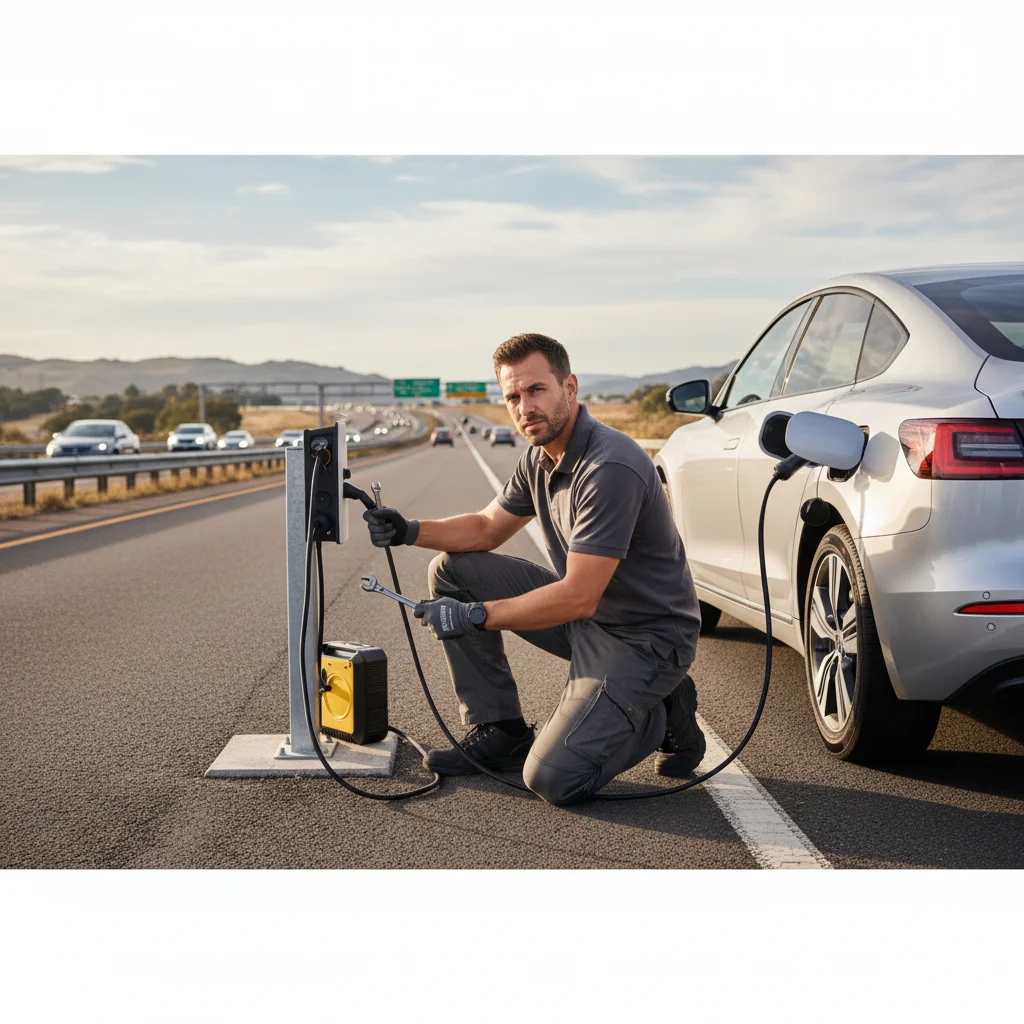
They bring a 240-volt Level 2 source to the car. Tesla vehicles get a native NACS plug. Other EVs get a CCS or J1772 adapter. Typical charging time is 15 to 30 minutes. That’s time on the plug, never a promise of when someone arrives. In that charging window the car usually gains about 10 to 20 miles of range. That’s enough to leave the shoulder under the car’s own power. It’s not a DC fast session, and it’s not a full pack.
This is mobile EV charging on a live interstate. The point is to get you off I-880, not to fill the battery for the week.
Why a home charger often isn’t waiting in Hayward
About 64.1% of Hayward housing was built before 1980, per ACS 2019-2023. Census uses that share as a proxy for older, often panel-limited stock. A large mixed-income renter population lives here too. Street parking in downtown, Fairway Park, and the Jackson Triangle is common. A 240-volt wall unit isn’t sitting behind every curb. Even if your building is close, an empty pack on 880 can’t use it.
The hills add a second squeeze. Cal State East Bay and the Hayward Highlands sit above the flats. SR-238 toward Fremont climbs that foothill corridor. A range number that looked fine on Jackson Street can shrink on the way up. No verified miles-lost figure turned up for that grade. Plan as if the hill costs more than the map said.
PG&E still delivers the wires in Hayward. Ava Community Energy is the community choice aggregator. Ava publishes programs such as the Alameda County Incentive Project. Those programs don’t wake a car that’s already dead on the shoulder. The outage line isn’t a rescue line. Don’t call it for a stranded EV.
Cherryland sits just next door. Castro Valley sits inland on I-580. San Mateo sits across the bridge. None of those neighbors put a garage outlet on the I-880 shoulder with you.
Tell the operator where you actually are
Direction of travel matters on this stretch. Southbound at SR-92 isn’t the same as northbound near Jackson. Downtown exits don’t match the bridge approaches. The Mission Boulevard and SR-238 side is a different beat from Mount Eden. Name the nearest exit. Name the city as Hayward. ZIP codes that overlap the place include 94541, 94544, and 94545, but a ZIP isn’t a city limit. Use it only if that’s what you know.
Stay in the car until help is on the scene. Keep hazards on. If CHP arrives first, tell them you’ve already summoned a charge, not only a tow.
If you’re already on the I-880 shoulder in Hayward, call (415) 630-6268. Charge Pro SF will connect you with a local operator. That operator sets the price and the timing. We don’t.
Frequently asked questions
Will the Freeway Service Patrol charge an empty EV on I-880?
No published FSP offering covers an out-of-charge pack. The MTC page lists gas, jump-starts, and radiator refills. It doesn’t list a traction-pack charge. A 12-volt jump, if they can do one, still won’t add range. For an empty pack you want a mobile Level 2 operator.
How long can a dead EV sit on the I-880 shoulder?
CVC 22651(f) allows removal after more than four hours on a full-access-control freeway. That applies when the car can’t move itself. Call as soon as you’re stopped. Don’t treat the four-hour mark as a plan.
Can a non-Tesla get a roadside charge in Hayward?
Non-Tesla drivers can get the same Level 2 top-up. Operators bring a CCS or J1772 adapter for those cars, and native NACS for Tesla. They handle every major EV brand. The quote happens before the session starts.