EV roadside assistance in San Leandro is a charge or jump where you sit. Renters on East 14th and along I-880 often have no home plug. Charge Pro SF matches you with an independent operator at the car.
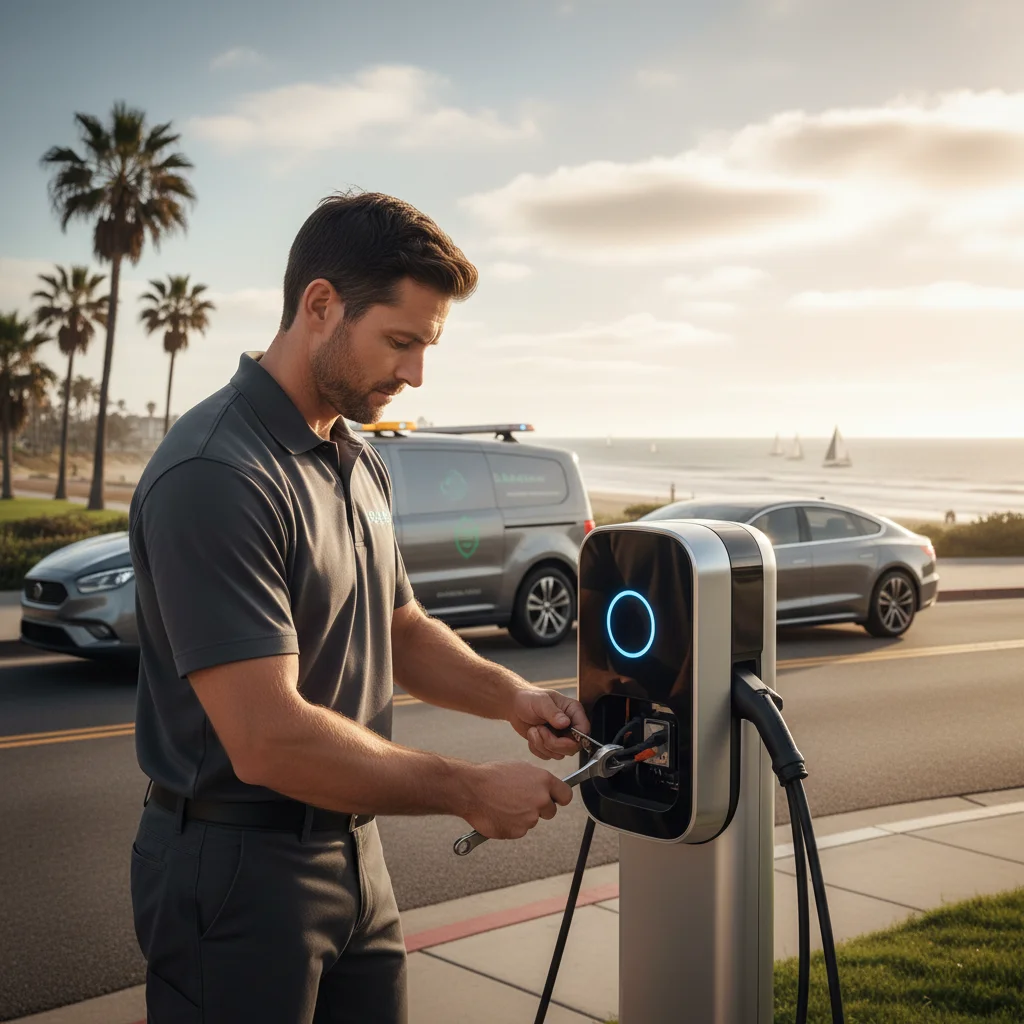
Street parking on East 14th leaves a renter without a wall circuit
East 14th Street is SR-185 through downtown San Leandro. It’s a commercial strip with housing behind the storefronts. Much of that housing is old. ACS 2019-2023 figures show 76.8% of San Leandro housing was built before 1980. Older stock often means apartments, tight driveways, and overnight curb parking. That doesn’t prove any one building lacks 240 volts. It does explain why many drivers only have a 120-volt outlet. Others have no plug at all.
Washington Manor sits south of the commercial core. Bayfair sits toward the mall and the BART park-and-ride. Downtown San Leandro packs street parking around East 14th. Marina Faire faces the water at the San Leandro Marina. Estudillo Estates and Bal sit in the older interior fabric. In those neighborhoods a renter can leave an EV on the curb overnight. A guest on the only outlet can leave the pack short for I-880. A tripped breaker or a slow Level 1 session can do the same.
The Kaiser area and the industrial corridors add a second pattern. The car sits through a full shift, then has to merge onto 880. Bayfair Center and the BART park-and-rides are the same kind of sit. None of those lots are your garage.
A household outlet may be all you control. Compare that with a roadside 240-volt rescue in this 240-volt guide. A shared outlet in an older building can’t recover a pack that’s already empty.
San Leandro is an incorporated city in Alameda County. The Census Gazetteer lists 13.323 square miles of land. ACS 2019-2023 counted 88,531 residents, and the 2024 estimate is 86,571. Those two Census series don’t match, and both are shown on purpose. Callers sometimes give ZIP 94577, 94578, 94579, or 94580. A ZIP can spill past the city line. Use it as a hint for the operator, not as a boundary.
I-880, the I-580 split, and the surface streets that feed them
I-880 is the north-south spine through town. I-580 meets it at the south edge of Oakland. That split is San Leandro’s north door. Drivers coming off Oakland don’t get extra miles from the merge. Marina Boulevard, Davis Street (SR-112), and East 14th all dump into that freeway system. I-580 then continues toward Castro Valley.
Davis Street is the marina and industrial cut across the west side. Marina Boulevard serves the San Leandro Marina and the bayside lots. East 14th carries local errands through downtown, not a long highway run. When a pack hits a warning on those streets, stay out of through lanes. Put the hazards on and call for a charge at the car. Don’t roll a dead EV into moving traffic.
If you’re already on I-880 when propulsion fades, ease as far right as you can. Turn on the hazards and stay with the car if it’s safe. Call 911 if you’re in a live lane or a tight merge. Then request EV roadside assistance so an operator can be summoned to the shoulder.
Hayward is the next city south on 880. This Hayward 880 guide covers stalls on that stretch.
Freeway rules on 880, and what FSP doesn’t cover
California Vehicle Code 21718 bars stopping on a freeway except in limited cases. One exception is a vehicle so disabled that stopping is unavoidable. Another vehicle has to be summoned to assist. That’s why you call for help before you walk the shoulder.
California Vehicle Code 22651(f) is the four-hour rule. On a full-access-control freeway the clock is four hours. A vehicle that can’t move under its own power may be removed after that. That’s a removal statute, not a service promise. Don’t wait on the shoulder hoping the pack recovers.
I-880 has express lanes, and FasTrak is required in them. Hours are generally 5 AM to 8 PM on weekdays. MTC runs the regional FasTrak network. Alameda CTC runs the I-880 express lanes. No primary page confirmed a disabled-vehicle rule for those lanes. Don’t pull left on a rumor about the median. Get as far right as you can. Stay with the car when that’s the safer choice.
The Bay Area Freeway Service Patrol is a partnership of MTC, CHP, and Caltrans. Private tow companies run the beats. Published hours are Monday through Friday, 6 to 10 AM and 3 to 7 PM. Dial 511 and say “Freeway Assist,” or use a call box. MTC’s FSP page lists a free gallon of gas, jump-starts, and radiator refills. As of 18 September 2026, that page doesn’t mention electric vehicles or out-of-charge help. FSP can clear a stall from a lane. It isn’t published as a mobile EV charge.
Outside those hours, freeway tows often run through the CHP Rotation Tow Program. You don’t choose the tower on that rotation. Caltrans District 4 covers the nine Bay Area counties on QuickMap. 511 SF Bay is the regional traveler line.
A long sit can kill the 12V while the pack still shows miles
San Leandro is a mild bayside city with a low to moderate AC load. Oakland Airport’s 1961-1990 July normal high is 70.4F. That’s the nearby bayside station, not a downtown sensor. Inland cities run hotter than this shoreline. Don’t copy a Livermore or Antioch heat plan onto San Leandro.
The 12V failure here is usually time parked. Cabin modules, alarms, and telematics still draw overnight on East 14th. They draw all day in a Bayfair or Kaiser lot. They draw at a BART park-and-ride while you ride the train. The high-voltage pack can still show range. The 12-volt battery can be too weak to boot the car.
If the fob does nothing, treat it as a 12V problem first. Dark screens and a car that wakes and dies point the same way. Operators in this network jump a dead 12V on site. They can replace one when that’s the job. They handle Tesla and every major EV brand.
Don’t clip a gas-car jump pack onto the first metal you see. Jump points differ by model and year. Some Teslas want a specific under-hood post. Tell the operator the make and year. For Tesla work, request a Tesla 12V battery jump.
What the operator brings, and who actually bills you
Charge Pro SF is a referral line and doesn’t hold a trade license. It owns no trucks and employs no technicians. Independent local operators do the charging and the 12V work. The operator quotes you before starting and bills you directly. The pros we connect you with are licensed and insured.
A typical stop uses a 240V Level 2 source at the car. Tesla and other NACS vehicles take a native NACS plug. CCS or J1772 adapters cover non-Tesla EVs. A session typically adds 10 to 20 miles of range. That takes 15 to 30 minutes of charging. That’s plug time, never an arrival time. Charge Pro SF doesn’t publish response clocks.
Ten to twenty miles can get you to a charger you confirm is open. Confirm the stall is working before you drive to it. Use the US Department of Energy AFDC station locator. Ava Community Energy is San Leandro’s CCA. It publishes Ava Charge as a fast-charging network, plus the Alameda County Incentive Project. Confirm live sites at avaenergy.org or on the AFDC map. This page doesn’t guess which post is closest to East 14th, Bayfair, or the marina.
PG&E still delivers the power, and Ava supplies the generation. That’s different from the City of Alameda. Alameda runs Alameda Municipal Power and isn’t on Ava. Don’t mix those two utilities. PG&E publishes Home Charging EV2-A and Electric Vehicle EV-B. It also lists Electric Home E-ELEC as a residential EV rate name. None of those rates move a car that’s already dead on the curb. Don’t sit in a driveway waiting on a panel upgrade. Ask for a mobile EV charging quote instead.
BART publishes Level 2 charging at Warm Springs / South Fremont and at Lafayette. Confirm any other BART lot on bart.gov. This page doesn’t invent a San Leandro BART station. Caltrain publishes no park-and-ride EV charging.
Non-Tesla drivers should ask for non-Tesla EV rescue. That covers CCS and J1772 cars. Ioniq, Mach-E, EV6, Rivian, Chevy, and BMW sit in that group. So do other major packs.
Shopping-center and apartment tows are their own rule set. California Vehicle Code 22658 requires a posted sign before a private-property tow. The sign must be at least 17 by 22 inches. Lettering has to be at least one inch. It has to state removal at the owner’s expense. It also needs the enforcement phone number and each tow company’s name and number. The tower must notify law enforcement within one hour. California doesn’t cap ordinary consensual tow rates statewide. Get the number in the quote before a hook touches the car.
Nearby cities on the same East Bay grid
Oakland is immediately north at the 880/580 split. Hayward sits south on 880. Castro Valley is up I-580 as an unincorporated community. The City of Alameda sits across the estuary with a different utility. San Lorenzo sits between San Leandro and Hayward.
The San Leandro EV charging and rescue page collects city-level service-area detail.
Frequently asked questions
Does Charge Pro SF cover San Leandro?
Yes, San Leandro is inside the Bay Area service area. That includes I-880, I-580, East 14th Street, Davis Street, and Marina Boulevard. It also includes downtown, Bayfair, Washington Manor, Marina Faire, Estudillo Estates, and Bal. Charge Pro SF doesn’t roll its own truck. It connects you with an independent operator. That operator quotes the charge or the 12V jump before work starts.
What if my EV won’t turn on at all?
If the car is fully dark, start with the 12V auxiliary battery. The traction pack can still hold miles. Operators in this network carry 12V jump gear. Many can replace a failed 12V on site. Give the make and model so they bring the right leads. Don’t guess at Tesla or Hyundai posts with a generic pack.
Is a mobile charge better than a tow from East 14th?
For a flat pack or a dead 12V, charge or jump the car in place. A tow only relocates an empty EV, and you still have to charge. Collision damage or a mechanical fault is a tow job. So is a car that can’t take power. On the freeway, follow CVC 21718 and get out of live traffic first. Then sort charge versus hook with the operator, not from a merge lane.
Call (415) 630-6268 from East 14th or the 880 shoulder. Charge Pro SF matches you with a local operator. That operator quotes the job, does the work, and bills you directly.