The range estimate dropped faster than you planned. The display flipped to zero. Power dropped. You are watching the shoulder slide past on US-101 and thinking through a short list of bad options. This guide is for that moment. Read it now, save it for later, and know what to do when it happens in the Bay Area. Every EV handles the last few percent differently, but the physics and the freeway rules are the same.
What happens when the pack reads zero
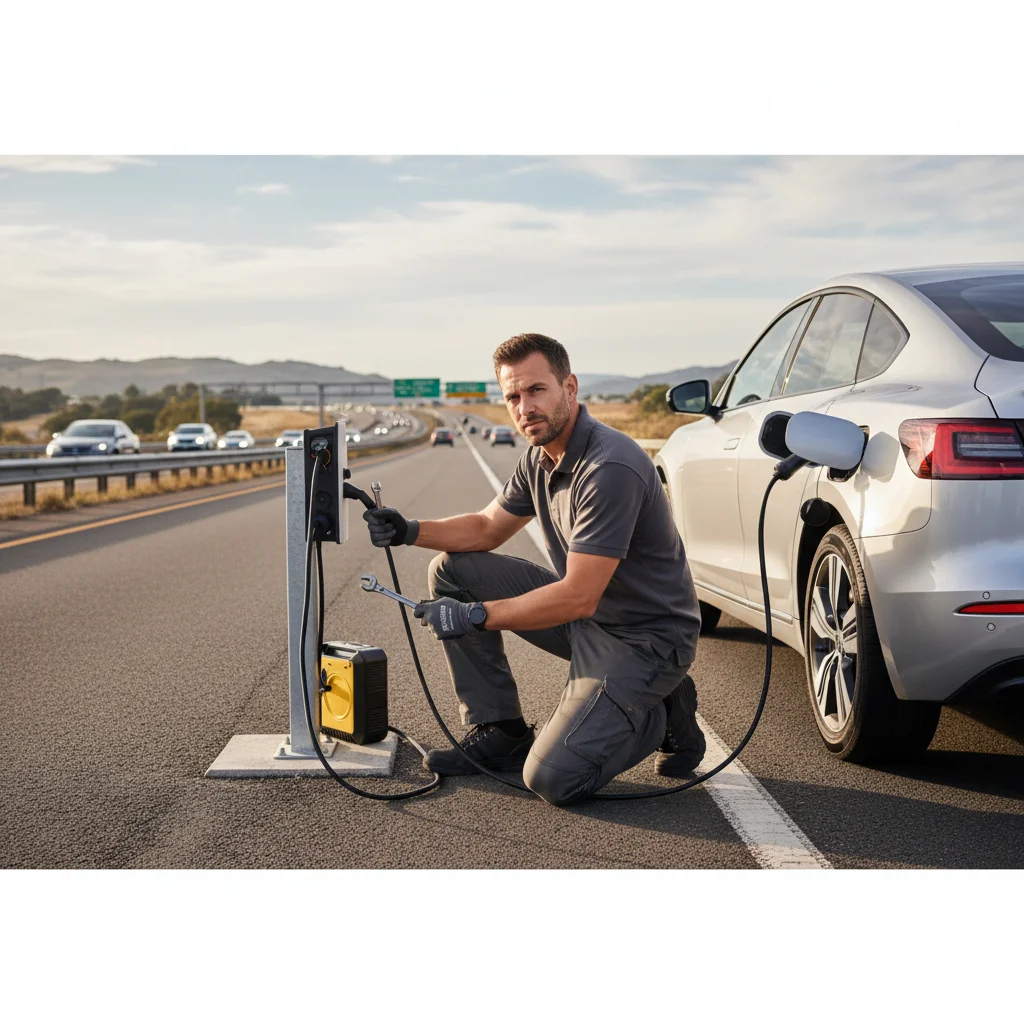
The range estimate is not a fuel gauge. It is a prediction based on recent driving. When it hits zero, there is usually a small reserve left, somewhere between 2 and 8 miles depending on the car, the temperature, and how hard you have been pushing.
In a Tesla, you see warnings starting around 20 miles. Below 10, the car pleads with you to find a Supercharger. At zero, the car enters a limp mode that caps speed and cuts climate. Below that, the traction motor stops driving the wheels. You coast.
Other EVs are similar. Rivian, Ford Lightning, Hyundai Ioniq 5, Kia EV6, Polestar 2, and Lucid Air all give you a reserve, all cap speed near empty, all eventually stop.
Pull over now, not in a minute
If you are on US-101, I-280, I-880, I-580, I-680, or I-80 and you see the warning, do not try to make the next exit. Pull over while you still have power steering and brake assist.
- Flip the hazards the moment you know you are in trouble.
- Pick the right shoulder. Left shoulders on Bay Area freeways are narrow and dangerous.
- Get as far right as you can, past the white line, onto dirt if there is dirt.
- Turn the wheels away from traffic once you stop.
- Stay in the car unless you can get over a barrier or onto a wide dirt shoulder. Standing beside a running lane at highway speed is the single biggest risk in this whole situation.
If you are in a construction zone, a tunnel, or on a bridge, call 911. CHP will roll a unit to push traffic around you. That is their job and they are good at it.
What Freeway Service Patrol covers
The Freeway Service Patrol is a partnership of MTC, CHP and Caltrans. It runs Monday through Friday, 6 to 10 AM and 3 to 7 PM. You reach it by dialing 511 and saying Freeway Assist, or by using a call box. The MTC FSP page lists a free gallon of gas, jump-starts, and radiator refills. It does not mention electric vehicles or out-of-charge assistance. That reading is from mtc.ca.gov as of 2026-09-18.
FSP will stop, set cones, and try common services. They will not bring a Level 2 source or a NACS or CCS connector. They are a freeway shoulder service for short fixes, not an EV rescue operation.
Outside FSP hours, your call goes to the CHP Rotation Tow Program. CHP distributes tows among approved vendors on a rotation. The driver does not pick that company on rotation.
Caltrans District 4 covers the nine Bay Area counties.
The four-hour clock you do not want to learn about
CVC 22651(f) allows removal of a vehicle stopped or left standing more than four hours on a full-access-control freeway when the driver cannot move it under its own power. CVC 21718 limits stopping on a freeway to limited exceptions, including a vehicle so disabled that stopping is unavoidable and another vehicle has been summoned to assist.
What that means in the Bay Area: if you stall on I-880 near the Oakland Coliseum at 9 PM and wait for help, the clock starts. After four hours, Caltrans or CHP has authority to remove the car. A car towed under that authority goes to a yard and you pay storage.
A mobile rescue operator who arrives within the window keeps you off that clock. A tow from a generalist contractor, who may take 90 minutes to reach you and then need to take the car to a working DC fast charger, can put you right up against the limit.
What a mobile charge at the shoulder looks like
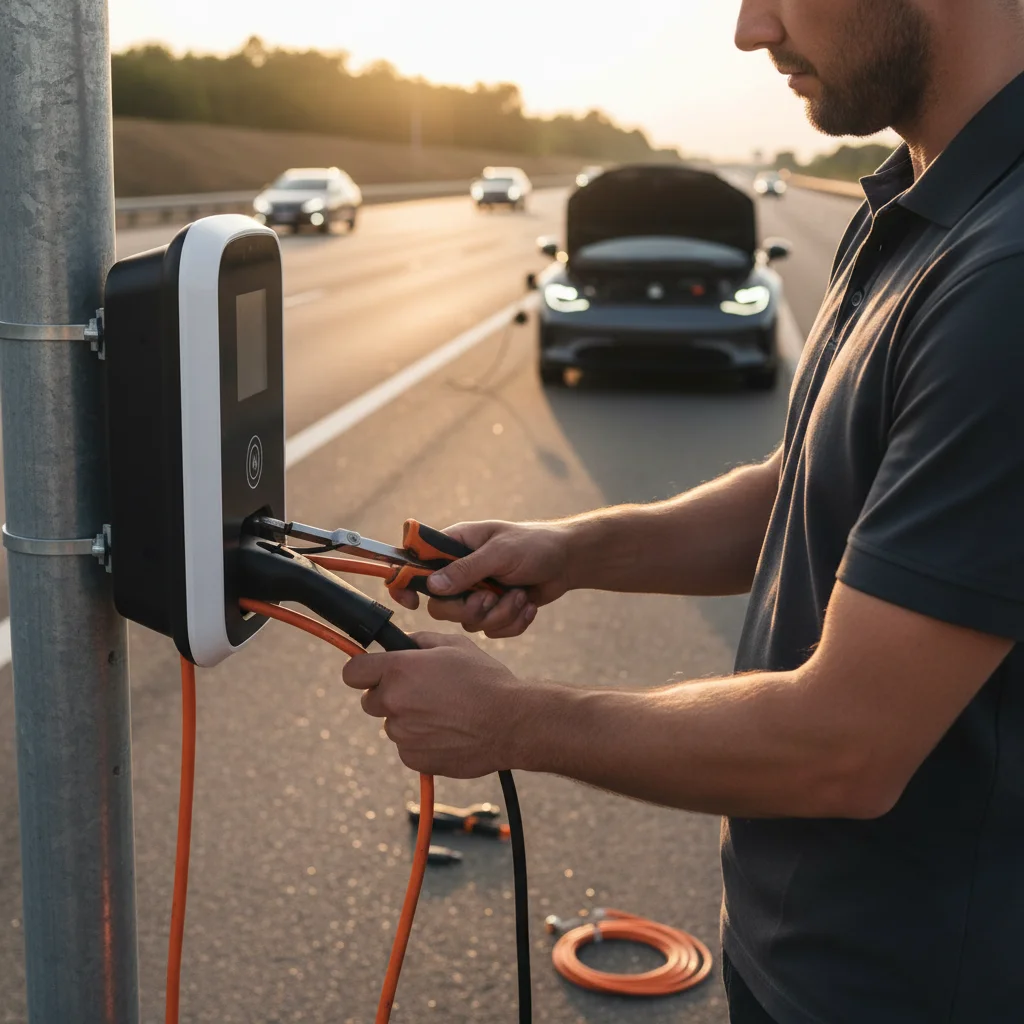
A mobile operator pulls onto the shoulder behind you, sets cones, and plugs in. With a 240V Level 2 source and a long output cable, the operator adds 10 to 20 miles of range in 15 to 30 minutes. That is enough to reach the nearest Supercharger, a working EA or EVgo station, or home if you are close.
This is a Level 2 AC top-up, the same rate as a home wall charger. That is by design. Fast charging on a freeway shoulder is not safe, and adding enough range to reach real infrastructure is the right call. Twenty minutes of AC gets you there.
What to tell the dispatcher
When you call, you need three things fast:
- Exact location. Freeway, direction of travel, nearest exit or mile marker. “I-880 north, just passed the High Street exit, about a mile before 23rd Avenue” is perfect.
- Vehicle. Year, make, model. A Tesla Model Y, a Rivian R1S, a Ford Lightning, an Ioniq 5. The cable we need changes.
- State of the car. Pack dead only, or 12V also dead. Any warning lights. Any collision damage.
That gets the right truck with the right cable in the right direction.
Quick decision tree
| Situation | Best move |
|---|---|
| Pack empty, you are safe on the shoulder, Supercharger within 20 miles | Mobile charge, roll to Supercharger |
| Pack empty, you are in a lane or on a bridge | Call 911, then mobile charge or tow |
| 12V also dead (no screens, no handles) | Mobile rescue with 12V jump plus charge |
| Collision, warning lights, smoke, fluid, or damage | Tow, not charge. No exceptions. |
| Pack empty, you are walking distance from home or a charger | Walk, charge on a Level 1 adapter, tow if needed |
Bay Area rules of thumb for next time
Most out-of-charge calls share a pattern. The driver trusted the in-car range estimate on a cold, windy, or uphill leg, and the estimate was optimistic. After you reach a charger, take 10 minutes to plan differently.
- Add 15% buffer for I-580 east past Livermore into the Altamont wind.
- Add 15% buffer for SR-17 over the Santa Cruz Mountains, out of scope but worth knowing if you ever drive south.
- Add 10% buffer for I-880 in slow traffic on a hot day.
- Add 10% buffer for the Bay Bridge approach in stop-and-go.
- Never leave home below 30% if you are driving east of the Altamont or over the Sunol Grade.
When to call a mobile EV rescue
If you are stranded, call. We will tell you on the phone whether mobile charging is the right answer for your situation, or whether you need a tow. If a tow is faster or cheaper for your case, we will say so, and if the pack has shut down and the parking pawl is locked, the right move is a flatbed from a local EV-aware operator.
We serve the Bay Area across I-80, US-101, I-280, I-580, I-680, I-880, SR-24, SR-84, SR-92 and the state-owned toll bridges. Learn more about our out-of-charge recovery and EV roadside assistance services, or dispatch now from anywhere in the Bay Area.
Call (415) 630-6268 and we will connect you with a local operator who covers your area. Operators carry enough power to get you moving, and enough cable to reach you wherever you stopped.