You left the car in a Moffett Field lot before a long work block. You walk back hours later and nothing wakes. The cabin stays dark. The app never finds the vehicle. That pattern is usually the 12-volt, not an empty pack.
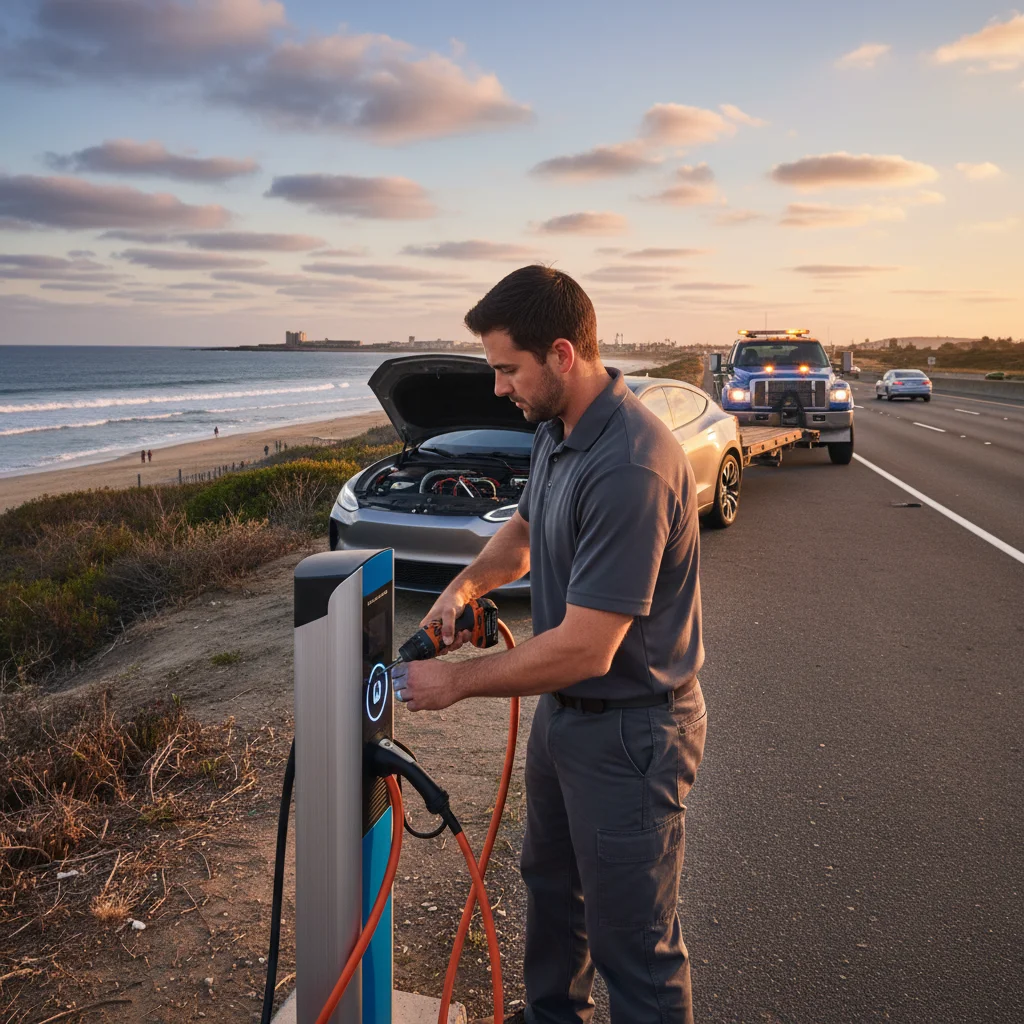
Why a long Moffett Field sit kills the 12-volt first
Federal lots around Moffett Field are built for long dwell. Cars sit through shifts, briefings, and visitor days. The traction pack can still hold plenty of range. The small 12-volt that boots the computers often doesn’t.
Every modern EV still has that low-voltage battery. It unlocks doors, wakes screens, and closes the high-voltage contactors. Park locked, with the app still polling, and it keeps sipping power. A full workday can drain a weak one. A weekend on the lot is harder on it.
Mountain View sits on the South Bay side of this federal site. The Census ACS 2019-2023 count is 82,363 people. The 2024 estimate is 87,316. About 62 percent of Mountain View housing predates 1980. Many of those buildings never got a 240-volt wall plug. Drivers who can’t charge at home still have to park somewhere. The work lot is where that car sits all day. That’s the sit that hides a dead 12-volt.
Sunnyvale is the next city east. ACS puts it at 153,455 people. Cars sit through long campus days. Then they won’t wake when you come back.
EV roadside help in Mountain View covers campus days and city streets. This page is the lot version of the same stall. The Mountain View charging hub is the city page if you need the broader map.
Dead 12-volt or empty pack
From the sidewalk the two failures look alike. They aren’t the same job.
A dead 12-volt usually means no screens and no handle present. The charge-port door may stay shut. The app may show the car offline. Yesterday’s range reading doesn’t matter. The computers never booted. The pack never got a chance to move the car.
An empty pack is different. You can often still get in. The display may warn you to charge or tow. You just can’t drive far. For that stall, a mobile Level 2 charge is the usual path. A 12-volt jump won’t fill an empty pack.
Tesla drivers see the long-park 12-volt failure a lot. The longer write-up on Tesla 12V failure after a long park maps the same fault. Hyundai, Ford, Rivian, and GM EVs use a 12-volt for the same wake-up job. Brand doesn’t save you after a long sit.
If the doors never open, don’t pry a handle. Start with what happens when an EV 12-volt dies, then call. Forcing a door can add a body repair to a battery problem.
Screens stay black
No logo, no chime, no climate, no gear. That’s the 12-volt failing to wake the car. A jump on the low-voltage posts is the first real test. If the car boots and then dies again, the 12-volt is done.
Doors open and the dash still works
You got in and the car talks to you. It just won’t roll. Look at the range number. If it’s near zero, you need electrons in the pack. If range looks fine, you may still have a 12-volt fault. Tell the operator which signs you see.
What you can try before anyone rolls out
Stand next to the car, not across the lot. Try the app again from a few feet away. Try the physical key card or backup fob. Listen for a click from the contactors.
If a door opens and the screens stay black, treat it as 12-volt. Don’t keep hammering the accelerator. Don’t guess at jump posts under a random cover.
If you can’t open the car at all, stop. A locked EV with a dead 12-volt is a roadside job. It isn’t a parking-lot DIY. The operator we connect you with can jump or replace that 12-volt on site. That’s only when they can reach the car.
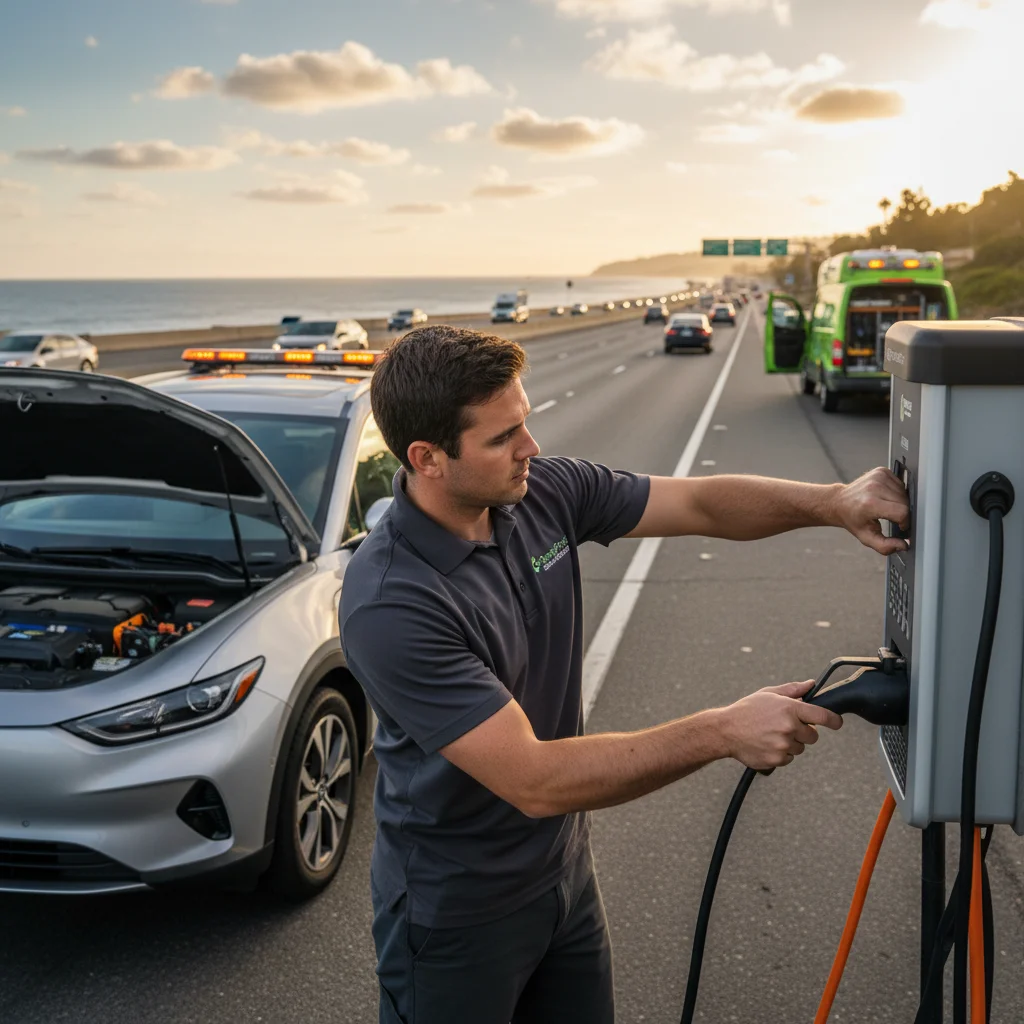
Federal lots, gates, and what we couldn’t confirm
Moffett Field is a federal site. Gate rules belong to the facility, not to a referral line. We couldn’t confirm whether a civilian operator can enter those lots. Don’t assume a van can roll to your stall.
Ask the gate or your host before you drop a pin inside the fence. Name a public street on the Mountain View or Sunnyvale side. Say that when you call if the car is reachable from there. Some drivers walk a staff member out to meet the operator at a public curb. That’s a facility decision. Charge Pro SF can’t make it for you.
Charge Pro SF is a referral line. It matches stranded EV drivers with independent local mobile rescue operators. It doesn’t hold a trade license, own trucks, or send its own technicians. The pros we connect you with are licensed and insured. The operator quotes you before work starts. The operator bills you directly.
If a lot posts a tow-away sign, California Vehicle Code 22658 sets the posting rules. The sign must be at least 17 by 22 inches. Lettering must be at least one inch. It has to name the enforcement number and each tow company. The operator must notify law enforcement within one hour. Overcharging beyond the approved rate creates extra liability in that private-property setting. The statute sets that at four times the amount charged. California doesn’t cap ordinary consensual tow rates statewide. Confirm any posted rate with the lot and the tow company before you sign.
A mobile 12-volt jump on the stall usually beats a hook from a federal lot. That’s when access is allowed. That’s the point of calling before the lot calls a tow.
If you already rolled out onto 101 or 237
Some drivers get the car to wake, then die on the first freeway mile. US-101 and SR-237 run along this edge of the South Bay. Both have express lanes in the regional FasTrak network. Hours there are generally 5 a.m. to 8 p.m. weekdays.
Stopping on a freeway is restricted under California Vehicle Code 21718. A disabled vehicle that can’t keep moving is an exception, once you’ve summoned help. California Vehicle Code 22651(f) covers a dead vehicle on a freeway. Officers can have it removed after four hours. That applies when it can’t move under its own power. Put the hazards on. Stay off the travel lanes.
The Bay Area Freeway Service Patrol is a partnership of MTC, CHP, and Caltrans. Private tow companies run the beats. Hours are Monday to Friday, 6 to 10 a.m. and 3 to 7 p.m. The MTC FSP page lists a free gallon of gas, jump-starts, and radiator refills. It doesn’t mention electric vehicles or out-of-charge help. That read is from 2026-09-18. Outside those hours, CHP Rotation Tow is the highway path. You don’t pick the company.
If you’re empty on SR-237, start with stranded on SR-237. A lot stall and a shoulder stall are different calls.
What the operator can do when they can reach the car
The pros we connect you with bring a 240-volt Level 2 source to the vehicle. Tesla and other NACS cars use a native NACS plug. CCS or J1772 adapters cover most other EVs. Typical on-site charging adds 10 to 20 miles. That takes 15 to 30 minutes on the cable. That’s charge time, not travel time to you.
If the 12-volt is the fault, they can jump it on site. They can replace it when a battery is on the truck. Tesla 12V battery jump is the Tesla path. The same low-voltage job applies to other brands. A pack that’s truly empty needs the Level 2 charge, not another 12-volt pulse. Use EV roadside assistance if you’re not sure which job you have.
Mountain View’s wires utility is PG&E. Generation is Silicon Valley Clean Energy. Palo Alto next door is City of Palo Alto Utilities. That’s a municipal utility with no CCA. Santa Clara runs Silicon Valley Power. None of those home programs can reach a dark car in a Moffett Field stall.
South Bay summer heat doesn’t help a weak 12-volt. San Jose’s July average max is about 82F on the 1961-1990 normals. A soaked cabin makes the car’s systems work harder when you try to wake it. That’s climate, not a charger story.
What to say when you call
Lead with the lot, not the airfield name alone. Moffett Field is a large federal site. A public cross-street on the Mountain View or Sunnyvale edge is more useful. Say whether you can meet a civilian van at a gate or a curb. Say make, model, and year. Say whether any screen came on, and whether a door opened.
Say whether the car sat for hours or for days. A weekend sit points harder at the 12-volt.
Charge Pro SF serves the Bay Area, including Mountain View and Sunnyvale. The operator you get is independent. They set the price. They set whether they can enter. They do the work. If the 12-volt is dead in a Moffett Field lot, call (415) 630-6268. Walk through that list with the operator.