EV roadside assistance in Walnut Creek is a charge or 12V jump at the car. It isn’t a hope that you’ll make the next stall on SR-24. That climb toward the Caldecott Tunnel spends range the display still showed. Charge Pro SF is a referral line. It matches stranded drivers with independent local operators. Those operators quote you before they start, then bill you directly.
The SR-24 grade spends miles you thought you had
Walnut Creek is an incorporated city in central Contra Costa County. It sits inland of Lafayette and the Caldecott Tunnel. SR-24 is the westbound climb out of the valley. I-680 is the north-south spine. Their interchange is where a comfortable range reading often fails.
Leave Rossmoor or Walnut Heights with a thin buffer. Run errands on Ygnacio Valley Road or Treat Boulevard. Then point the car at the tunnel. The hill, the heat, and the cabin AC stack on the same miles. North Main Street dumps downtown traffic into that mix. You’re not on a flat bayshore loop. You’re climbing out of an inland valley.
The Census Gazetteer lists Walnut Creek at 19.76 square miles. ACS 2019-2023 population is 69,790. The 2024 Census estimate is 70,817. Hispanic or Latino residents are 11.8% of the city. About 67.4% of housing went up before 1980. Those figures come from Census ACS, PEP, and B25034 files read 2026-09-18. They describe a busy inland commute city with a lot of older buildings. They don’t predict your remaining range. They do explain why so many cars sit all day. Then those cars hit SR-24 on a low pack.
Nearby Lafayette, Concord, Alamo, and Danville share this 680 and 24 pattern. Pleasant Hill sits in the same BART commute. The Lafayette roadside write-up is the next westbound stretch toward the tunnel.
Broadway Plaza, BART lots, and a pack that sat in heat
Downtown Walnut Creek and Broadway Plaza hold cars through long shopping blocks. The Lesher Center fills evening garages. The Walnut Creek BART station holds commuter cars all day. So does Pleasant Hill/Contra Costa Centre BART. Northgate, Rudgear, and Saranap feed those lots. Mount Diablo State Park sits above the east side. Weekend hill miles aren’t the same as a flat grocery run.
A pack that baked in a lot is weaker on the first climb home. Walnut Creek has a warm inland valley climate. Summer heat and AC load are real here. Coastal San Francisco’s 1961-1990 July average max at SFO is 71.5°F. That’s from NWS cooperative normals via WRCC. Livermore’s July max is 89.7°F. Walnut Creek sits in that inland band, not the marine layer. Don’t treat a coastal range estimate as a 24 grade plan.
BART publishes Level 2 charging at Lafayette station: four plugs. That is on bart.gov, verified 2026-09-18. Naming that site isn’t the same as saying you’ll reach it. If the car already won’t roll, you need energy at the car. The stall or the shoulder you’re in is the worksite.
Overnight charge misses in older Walnut Creek housing
67.4% of Walnut Creek housing predates 1980, from ACS B25034. That’s a Census proxy for older, panel-limited stock. Many buildings never planned on a nightly EV plug. A tripped breaker or a loose cord leaves you low at breakfast. Then the first westbound move is SR-24.
PG&E runs the wires. MCE, Marin Clean Energy, is Walnut Creek’s community choice aggregator. MCE publishes Charge Up Contra Costa and the MCE EV Instant Rebate. Those programs are for home and workplace gear. They don’t move a car that’s already empty on Treat Boulevard. Don’t wait on a rebate when you need miles now.
Home charging context for this city is on the Walnut Creek page. A dead car on the street is a rescue call, not an install call.
What a local operator does when they reach you
Charge Pro SF doesn’t hold a trade license. It doesn’t own trucks, a yard, or a fleet. It doesn’t employ technicians or set prices. Independent operators do the work. The pros we connect you with are licensed and insured.
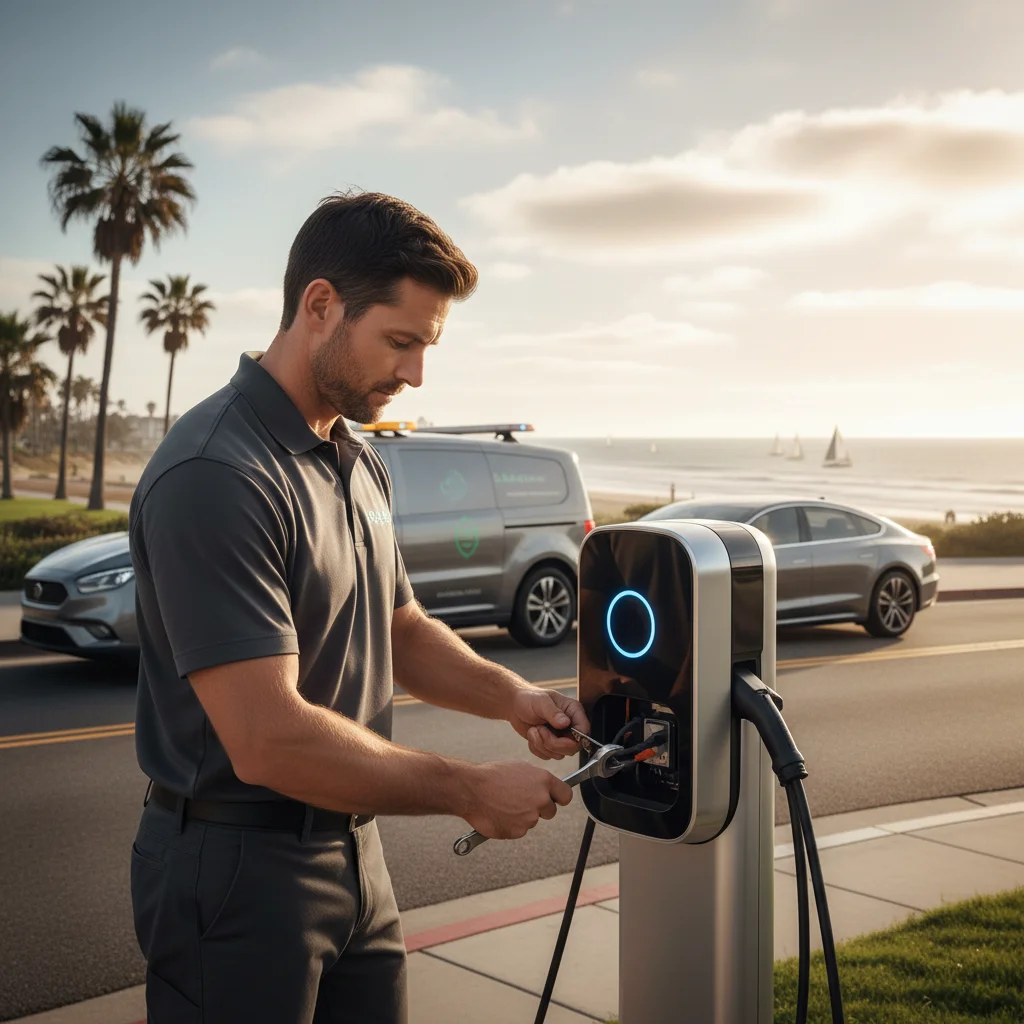
They bring a 240V Level 2 source to the car. Teslas use a native NACS plug. Other EVs use a CCS or J1772 adapter. A typical session adds 10 to 20 miles of range. That takes 15 to 30 minutes of charging. That’s plug time, never a promise of when someone arrives. The operator quotes first. They bill you directly.
If the screens are dark and the doors won’t wake, start with the 12V. Teslas still have that small battery. So do other major EV brands. It runs the computers that close the high-voltage contactors. A dead 12V looks like a dead pack. It isn’t always. Tesla 12V battery jump work happens at the car. Then a Level 2 charge can add miles if the pack is low. For a pack that’s truly empty, out-of-charge recovery is the charge-in-place path. The broader EV roadside assistance page covers both.
They handle Tesla and every major EV brand. A jump isn’t a pack replacement. If the car dies again after it wakes, the 12V still needs shop time.
When the stall is the SR-24 or I-680 shoulder
California Vehicle Code 21718 generally bans stopping on a freeway. A vehicle so disabled that stopping is unavoidable, with help already summoned, is an exception. Use the shoulder only if that’s the safe place you have.
CVC 22651(f) allows removal after four hours on a full-access-control freeway. That applies if the car can’t move under its own power. Don’t treat the shoulder as a waiting lot.
The Freeway Service Patrol is an MTC, CHP, and Caltrans partnership. Private tow companies run the beats. 511.org lists FSP hours Monday through Friday. Those windows are 6 to 10 a.m. and 3 to 7 p.m. Dial 511 and say “Freeway Assist,” or use a call box. MTC’s FSP page, read 2026-09-18, lists gas, jump-starts, and radiator refills. It doesn’t mention electric vehicles or charging a depleted pack. Don’t assume that truck can add EV miles.
Outside FSP hours, CHP’s Rotation Tow Program assigns the vendor. You don’t pick the company. Caltrans District 4 covers the nine Bay Area counties on QuickMap. I-680 in Contra Costa has express lanes. FasTrak is required. Hours are generally 5 a.m. to 8 p.m. weekdays. A published disabled-vehicle rule for those lanes wasn’t confirmed here. Follow CHP and 511 if you’re stopped in them.
If the car will still creep, get it out of traffic. A Broadway Plaza stall or a side street off North Main is enough. Then the operator can stand and plug in. If it won’t move, stay with the disabled-vehicle rules. Mobile charging versus a tow is the choice once you’re safe. If you’re south on 680, use the I-680 out-of-charge guide. It covers that freeway from another angle.
Tell the operator where you actually are
Callers use ZIPs 94507, 94518, 94595, 94596, 94597, and 94598. Census ZCTAs overlap the city. Give a pin. Name the garage level at Broadway Plaza. Give a cross street on Ygnacio Valley Road, Treat Boulevard, or North Main Street. Say whether the car still rolls. Say whether it’s dark and locked, or awake with a zero-mile warning. Say Tesla or the other make, so the plug is right.
Walnut Creek doesn’t sit alone on this commute. Concord is next north on 680. Danville and San Ramon sit south on the ridge. Lafayette is the next westbound step toward the Caldecott. Charge Pro SF serves every city in the county.
Private-property tows from a posted lot follow CVC 22658. California doesn’t cap ordinary consensual tow rates statewide. Read the posted sign. Get the quote before you approve a hook. A charge at the stall keeps you off that path. That only works when the car will take a charge.
Frequently asked questions
Can a mobile charge help on the SR-24 climb, or only in a parking lot?
It helps at the car. That can be a legal shoulder stop when you’re disabled. It can also be a Broadway Plaza stall or a BART space. The operator still has to reach you and stand safely. A live lane isn’t a worksite. If the car will roll a short way, get it out of traffic first.
What if the Tesla is locked and the screens are dead?
That’s often the 12V, not an empty pack. The car may not unlock or boot until the 12V wakes. It may not accept a charge either. Tell the dispatcher the car won’t respond at all. The operator can jump or replace that 12V on site. Then they can add Level 2 miles if the pack needs them.
Do these operators only rescue Teslas in Walnut Creek?
They bring NACS for Teslas. They bring a CCS or J1772 adapter for other brands. Hyundai, Kia, Ford, GM, VW, and Rivian are in the mix. Name the make when you call so the plug matches the port.
If you’re stuck in Walnut Creek or on the SR-24 grade, call Charge Pro SF. The number is (415) 630-6268. You’ll get a referral to a local operator. That operator quotes before any cable goes in.