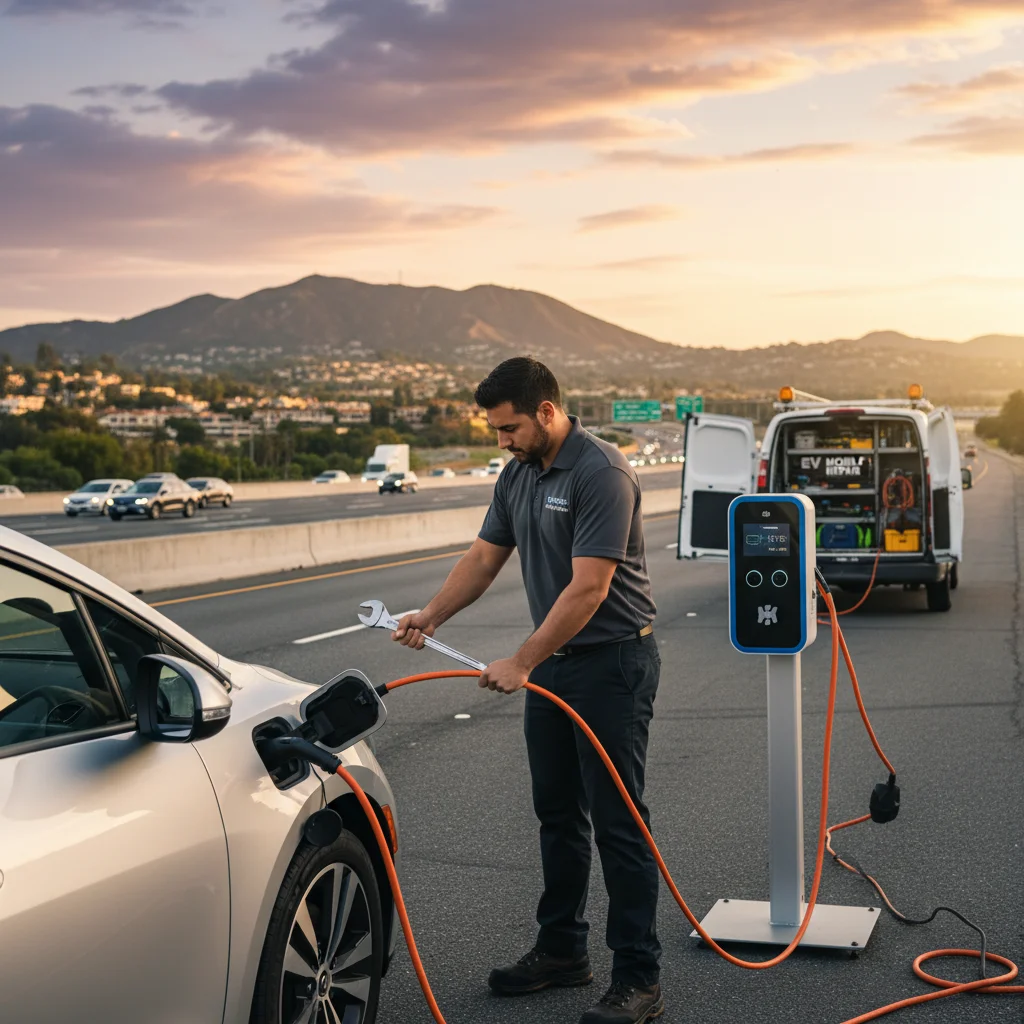
EV roadside assistance in San Mateo is help at the car. US-101 and the SR-92 bridge approach spend a thin pack. Charge Pro SF is a referral line for that stall. It matches you with an independent operator who comes over. The operator quotes you before work starts and bills you directly. Independent operators bring a 240-volt Level 2 source to the bumper. Teslas take a native NACS plug on that lead. Other EVs use a CCS or J1772 adapter. Charging time is usually 15 to 30 minutes on the port. That window is plug time, not an arrival estimate. Typical added range is about 10 to 20 miles.
Why San Mateo eats a thin pack on 101 and SR-92
San Mateo sits on the bayside Peninsula in San Mateo County. It’s an incorporated city of about 12.1 square miles. The ACS 2019-2023 count was 103,555 residents. The separate 2024 Census estimate is 103,006. The city is a Peninsula commute hub on stacked corridors.
US-101 carries the heavy north-south commute through town. I-280 is the inland freeway through San Mateo. SR-82 is El Camino Real through the grid. Hillsdale Boulevard feeds the mall and nearby streets. SR-92 is the branch that splits the trip. Eastbound SR-92 puts you on the San Mateo-Hayward Bridge. West is the climb toward Half Moon Bay. Research on this city flags both legs as range-costly.
Downtown, Hillsdale, Hayward Park, and Shoreview all feed those roads. San Mateo Park and Sunnybrae do the same. Nearby cities include Foster City, Burlingame, San Carlos, and Belmont. Hayward is the East Bay landing across the bridge. Callers often cite ZIP 94401, 94402, 94403, or 94404.
US-101 through town when the estimate turns red
US-101 is the Peninsula spine through San Mateo. Drivers roll south from Burlingame or north from San Carlos. The range number on the dash can still look fine. Stop-and-go, climate control, and a late merge can spend that cushion. The car then meets SR-92 with nothing left for a crossing or a climb.
Express lanes run on US-101, and FasTrak is required there. Regional hours are generally 5 AM to 8 PM on weekdays. MTC runs the regional express-lane network here. A published disabled-vehicle rule for those lanes wasn’t confirmed. Don’t assume a special refuge just because you’re in an express lane.
If the car dies on 101, stay put when the shoulder is the safer choice. Turn on the hazards and keep seatbelts on. Call 911 if traffic is on top of you. California Vehicle Code 21718 bars freeway stopping except in limited cases. A vehicle so disabled that stopping is unavoidable qualifies when help is already summoned.
Then request EV roadside assistance that can charge or jump on site. A rotation tow doesn’t refill the traction pack. Bookmark the San Mateo city page if you drive this town every week. For the wider freeway checklist, use the Bay Area out-of-charge freeway guide.
Charge Pro SF doesn’t publish arrival windows on this line. Traffic on 101 is the same traffic the operator sits in. The operator on the phone tells you what they can do. You accept or you don’t, before they start.
The SR-92 split: bridge run and coast climb
The SR-92 interchange is the stall pattern that belongs to this city. One ramp sends you toward Hayward on the San Mateo-Hayward Bridge. The other sends you west toward the coast. You don’t get a third, flat option once you’re in that commit.
The bridge is one of seven state-owned Bay crossings. Caltrans owns the span, and BATA and MTC set the tolls. Cash collection ended for good in March 2020. Tolling uses all-electronic Open Road Tolling. Pay with FasTrak, a license-plate account, or an invoice. The tolled direction on this bridge is westbound only.
No published disabled-vehicle-on-a-bridge policy showed up in BATA or Caltrans materials checked on 2026-09-18. If you stall on the span, follow CHP and Caltrans on the scene. Caltrans District 4 covers the nine Bay Area counties. 511 SF Bay and QuickMap carry the highway feeds.
A pack pointed at Hayward still has to finish the water. If it can’t, an operator has to come to a legal stop. That stop is a mobile EV charging job, not a guess at the next plug. Drivers who do make the East Bay can keep the Hayward roadside notes. Those notes cover I-880 and the Hayward landing.
Westbound SR-92 leaves San Mateo’s mild bayside climate behind. The corridor then climbs into fog toward Half Moon Bay. Grade plus climate control both draw the pack. College of San Mateo is one of the city’s landmarks. Confirm the miles you still have before you take the coast.
Hillsdale, Downtown, and a slow overnight plug
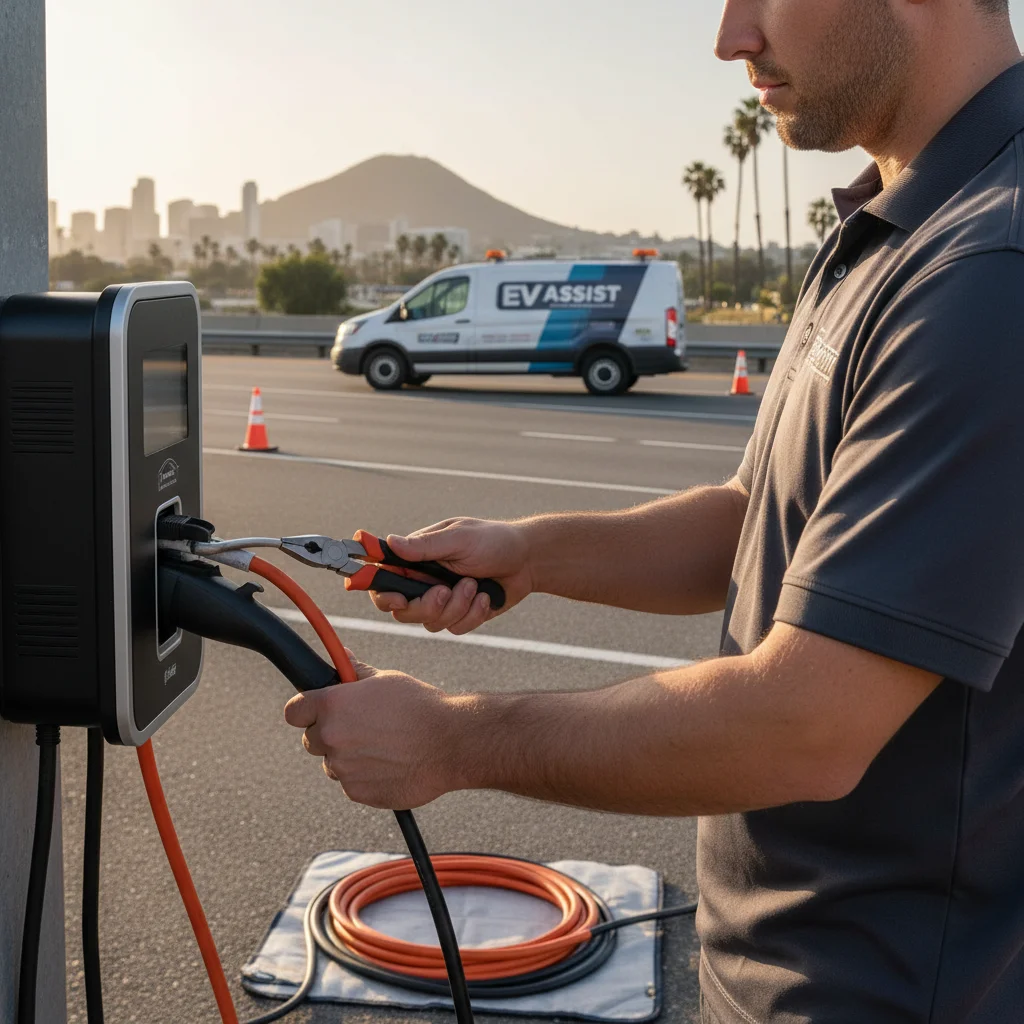
Plenty of stalls never reach a freeway shoulder. Hillsdale Shopping Center pulls shoppers from across the mid-Peninsula. Central Park pulls short local loops around town. Downtown and El Camino Real stack extra trips on a low pack. You meant to charge after the errand, and the stop ran long.
About 72.0% of San Mateo housing was built before 1980, per ACS 2019-2023. That share is a proxy for panel-limited houses and plug-light apartments. A 120-volt outlet can leave a car short after a heavier commute week. Wednesday’s 101 run then starts thinner than the dash made it look.
The same referral line covers Downtown, Hillsdale, Shoreview, Hayward Park, and San Mateo Park. PG&E runs the distribution wires in this city. Peninsula Clean Energy is the Community Choice Aggregator for San Mateo County. It publishes an EV Incentives Program for drivers. The EV Ready Program covers business and multifamily sites. Those pages don’t rescue a car already dark on Hillsdale Boulevard. Confirm current rules on peninsulacleanenergy.com if you’re shopping for a home plug later. Don’t treat a rebate page as roadside help.
The Energy Department AFDC map is the public station finder. Use it to plan a normal charging week. Don’t trust a remembered pin as proof a stall still works.
Empty pack, or a 12-volt that killed the wake-up
Two failures get reported as a dead EV. They’re not the same kind of stall.
An empty traction pack means the car rolled until it stopped. You need energy into the charge port now. The operator’s Level 2 lead covers Tesla and the other major brands. Typical plug time adds about 10 to 20 miles in 15 to 30 minutes. That’s charging time on the bumper, not a show-up clock.
A dead 12-volt is the other common stall. The traction pack can still hold energy afterward. Screens, locks, and contactors still fail with it. Operators can jump or replace that 12-volt on site. Read what happens when an EV 12-volt dies if the car won’t wake at all.
Tell the operator what the dash did last. Say whether the charge port still opens. They quote the work before they touch the car.
What Charge Pro SF is, and isn’t
Charge Pro SF doesn’t hold a trade license for this work. It owns no trucks, no yard, no gear, and no technicians. It sets no prices and publishes no hours. The pros the line connects you with are licensed and insured. They handle Tesla and every major EV brand.
You hear the quote first, then you pay the operator. Nothing on this page is a rate. Confirm the quote they speak before they plug in.
The job is enough range to reach a charger you pick, or a 12-volt wake-up. It isn’t a full pack or a shop repair.
511, four hours, and a tow that still leaves you empty
The Freeway Service Patrol is a partnership of MTC, CHP, and Caltrans. Private tow firms run the beats under contract. Published hours are Monday through Friday, 6 to 10 AM and 3 to 7 PM. Dial 511 and say “Freeway Assist,” or use a call box.
MTC’s FSP page lists a free gallon of gas, jump-starts, and radiator refills. It also cites more than 100,000 incidents a year. As of 2026-09-18, that page doesn’t mention electric vehicles or out-of-charge help. Don’t wait on FSP to fill a traction battery.
Outside those hours, freeway removal often goes through the CHP Rotation Tow Program. You don’t pick the company on that rotation. California Vehicle Code 22651(f) allows removal after more than four hours on a full-access-control freeway. That clock starts when the car can’t move under its own power. Summon help before you’re watching it from the shoulder.
A tow is the right tool after a collision. It’s also right for a failed drive unit. Use it when a high-voltage fault won’t clear. An empty pack is usually a charge problem. A flatbed still leaves you with an empty car in a new lot. Walk through that choice in mobile EV charging or a tow.
California doesn’t cap ordinary consensual tow rates statewide. The operator, or a local ordinance, sets that bill. Confirm the tow quote before the hook goes on. Charge Pro SF doesn’t set tow prices either.
When to call
If the car is stuck in San Mateo, use the referral line. That covers an empty pack or a dark 12-volt. US-101, SR-92, and I-280 sit in the service area. So do El Camino Real, Hillsdale, Downtown, and the residential pockets. The Bay Area is the coverage, including this Peninsula hub.
Call (415) 630-6268 for the referral. Give your direction, the nearest ramp, and whether the car still wakes. The operator quotes the job and bills you. You decide before anything on the car starts.