The Tesla sat in a San Jose garage all day. Now the screens stay black and the handles won’t pop. That’s usually a dead 12V, not an empty pack. Campus lots and office ramps do this on ordinary weekdays.
San Jose is Santa Clara County’s big South Bay city. The Census ACS 2019-2023 count is about 990,054 residents. The separate 2024 Census estimate is 997,368. The city covers about 178 square miles of valley floor. Downtown parking isn’t the same as Willow Glen. Almaden Valley, Evergreen, Berryessa, and Alviso don’t share one pattern. Japantown and East San Jose add ramps and street stalls of their own. A Tesla that sat under San Jose State University is one pin. A car stuck on SR-17 is another. EV charging and rescue in San Jose starts from that map.
Heat, a workday sit, and a 12V that quits
South Bay heat isn’t San Francisco’s cooler weather. SFO’s 1961-1990 July normal high is 71.5F. San Jose’s is about 82F on the same vintage. The flats run AC hard once you do drive. While you work, cabin overheat protection still fights that sun. Sentry mode still watches the garage camera feed. Those systems sip from the small battery that boots the car.
Every Tesla still has that small low-voltage battery. It isn’t the drive pack under the floor. When it sags, the car looks fully dead. The doors may not unlatch from the outside. The phone app may go quiet on you. The center screen never comes up at all. Plenty of drivers assume they hit zero miles. A lot of the time they didn’t hit zero. A long campus sit is the usual setup. Tesla 12V failure after a long park covers the same failure after a quiet day.
The city’s older housing stock matters here too. Census ACS 2019-2023 shows 60.8 percent of San Jose housing was built before 1980. A lot of apartments and older lots never got a 240-volt wall box. Cars then live in workplace structures for the whole day. You meant to plug in at the office, but the stall was taken. Ten hours later the Tesla is a brick.
PG&E still delivers the wires in San Jose. San Jose Clean Energy is the community choice aggregator. They publish EV Instant Rebates and Multifamily EV Charger Assistance. Those program names only help a future install. They don’t wake a car that’s already dark. Don’t wait on a rebate from a stall you can’t leave.
Tell a dead 12V from an empty pack
Check what you still remember before you dial. That memory changes what you should ask for. If the car last showed healthy miles, start with the 12V. If you rolled around on a low-pack warning, plan for both. A charge port that won’t open can be 12V. The charge-port latches still need that small battery. A pack at true zero can refuse to wake too. You won’t always tell them apart from the concrete. Empty pack or a dead 12V goes deeper on that split.
Try the key card on the B-pillar. Then try an unlock from the app. If you can open a door, use the mechanical release in the front pocket. Don’t pry at a stuck exterior door handle. Don’t treat this like a gas-car jump from a neighbor in the next stall.
If the screen comes up, read the miles. If it doesn’t, say that when you call. The operator needs to know what to bring. That’s a 12V jump, a 240-volt charge, or both.
Tesla, a club truck, or a local EV operator
Stranded Tesla owners usually reach for three numbers. Those three paths send very different kinds of help.
Tesla roadside is requested in the app, or through Tesla’s published phone path. Confirm the current terms for your VIN in writing. Coverage can change with model year and remaining policy. We couldn’t verify one wait or fee that covers every San Jose owner. Tesla may send a tow toward service. That can be right for a failed part. It can be the wrong tool in a garage. A garage brick often only needs a 12V wake. Read Tesla’s current terms in the app. Don’t trust a forum post for tonight’s outcome.
AAA and other clubs dispatch from a general network. Ask if that truck will jump a Tesla 12V. Ask if it carries a Level 2 source. If they only tow, you want that said early. Those auto club contracts vary by membership tier. We can’t publish a San Jose AAA promise we haven’t confirmed. Read AAA versus a mobile charge when your EV won’t move.
Charge Pro SF is a referral line, not a shop. We match stranded drivers with independent local operators. We don’t own trucks or a yard. We don’t employ the technicians who show up. We don’t set the operator’s prices either. We don’t promise an arrival clock to anyone. The operator quotes you before starting and bills you directly. When the car is bricked in a garage, that’s a Tesla 12V battery jump. When the pack is empty, that’s a mobile 240-volt charge. When you need both, say so on the call. That’s Tesla roadside rescue as it actually runs here. They try to wake the car where it sits, if that’s possible.
What shows up in the stall
Operators bring a 240-volt Level 2 source to the car. Teslas take a native NACS plug on the charge port. Other EVs use a CCS or J1772 adapter. That charge typically adds 10 to 20 miles of range. The charging window is usually 15 to 30 minutes. Keep that figure as charging time, not an arrival estimate. It isn’t a promise of when the truck appears.
They can jump or replace a dead 12V on site. That’s the usual campus-garage job in San Jose. The screens come back after a clean jump. The charge port may finally release for a plug. Then you can plug into a post in that structure if one is open. If you can’t plug in where you sit, you still need miles. A short Level 2 session can cover a short drive. Go to a Supercharger you already know. Or it can cover a crawl to a home plug that’s waiting. The car still has to wake first. None of the rest matters until it does.
If the 12V dies again the next morning, treat it as a failing battery. A jump only wakes the car for now. It isn’t always a lasting repair on its own. Schedule a test of that small battery this week. Plan a replacement on your schedule, not on the next workday sit.
North San Jose, airport workers, and SR-237
North San Jose sits against SR-237 and the Milpitas line. Office garages there hold cars from morning until evening. Mineta San Jose International Airport sits on that same north edge. Airport staff leave Teslas in Hourly Lot 2 and Lot 3 for a shift. The 12V doesn’t care which story it is. 95134 and 95110 are ZIP clues people say. Those ZIPs can overlap the city line. Say the garage name anyway when you call.
Berryessa and the east side feed Capitol Expressway and I-680. Alviso sits on the north edge toward SR-237. Those pins are still inside San Jose proper. They’re not downtown pins, so say so. Give the neighborhood, not just the city. Fremont is the next city north on I-880. That’s Alameda County, not Santa Clara County.
If you already made it to a freeway
Some Teslas die on the way in, not at the stall. US-101 and I-280 cut the west side. I-880 and I-680 handle the east and north. SR-87, the Guadalupe, runs right through downtown. SR-85 and SR-237 move Silicon Valley traffic. Almaden Expressway and Capitol Expressway feed the neighborhoods. SR-17 climbing toward Santa Cruz asks more of a low pack. That’s grade and heat, not a garage sit.
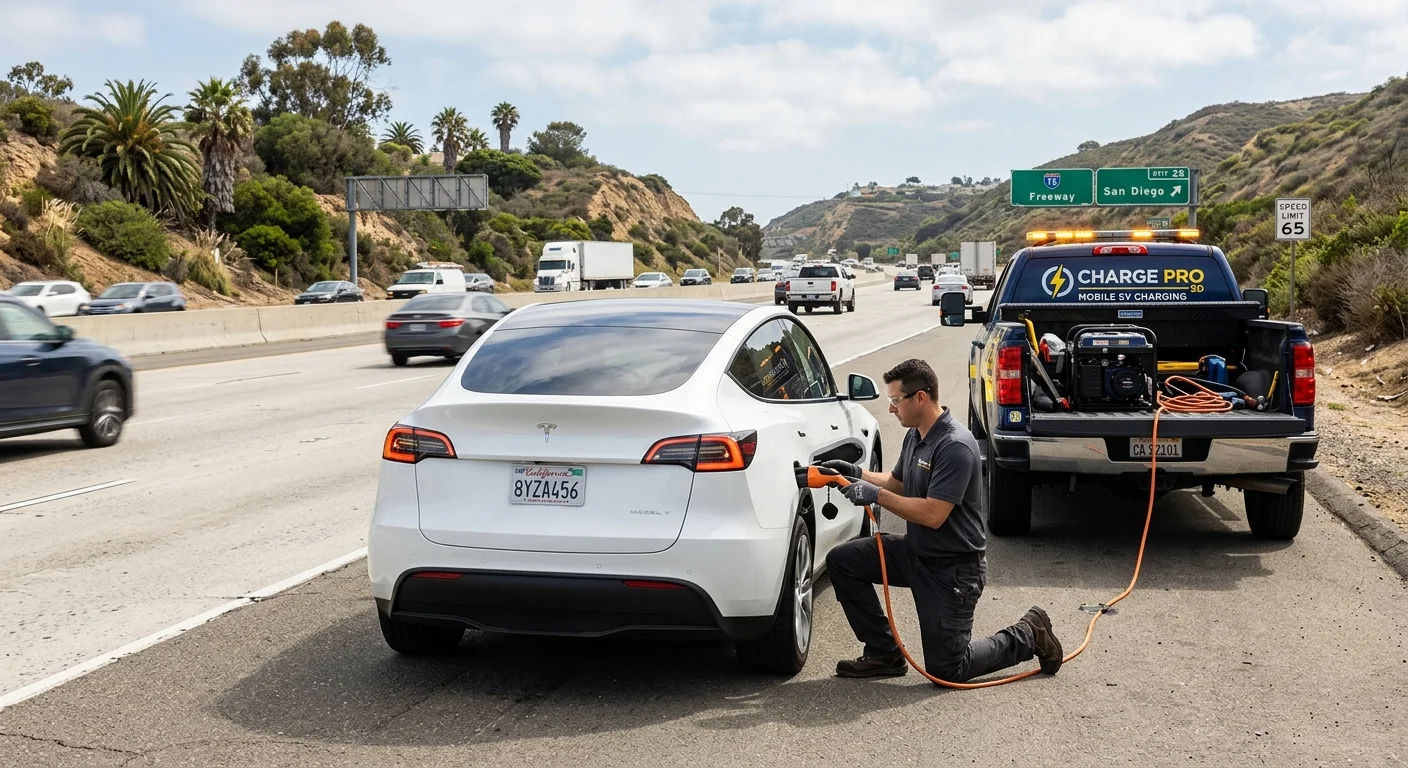
If you’re on a full freeway, California Vehicle Code 21718 generally bars stopping. There’s a disabled exception when stopping is unavoidable. You also need to have summoned another vehicle to help. Stay well out of the live travel lanes. Use a shoulder if you have one. Put the hazard lights on and stay with the car if it’s safe. California Vehicle Code 22651(f) allows a removal in that setting. The trigger is more than four hours on a full-access-control freeway. The car also has to be unable to move under its own power. Don’t treat the freeway shoulder as overnight parking.
The Bay Area Freeway Service Patrol is a partnership of MTC, CHP, and Caltrans. Published hours are Monday to Friday, 6 to 10 a.m. The afternoon window is 3 to 7 p.m., per 511.org. Dial 511 and say Freeway Assist to reach them. FSP lists a free gallon of gas, jump-starts, and radiator refills. The MTC page, read 2026-09-18, doesn’t mention electric vehicles or out-of-charge help. A 12V jump may fit what they already list. A mobile EV charge doesn’t appear on that page. Outside those hours, freeway tows often go through the CHP Rotation Tow Program. You don’t pick the company. Caltrans District 4 covers the nine Bay Area counties on QuickMap.
A campus garage follows a different towing rulebook. Statewide, CVC 22658 sets posting rules for private-property tows. The sign must be at least 17 by 22 inches. Lettering on that sign must be at least one inch. San Jose also has Municipal Code Chapter 6.66 and Title 23. The specific local text wasn’t verified in this research pass. Read the posted sign in that garage. If a lot is towing you, that clock is the lot’s, not Tesla’s.
Downtown, Diridon, and the Shark Tank
Downtown, Diridon Station, San Jose State, and the SAP Center stack cars for hours. Locals still call the SAP Center the Shark Tank. The Winchester Mystery House sits on the west side of town. After a Sharks night, a dark screen is still usually the 12V. If the pack hit zero downtown, read your EV died downtown in San Jose.
After the car wakes
Once the screens are up, don’t just sit in sentry. Drive to a charger you already know, or plug in at home. A 12V that was on the floor may drop again. The next long sit can brick it again. If the car warns about the 12V, believe it. Schedule a replacement through Tesla service or a shop that works on EVs. Charge Pro SF doesn’t perform that 12V repair. The operator’s job was the stall wake. Yours is to not repeat tomorrow’s brick in the same garage.
If the car commutes out of town
Plenty of San Jose Teslas sleep in Santa Clara, Sunnyvale, Cupertino, or Milpitas. Others sit in Campbell or Los Gatos and work the other way. The 12V doesn’t care which city signed the permit. The pin drop still has to be right. Use the San Jose city page for the pin. Don’t make the operator guess between Berryessa and Almaden Valley. Sunnyvale campus lots look the same at 6 p.m. SR-237 and I-880 only change the freeway chapter.
What to say so the quote matches the car
Give the garage name or the street. Name the nearest corridor if you know it. Say it’s a Tesla, and the model if you can. Tell them how long the car sat idle. Say whether the app still sees the car. Say the last miles if you remember them. Say whether the charge port is stuck. That lets the operator quote the right job.
Charge Pro SF serves the Bay Area, including San Jose. We connect stranded EV drivers with independent local operators. They handle Tesla and every major EV brand. The quote and the bill belong to the operator. If you want that path, call (415) 630-6268. We’ll pass you to an operator who quotes before starting.
Don’t wait on a freeway hoping the car revives. Don’t accept a wheel-lift if the car must ride a flatbed. Tesla towing rules with no power are model-specific. Confirm them in the manual or the app before a hook goes on. A 12V wake in the stall is the smaller job. Ask for that first when the car never left campus.