The last bar is already gone when you merge onto SR-237 in Milpitas. Traffic on the I-880 curve spends the buffer you thought you had. EV roadside assistance in Milpitas is how you get moving again. Charge Pro SF is a referral line, not a shop. We match you with independent local operators. We don’t own trucks, and we don’t set the price.
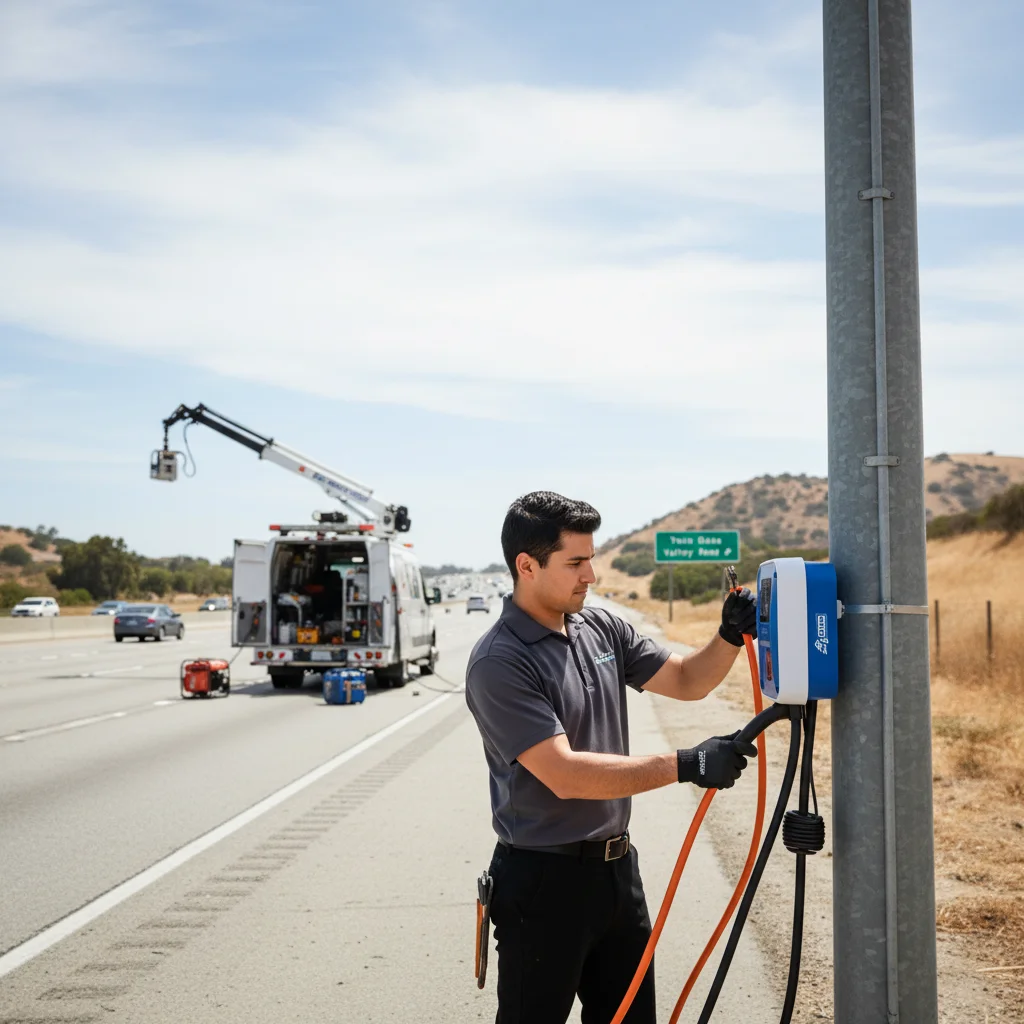
Why this city stalls on 237 and the 880 curve
Milpitas is an incorporated Santa Clara County city covering 13.481 square miles. I-880, I-680, and SR-237 all cut through town. Calaveras Boulevard and Montague Expressway feed that same knot. The I-880 and I-680 interchange is the curve people mean. Live traffic doesn’t give you a quiet shoulder to wait it out.
Express lanes run on I-880 and SR-237, and FasTrak is required. Hours are generally 5 AM to 8 PM on weekdays. MTC runs the regional network, and Alameda CTC runs the I-880 lanes. No primary page confirmed a median or left-shoulder rule for a disabled car. Don’t pull left because a snippet said so.
This is a warm, sunny valley climate with real summer heat. San Jose’s July normal high is about 82F on the 1961-1990 WRCC normals. Milpitas shares that inland South Bay pattern. AC on a 237 crawl uses range you wanted for the last exit. Bay wind on the Alviso wetlands edge can take the edge off. It doesn’t cool the Great Mall lots or Midtown the same way.
ACS 2019-2023 puts the population at 78,216, and the 2024 estimate is 79,746. About 39% of housing was built in 1979 or earlier. That’s a newer stock than the older Peninsula and East Bay cores. The local call mix leans to road strandings and 12V work. Missing home charging isn’t the main local pattern. Midtown, Sunnyhills, McCarthy Ranch, and the Great Mall sit in that newer pattern. The Berryessa border still dumps cars onto this same freeway split.
PG&E runs the wires here, and Silicon Valley Clean Energy supplies generation. That’s a bill fact, not a roadside fact. It doesn’t put electrons into a car that’s already stopped.
All-day campus dwell, then a thin pack on the ramp
The stall often starts in a parking space. You left a South Bay campus lot after a full day. The cabin sat closed in the sun. Or you left the car at the Milpitas BART park-and-ride until the evening train. The morning estimate looked comfortable, then the closed cabin spent it. You merge onto SR-237 and the number falls in traffic.
McCarthy Ranch is the office version of the same sit. Cars stay from the first meeting to the last. Great Mall trips compress it into a few hours. You park, walk, eat, and return to a hot cabin. Then you still have to get onto 880 or 237 with what’s left.
This isn’t a claim that those lots have no chargers. Inventories for the mall, BART, and campus ramps weren’t verified for this page. Check the app you already trust before you count on a stall. If the car already can’t roll, a post down the street won’t help.
San Jose EV roadside help covers the next city south on the same 880 run. The SR-237 stall guide is the highway companion. Fremont and Newark feed 880 from the north. Sunnyvale and Santa Clara campus days spill east on 237 after dark.
Most residents give ZIP 95035, and ZIP 95134 also overlaps the place. That overlap runs into North San Jose. A ZIP isn’t a city limit. Tell the operator which side of the line you’re actually on.
Empty pack, or a 12V that won’t wake the car
Two failures get described as a dead car, and they’re not the same job. An empty traction pack means there are no miles left. A dead 12V can hide a healthy pack behind dark screens. That small battery runs computers, contactors, locks, and the wake sequence. If it’s down, the car may not unlock or go into gear.
Long parking is the 12V setup. BART, a campus garage, and a mall day all qualify. Tesla still uses a 12V, and so does every major EV brand. Don’t keep waking the car to refresh the estimate. Each wake can pull the 12V lower. Dark glass and dead handles point to 12V first.
Operators can jump or replace a 12V on site, separate from adding range. Use the Tesla 12V battery jump path when the car is a brick.
What the operator brings, and who bills you
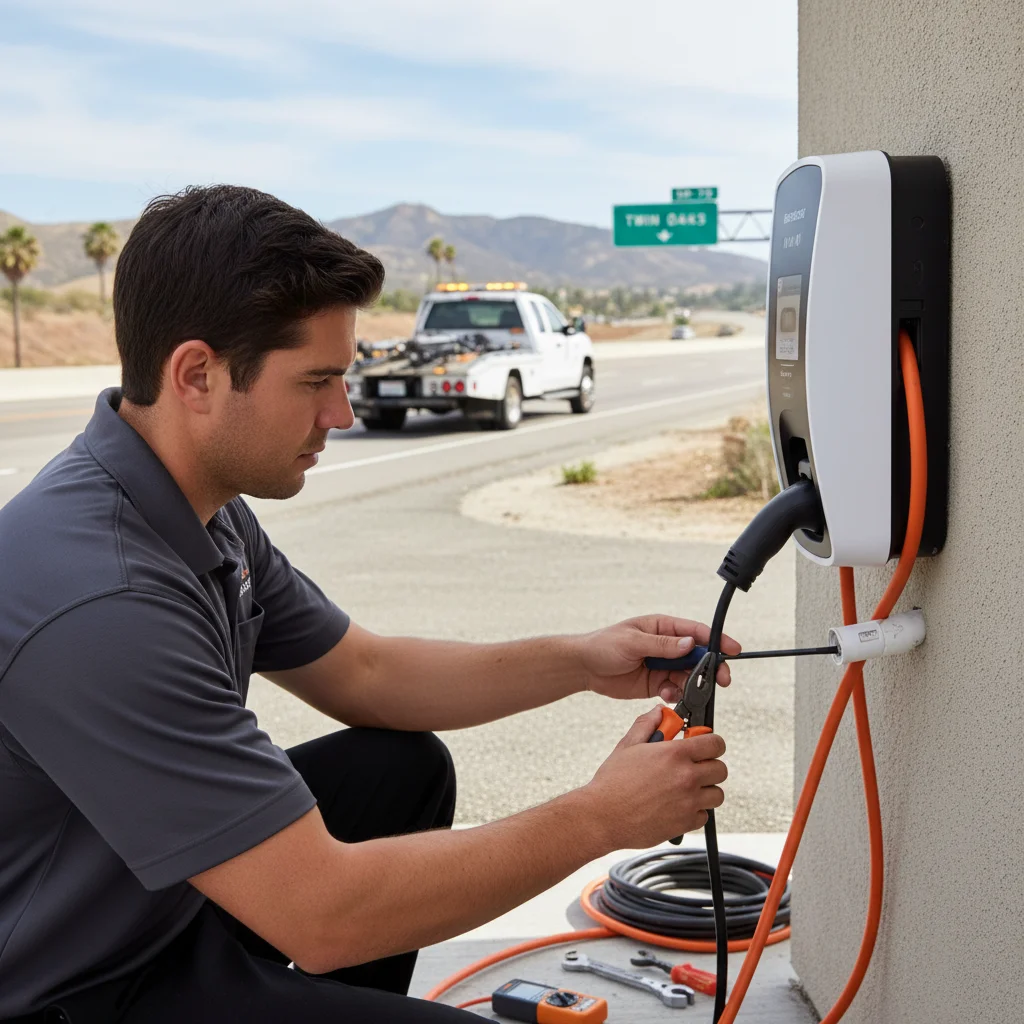
Charge Pro SF doesn’t perform the work, and we connect you with independent operators. The pros we send bring a 240V Level 2 source to the car. Teslas take a native NACS plug. Other EVs use a CCS or J1772 adapter. Typical charging adds about 10 to 20 miles of range. That takes 15 to 30 minutes of charging time. It isn’t a travel-time promise, and this line doesn’t publish one.
The operator quotes you before any cable goes in. They bill you directly, and you can decline a quote that isn’t right.
Mobile EV charging is the empty-pack job. EV roadside assistance is the broader call when you’re not sure which battery failed. Operators handle Tesla and every major EV brand. If the car is intact and just empty, you need electrons.
If you’re already on the 880 or 237 shoulder
California Vehicle Code 21718 bans stopping on a freeway in most cases. There’s an exception when the vehicle is so disabled that stopping is unavoidable. You also need another vehicle summoned to assist. That’s the legal shape of a live stall on I-880 or SR-237.
CVC 22651(f) is the removal clock. On a full-access-control freeway, a disabled vehicle may be removed. The trigger is more than four hours stopped or left standing. Time on the 880 curve still counts.
The Freeway Service Patrol is a partnership of MTC, CHP, and Caltrans. Private tow companies run dedicated beats. Hours are Monday to Friday, 6 to 10 AM and 3 to 7 PM. 511.org is the source for those hours. Dial 511 and say “Freeway Assist.” A call box works too. The MTC FSP page lists a free gallon of gas, jump-starts, and radiator refills. It doesn’t mention electric vehicles or out-of-charge help. That page was read on 2026-09-18. Don’t treat FSP as your EV charge plan.
Outside those hours, the CHP Rotation Tow Program assigns the tow. You don’t pick the company. Caltrans District 4 covers the nine Bay Area counties. 511 SF Bay and QuickMap show conditions and cameras. None of those tools send a Level 2 cable.
A stall in a Great Mall garage or a BART lot is private property. CVC 22658 governs those tows. The posted sign must be at least 17 by 22 inches. Lettering has to be at least one inch. It must state removal at the owner’s expense. It must list the enforcement number and each tow company’s name and number. The operator must notify law enforcement within one hour. Overcharging beyond the approved rate creates liability. That liability is four times the amount charged. Ordinary consensual tows aren’t under that statewide cap. Operators set those rates, subject to local ordinance. CHP sets rates only for its own rotation vendors. Confirm the posted notice on that lot. Don’t copy a fee table from another city.
A mobile charge versus a tow
An empty pack is an energy problem. A tow is for a car that shouldn’t roll even with miles. A flat, a crash, or a damaged charge port still needs a hook. A pack at zero usually needs a charge first.
Many EVs shouldn’t be flat-towed. A flatbed is the common safe method when a tow is truly required. Get the quote from the person with the truck before the winch moves.
The mobile charge versus tow guide is the decision tree. Read it before you’re the one on Calaveras looking at a dead display.
Fremont, Newark, Santa Clara, and Sunnyvale all push cars through this city. The Alviso edge, the 680 interchange, and the 237 corridor are the local facts. Swap those names for a coastal town and this page would be wrong.
When to call
Call when the car is too low to finish the 237 run. Call when it sat all day and now won’t wake. Call when you’re on the 880 curve and the estimate just died. We’ll connect you with a local operator who can quote the work. The number is (415) 630-6268. That’s a referral line, not a promise about arrival. The operator gives you their window when they call you back.