The commute home through Martinez can leave an EV with a thin pack. Grades off the Carquinez Strait and older streets do that after work. If you’re stuck on I-680, SR-4, or Alhambra Avenue, you need help. That help is a charge or a 12V jump at the car. Charge Pro SF is a referral line. We connect stranded drivers with independent local operators. Those operators bring a 240V Level 2 source, or they jump a dead 12V. We don’t own trucks, and we don’t employ technicians. We don’t set a price or an arrival time.
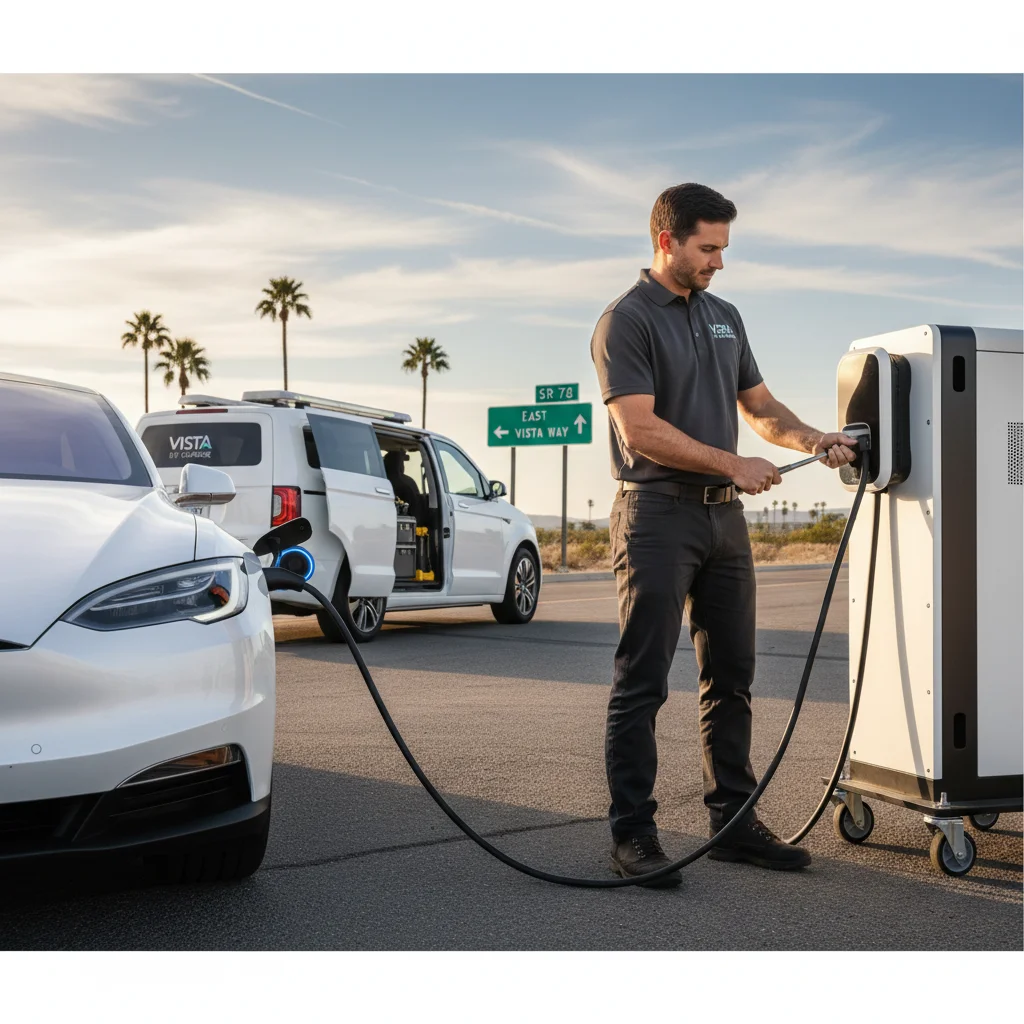
Martinez after work, on the Carquinez edge
Martinez is the Contra Costa County seat. It sits at the foot of the Benicia-Martinez Bridge on I-680. Census ACS 2019-2023 counted 36,926 people, and the 2024 estimate is 37,006. Land area is 12.643 square miles, and the ZIP on most calls is 94553. That ZIP can spill past the city line.
Martinez isn’t a coastal flat commute. It’s inland on the Carquinez Strait. Summers run hot, and strait wind hits the bridge approach. A range number that looked safe at 5 p.m. can sag fast. Alhambra Valley is where that buffer disappears.
Housing stock is older than Brentwood or much of the Delta. ACS 2019-2023 puts 58.6% of homes as built before 1980. Downtown, Vine Hill, and Mountain View still run on that older grid. Parts of the Marina do too. Pre-1980 stock is a proxy for homes without a wall charger. You finish a courthouse day on whatever the pack still holds.
I-680, the bridge, and SR-4
I-680 is the spine through town, and the Benicia-Martinez Bridge is the gate. Tolls are eastbound only, and collection is all-electronic. BATA and MTC set the tolls on this Caltrans-owned span. Cash ended in March 2020. Use FasTrak, a license-plate account, or wait for an invoice.
No published disabled-vehicle policy for the bridge turned up on 2026-09-18. If you’re stopped on the span, call 511 and ask for CHP. Check Caltrans District 4 conditions on QuickMap. Don’t guess a pull-over rule from a blog.
On the Martinez side, Marina Vista feeds the waterfront. The Martinez Marina and the Shell refinery sit on that industrial edge. A low pack here still has grades ahead. Pacheco Boulevard ties you toward Concord. Alhambra Avenue is the old north-south street through town.
SR-4 is the other hard line. Eastbound it runs toward Pittsburg and the Delta. Westbound it ties Martinez to Concord. After a hot day, that corridor is where a thin pack gets thinner. John Muir National Historic Site sits up in the Alhambra Valley fold. The climb toward those hills isn’t a freeway, but it still costs range.
If you’re already stranded, start with EV roadside assistance. That’s the match for a mobile charge or a 12V wake-up.
Downtown lots, the Marina, and older streets
Downtown is the county courthouse crowd, and cars sit for hours. Heat soaks the cabin on those lots. A 12V can quit even when the traction pack is fine. You tap the app, and nothing wakes. That’s a 12V job, not an empty pack.
The Marina lots see long shifts and evening parking. Vine Hill and Mountain View are residential and older. Alhambra Valley is the hill side of town. You can stall on those streets without ever touching a freeway shoulder.
PG&E delivers the power, and MCE is the community choice aggregator for Martinez. MCE lists Charge Up Contra Costa for multifamily and workplace Level 2. It also lists an EV Instant Rebate. Confirm those programs on mcecleanenergy.org. They won’t move a car that’s already dead on Alhambra Avenue.
For local charging context, use the Martinez city page. Lafayette BART, over the hills, publishes four Level 2 plugs.
Empty pack, or just the 12V
From the curb, both failures look alike, and screens stay dark. Door handles may not present on some Teslas. Your pack can still hold a commute’s worth of energy. Or it can be at zero after the bridge and the SR-4 merge.
Note whether the car warned you about low charge. Note whether it sat all day downtown. Note whether it died on the I-680 approach. That split decides whether you need a charge or a jump.
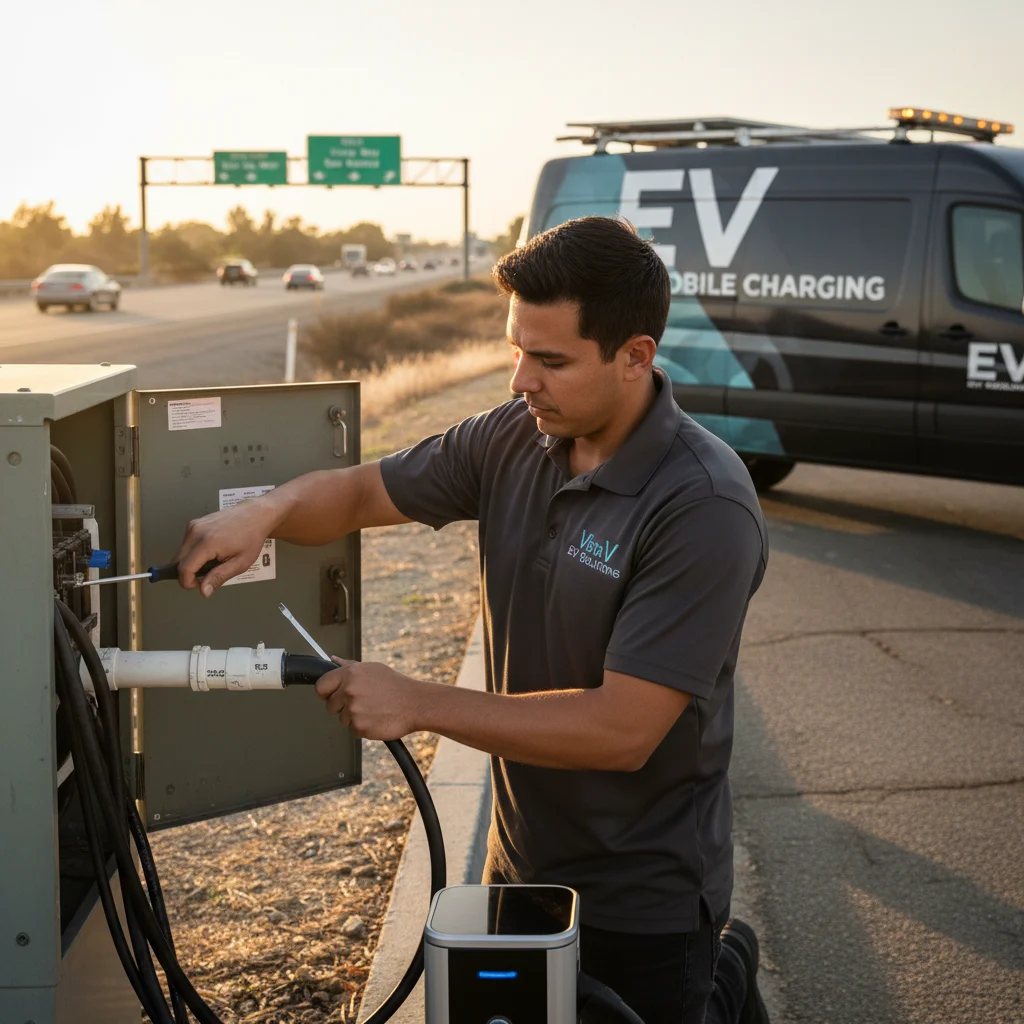
Operators we connect you with bring a 240V Level 2 source to the car. Tesla gets a native NACS plug. Other EVs use a CCS or J1772 adapter. Typical charging time is 15 to 30 minutes. That usually adds 10 to 20 miles of range. Treat that as charging time only. It isn’t a clock on when someone shows up.
They also jump or replace a dead 12V on site. Tesla is in scope, and so is every major EV brand. The operator quotes you before work starts. They bill you directly, and Charge Pro SF doesn’t take that payment.
If the pack is actually empty, mobile EV charging is the on-street charge. A 12V that dies after a long downtown park is a curb jump. A replacement on site is in scope too.
Shoulder rules on I-680 and SR-4
California Vehicle Code 21718 bans stopping on a freeway in most cases. A disabled car is an exception under that rule. You’ve got to be so disabled that the stop is unavoidable. You’ve also got to have summoned another vehicle to assist. Make that call, and then you’re in the exception.
CVC 22651(f) is the removal clock. On a full-access-control freeway, that clock is four hours. A car that can’t move on its own may be removed after that. That’s not a service window. It’s a legal limit.
The Freeway Service Patrol works weekday peaks only. Hours are Monday to Friday, 6 to 10 AM and 3 to 7 PM. Dial 511 and say “Freeway Assist.” MTC, CHP, and Caltrans partner on it. Private tow companies run the beats. The MTC FSP page lists a free gallon of gas, jump-starts, and radiator refills. It doesn’t mention electric vehicles or an empty traction pack. Confirm with 511 before you assume a truck can charge you.
Outside those hours, CHP’s Rotation Tow Program assigns the hook. You don’t pick the vendor on that rotation. I-680 in Contra Costa also has express lanes. FasTrak is required on those lanes. Hours are generally 5 AM to 8 PM on weekdays. Left-shoulder claims for those lanes aren’t verified here. Don’t walk a lane on a guess.
For a stall farther down 680, read out of charge on I-680. For the Delta run, read out of charge on SR-4.
Charge the car, or tow it
A tow relocates a dead EV. It doesn’t put range in the pack. If the car will accept charge, a Level 2 rescue is the shorter path. You stay with the car while the operator charges on site. You drive off on the miles they added.
If the car has a charge-port fault, say so on the quote call. If the pack won’t accept current, say that too. The operator should tell you before they bill a session that can’t work. We’re a referral line, not a shop. We won’t pretend to remote-diagnose a pack error.
California doesn’t cap ordinary consensual tow rates statewide. CVC 22658 is about private-property tows with posted signs. It isn’t your freeway quote. Get the operator’s price first. Get the tow company’s price first if that’s the path. Overcharging on a CVC 22658 private-property tow has a statute behind it. Liability can be four times the amount charged. Confirm the current text on leginfo if you’re in a lot dispute.
Mobile EV charging or a tow is the longer version of this split.
Next towns on the same corridors
Concord sits just inland, and Pittsburg is east on SR-4. Benicia is across the bridge, and we serve every city in the county. If your stall is really a Concord commute, use the EV roadside help in Concord write-up.
How to get an operator on the phone
Call when the estimate is collapsing on Marina Vista or Alhambra Avenue. Call when the car won’t wake in a downtown lot. Call when you’re on the I-680 approach with nothing left for the grade. We match you with a local independent operator. They quote, and you accept or you don’t.
Call (415) 630-6268 when you need that match.