A luxury EV sits dark in a Cupertino Apple Park stall. It won’t wake. You need EV roadside assistance in Cupertino at the car, not a shop visit. Quiet campus lots and neighborhood streets hide that stall. The screen is black. The handles won’t present. You need a 12-volt jump or a short 240-volt charge on the spot.
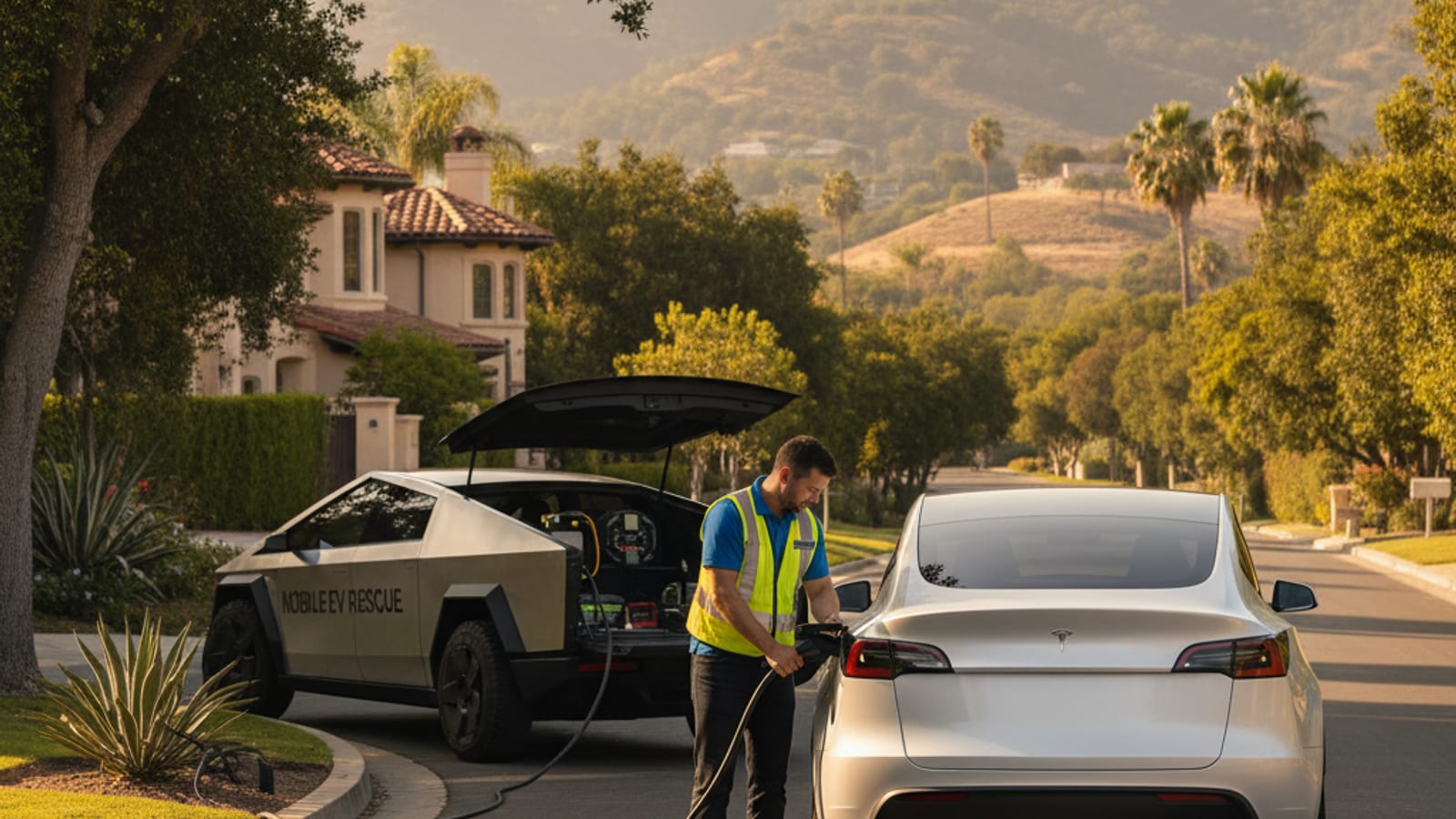
Charge Pro SF is a referral line. We match stranded EV drivers with independent local operators. We don’t own trucks or equipment. We don’t employ technicians. We don’t set prices. We don’t promise an arrival time. The operator quotes you before work starts. Then they bill you directly.
The car that won’t wake after a campus day
Apple Park is the ring campus. Thousands of EVs sit there all day. That’s the densest campus-dwell 12-volt pattern in the valley. A Tesla can sit from morning standup to the evening walk-back. So can a Lucid Air, Porsche Taycan, Mercedes EQS, or Rivian. Sentry mode, cabin climate, and phone apps keep drawing the 12-volt. You walk back after a long day. The pack may still show range. The small battery that boots the computers may already be finished.
That split is the whole call. A dead 12-volt looks like a brick. Lights stay off. The app can’t find the car. Doors may not present. Drivers assume the traction pack hit zero. Often it didn’t.
The same stall shows up at De Anza College after a class block. It shows up at the Apple Visitor Center after a tour. It shows up on a quiet street in Monta Vista. You left the car and walked to Main Street Cupertino. Fairgrove, Seven Springs, and Rancho Rinconada hide it just as well.
Apple Park security rules for a dead EV could not be confirmed from public pages. Ask the desk whether a service vehicle can enter. Give that answer to the operator. De Anza parking rules were not verified either. Ask campus parking before you wait.
If the car is a Tesla and it sat for hours, start here: Tesla 12V failure after a long park. Other luxury EVs fail the same way. The 12-volt still runs the brains.
What to try while you’re still standing there
Open the app once. If the car answers, you’re not fully locked out. If it doesn’t, stop pinging it. That won’t refill a 12-volt.
Check the charge port door. A cable that never released can freeze a finished session. Don’t yank it. A stuck latch is a latch job. It isn’t a pack job.
If you can get in, look for a low-voltage warning. Ignore the range number until the car is actually awake. Range is the pack. The 12-volt is the key that lets the pack talk.
Don’t borrow jumper cables from a gas car in the next stall. Clamp points on these EVs aren’t always where a neighbor expects. Wrong order, and you risk both vehicles. The operators we send treat the 12-volt as a 12-volt.
If the car is on and the number is near zero, you’re in pack territory. Skip the jump. You need electrons in the traction battery.
Empty pack versus a car that simply won’t boot
Cupertino sits in Santa Clara County at the foot of the hills. I-280 and SR-85 are the climbs. Stevens Creek Boulevard, De Anza Boulevard, and Foothill Boulevard are the local spines. A healthy 12-volt plus a truly empty pack is a different job. A jump won’t put miles in the traction battery.
This valley runs warm and sunny in summer. Cabin AC on the 280 grade eats range. San Jose’s July normal high is about 82F on the 1961-1990 WRCC record. That’s inland valley weather. Heat doesn’t prove the 12-volt failed. It does make an already low pack sag faster on the SR-85 merge.
When the pack is the problem, the operator brings 240-volt Level 2 to the car. Teslas take a native NACS plug. Other EVs take a CCS or J1772 adapter. Typical add is 10 to 20 miles of range. That’s in 15 to 30 minutes of charging. That’s charging time, never an arrival time.
That bump is often enough to reach a public post you pick in your map. We won’t guess a site from this page. Confirm the stall is free and working before you leave. Mobile EV charging is the service path for that on-site session.
If you’re not sure which failure you have, say so on the call. A careful operator checks the 12-volt first. Then they decide if the pack needs a charge. That order avoids a tow you didn’t need.
Quiet streets hide the stall better than a freeway
Cupertino covers about 11.34 square miles. ACS 2019-2023 puts population at 58,886. The separate 2024 Census estimate is 58,710. It’s a compact South Bay city. Campus lots, older neighborhoods, and two freeway edges share a small map.
Monta Vista, Rancho Rinconada, Fairgrove, and Seven Springs don’t look like a breakdown scene. Neither does the Apple Park area. There’s a dark luxury EV in a driveway or a visitor stall. People walk past it. You’re still not moving.
The operators we connect you with work that lot like a shoulder. They find the pin. They quote. Then they jump or charge in place. They handle Tesla and every major EV brand. They don’t need you to drag the car to a shop first.
Main Street Cupertino is a short commercial strip. De Anza College lots fill and empty on a class clock. Stevens Creek Reservoir is a local landmark for weekend loops. It just makes a dead car easy to miss until you’re late.
If the stall is on I-280 or SR-85, the rules change. California Vehicle Code 21718 bars stopping on a freeway except in limited cases. One case is a vehicle so disabled that stopping is unavoidable. Another vehicle must already be summoned to help. Stay in the car if that’s safer. Keep hazards on. Don’t walk the lanes.
CVC 22651(f) allows removal after more than four hours on a full-access-control freeway. That’s if the car can’t move under its own power. That’s a removal clock. It isn’t a charging plan. Call for a jump or a charge before a rotation tow becomes the default.
For the three-way fork, read Your electric car died: charge it, jump it, or tow it.
I-280, SR-85, and the streets in between
I-280 runs the foothill edge. SR-85 cuts across the valley floor. A stall on 280 is a freeway stall with those CVC rules. A stall on Stevens Creek Boulevard is a city-street stall. Don’t treat them as the same call.
Foothill Boulevard climbs toward the hills. Range that looked fine on De Anza can sag on that grade. Cabin AC in summer heat adds load. You may still be inside the city and already short.
Stevens Creek Boulevard is the east-west commercial spine. De Anza Boulevard takes you toward the college. If you’re low, use your map app to pick a working post. If you can’t make it, that’s when a mobile charge earns its keep.
If you’re empty on SR-237 instead, that’s a different Silicon Valley corridor. Cupertino’s own problem is 280, 85, and the campus lots.
What freeway patrol actually does on these beats
The Freeway Service Patrol is a partnership of MTC, CHP, and Caltrans. Private tow companies run dedicated freeway beats during posted hours. Hours are Monday to Friday, 6 to 10 AM and 3 to 7 PM, per 511.org. Dial 511 and say “Freeway Assist.”
FSP clears crashes and debris. It offers a free gallon of gas, jump-starts, and radiator refills. The MTC FSP page, checked 2026-09-18, doesn’t mention electric vehicles. It also doesn’t mention out-of-charge help. Don’t wait on a gas can that can’t fill your pack.
Outside those hours, freeway calls go to the CHP Rotation Tow Program. You don’t pick the vendor. Caltrans District 4 covers the nine Bay Area counties for highway conditions. 511 SF Bay is the regional traveler line.
A rotation tow can move a disabled EV. It may not bring a 240-volt source. If you only need a 12-volt jump or a short Level 2 session, say that. We’ll pass you to an operator who does that work. If a CHP rotation truck is already coming, ask what it carries before they hook you.
A wall charger at home can’t reach Apple Park
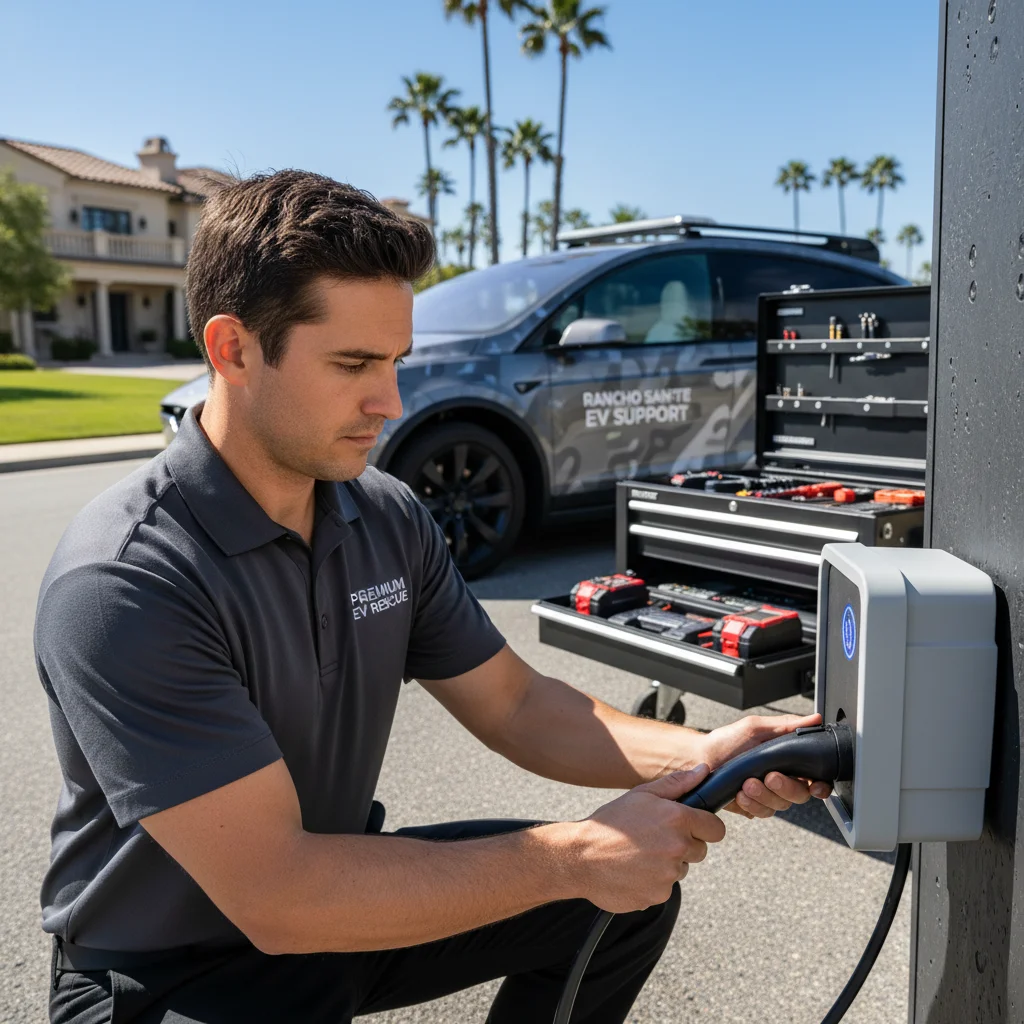
About 64.2% of Cupertino housing was built before 1980, per ACS 2019-2023. That’s older stock. Some of those garages have a wall unit now. Some don’t. A Level 2 plug in Monta Vista still can’t reach a dark car in an Apple Park stall.
PG&E still runs the wires. Silicon Valley Clean Energy is the community choice aggregator for generation. SVCE publishes an Electric Vehicle Rebate. PG&E publishes residential EV rate names. Those names are Home Charging EV2-A, Electric Vehicle EV-B, and Electric Home E-ELEC. None of those schedules wake a car that’s already stranded. Don’t sit in a lot arguing with a bill.
If you charge at home most nights, a campus stall is still a stall. Sentry and climate don’t care that your driveway plug is solid. The 12-volt still ages in heat. The pack still sags on the 85 climb if you left with a thin buffer.
Census ZIPs that overlap Cupertino include 95014, 95051, 95070, 95129, 94024, and 94087. A ZIP on that list can run past city limits. If you tell the operator 95014, also give the nearest cross street. Stevens Creek isn’t a Saratoga-side pin that shares a ZIP.
City notes and maps live on the Cupertino EV charging page.
Luxury EVs still live and die on a small battery
A Taycan, Lucid Air, or EQS looks nothing like a gas sedan. The 12-volt job is still a 12-volt job. Computers, contactors, and latches need that small battery. When it drops, the expensive pack sits unused.
The operators we send can jump that 12-volt on site. They can replace it on site when that’s the right call. They don’t treat Tesla as the only brand that fails this way. Non-Tesla EV rescue is the same referral network with the right adapter.
If the car is a Tesla and the 12-volt is the suspect, use Tesla 12V battery jump. After a jump, watch whether it dies again. A repeat drop usually means the battery is finished. It doesn’t mean the first jump didn’t take.
Don’t let a generic truck lift on a battery pan or an aero cover. Jacking points on these cars are specific. A botched lift turns a lot stall into bodywork. If the plan is a tow, it should be a flatbed. And only after a jump or a charge is ruled out.
Tires are a different stall. Many EVs skip a spare. A puncture on Foothill Boulevard needs a tire call, not a charger. Say flat if that’s the problem. Don’t mix it with a no-start, or you’ll get the wrong rig.
Charge ports fail too. A locked cable after a public session can strand you in a working stall. That’s not an empty pack. Say the cable won’t release so the operator brings the right approach.
What the operator actually carries
The operator vehicle brings a 240-volt Level 2 source. That’s the roadside cousin of a home wall charger. It isn’t a Supercharger. It isn’t meant to fill the pack. It’s meant to add enough range to move.
They bring a native NACS plug. They bring CCS or J1772 adapters for other brands. If your luxury EV uses NACS, say so. If it still wants CCS, say that. Guessing at the port wastes the session.
The quote happens before work starts. You hear it. You accept or you don’t. Charge Pro SF doesn’t set that number. We don’t add a second invoice. The operator bills you.
There’s no arrival promise on this site, and we won’t invent one. Campus lots and 280 traffic all change the clock. Give a pin that a stranger can use. Saying you’re at Apple isn’t one. Apple Park is a large ring. Name the visitor lot, the Visitor Center, or the side of campus you can describe.
If you’re on a residential street in Fairgrove or Seven Springs, give a house number. Say which way the car faces. If you’re at De Anza, name the lot as you see it on the sign. If you’re on Stevens Creek Boulevard, name the nearest cross street.
The pros we connect you with are licensed and insured. Charge Pro SF itself holds no trade license and performs no work. First-person voice on this site still means a referral.
Clubs, the OEM app, and a local backup
Tesla’s in-app roadside, Rivian highway assist, and a motor-club card all have a place. They also miss. A club truck built for gas cars may not know the 12-volt location. An OEM van that’s days out doesn’t help a car that’s already dark. We don’t replace those plans.
If Tesla roadside is already rolling, stay on that thread. If they can’t come, a local operator is the backup. Same idea for Lucid, Porsche, Mercedes, and Rivian programs.
Insurance roadside is another fork. Many cards still think in gallons and tows. Confirm whether yours covers a mobile charge before you assume it does. The operator can still come. You’d pay them directly if the club won’t.
How to place the call so the right person gets it
Say the city first: Cupertino. Then the pin. Apple Park, De Anza, Monta Vista, I-280, SR-85, Stevens Creek, or Foothill. Then the symptom in one line. Won’t wake, app is dead, points at 12-volt. Woke, shows zero, won’t move, points at the pack. Cable stuck in the port is a third job.
Mention the brand and the plug if you know it. Tesla, Lucid, Rivian, Porsche, Mercedes, Hyundai, Ford, Chevy: the operators handle them. The adapter only helps if they bring the right one.
If you’re on a freeway, say whether hazards are on. Say whether CHP or FSP is already involved. Don’t stand outside the car on 280 to flag a truck. The operator will find the pin.
If a security desk is asking you to move, tell the operator that too. They can’t invent a tow-away clock that isn’t in the law. They can plan the pin when they know a desk is waiting.
We serve Cupertino and the rest of the Bay Area. Nearby Sunnyvale, Santa Clara, San Jose, Saratoga, and Los Altos sit on the same valley floor. A car that dies on a 280 ramp may cross a city line before the next exit. The pin you give still has to match the asphalt you’re on.
After the car wakes
If it was the 12-volt, don’t treat the jump as a cure. Drive to a place you can park safely and plan a replacement. If it dies again in the same lot, stop repeating jumps. The battery is telling you it’s done.
If it was the pack, don’t leave with a thin buffer into the foothills. Foothill Boulevard will spend those extra miles faster than a flat Main Street crawl. So will the 280 climb. Pick a public post while the session is still on the car. Confirm it’s open. Then go.
If a tow was the only option, keep it a flatbed. Ask how they’ll secure an EV with no power. Neutral and transmission rules differ by brand. A wheel-lift on an AWD luxury EV is how motors get damaged.
Keep the operator’s quote and the work they did. If a club reimburses later, you’ll need that paper. Charge Pro SF isn’t the billing party.
Frequently asked questions
What do I do if my luxury EV won’t wake in an Apple Park lot?
Treat it as a 12-volt no-start until the car proves otherwise. Try the app once. Don’t keep pinging it. Call for a local operator who can jump the 12-volt on site. Or charge the pack if the car is awake and empty. Charge Pro SF refers that call. We don’t send our own truck.
Can an operator jump a Tesla 12-volt in Cupertino?
Yes. The operators we connect you with jump Tesla 12-volt batteries on site. They jump other EV 12-volts the same way. They can replace the 12-volt when that’s the right call. They quote before they start. They bill you directly.
Do you help non-Tesla luxury EVs on Cupertino streets?
Yes. Lucid, Rivian, Porsche, Mercedes, BMW, Audi, Hyundai, Kia, Ford, and Chevy are in the mix. The operator brings NACS plus CCS or J1772 adapters. Tell them the brand and the port so they don’t guess.
When a luxury EV goes dark in Cupertino, useful help comes to the stall. A jump. A short 240-volt charge. A flatbed only when those two can’t move you. For the service menu, start at EV roadside assistance. To reach a local operator, call Charge Pro SF at (415) 630-6268.