The ev maintenance schedule by brand still reads like a shop list. Tesla, Rivian, Ford, Hyundai, and Chevy all publish one. None of those cards start a 12V that died tonight in Daly City.
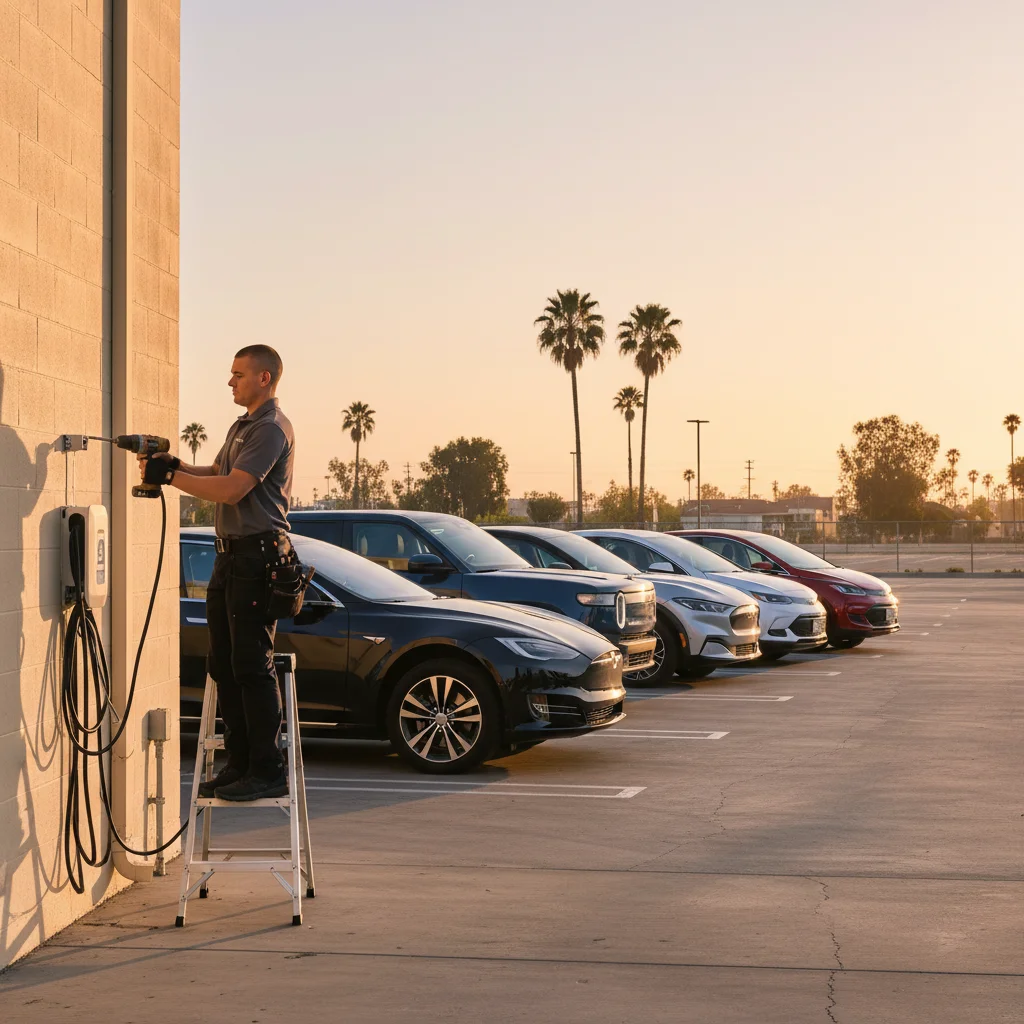
Brand lists tell you when to rotate tires and swap a cabin filter. They don’t cover a car that sat on a San Francisco hill and won’t wake. Charge Pro SF is a referral line. We match stranded drivers with independent local operators. We don’t hold a license, and we don’t own trucks. The operator quotes you before work starts, and they bill you directly.
Why a Bay Area week isn’t a shop calendar
San Francisco’s ACS population is 836,321, and Daly City’s is 102,560. A large share of that housing predates 1980. Census B25034 buckets put pre-1980 stock at 77.2% in San Francisco. Daly City sits at 78.7%, and San Bruno at 81.9%. Berkeley is 80.8%, and Oakland is 77.9%. Pacifica, on the Coastside, is 81.1%. Those shares flag older stock and curb parking.
The car often lives on the street. Overnight computers still pull on the 12V. You can follow Tesla’s two-year cabin-filter note and still fail to unlock the doors. That failure is why a calendar isn’t a rescue plan.
Tri-Valley and Delta housing is newer. Brentwood’s pre-1980 share is 10.9%. Dublin’s is 21.0%, and San Ramon’s is 23.8%. Garages are more common in those tracts. They still don’t replace a 12V that already failed.
Summer heat isn’t one Bay Area number. NWS 1961-1990 normals put San Francisco’s July average high at 71.5F. Oakland Airport’s July average high is 70.4F. San Jose sits near 82F. Livermore’s July average high is 89.7F. Antioch is 90.4F, and Gilroy is 88.3F. A national filter interval doesn’t know that inland gap. Confirm every interval in the current owner’s manual for your VIN. A count of 100F days was not verified in those normals.
Hills add tire wear the card underplays. Los Gatos climbs off the valley floor. Lafayette feeds the Caldecott on SR-24. Livermore sits before the Altamont grade on I-580. Instant torque plus grade eats inner shoulders. Every brand below still puts rotation first, and that job belongs on your list.
Campus lots in Mountain View, Sunnyvale, and Santa Clara add the same sit-and-drain pattern. The 12V is the part that actually woke it this morning.
For a maker-neutral checklist, start with what EV owners should actually watch. This page splits the same jobs by brand.
Tesla: short tire miles, and a 12V the card doesn’t bold
Tesla dropped the old yearly shop visit. Tesla’s published tire rotation is every 6,250 miles. They also call for a rotation if two tires differ by 2/32 inch. Confirm the figure in the car’s current service menu.
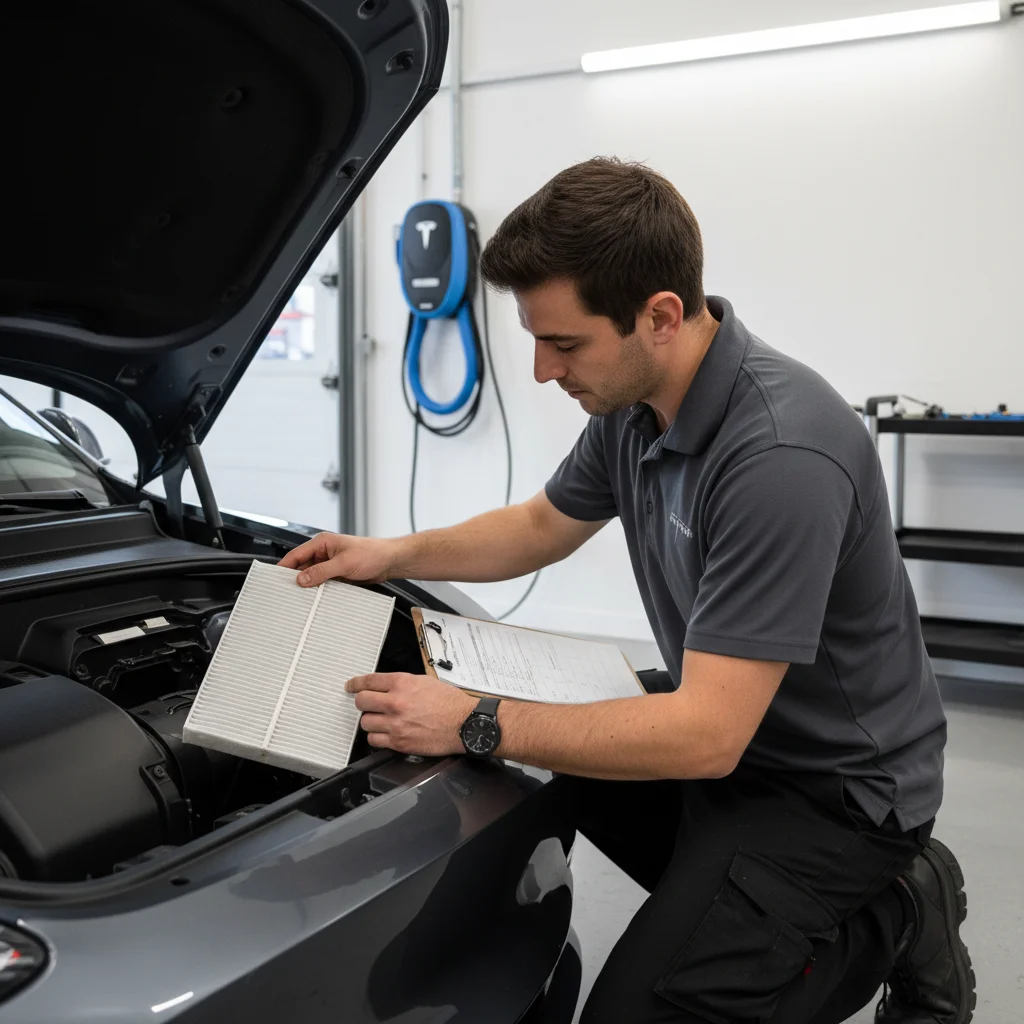
Brake fluid gets a health check every two years. Tesla says replace it if the test shows contamination. Standard cabin filters are every two years. Later Model S and Model X HEPA and carbon filters are listed at three years. The A/C desiccant bag is a Tesla-specific item. Model 3 and Model Y list four years. A 2012-2020 Model S lists three. Other models land between three and six. Check your VIN’s manual, not a screenshot.
What Tesla’s card doesn’t bold is the 12V. That small battery still wakes the computers, the locks, and the contactors. If it dies, a full traction pack won’t save you. Airport pages don’t publish a playbook for a car that sat through a trip. Tesla 12V failure after a long park walks that next step.
If the car already won’t wake, you’re past the filter interval. A Tesla 12V jump from a local operator is the roadside path. Charge Pro SF doesn’t do that work. The matched operator does, and they bill you.
Ford: a 10,000-mile visit that still misses tonight
Ford kept a checklist that feels like a gas-car shop. Mustang Mach-E and F-150 Lightning both sit on a 10,000-mile or annual multi-point. That visit covers tire rotation and a brake look. It also covers cooling hoses, half-shaft boots, steering, and ball joints.
Cabin filters on Ford’s EV list run longer, at 20,000 miles. The Lightning’s rear eAxle fluid is a 150,000-mile item. First high-voltage coolant drain is listed at 100,000 miles. Later fills are every 50,000 after that. Confirm those miles in the current Lightning or Mach-E manual.
None of that helps a Lightning that sat in San Bruno and won’t start. The 12V is still the switch. Ford’s annual inspection can catch a weak battery if you go. It can’t catch a failure at night on US-101. Ford F-150 Lightning 12V checks stay useful even when you’re not in a bay.
A Peninsula Clean Energy or PG&E home rate doesn’t wake a dead 12V. Santa Clara, Palo Alto, and Alameda run municipal utilities. Those offices handle meters and rebates, not a jump.
Hyundai and Chevy: inspection miles, then a long coolant wait
Hyundai’s Ioniq 5 cadence is 8,000 miles for a rotation. Brakes, steering, and suspension get a look at 16,000. The cabin filter is 24,000. Battery coolant inspection is 40,000. First coolant replacement is listed at 120,000, then every 40,000 after. Brake fluid flush is every two years. Confirm each figure in the current Ioniq 5 book. Don’t borrow those miles for an Ioniq 6 or Kona Electric without checking.
Chevy Bolt EV and Bolt EUV sit on 7,500-mile rotations plus a multi-point. The cabin filter is 22,500. Brake fluid is a five-year item. The battery, electronics, and cabin-heater coolants share a five-year or 150,000-mile drain. A neglected 12V still ends the night first.
Hyundai and Chevy both lean on inspect-and-wait. That’s fair for pads, because regen takes the load. It’s not a plan for a 12V that sat on an Oakland street. Pre-1980 stock in Oakland is 77.9%. San Jose’s ACS population is 990,054, with 60.8% pre-1980. What happens when an EV 12-volt battery dies is the sequence, not the coolant note.
Rivian: fluids and air springs the other brands skip
Rivian R1T and R1S carry extra hardware, and the published list shows it. Tire rotation is every 7,000 miles. Alignment is every 14,000, or sooner if wear looks uneven. The cabin filter is yearly or 14,000 miles. Brake fluid is every three years.
Drive unit fluid is the item Tesla doesn’t put on a short card. Rivian lists a change at 140,000 miles. That oil lives in the gearsets at each motor. Air suspension gets an inspection at 28,000 miles. The compressor filter is 56,000. If you use rough roads, those inspections matter. If you only commute I-680 through San Ramon, they still sit in the book. Confirm current miles in Rivian’s latest guide.
A stalled R1S in a Fremont lot still needs the 12V alive before anything else boots. Quad motors and air springs don’t wake if the low-voltage pack is dead. Rivian R1T or R1S 12V checks come before a drive-unit appointment you can’t reach.
Shared jobs that belong on a Bay Area calendar
Tires are the one shared job with teeth. Every brand above wants rotations on a short interval. Weight plus torque plus grade will shoulder the inner edges. Check pressure monthly, and use the door-sticker number, not a guess. Soft tires cut range on the Altamont climb. They also heat a sidewall on a hot Antioch afternoon.
Brakes last longer with regen. Fluid still takes on moisture. Tesla wants a two-year check. Hyundai wants a two-year flush. Rivian lists three years. Chevy lists five. Ford’s multi-point includes a brake look each visit. Rust on rotors still shows up in stop-and-go on I-880 when you barely use the pedal. Don’t wait for a grind on the Bay Bridge approach. A disabled car there is a CHP problem, not a filter job.
Cabin filters clog with dust inland. Replacement miles range from Rivian’s yearly note to Ford’s 20,000. Pick the book for your VIN. A dirty filter is a comfort problem. It’s not why the car is dark. Your year, your software, and your manual win.
What the interval never covers on a Bay Area shoulder
A maintenance visit is a parked-car job. A dead EV on a freeway is a legal and dispatch problem.
California Vehicle Code 21718 bars stopping on a freeway except in tight cases. A disabled vehicle that can’t keep moving, with help summoned, is one of those cases. California Vehicle Code 22651(f) covers a vehicle left on a full-access-control freeway. It can be removed after more than four hours if it can’t move on its own. That clock is real. It’s not a shop appointment.
The Freeway Service Patrol is a partnership of MTC, CHP, and Caltrans. Hours published on 511.org are Monday to Friday. Windows are 6 to 10 a.m. and 3 to 7 p.m. You reach it by dialing 511 and saying “Freeway Assist,” or from a call box. MTC’s FSP page, read 2026-09-18, lists a free gallon of gas, jump-starts, and radiator refills. It doesn’t mention electric vehicles or an out-of-charge recovery. Don’t wait on FSP for a pack that already hit zero.
Outside those hours, CHP’s Rotation Tow Program assigns the truck. You don’t pick the company. Caltrans District 4 covers the nine Bay Area counties on QuickMap. If the high-voltage pack is empty, a rotation won’t move you. Operators Charge Pro SF refers can bring a 240V Level 2 source to the car. Tesla uses a native NACS plug. Other EVs use a CCS or J1772 adapter. Typical added range is 10 to 20 miles in 15 to 30 minutes of charging. That’s charging time, not a promise of when someone arrives. The operator quotes first and bills you. See how a mobile charge actually works.
If the 12V is the failure, you need a jump or a replacement on site. A Supercharger stall you can’t unlock won’t help.
Service the car. Then have a plan for tonight
Rotate on Tesla’s 6,250 or Chevy’s 7,500, whichever you drive. Flush brake fluid on the book’s years. Swap the cabin filter before the HVAC smells like a closed garage in inland July. Book Rivian’s air-suspension look if you have one.
A Bay Area 12V still dies on a parked Mach-E in Redwood City. It dies on a Bolt on an Oakland street. It dies on a Model Y that sat through a long-haul flight. No published interval on this page is a rescue.
Charge Pro SF doesn’t service Teslas, Rivians, Fords, Hyundais, or Chevys. We connect stranded drivers with independent local operators. Those pros handle Tesla and every major EV brand. They jump or replace a dead 12V. They charge a pack that won’t make the next ramp. They quote before they start.
If the car already won’t move, call (415) 630-6268. Confirm the work and the price with the operator, not with a blog interval.